
Every memorable hero faces a persistent rival. Batman battles the Joker across the dark rooftops of Gotham. Sherlock Holmes tests his analytical mind against the criminal intellect of Professor Moriarty.
In everyday conversation, we use the word nemesis quite loosely. People apply it to an unbeatable tennis opponent. Others use it for an impossible chemistry exam or an uncooperative coworker.
Yet for over two millennia, the term had nothing to do with personal grudges or athletic rivalries. Calling an individual person your nemesis would have sounded absurd to an ancient Greek citizen. The word represented an inescapable force of cosmic balance that humbled mortal arrogance.
Quick Answer: Origin of the Word Nemesis
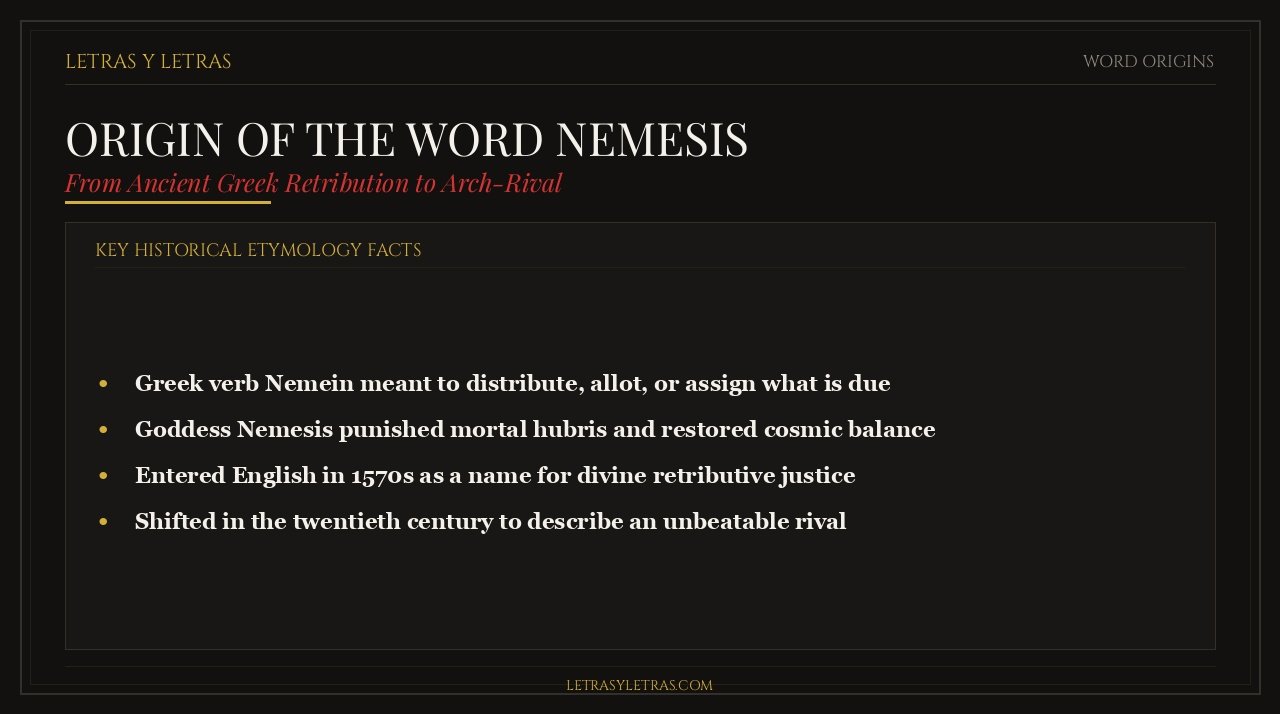
The word nemesis comes from the Greek verb nemein, meaning to distribute or allot what is due. In classical mythology, Nemesis was the winged goddess who punished mortal hubris and restored cosmic balance. The word entered English in the 1570s as divine retribution before twentieth-century fiction created the modern arch-rival meaning.
Key Takeaways
- The word stems from the Greek verb nemein, meaning to distribute or allot what is rightfully due.
- In Greek mythology, Nemesis was the daughter of Night who punished human hubris and arrogance.
- The Persians brought a block of marble to Marathon for a trophy, which became Nemesis’s cult statue after their defeat.
- The word entered the English language during the Elizabethan era as a term for divine vengeance.
- Twentieth-century literature transformed the cosmic goddess into the modern concept of an arch-rival.
The Ancient Greek Verb: Giving What Is Due
To understand the true origin of the word nemesis, we must look at ancient pastoral life. The term originates from the Proto-Indo-European root nem-. This ancient root meant to assign, allot, or distribute.
Linguists trace several familiar words across Indo-European languages back to this common origin. The German verb nehmen, meaning to take, shares this ancient ancestry. This root reflects early community sharing of pasture land.
In classical Greek, this root produced the verb nemein. The verb initially referred to managing pastures and feeding herds of livestock. Over centuries, the meaning broadened to distributing land, food, and social honors.
From this verb arose the Greek noun nomos, which signified custom, arrangement, or statutory law. We retain this heritage in modern terms like economy and astronomy. The Greeks viewed orderly distribution as the foundation of civilized life.
The noun nemesis specifically designated the distribution of what was deserved. According to the Online Etymology Dictionary, it expressed righteous indignation at unearned fortune. It was the rightful anger felt when someone took more than their share.
When an individual seized excessive wealth or glory, they disturbed universal order. Ancient thinkers believed that nature possessed an inherent balance. Any overstep required an equal moral correction.
Hesiod and the Daughter of Night
Before becoming an abstract philosophical term, Nemesis walked through ancient poetry as a goddess. Hesiod recorded her mythic lineage in his Theogony around 700 BC. She was not a daughter of Zeus or an Olympian deity.
Hesiod wrote that Nyx, the primordial goddess of Night, gave birth to Nemesis without a male partner. Night produced this daughter to serve as a check against mortal arrogance. The Greeks associated retribution with the dark inevitability of nightfall.
Classical literature often paired Nemesis with Aidos, the personification of shame and reverence. As preserved in Hesiod’s Theogony on Perseus, the two goddesses protected mortal morality. Hesiod warned that if mortals abandon humility, both goddesses would flee back to heaven.
Greek thinkers saw Aidos and Nemesis as two sides of moral restraint. Aidos acted from within as internal conscience and healthy shame. Nemesis acted from without as public indignation and divine retribution.
In Homeric poetry, the common noun nemesis reflected community moral standards. In the Iliad and the Odyssey, warriors respected the collective opinion of their peers. If an individual violated traditional customs, he feared the nemesis of his fellow citizens.
This social emotion helped keep human ambition within sensible limits. Mortals who enjoyed sudden wealth or unbroken military victories faced mortal danger. Such success bred hubris, the dangerous illusion that a mortal could match the gods.
The Sanctuary at Rhamnous and the Persian Marble
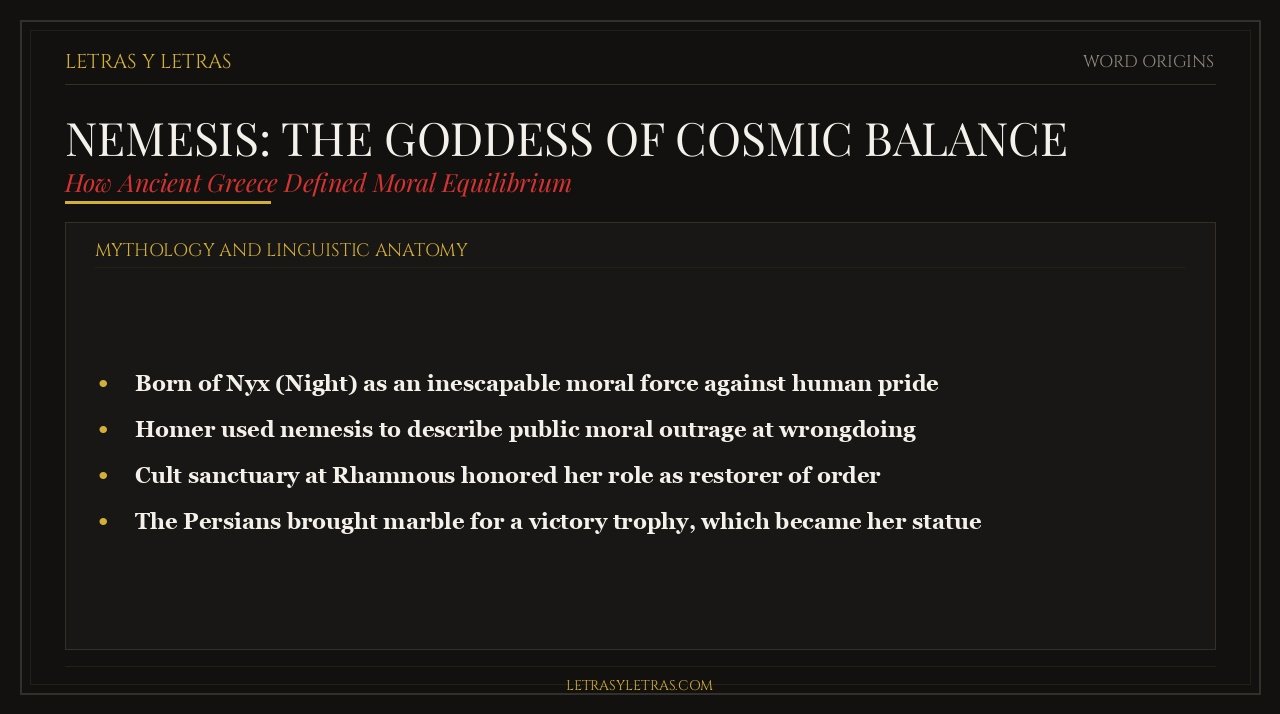
The primary center for the worship of Nemesis stood at Rhamnous on the coast of Attica. Sailors honored the goddess as Rhamnousia, guardian of physical borders and moral limits. Her cliffside temple stood sentinel above the turbulent coastal waters.
The sanctuary gained historic fame during the Persian invasion of Greece in 490 BC. King Darius sent an enormous fleet to crush the rebellious Greek city-states. Confident of swift victory, the Persian commanders carried a massive block of Parian marble on their flagship.
The Persians intended to carve a lavish victory monument after sacking the city of Athens. Instead, Athenian soldiers won an astonishing triumph on the plains of Marathon. The Persian fleet fled in panic, abandoning the giant marble block on the shore.
The ancient travel writer Pausanias documented what the victorious Greeks did next. They delivered the abandoned marble block to Agoracritus of Paros, a master sculptor trained by Phidias. Agoracritus carved that stone into an imposing cult statue of Nemesis.
The irony resonated across the classical Mediterranean world. The Persians brought raw marble out of arrogant overconfidence. Nemesis turned their prospective victory trophy into a permanent monument to their catastrophic defeat.
Classical myths constantly reminded mortals that arrogance invites disaster. We see similar lessons in the meaning of the name prometheus. The Greek worldview never allowed human pride to pass unpunished.
The Bridle and the Measuring Rod: Classical Symbols
Ancient artists depicted Nemesis with precise symbolic instruments. Rather than weapons of war, she carried everyday tools of measurement and restraint. These items illustrated her connection to the root verb nemein.
In classical reliefs, Nemesis held a cubit-rule or measuring rod in one hand. This rod symbolized the exact measurement of human fortune and deeds. She ensured that no mortal crossed their allocated boundary of happiness or pride.
In her other hand, she held a horse’s bridle or bit. The bridle represented the discipline required to rein in arrogant behavior. Roman sculptors later added a wheel of fortune to show the cyclical reversal of mortal destiny.
Wings attached to her shoulders emphasized swift and inescapable judgment. No mortal could outrun the winged distributor of justice. Her serene expression reminded observers that her verdicts were calm, measured, and absolute.
Narcissus, Croesus, and the Mechanics of Retribution
Classical stories demonstrate that Nemesis did not strike out of malice. She acted as an impartial arbiter who restored cosmic harmony. Her interventions restored moral balance when human behavior crossed divine boundaries.
One famous example appears in the tragic story of the hunter Narcissus. Our historical analysis on the origin of the word narcissist highlights his extreme vanity. Narcissus rejected all suitors with cruel contempt.
When a spurned youth prayed for justice, Nemesis answered his plea. She led Narcissus to a clear spring on Mount Helicon. By causing him to fall in love with his reflection, she punished his pride with an impossible obsession.
A historical case appears in the famous Histories of Herodotus. King Croesus of Lydia was the wealthiest monarch of the Mediterranean. He asked the wise Athenian statesman Solon if he considered him the happiest man alive.
Solon urged caution, observing that human life is subject to sudden reversals of fortune. Croesus dismissed Solon’s advice with disdainful mockery. Herodotus recorded that a terrible nemesis from the gods soon struck Croesus, destroying his kingdom.
How Nemesis Entered the English Language

The word entered English during the late sixteenth century as Renaissance scholars revived classical texts. English authors adopted the classical name to describe inescapable divine retribution. The earliest documented appearances in print date to the 1570s.
Elizabethan playwrights appreciated the dramatic weight of the classical goddess. In 1592, the satirist Thomas Nashe invoked Nemesis in his prose. That same year, William Shakespeare placed the word on the London stage.
In Henry VI, Part 1, a French commander laments the battlefield prowess of Lord Talbot. He describes Talbot as France’s only scourge and black Nemesis. Talbot represented a terrifying instrument of divine punishment against French ambitions.
Seventeenth-century writers continued using the capitalized noun to personify retributive justice. John Milton referenced the goddess when discussing moral accountability. Renaissance drama illuminates our modern speech, as seen in our guide to english idioms and meanings.
The Semantic Shift: From Cosmic Fate to Modern Arch-Rival
During the nineteenth century, the word gradually lost its capital letter in English prose. Victorian essayists began using nemesis as a common noun. It came to mean an act of poetic justice or an inevitable downfall.
This Victorian usage maintained an ethical connection to classical tradition. A person’s nemesis was not an external enemy. It was the direct consequence of their own greed, deception, or foolish ambition.
A corrupt financial speculator met his nemesis when fraudulent investments collapsed. The punishment belonged to the criminal because he created it himself. This principle of accountability appears across many famous quotes and quotations.
The dramatic transformation of the word happened in the early twentieth century. Popular magazine fiction and mystery novels expanded rapidly. Writers sought vivid terms to describe recurring villainous characters.
Authors began describing a persistent antagonist as a hero’s personal nemesis. The word shifted from an abstract principle of justice into an individual person. Instead of cosmic fate, it became a personified grudge.
By mid-century, sports journalists and comic writers adopted the modern definition. Supervillains became the eternal nemeses of caped crusaders. A sports team that continually defeated a rival became its dreaded nemesis.
Today, the Merriam-Webster historical definition recognizes both uses of the term. A nemesis can be an unbeatable adversary or a just punishment. The word successfully bridged ancient theology and modern popular culture.
Evolutionary Timeline of the Word Nemesis
| Time Period | Key Source / Milestone | Linguistic and Cultural Meaning |
|---|---|---|
| c. 700 BC | Hesiod’s Theogony | Primordial Greek goddess born of Night who brings righteous indignation and punishes human hubris. |
| c. 490 BC | Battle of Marathon | Persian marble trophy is carved into the cult statue of Nemesis at Rhamnous by Agoracritus. |
| c. 450 BC | Herodotus’s Histories | Used to explain the sudden fall of wealthy King Croesus following his arrogant boast of happiness. |
| 1570s | Elizabethan Scholars | Enters English as a classical proper noun describing divine retribution and inescapable vengeance. |
| 1592 | Shakespeare’s Henry VI | Lord Talbot is described as France’s black Nemesis, personifying military terror and divine fate. |
| 1850s | Victorian Literature | Lower-case noun denoting an unavoidable karmic disaster caused by one’s own ethical failings. |
| 1920s–Present | Pulp Fiction & Sports | Undergoes semantic shift to mean an arch-rival, persistent enemy, or insurmountable obstacle. |
Common Misconceptions Debunked
Because the modern word centers on competition, several popular myths surround its history. Language lovers often misinterpret the ancient Greek heritage.
The first misconception portrays Nemesis as a cruel monster or malicious demon. Ancient Greeks viewed her as an essential protector of social harmony. Without her divine oversight, violent tyrants would flourish unchecked.
The second misconception claims that the word always referred to an arch-rival. As historical records prove, the rival sense emerged only in the twentieth century. An ancient hero could not defeat Nemesis because she was natural law.
The third myth suggests a connection to the Latin noun inimicus, root of enemy. This claim is completely false. Latin inimicus combines in- and amicus, meaning not a friend.
Nemesis comes exclusively from the Greek pastoral verb nemein. Examining historical linguistic roots protects us from popular misconceptions. We uncover similar folk myths in our review of the origin of the phrase bite the bullet.
Frequently Asked Questions
What is the literal translation of the Greek word nemesis?
The literal translation of the Greek noun nemesis is distribution of what is due or righteous indignation. It comes from the verb nemein, which originally meant to dispense or distribute portions fairly.
Who were the parents of Nemesis in Greek mythology?
According to the poet Hesiod in his Theogony, Nemesis was the daughter of Nyx, goddess of Night. She was born without a father, symbolizing the mysterious inevitability of moral balance.
What is the difference between an enemy and a nemesis?
An enemy is simply any hostile opponent in a conflict. A nemesis is a formidable adversary who seems uniquely equipped to defeat you, representing a constant counterweight to your strengths.
Why is the sanctuary at Rhamnous historically famous?
Rhamnous was the primary Greek cult center for Nemesis. After Marathon in 490 BC, Athenian sculptors carved an abandoned Persian marble trophy into her sacred temple statue.
When did nemesis become a common English noun?
The word entered English in the 1570s as a capitalized name for divine vengeance. It became a common noun in the nineteenth century and acquired the rival meaning in the early twentieth century.
Cosmic Balance in the Modern Imagination
The evolution of the word nemesis demonstrates how language carries ancient philosophy across generations. An archaic shepherd’s term for pasture land became a divine guardian of cosmic justice. Later, that concept transformed into Elizabethan stage drama and modern fiction.
Although we now apply the term to sports rivals and comic villains, the classical truth endures. When mortals overreach their limits through blind arrogance, reality pulls them back to earth. That timeless principle of balance remains the true legacy of Nemesis.
Alan Sledge is the founder and lead writer at letrasyletras.com, dedicated to uncovering the true etymological histories behind our favorite words and phrases.


Alan Sledge is the writer and founder behind Letters & Letters. A lifelong lover of words, Alan has always been drawn to the small mysteries hidden in everyday language, why we say what we say, where our favorite sayings came from and the quotes that manage to put feelings into words better than we ever could ourselves.