
Few human impulses feel more irresistible than blabbing confidential news. A juicy piece of workplace gossip burns through personal restraint. Secret celebration plans crumble when someone blurts out the location.
When confidential information leaks before the scheduled time, we say someone spilled the beans. The colorful idiom is beloved across classrooms, newsrooms, and kitchen tables.
Most speakers believe a tidy legend about ancient Greek democracy. They assume voters knocked over clay jars filled with black and white legumes. Historical archives tell a completely different story.
Quick Answer: Origin of the Phrase Spill the Beans
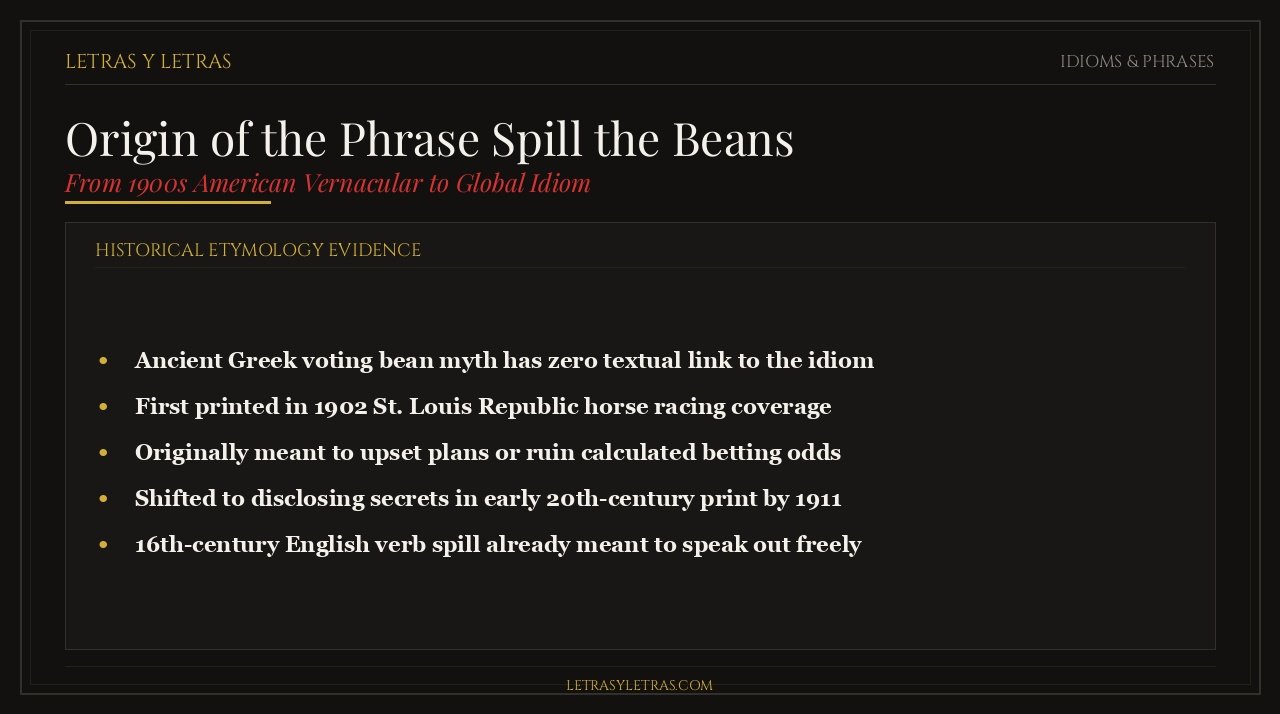
The phrase spill the beans emerged in American horse racing and baseball around 1902. It originally meant upsetting calculated plans. By 1911, the expression evolved into revealing confidential information, completely unrelated to ancient Greek voting.
Key Takeaways
- The ancient Greek voting bean theory is an unsubstantiated folk etymology.
- Earliest printed citation appeared in the Saint Louis Republic in November 1902.
- The original meaning signified upsetting plans, similar to upsetting the apple cart.
- The English verb spill has meant speaking carelessly since the sixteenth century.
- By 1919, American literature established the modern definition of revealing secrets.
The Seductive Myth of the Ancient Greek Voting Jar
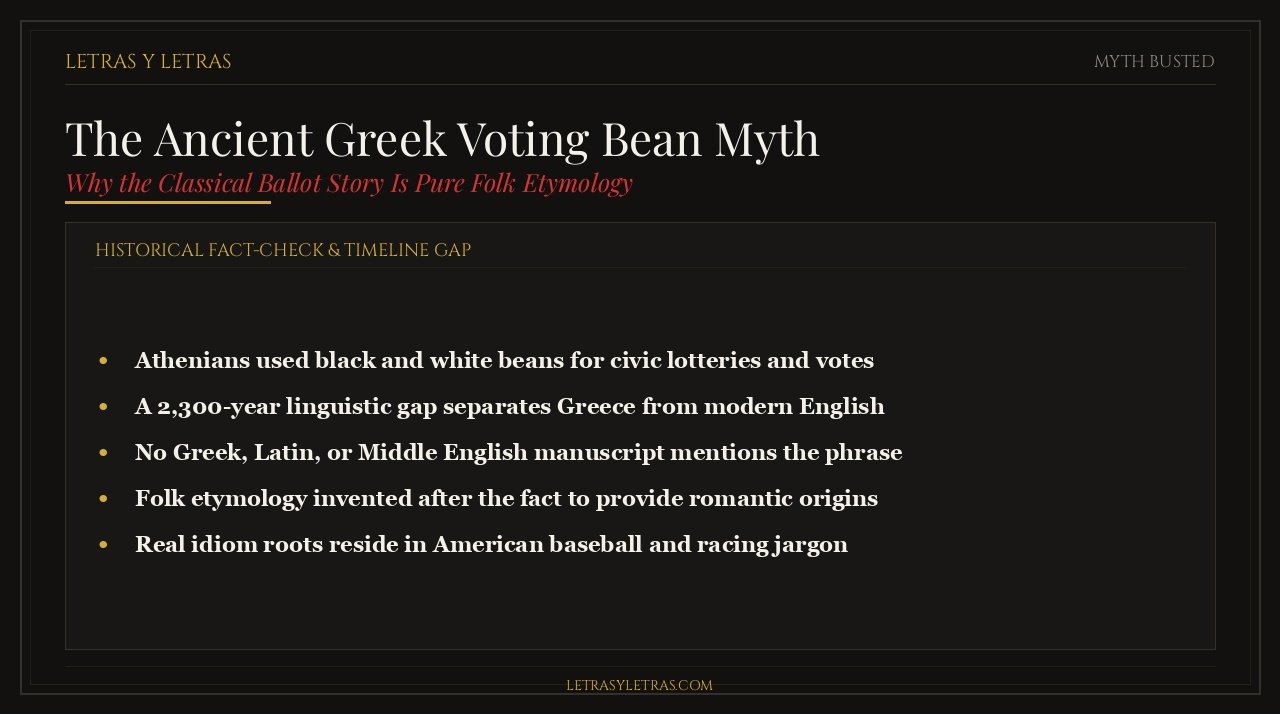
Ask casual language lovers about this phrase and you will receive a confident explanation. They will tell you about classical Athens, the birthplace of western democratic civic participation. According to this popular story, Greek magistrates gathered citizens to cast secret ballots.
The story claims voters dropped colored legumes into a clay urn or bronze helmet. A white bean signaled approval, electing a candidate or acquitting a defendant. In contrast, black beans signaled rejection, disapproval, or exile.
If an official accidentally knocked over the jar, the beans tumbled across the stone floor. The secret election tally became visible before final voting concluded. Therefore, according to the legend, premature disclosure became known as spilling the beans.
The explanation sounds scholarly, logical, and picturesque. It connects everyday kitchen chatter directly to ancient Mediterranean philosophy. Tour guides repeat it, lifestyle websites reprint it, and schoolteachers share it with students.
There is only one serious complication with this captivating story. It is completely fictitious.
Why Historians Reject the Ancient Greek Bean Theory
Linguists and classical historians have examined ancient civic records for centuries. Ancient Greeks undeniably used legumes for political administrative tasks. Athenian democracy utilized a mechanical allotment machine called a kleroterion.
Officials placed black and white faba beans inside the kleroterion to select jury members by lot. Aristotle described these lotteries in his treatise The Constitution of the Athenians. Athenian assemblies also voted using bronze tokens called psephoi or inscribed potsherds called ostraca.
Crucially, ancient Greeks did not speak twentieth-century American English. No ancient Greek text contains any proverb remotely translating to spilling beans. Classical Latin literature likewise contains zero references to overturned bean jars representing blabbed secrets.
A massive chronological canyon also separates ancient Athens from modern English speech. Ancient Athenian democracy flourished during the fifth century BCE. The idiom spill the beans did not appear in print until the early twentieth century CE.
More than two thousand three hundred years elapsed between Greek civic lotteries and this phrase. If the idiom had descended from classical antiquity, it would appear in Middle English literature. It would appear in Geoffrey Chaucer, William Shakespeare, John Milton, or Charles Dickens.
None of those literary giants ever wrote the phrase. The entire Greek voting theory was fabricated during the mid-twentieth century. Imaginative writers invented an antique explanation to give modern street slang classical pedigree.
The True Sixteenth-Century Roots of the Verb Spill
If ancient Greece did not invent the phrase, where did it truly begin? To solve the puzzle, we must trace both words separately through English lexicography. The verb spill carries a long, turbulent linguistic ancestry.
In Old English, the verb spillan meant to destroy, mutilate, or slaughter. Anglo-Saxon chronicles used the term when describing battlefield bloodshed. Over centuries, the harsh physical meaning softened into letting liquids escape from containers.
By the late sixteenth century, English speakers began using spill figuratively for speech. If you could spill beer from a flagon, you could spill words from your mouth. Letting words tumble out without caution felt like dropping liquid upon a floor.
The Oxford English Dictionary historical records cite early examples from the 1570s. Writers described individuals who could not contain their thoughts, choosing to spill talk across public taverns. By 1600, phrases like spill blood and spill ink were common literary figures.
English speakers were already primed to treat blabbing as a physical spill. They understood that spoken secrets, like spilt milk, could never be gathered back into the cup. The container metaphor sat waiting for a lively companion noun.
What Beans Meant in Nineteenth-Century American Slang
The second half of our idiom arrived through lively American slang during the nineteenth century. In rural America, dried beans were the quintessential cheap, durable staple food. Because beans were everywhere, American vernacular adopted the crop into countless vibrant sayings.
First, beans represented trivial worth. If something had little value, nineteenth-century pioneers declared it not worth a hill of beans. When an argument lacked substance, it amounted to mere bean fodder.
Second, beans represented mental sharpness and practical intellect. A shrewd trader who could calculate profit margins knew his beans. Rural folk praised capable neighbors for possessing plenty of bean knowledge.
Third, American slang adopted bean as a humorous synonym for the human head. By the 1890s, baseball pitchers threw beanballs aimed at the batter’s skull. People instructed foolish friends to use their beans before making rash financial gambles.
Finally, beans denoted energetic physical vigor. A lively horse bursting with energy was described as full of beans. By 1900, American slang revolved around beans as symbols of plans, ideas, coins, and thoughts.
The Turf and the Ring: 1902 Horse Racing and Sporting Upsets
When did the two words finally collide into a single recognized phrase? The historical record points directly to American sports journalism at the dawn of the twentieth century. Verified print evidence first emerged on the racetrack.
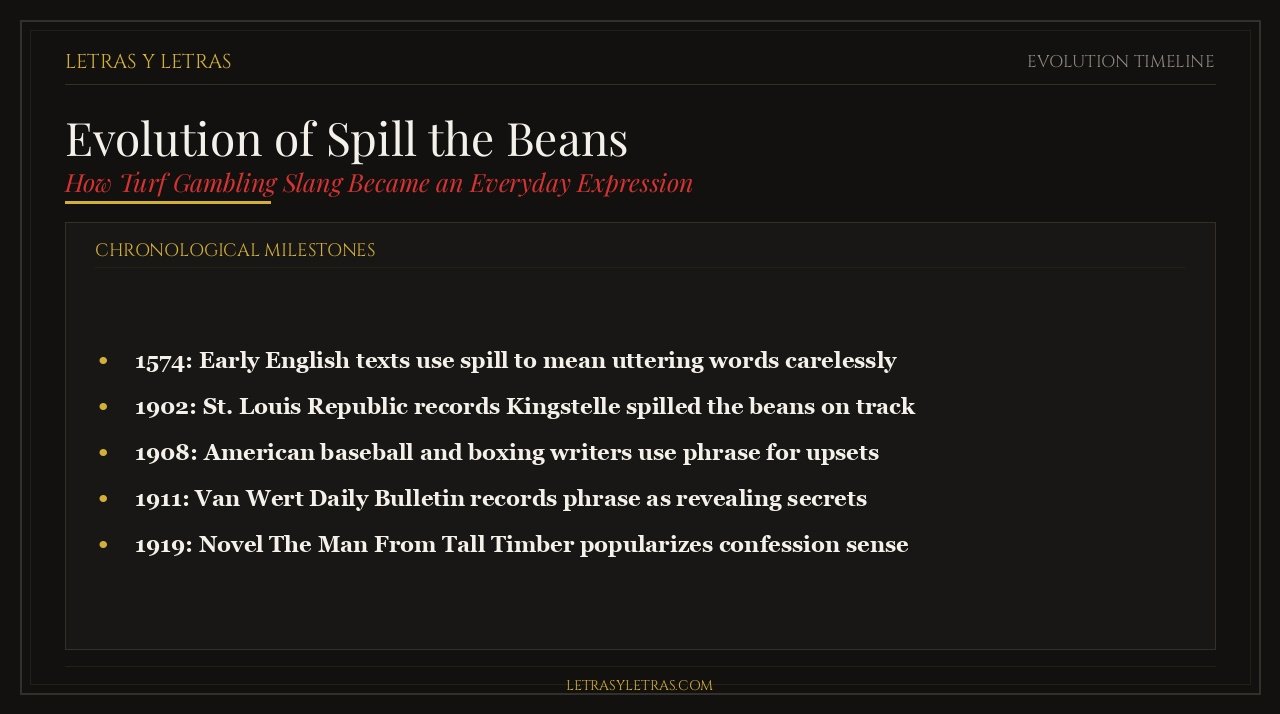
In late November 1902, the Saint Louis Republic published a sporting dispatch from the horse track. An unfavored racehorse named Kingstelle pulled off a shocking upset victory. The unexpected win ruined the calculated odds established by professional bookmakers.
Library of Congress archives preserve this race report from the Chronicling America collection. The dispatch noted that the underdog horse spilled the beans. In May 1903, the paper repeated the phrase in race headlines.
In this early sporting context, the phrase did not mean confessing a secret. It meant disrupting a settled plan or upsetting calculated expectations. The expression functioned as an American equivalent to upsetting the apple cart.
Professional bookmakers had arranged the gambling pots with careful calculation. When an outsider horse bolted ahead to seize the purse, the entire financial arrangement collapsed. The bookmaker’s tidy basket of beans was violently knocked across the turf.
Baseball, Boxing, and Political Turmoil
Sports journalists quickly fell in love with the vivid phrase. Between 1905 and 1910, baseball beat writers used it regularly to describe late-inning disasters. If an error-prone shortstop threw wildly to first base, he had spilled the beans for his team.
Prize-fighting reporters adopted the expression with equal enthusiasm. When an unheralded boxer knocked out a champion, newspapers proclaimed the underdog had spilled the beans. The phrase represented sudden, chaotic disruption.
Soon, political commentators borrowed the idiom from the sports pages. Municipal politics in early twentieth-century American cities was notoriously factional. Party bosses operated backroom machines designed to distribute patronage and control city council votes.
When an honest ward worker refused to cooperate, party leaders grew frantic. An uncooperative whistleblower could ruin months of quiet political maneuvering. The rebel had spilled the beans by upsetting the machine’s grand design.
This dynamic mirrors other idioms born from theatrical and cinematic history. Readers can explore our investigation into the origin of the phrase cut to the chase. Both expressions began as trade jargon before capturing mainstream imagination.
The Semantic Leap: From Ruining Plans to Blabbing Secrets
How did an expression meaning to spoil an athletic outcome shift into revealing hidden secrets? Language evolution frequently travels through practical semantic bridges. In municipal politics and police courtrooms, ruining a scheme usually required confessing confidential facts.
When a corrupt official spilled the beans on his syndicate, he ruined their scheme precisely by talking. The act of disruption and the act of disclosure fused into a single concept. By 1911, print records show the modern meaning emerging clearly.
In October 1911, the Van Wert Daily Bulletin in Ohio reported on local legal proceedings. The newspaper noted that a key witness named Campbell finally spilled the beans. In this context, Campbell did not upset a race; he revealed concealed evidence to investigators.
The famous Online Etymology Dictionary entry for spill documents this rapid semantic transition. Police detectives and crime reporters used the phrase alongside singing and squealing. Spilling the beans became the primary idiom for voluntary confession under pressure.
In 1919, American novelist Thomas Holmes published his popular adventure book The Man From Tall Timber. The novel featured characters using the idiom in contemporary dialogue. Holmes used the phrase strictly to mean disclosing concealed identities and hidden romances.
The Psychological Trap of Folk Etymologies
Why does the ancient Greek voting myth remain so stubborn despite clear historical evidence? The answer lies in the human brain’s appetite for noble ancestry. We prefer dignified historical myths over gritty street slang.
It feels cultured to picture Pericles, Socrates, and Plato casting legume ballots in sunlit marble forums. It feels far less poetic to acknowledge that our phrase came from dusty Missouri racetracks and smoky pool halls. People gravitate toward explanations that make them sound educated at dinner parties.
We observe this exact psychological tendency across dozens of popular phrases. Consider our historical analysis on the origin of the word posh. Millions still believe the false acronym Port Out, Starboard Home, despite zero supporting steamship logs.
Similarly, romantic storytellers created false military legends around battlefield surgery. We dismantled those myths in our guide to the origin of the phrase bite the bullet. Genuine word histories reflect human messiness, slang innovation, and cultural playfulness.
Language does not descend exclusively from elite philosophers in ivory towers. Everyday speech thrives through the wit of sports journalists, stable hands, and streetwise city dwellers. The true story of our language is far more democratic than any fictitious Greek jar.
Chronological Evolution: From Stable Hand Slang to Global Idiom
To understand the genuine trajectory of the phrase, review this documented timeline of historical records. Every entry reflects verifiable print appearances rather than modern internet folklore.
| Period | Source or Author | Evolutionary Milestone |
|---|---|---|
| c. 1574 | Early Modern English | The verb spill begins functioning as a metaphor for speaking carelessly and blurting out talk. |
| 1800s | American Vernacular | Beans becomes established slang for human heads, small value units, and personal energy. |
| 1902 | The Saint Louis Republic | First known print appearance: an unexpected horse victory upsets betting books and ruins plans. |
| 1908 | Sports Beat Columns | Baseball and prize-fight reporters use the idiom widely for sudden, unexpected sporting upsets. |
| 1911 | Van Wert Daily Bulletin | The phrase makes its semantic jump from ruining plans to confessing secret information in court. |
| 1919 | The Man From Tall Timber | Thomas Holmes features the phrase in literature, cementing its modern meaning across America. |
| 1940s | Commonwealth English | British, Canadian, and Australian speakers adopt the idiom via American wartime broadcasts and cinema. |
Spill the Beans vs. Let the Cat Out of the Bag
English possesses several colorful idioms describing the sudden escape of confidential knowledge. Speakers frequently wonder how spill the beans compares to letting the cat out of the bag. While they share similar dictionary definitions, their communicative nuances differ substantially.
Letting the cat out of the bag usually implies an unintentional slip of the tongue. An excited relative accidentally mentions a secret party date while ordering dessert. The disclosure happens through careless clumsiness rather than deliberate intent.
In contrast, spilling the beans carries stronger overtones of confession, betrayal, or complete capitulation. A guilty conspirator spills the beans after hours of intense police interrogation. Similarly, disgruntled employees disclose corporate misconduct to regulatory agencies.
Spilling the beans implies that the information was substantial, dense, and difficult to conceal. Once released, the beans scatter across the entire room, making quiet containment impossible. The phrase conveys both the volume of the secret and the finality of the disclosure.
Grasping these historical nuances enriches our daily vocabulary. We discover similar philosophical roots in our study of the origin of the word cynic. When we know why we speak as we do, our words carry genuine historical resonance.
The Enduring Power of Everyday Metaphors
The true story behind this phrase reminds us that language is an organic creation. It does not require ancient emperors, mythological gods, or classical philosophers to gain permanence. Instead, living idioms thrive through everyday people communicating urgency, frustration, and humor.
A Missouri sports reporter watching a horse race in 1902 needed a punchy image. He reached for a homely kitchen staple and created an immortal American idiom. Within two decades, his phrase had conquered the English-speaking world.
The next time someone reveals a secret, you can appreciate the real history behind the phrase. Skip the fictional Athenian voting jars and share the tale of Missouri racetracks. Authentic linguistic history is always more fascinating than the myths we invent.
Frequently Asked Questions
Where did the phrase spill the beans come from?
The phrase originated in early twentieth-century American slang around 1902. Sports journalists first used it in horse racing coverage to describe unexpected victories that upset betting calculations.
Did ancient Greeks really vote with beans?
Ancient Greeks used black and white beans to allot civic magistrate roles by lottery. However, there is zero historical or textual connection between Greek lotteries and this modern twentieth-century English idiom.
What was the original meaning of spill the beans?
Originally, the idiom meant to upset calculated plans or spoil an expected outcome. It was nearly identical in meaning to upsetting the apple cart before evolving into revealing confidential secrets.
When did spill the beans start meaning to reveal a secret?
The phrase shifted toward revealing confidential information around 1911 in American municipal newspapers. By 1919, novel publications established the modern definition of disclosing secrets across mainstream English literature.
Who first wrote spill the beans in print?
The earliest known printed appearance occurred in the Saint Louis Republic on November 25, 1902. The newspaper used the phrase to describe an underdog racehorse named Kingstelle who spoiled the betting odds.
Why is the Greek voting bean theory considered a myth?
Historians reject the theory because of a 2,300-year gap between ancient Greece and the phrase’s appearance. The idiom appears nowhere in classical Greek, Latin, Middle English, or Victorian literature.
Alan Sledge is the founder and lead writer at letrasyletras.com, dedicated to uncovering the true etymological histories behind our favorite words and phrases.


Alan Sledge is the writer and founder behind Letters & Letters. A lifelong lover of words, Alan has always been drawn to the small mysteries hidden in everyday language, why we say what we say, where our favorite sayings came from and the quotes that manage to put feelings into words better than we ever could ourselves.