
Noise fills every corner of modern life. We are surrounded by notifications, chatter, and endless streams of information. Yet, profound wisdom comes from the absence of words.
For centuries, poets and spiritual leaders revered quiet spaces. The greatest minds knew that constant speaking leaves no room for reflection. When we pause, we allow our minds to absorb the world.
These historical reflections share themes of restraint, solitude, and inner peace. You may seek inspiration for meditation or a quieter perspective. This collection of famous quotes and quotations offers timeless guidance.
Exploring these thoughts helps find balance in a loud world. Let us look closer at twenty-five verified statements. They celebrate the lost art of remaining quiet.
Quick Answer: Quotes About Silence
Silence is celebrated as a source of wisdom and strength. Quotes about silence emphasize the power of restraint and deep listening. Philosophers like Seneca viewed silence as an essential tool for self-reflection. Poets like Rumi saw it as a spiritual language connecting us to deeper truths. By studying these reflections, we learn that choosing not to speak is powerful. Cultivating quiet moments allows us to process our thoughts effectively. This practice builds better relationships and helps find lasting tranquility.
Key Takeaways
- Ancient philosophers considered silence a fundamental element of wisdom.
- Remaining quiet often communicates stronger emotions and boundaries.
- Historical figures emphasized the value of listening over speaking.
- Solitude and stillness are essential for achieving inner peace.
- Several popular quotes about silence are widely misattributed.
The Power of Restraint
Knowing when to speak requires immense discipline. These quotes illustrate the strength found in holding back. They remind us that restraint often prevents regret.
1. Francis Bacon on Wisdom
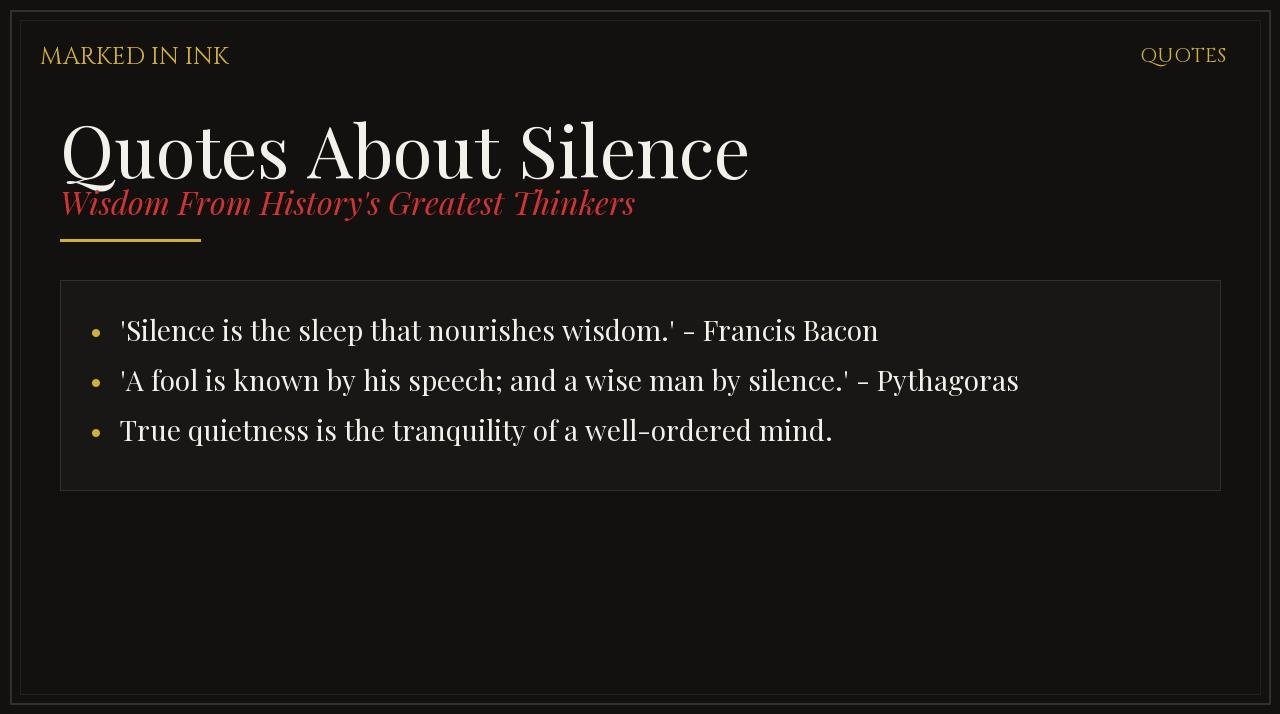
> “Silence is the sleep that nourishes wisdom.”
Francis Bacon knew the mind needs rest to process information. The intellect requires quiet periods to organize thoughts. Without these pauses, judgment becomes clouded by mental noise.
2. Pythagoras on Fools and Wise Men
> “A fool is known by his speech; and a wise man by silence.”
Pythagoras noted that excessive talking reveals a lack of depth. Those who speak constantly may try to mask their insecurities. Individuals who choose words carefully demonstrate grounded intellect.
3. Epictetus on Necessary Speech
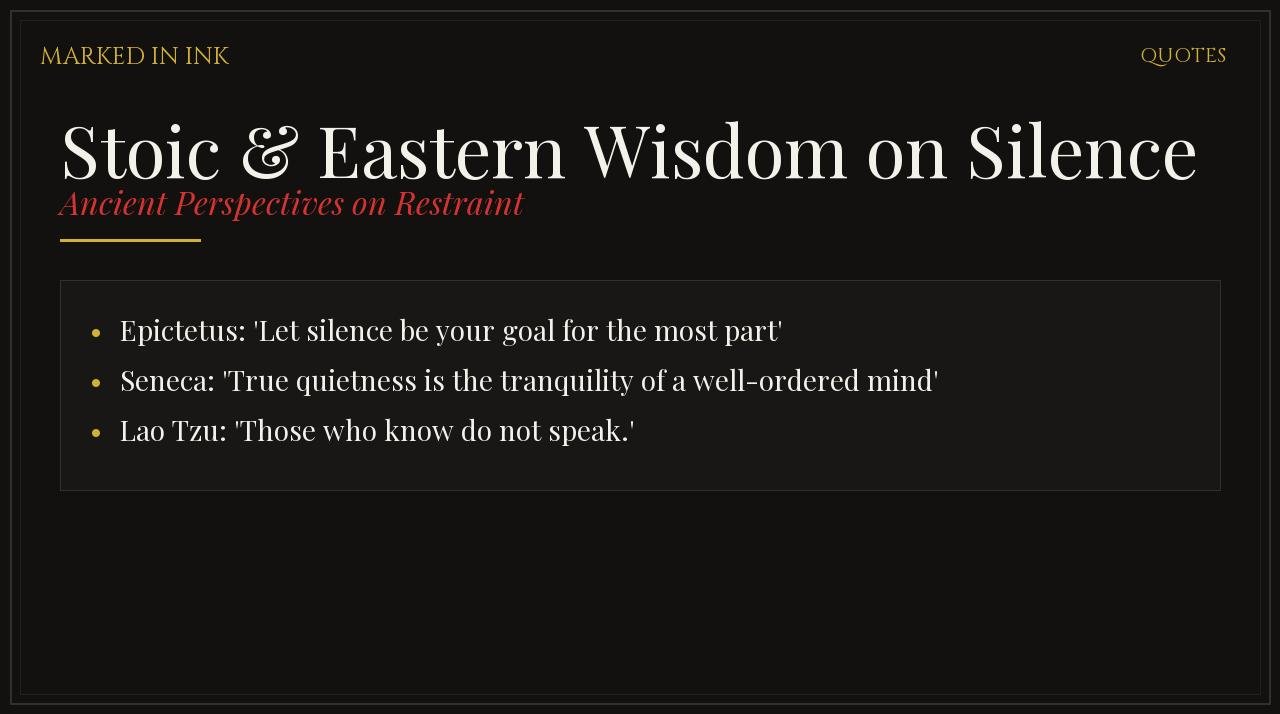
> “Let silence be your goal for the most part; say only what is necessary, and be brief about it.”
The Stoic philosopher Epictetus championed verbal economy. He believed speaking should serve a clear, practical purpose. By limiting our words, what we say carries weight.
4. Thomas Carlyle on Depth
> “Silence is as deep as eternity, speech as shallow as time.”
Thomas Carlyle contrasted the temporary nature of speech with stillness. Words are fleeting and bound by the moment. Quiet reflection connects us to something vast and enduring.
5. Lao Tzu on Knowing
> “Those who know do not speak. Those who speak do not know.”
Lao Tzu suggested that true wisdom transcends language. Someone who grasps a profound concept rarely broadcasts it. Constant explanation can dilute the essence of truth.
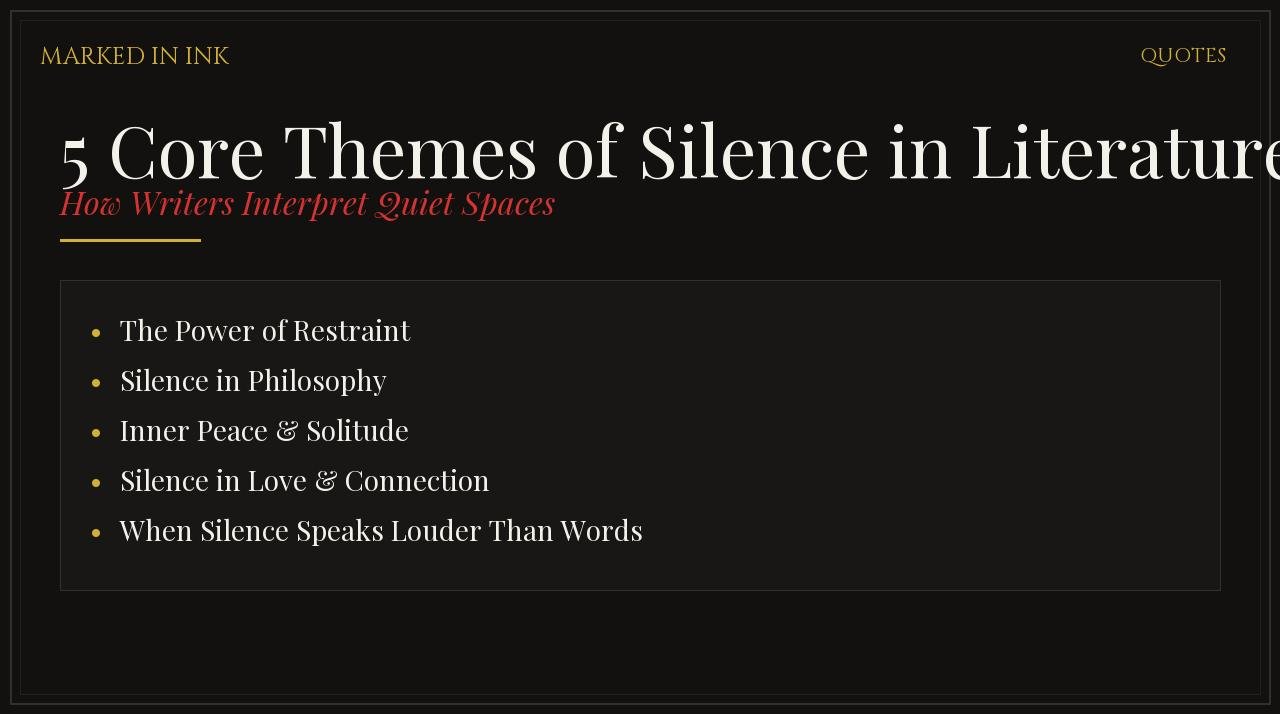
Silence in Philosophy
Philosophers have long debated the purpose of human expression. The absence of sound emerges as a vital component. It remains essential for a well-lived life.
6. Seneca on Inner Calm
> “True quietness is the tranquility of a well-ordered mind.”
Seneca taught that external silence means nothing if minds are chaotic. True peace comes from resolving internal conflicts. A serene mind naturally cultivates a calm exterior.
7. Marcus Aurelius on Retreat
> “Nowhere can man find a quieter or more untroubled retreat than in his own soul.”
Marcus Aurelius sought refuge from leadership through introspection. He advised we do not need physical isolation. Our internal landscape offers a sanctuary if we visit it.
8. Meister Eckhart on the Divine
> “Nothing is so like God as silence.”
For Meister Eckhart, verbalizing spiritual experiences diminished them. The ultimate connection to the divine requires total stillness. Words were inadequate tools for capturing such encounters.
9. Arthur Schopenhauer on Solitude
> “A man can be himself only so long as he is alone; and if he does not love solitude, he will not love freedom.”
Schopenhauer believed societal expectations force performative roles upon us. Stepping away from others lets us shed these masks. Embracing solitude is necessary for genuine personal freedom.
10. Søren Kierkegaard on Creating Silence
> “If I were a physician, and if I were allowed to prescribe just one remedy for all the ills of the modern world, I would prescribe silence.”
Kierkegaard observed a society overwhelmed by chatter and distraction. He believed spiritual ailments stem from lacking introspection. His remedy remains highly relevant in our digital age.
Inner Peace & Solitude
Finding peace in a hectic environment requires deliberate practice. These quotes highlight the restorative power of separation. We must step away from the loud crowd.
11. Rumi on the Language of the Soul
> “Silence is the language of God, all else is poor translation.”
Rumi explored the severe limitations of human vocabulary. He believed deepest truths can only be felt. To grasp the universe, we must interpret quiet signals.
12. Kahlil Gibran on Learning
> “I have learned silence from the talkative, toleration from the intolerant, and kindness from the unkind.”
Kahlil Gibran noted we learn valuable lessons through contrast. Observing the consequences of excessive talking inspires quietness. Sometimes negative examples are the strongest teachers.
13. Hemingway on Listening
> “I like to listen. I have learned a great deal from listening carefully. Most people never listen.”
Ernest Hemingway recognized true observation requires silencing our egos. Stopping our planned responses helps us hear others. To see how phrases evolve, check the origin of the word sandwich.
14. Virginia Woolf on Bare Things
> “How much better is silence; the coffee cup, the table. How much better to sit by myself.”
Virginia Woolf found profound beauty in ordinary quiet moments. She valued raw reality unclouded by constant conversation. These still periods allowed her creative mind to wander.
15. Chaim Potok on Space
> “I’ve begun to realize that you can listen to silence and learn from it. It has a quality and a dimension all its own.”
Chaim Potok described quietness as a rich, textured space. There is vital information in the pauses between sounds. Decoding silent moments adds depth to our perception.
Silence in Love & Connection
In relationships, words are only one way to communicate. Often, what remains unsaid carries the strongest emotional resonance. Silence can connect souls deeply.
16. George Elliston on Connection
> “It is not always words that bring / New sight deeply seen, / Sometimes it is the silences / That fall between.”
George Elliston beautifully captured how non-verbal spaces connect us. Pauses in a conversation allow emotions to settle. These quiet intervals are essential for genuine empathy.
17. Mother Teresa on Prayer and Action
> “The fruit of silence is prayer. The fruit of prayer is faith. The fruit of faith is love.”
Mother Teresa outlined a progression starting with intentional withdrawal. She viewed quiet devotion as the foundation for action. Without initial stillness, one cannot generate compassionate energy.
18. Antoine de Saint-Exupéry on Friendship
> “True love begins when nothing is looked for in return. Silence is the ultimate expression of this unconditional presence.”
Antoine de Saint-Exupéry believed true companions skip constant verbal affirmation. Sitting together without pressure indicates deep comfort and security. To see how phrases evolve, look at the origin of the phrase caught red handed.
19. Hermann Hesse on Shared Quiet
> “When two people are at one in their inmost hearts, they shatter even the magnetic iron bond of earth and stand free and in a new heaven.”
Hesse wrote about a connection that transcends regular communication. When souls are truly aligned, speech becomes secondary. Intimacy thrives in the quiet spaces shared between individuals.
20. Carl Jung on the Unconscious
> “The meeting of two personalities is like the contact of two chemical substances: if there is any reaction, both are transformed.”
Jung recognized deep connection happens beneath the surface. Unspoken, unconscious alignment creates lasting and powerful bonds. Speaking of unexpected phrases, the origin of the word berserk is fascinating.
When Silence Speaks Louder Than Words
Sometimes, refusing to speak is a powerful, active choice. It can communicate dissent, strength, or profound grief. This acts far better than any loud speech.
21. Martin Luther King, Jr. on Complicity
> “In the end, we will remember not the words of our enemies, but the silence of our friends.”
Martin Luther King pointed out inaction in the face of injustice. In this context, staying quiet is deeply harmful. We must choose our quiet moments ethically and carefully.
22. Elie Wiesel on Oppression
> “Neutrality helps the oppressor, never the victim. Silence encourages the tormentor, never the tormented.”
Elie Wiesel warned against remaining quiet when action is required. We must distinguish between inner peace and toxic complicity. Idioms capture this well, like the origin of the phrase bite the bullet.
23. Abraham Lincoln (Attributed) on Doubt
> “Better to remain silent and be thought a fool, than to speak and remove all doubt.”
This witty observation emphasizes that speaking can expose ignorance. It is often wiser to observe and let others assume. A quiet demeanor can project intelligence and control.
24. Sun Tzu on Strategy
> “Let your plans be dark and impenetrable as night, and when you move, fall like a thunderbolt.”
Sun Tzu saw quietness as a critical tactical advantage. Keeping your intentions hidden maintains the element of surprise. Broadcasting your next move is a fatal strategic error.
25. Ralph Waldo Emerson on Character
> “What you do speaks so loudly that I cannot hear what you say.”
Emerson highlighted that actions are the truest communication form. Verbal promises mean nothing if behaviors do not align. A person’s character is demonstrated through quiet, consistent actions.
Myths & Misattributions
When exploring famous sayings, we encounter historical inaccuracies. Many quotes about silence are misattributed to well-known figures. People love attaching wisdom to recognizable names without evidence.
You can explore similar histories by checking the origin of the word salary.
One common myth involves Wolfgang Amadeus Mozart. People claim he said music lives in the silence between notes. Historians confirm this phrase never appears in his letters.
It is a modern interpretation attached to his famous name. Like theater superstitions, seen in the origin of the phrase break a leg, myths spread quickly.
Another misattribution involves the Buddha. The internet claims he said silence is the best answer. Buddhist scholars maintain this phrasing is absent in scriptures.
We see this often in language development. This is similar to how the origin of the phrase bless you evolved.
The quote about remaining silent and being thought a fool is debated. Though attributed to Abraham Lincoln, print variations existed long before.
You can verify etymology at the Online Etymology Dictionary. People can also consult Merriam-Webster.
Comprehending histories is like studying english idioms and meanings. Readers might also enjoy learning the origin of the phrase kick the bucket.
Frequently Asked Questions
Why is silence considered powerful in communication?
Silence forces the other person to fill the void. It prevents reactive, emotional responses and maintains conversational control. This calculated pause projects total confidence and deep thoughtfulness.
Did Einstein really say silence is the best response?
No, Albert Einstein is falsely credited with quotes about quietness. Many inspirational sayings are attached to him for instant credibility. Always verify quotes through historical archives or academic databases.
How can practicing silence improve mental health?
Taking quiet breaks reduces sensory overload and lowers brain cortisol. It provides a dedicated space for essential self-reflection. Regular quietness can significantly decrease anxiety and improve mental focus.
What does it mean when someone gives the silent treatment?
The silent treatment is a passive aggressive manipulation tactic. This behavior aims to punish someone by withdrawing affection. It is a strict refusal to communicate rather than peace.
Are there different types of silence in literature?
Authors use quietness to build tension or signify deep grief. It can represent isolation and loneliness or peaceful intimacy. The context dictates if the absence of sound is comforting.
Finding comfort in quietness is a lifelong rewarding practice. By reflecting on wisdom, we learn to value spaces. Let these reflections guide you toward a more peaceful routine.


Alan Sledge is the writer and founder behind Letters & Letters. A lifelong lover of words, Alan has always been drawn to the small mysteries hidden in everyday language, why we say what we say, where our favorite sayings came from and the quotes that manage to put feelings into words better than we ever could ourselves.