
Modern conversation values direct speech. Long introductions test human patience during business meetings and daily conversations. We expect speakers to skip preliminary details and reach the core point quickly.
When discussions wander into unnecessary trivia, someone inevitably speaks up. They urge the speaker to cut to the chase. The phrase serves as our most popular shorthand for eliminating idle chatter.
Most speakers use this expression without considering its mechanical heritage. The idiom did not begin on horseback or in medieval hunting grounds. It was born on physical cutting benches inside 1920s Hollywood film studios.
Quick Answer: Origin of the Phrase Cut to the Chase
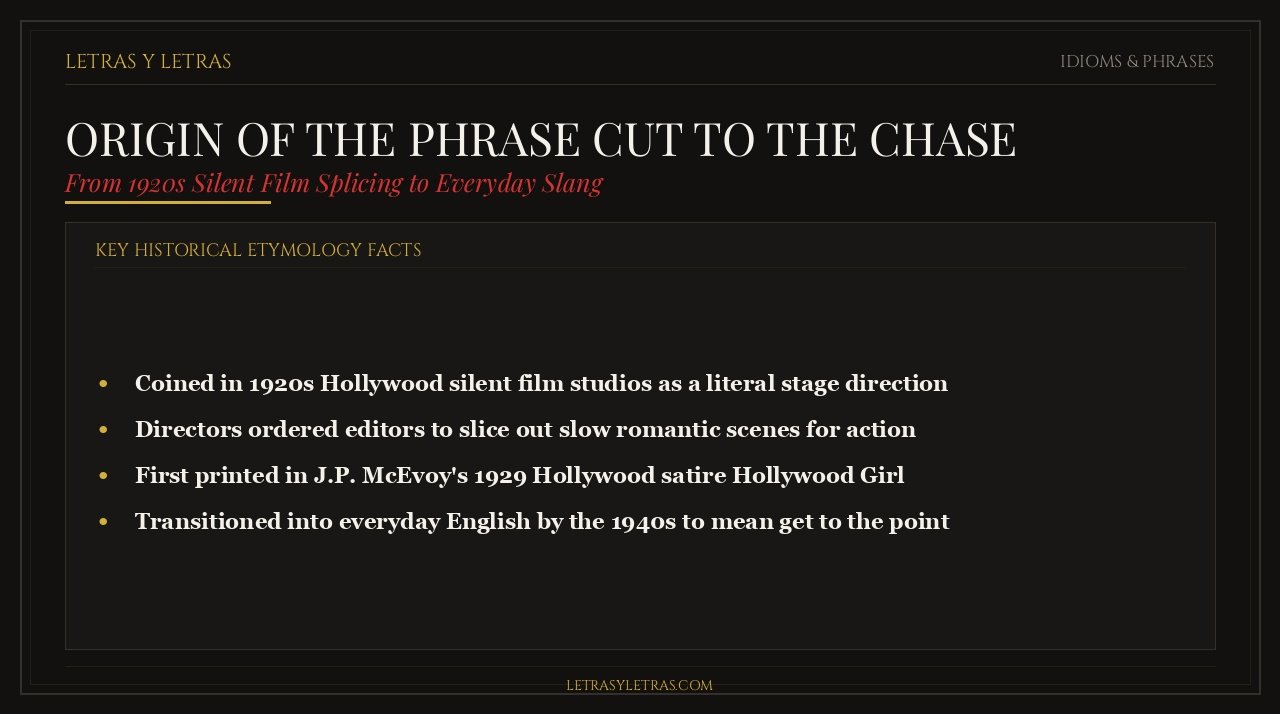
The phrase originated in 1920s Hollywood silent film studios as a literal editing and screenplay cue. Film cutters sliced away slow dialogue scenes to jump directly to action-packed pursuit sequences. It first appeared in print in JP McEvoy’s 1929 novel Hollywood Girl before entering common speech.
Key Takeaways
- Originated as a technical production direction in early American silent cinema.
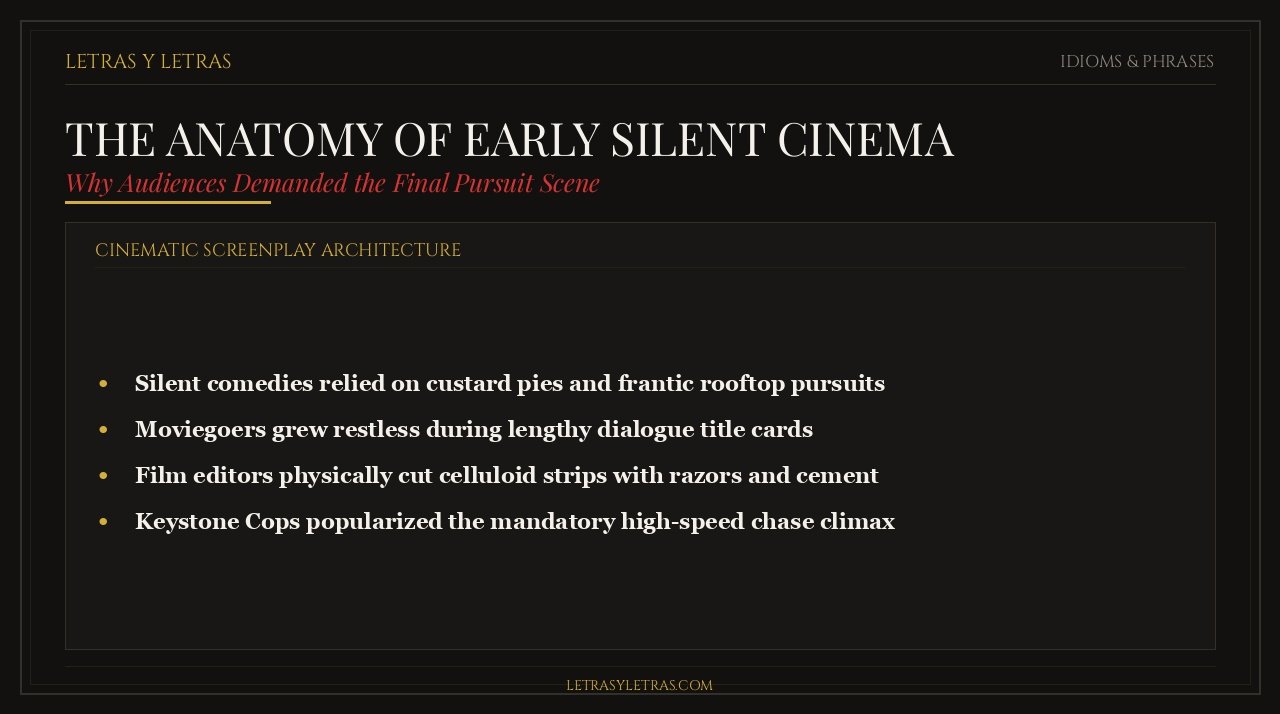
- Studio editors used razors and cement to cut away boring expository footage.
- Earliest known printed citation dates to JP McEvoy’s 1929 satire Hollywood Girl.
- Entered national journalism in 1947 through a political article in The New York Times.
- Has no historical connection to British fox hunting or cavalry combat charges.
The Mechanical Reality: Razors, Cement, and 35mm Celluloid
To understand this expression, one must examine early motion picture technology. Filmmakers in the 1920s did not use digital software or computer timelines. Editing was an intense physical craft conducted on workbenches.
Directors captured raw footage on highly flammable 35mm cellulose nitrate film reels. Assistants delivered hundreds of feet of developed negative strips to editorial rooms. Editors inspected every frame against frosted glass backlights.
When an editor decided to remove a scene, they literally picked up steel razor blades. They severed the physical film strip at the frame line. Then they scraped the emulsion off the edge with fine sandpaper.
The craftsperson applied foul-smelling film cement made from volatile amyl acetate. They pressed the two severed film edges together inside a mechanical film splicer. The chemical solvent welded the celluloid strips into one continuous ribbon.
Cutting was therefore a destructive physical action. Every edit required careful measurement, manual slicing, and chemical bonding. Removing unnecessary footage meant saving actual physical feet of costly film stock.
The Silent Comedy Boom: Why Audiences Demanded the Chase
Early cinema was visual pantomime. Without recorded audio tracks, actors conveyed emotion through exaggerated gestures and expressive facial expressions. Writers inserted printed title cards between shots to provide necessary dialogue.
Audiences tolerated title cards for basic plot exposition. However, excessive written text destroyed narrative momentum. Ticket buyers packed theaters to witness kinetic physical spectacles that could not exist on stage.
Pioneering producer Mack Sennett built a film empire on comedic movement. His famous Keystone Cops series featured frantic chases involving speeding police wagons and collapsing buildings. Audiences squealed with delight as bumbling officers stumbled across rooftops.
Similar frantic pursuits dominated western serials and dramatic melodramas. Villains tied distressed heroines to train tracks while mounted heroes galloped to the rescue. The final chase sequence delivered the emotional climax of every screening.
Preserved films in the Library of Congress National Film Registry reveal this consistent structural pacing. Early studios recognized that plot dialogue was merely a preamble. The chase was what sold tickets across global cinema houses.
Screenplay Shorthand: The Birth of CUT TO CHASE
Silent film screenplays followed rigid technical formatting conventions. Writers drafted continuity scripts outlining camera angles, shot numbers, and descriptive scene actions. These documents instructed both camera crews and post-production cutters.
Romance and sentimentality frequently bogged down mid-tier studio productions. Directors often shot extended parlor conversations and romantic courtships to build romantic tension. Studio heads and test audiences found these middle acts tedious.
Studio executives reviewing daily rushes sent blunt notes to the editing department. When pacing dragged, supervisors scrawled brief instructions across production notes. They ordered editors to slice out the dialogue and get directly to the thrilling action.
Screenwriters incorporated this imperative directly into their typewritten manuscripts. A continuity script would conclude a sluggish dialogue scene with capital letters: CUT TO CHASE. The instruction commanded an immediate transition to the pursuit sequence.
The command bridged the gap between writer, director, and mechanical editor. It prioritized sensory excitement over narrative delay. Studio workers absorbed the phrase into their daily professional vocabulary.
JP McEvoy and the 1929 Satirical Debut
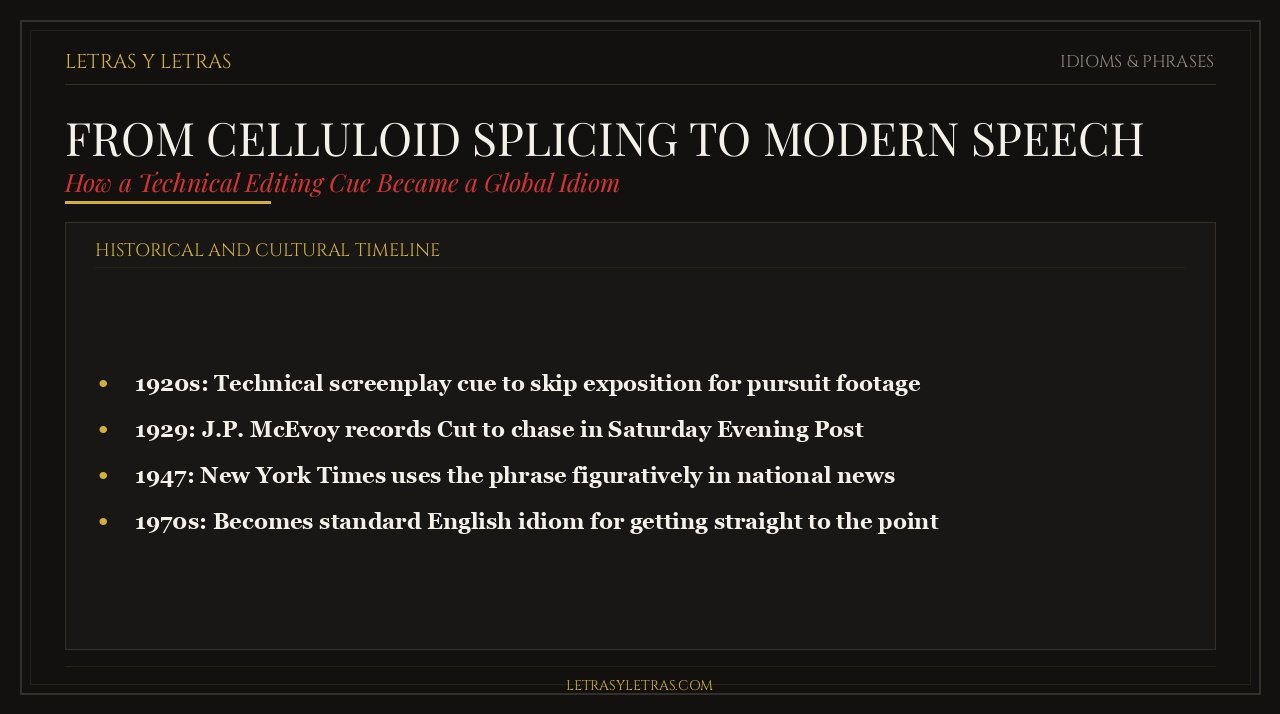
The earliest documented appearance of the phrase in print arrived in 1929. The American humorist and playwright JP McEvoy was a keen observer of studio culture. He wrote scripts and humorous fiction depicting the chaotic business of show business.
McEvoy serialized his satirical novel Hollywood Girl in The Saturday Evening Post. The novel followed a young aspiring actress encountering absurd studio executives. McEvoy portrayed film moguls and theater directors with sharp comedic dialogue.
In one memorable scene, a director instructs a novice scriptwriter on commercial film structure. The seasoned professional snaps with frank impatience: Cut to the chase. McEvoy used the studio slang to satirize commercial Hollywood priorities.
The serialization introduced thousands of regular readers to insider studio jargon. Lexicographers at the Oxford English Dictionary cite McEvoy’s novel as the earliest written record of the expression. The phrase demonstrated how technical trade language drifts into creative literature.
McEvoy captured a moment of profound cultural transformation. Silent cinema was yielding ground to synchronized sound films. Yet the editing vernacular of the silent era was already permanently fixed in American popular culture.
From Studio Cutting Rooms to National News: The 1947 Milestone
For two decades following McEvoy’s novel, the phrase circulated primarily among actors, writers, and theater agents. People working on Broadway and in southern California adopted it as common professional shorthand. It meant skipping past pleasantries during contract talks.
The expression made its historic debut in mainstream American political journalism in 1947. On April 25 of that year, The New York Times published a financial dispatch on federal tax policy. The reporter covered heated discussions surrounding post-war fiscal legislation.
The article quoted an impatient fiscal observer addressing public hopes for lower taxes. The source declared bluntly: Let us cut to the chase. There will be no tax relief this year.
This appearance marked a crucial linguistic turning point. The speaker was not discussing movie scripts, cameras, or celluloid film reels. That idiom had fully separated from cinema technology to represent blunt conversational honesty.
National newspapers helped distribute regional idioms across the country. Readers in Chicago, Boston, and Atlanta encountered the expression in serious public discourse. The phrase offered concise energy that traditional idioms lacked.
The Corporate Boardroom: Why the Idiom Exploded in the 1970s
During the 1970s and 1980s, corporate America experienced massive reorganization. Conglomerates expanded rapidly, leading to fast-paced executive cultures. Business schools emphasized efficiency, concise executive summaries, and decisive corporate communication.
Corporate managers seized upon cinematic vocabulary to invigorate office meetings. Phrases like fade out, run the reel, and cut to the chase entered daily boardrooms. Business speakers appreciated the commanding tone of the phrase.
Using the phrase established immediate leadership authority. It signaled that the speaker valued time and would not tolerate diplomatic evasion. Saying let us cut to the chase forced colleagues to state bottom-line numbers.
The phrase also gained widespread popularity in courtroom dramas and television scripts. Detectives on crime shows urged evasive witnesses to drop their alibis and state the facts. Audiences heard the phrase weekly in living rooms across the globe.
According to the Online Etymology Dictionary entry, the expression achieved global ubiquity by the late twentieth century. English speakers on every continent now recognized its meaning instantly.
Debunking Common Folk Myths About the Phrase
Because the word chase features prominently, people often invent colorful historical origins. Folk etymology loves connecting modern sayings to ancient sports or heroic military battles. Several false explanations circulate across popular websites today.
The most persistent myth connects the phrase to traditional British fox hunting. Storytellers claim that riders cut across fields to intercept the hounds during an active chase. While hunters undeniably took shortcuts, historical records reveal no such equestrian phrase.
British fox hunters relied on specific traditional terms like tally-ho, riding to hounds, and being in at the death. Historical sporting journals contain zero references to cutting to the chase. The phrase was completely unknown in Victorian England.
A second popular misconception attributes the saying to nineteenth-century cavalry charges. Proponents suggest that commanders ordered buglers to sound a cut call to pursue retreating infantry forces. Military handbooks from the Napoleonic era and American Civil War disprove this theory.
Cavalry orders utilized standard terms like charge, wheel, and tactical pursuit. Military units never employed theatrical film terminology on battlefields. We see similar invented military legends when studying the origin of the phrase bite the bullet.
A third myth claims that stagehands cut ropes to drop theatrical pursuit backdrops. Traditional theaters used elaborate counterweight pulley systems to raise and lower canvas backdrops. Stagehands never sliced ropes with knives during live performances.
These false origins demonstrate how easily people mistake poetic speculation for real history. The actual truth is far more recent and technological. That phrase belongs entirely to twentieth-century American motion pictures.
Historical Timeline of the Phrase Cut to the Chase
| Time Period | Historical Milestones | Linguistic and Practical Context |
|---|---|---|
| 1910s–1920s | Early Silent Film Boom | Directors rely on climactic chase scenes to thrill crowds. Physical film editors splice 35mm celluloid using razors and cement. |
| c. 1925 | Screenplay Shorthand | Writers adopt the uppercase cue CUT TO CHASE in continuity scripts to instruct editors to drop slow romantic subplots. |
| 1929 | McEvoy’s Hollywood Girl | First known printed appearance in a satirical novel serialized in The Saturday Evening Post, mocking impatient studio directors. |
| 1947 | The New York Times | First appearance in mainstream journalism applied to federal tax policy, signaling its leap into everyday figurative language. |
| 1970s–1980s | Corporate Boardrooms | Becomes a dominant idiom in business management, television police procedurals, and executive communications worldwide. |
| Present Day | Global English Standard | Recognized across international dictionaries as an indispensable idiom for demanding immediate honesty and core facts. |
Sibling Idioms: How Cinema Reshaped Modern Speech
Cut to the chase is not the only expression gifted to us by movie sets. The twentieth-century film industry created a rich reservoir of figurative idioms. Many terms describe human psychology through technical production equipment.
Consider the common phrase in the can. When a director finishes shooting a scene, crew members store the exposed film inside metal containers. Today, business teams declare a finished project safely in the can.
Another prominent example is fade out. Filmmakers gradually decreased lens exposure to create smooth scene transitions. Today, people use the term when tired guests slip away quietly from noisy social gatherings.
We also frequently use the term wrap up. When early camera crews completed daily shooting, workers announced that wind-up cameras were wound. The phrase evolved into our favorite idiom for concluding work meetings.
Similar linguistic transformations occur across military, legal, and printing trades. For example, civil war prison camps produced the origin of the word deadline. Language constantly borrows mechanical trade jargon to enrich human communication.
Other phrases highlight physical psychological reactions. Readers explore this bodily connection in our study on the origin of the phrase cold feet. Expressions survive because they provide memorable sensory metaphors for complex emotions.
Frequently Asked Questions
What does the phrase cut to the chase mean today?
It means getting straight to the point without wasting time on preliminary discussions. Speakers use it to demand essential facts and eliminate unnecessary conversational delay.
When was cut to the chase first used in print?
The phrase first appeared in print in 1929. The American writer JP McEvoy recorded it in his satirical novel Hollywood Girl, published in The Saturday Evening Post.
Is cut to the chase connected to fox hunting?
No, the expression has no connection to fox hunting. British hunters used traditional terms like tally-ho. The phrase originated strictly in early twentieth-century American movie studios.
Why did silent movies always have chase scenes?
Silent films lacked recorded speech, so audiences craved physical action and kinetic motion. High-speed chases in cars or on horseback provided thrilling visual climaxes that kept viewers entertained.
What is the difference between cut to the chase and cut to the quick?
Cut to the chase means reaching the core topic quickly. Cut to the quick means causing deep emotional pain by striking a person’s most vulnerable feelings.
The Lasting Splice: Why the Phrase Remains Indispensable
A century has passed since editors first severed cellulose ribbons on studio cutting benches. Digital sensors have replaced chemical film emulsions. Filmmakers assemble modern blockbusters using keyboard hotkeys rather than steel razors.
Yet the physical metaphor remains as sharp and necessary as ever. Modern life bombards us with relentless distractions and superficial chatter. We crave authentic clarity in our professional work and personal relationships.
When someone tells us to cut to the chase, they invite honest focus. They strip away diplomatic pretensions and focus on what truly matters. In that brief command, the frantic energy of early cinema lives on in our everyday speech.
Exploring phrase histories teaches us how everyday language reflects cultural invention. You can explore dozens of fascinating expressions in our guide to english idioms and meanings. Each phrase holds a hidden story waiting to be discovered.
Alan Sledge is the founder and lead writer at letrasyletras.com, dedicated to uncovering the true etymological histories behind our favorite words and phrases.


Alan Sledge is the writer and founder behind Letters & Letters. A lifelong lover of words, Alan has always been drawn to the small mysteries hidden in everyday language, why we say what we say, where our favorite sayings came from and the quotes that manage to put feelings into words better than we ever could ourselves.