

The pursuit of flawless performance has haunted artists, thinkers, and builders for thousands of years. We polish our sentences, refine our routines, and measure ourselves against impossible standards. Yet history shows that demanding absolute flawlessness often produces silence and creative paralysis.
The finest philosophers viewed human flaws from a completely different perspective. They recognized that true wisdom grows out of patient practice, awkward errors, and courageous action.
Exploring these timeless quotes about perfection reveals how great minds escaped the trap of rigid expectations. Their reflections offer practical sanity for modern writers, creators, and leaders.
Quick Answer: Quotes About Perfection
Quotes about perfection from historical figures like Salvador Dalí, Voltaire, Aristotle, and Seneca warn that seeking absolute flawlessness leads to creative paralysis. Etymologically rooted in the Latin perficere (meaning to complete), perfection originally denoted finishing a task rather than achieving divine purity. Major thinkers throughout history argue that excellence is an ongoing habit of resilient action, while perfectionism is a rigid defense mechanism that stifles growth and genuine human connection.
Key Takeaways
- Classical Latin perfectus meant finished or completed rather than morally flawless.
- Voltaire popularized the principle that the best is the enemy of the good in 1770.
- Aristotle defined excellence as a continuous daily habit rather than a single perfect act.
- Japanese Wabi-Sabi and Kintsugi celebrate the beauty and wisdom of repaired flaws.
- Historical research debunks famous perfection quotes misattributed to Vince Lombardi and Henry Royce.
The Linguistic Roots: From Completion to Flawlessness
To grasp why perfectionism causes such mental anguish, we must examine the history of the word itself. In classical Latin, the term derives from the verb perficere. This linguistic root is cataloged in the Perseus Digital Library Latin Lexicon.
In classical Latin, perfectus meant that an object was finished or accomplished. Roman builders used the term when a stone aqueduct stood complete and functional.
It carried no moral demand for divine flawlessness. An object was considered complete simply because workers had finished their labor.
Over subsequent centuries, European theological debates transformed this practical term. Renaissance scholars began equating perfection with absolute purity, unblemished symmetry, and divine virtue.
This subtle shift in definition created a painful psychological burden for ordinary mortals. Modern humans stopped striving for completion and began demanding unattainable flawlessness.
Grasping this etymological shift helps restore sanity to our daily routines. We can choose to view our work as completed tasks rather than immaculate monuments.
The Illusion of Flawlessness and the Pursuit of Mastery
Great masters understood that complete flawlessness is a mirage. Mastery requires showing up, practicing daily, and accepting honest mistakes as part of growth.
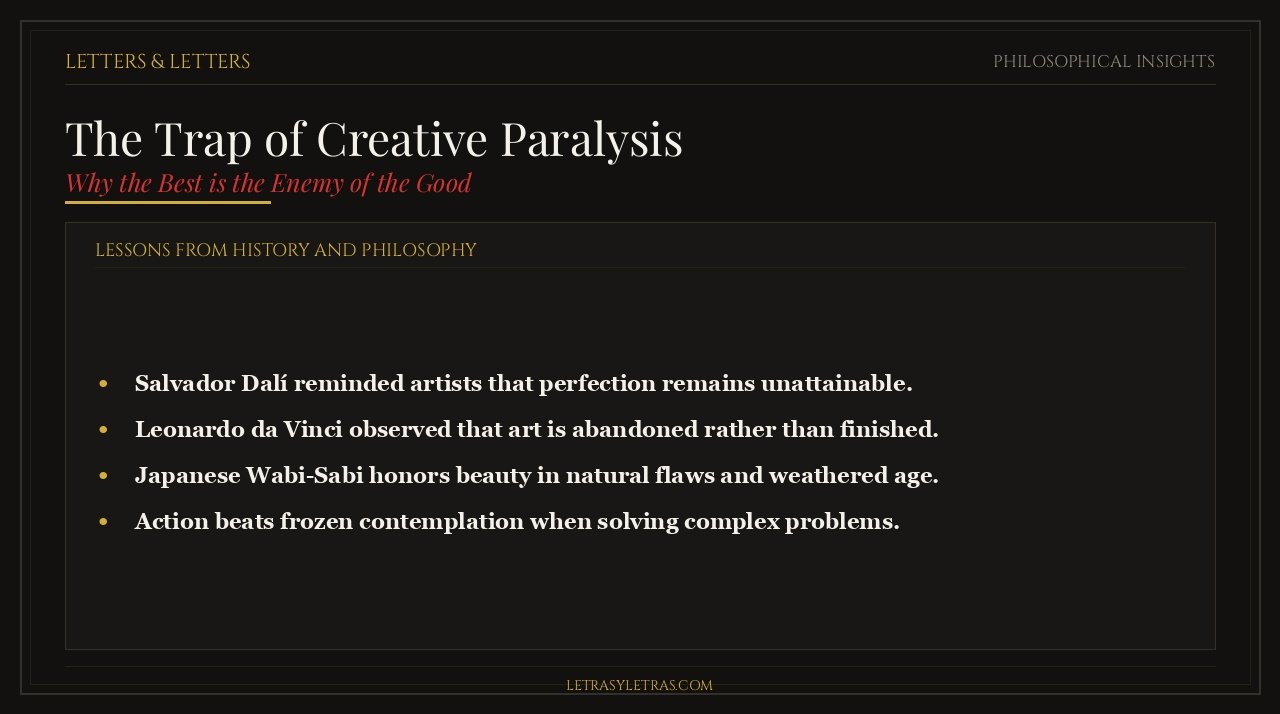
- “Have no fear of perfection, you will never reach it.” — Salvador Dalí
Reflection: Recognizing the impossibility of flawlessness frees creators from crippling artistic anxiety. - “Art is never finished, only abandoned.” — Leonardo da Vinci
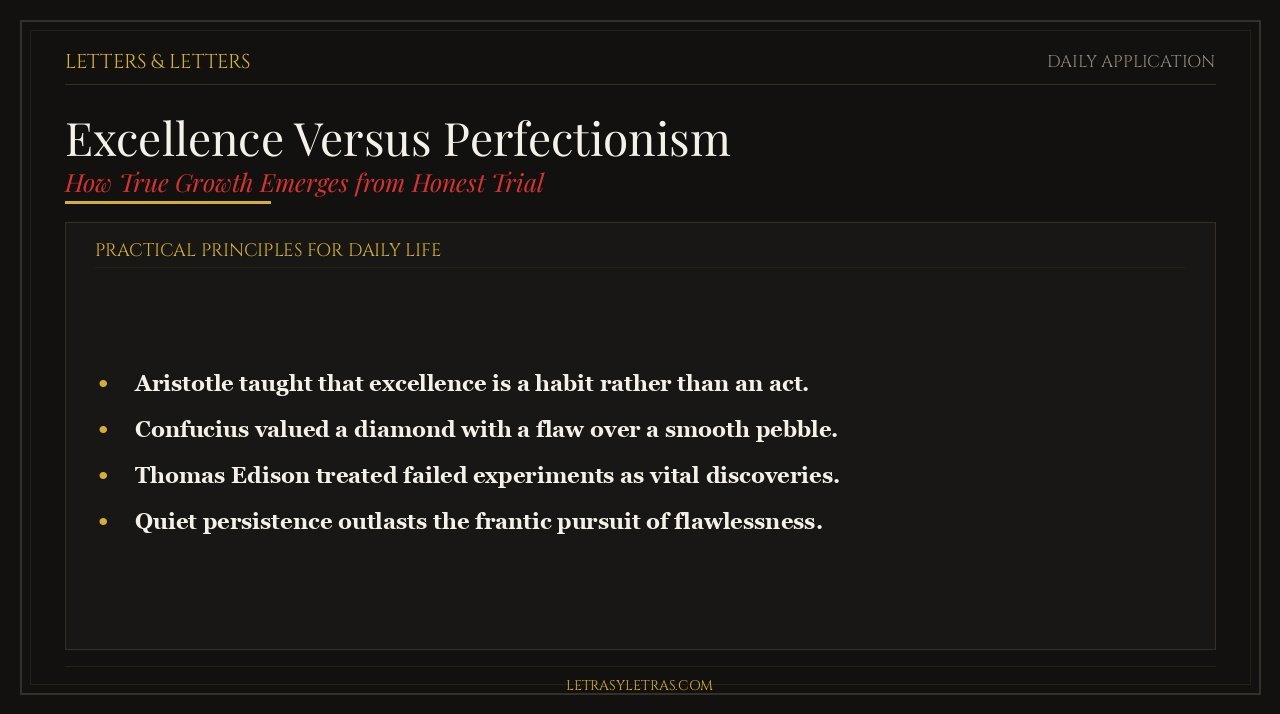
Reflection: Every creative work reaches a point where further tweaking yields diminishing returns. - “We are what we repeatedly do. Excellence, then, is not an act, but a habit.” — Aristotle
Reflection: Ancient Greek thinkers separated daily excellence from rigid, impossible standards. - “Be like water making its way through cracks. Adjust to the object, and you will find a way through it.” — Bruce Lee
Reflection: Flexibility and adaptation succeed where rigid demands for control inevitably shatter. - “There is only a queer divine dissatisfaction, a blessed unrest that keeps us marching.” — Martha Graham
Reflection: The restlessness of an artist fuels progress without requiring paralyzing self-criticism.
The Renaissance Insight on Completion
Renaissance studios in Florence and Venice buzzed with feverish activity. Apprentices ground pigments while master sculptors chiseled blocks of Carrara marble.
Leonardo da Vinci spent decades carrying notebooks filled with anatomical sketches and mathematical proportions. Yet many of his greatest paintings remained technically unfinished in his personal workshop.
Michelangelo left entire series of marble figures deliberately rough. This aesthetic choice is preserved in the Metropolitan Museum of Art archives. Scholars refer to these sculptures as non finito, meaning unfinished.
These Renaissance masters recognized that a work possesses vitality precisely because it hints at human struggle. Polishing every stone surface until smooth often robs a sculpture of its emotional electricity.
Modern creators face the identical dilemma when working on digital screens. Knowing when to step back and declare a project finished is the greatest mark of artistic maturity.
The Best as the Enemy of the Good: The Voltaire Principle
Demanding the ultimate outcome frequently prevents people from completing practical, helpful work. French satirist Voltaire famously warned against this self-defeating mindset.
- “The best is the enemy of the good.” — Voltaire
Reflection: Holding out for an unattainable standard often prevents us from completing valuable work. - “Better a diamond with a flaw than a pebble without.” — Confucius
Reflection: Authentic character containing minor blemishes far outshines shallow, unblemished mediocrity. - “Perfectionism is spelled paralysis.” — Winston Churchill
Reflection: Waiting for conditions to align flawlessly ensures that bold actions never occur. - “Do what you can, with what you have, where you are.” — Theodore Roosevelt
Reflection: Grounded action in messy circumstances always defeats frozen contemplation. - “If a thing is worth doing, it is worth doing badly.” — G.K. Chesterton
Reflection: Beginning clumsily is far nobler than avoiding an endeavor out of pride. For insights on facing adversity, explore our collection of quotes on courage.
Voltaire and Eighteenth-Century Common Sense
Voltaire penned his famous warning in his 1770 philosophical poem La Bégueule. He watched Parisian intellectuals debate abstract theories while ignoring practical reforms that could help suffering citizens.
His Italian source material originally ran as an old proverb: il meglio è l’inimico del bene. Voltaire adapted the line into French to defend incremental progress over utopian dreams.
When politicians or writers wait for pristine conditions, they abandon the present moment. Voltaire insisted that a useful reform completed today surpasses an immaculate fantasy delayed forever.
We see this principle validated across medicine, governance, and daily craftsmanship. Providing real relief to real people always trumps waiting for flawless solutions.
Chesterton echoed this wisdom when defending amateur hobbies and community life. An amateur who plays an instrument poorly out of love brings more joy than a critic who stays silent.
The Beauty of Imperfection and Natural Grace
Across many cultures, thinkers celebrated the elegance of weathered age and natural asymmetry. The Japanese tradition of Wabi-Sabi specifically honors cracked vessels and worn surfaces.
- “There is a crack in everything, that is how the light gets in.” — Leonard Cohen
Reflection: Vulnerability and cracks allow genuine connection and insight to enter our lives. - “Every artist was first an amateur.” — Ralph Waldo Emerson
Reflection: Stumbling through awkward beginnings is the only road toward genuine creative skill. - “Even monkeys fall from trees.” — Japanese Proverb
Reflection: Even the most capable experts occasionally lose their grip and make simple mistakes. - “No man was ever wise by chance.” — Seneca
Reflection: Wisdom requires years of stumbling through misjudgments and gathering hard-won insight. - “The impediment to action advances action. What stands in the way becomes the way.” — Marcus Aurelius
Reflection: Obstacles and unexpected blunders provide the exact material needed for character growth. Learn how ancient resilience shapes speech in our guide to quotes on discipline.
The Philosophy of Kintsugi and Cracked Gold
Japanese potters developed a repair technique called kintsugi during the fifteenth century. When a ceramic tea bowl shattered, craftsmen refused to discard the broken shards.
Instead, they bonded the pieces back together using natural lacquer dusted with powdered gold. The golden seams highlighted the fractures rather than concealing them.
A repaired bowl became more valuable and cherished than a brand new vessel. The gold seams narrated the physical history of the object, celebrating its survival and resilience.
In Western culture, people often attempt to hide their mistakes and vulnerabilities behind manicured facades. We fear that showing a crack will invite rejection or ridicule from peers.
The philosophy of kintsugi offers a soothing antidote to modern digital anxiety. Our scars, missteps, and awkward recoveries constitute our truest beauty and deepest wisdom.
Breaking the Chains of Harsh Self-Criticism
Perfectionism often masks a deep terror of judgment. Modern writers and psychologists note that chronic self-criticism paralyses productivity and damages human connection.
- “Perfectionism is the voice of the oppressor.” — Anne Lamott
Reflection: Rigid standards often serve as internal censors designed to stifle authentic creative risk. - “Perfectionism is a twenty-ton shield that prevents us from being seen.” — Elizabeth Gilbert
Reflection: Hiding behind immaculate facades prevents the honest vulnerability necessary for deep relationships. - “I have not failed. I have found ten thousand ways that will not work.” — Thomas Edison
Reflection: Reframing technical setbacks as scientific eliminations prevents discouragement. - “You cannot go back and change the beginning, but you can start where you are and change the ending.” — C.S. Lewis
Reflection: Regretting past missteps achieves nothing while today offers fresh choices for action. - “Do not let what you cannot do interfere with what you can do.” — John Wooden
Reflection: Fixating on personal deficiencies diverts vital energy away from practical, achievable contributions. Discover more classical insight in our curated compendium of famous quotes and quotations.
Edison and the Crucible of Iteration
In his Menlo Park laboratory in New Jersey, Thomas Edison tested thousands of materials for electric light filaments. Assistants tested cardboard, cedar, platinum, and bamboo from Japanese bamboo groves.
Newspaper reporters frequently asked Edison how he endured so many continuous failures without quitting. Edison laughed at their characterization of his daily laboratory routine.
He explained that each non-working filament provided valuable empirical data. The inventor was not failing; he was identifying materials unsuitable for incandescent light.
This distinction separates resilient builders from fragile perfectionists. Perfectionists interpret an unsuccessful outcome as proof of personal deficiency.
Iterative builders treat unexpected outcomes as neutral data points. By decoupling self-worth from immediate results, creators maintain the stamina needed for groundbreaking discovery.
Truth, Growth, and Creative Boldness
Real accomplishment emerges from embracing chaos, trial, and honest effort. The following thinkers urge us to exchange frozen anxiety for vibrant engagement with life.
- “You must have chaos within you to give birth to a dancing star.” — Friedrich Nietzsche
Reflection: Orderly predictability rarely produces groundbreaking art or profound personal insight. - “You may encounter many defeats, but you must not be defeated.” — Maya Angelou
Reflection: Resilience means separating temporary tactical setbacks from core personal identity. - “By seeking and blundering we learn.” — Johann Wolfgang von Goethe
Reflection: Erring along the way is the natural curriculum of all meaningful human education. - “If you want to improve, be content to be thought foolish and stupid.” — Epictetus
Reflection: Willingness to look awkward in public is the prerequisite for acquiring any skill. - “Great things are done by a series of small things brought together.” — Vincent van Gogh
Reflection: Massive achievements accumulate through humble daily brushstrokes rather than sudden divine miracles.
Stoic Equanimity and Foolish Beginnings
In ancient Rome, the Stoic teacher Epictetus lectured young students on character and emotional freedom. His lectures, preserved in the Stanford Encyclopedia of Philosophy, warned against the vanity of wishing to appear competent instantly.
Epictetus reminded students that learning any language, craft, or philosophical discipline requires appearing foolish. When children learn to walk, they tumble, wobble, and scrape their knees repeatedly.
Adults often abandon creative dreams because they cannot bear the discomfort of looking clumsy in front of observers. They prefer the safety of inaction over the awkwardness of public growth.
The Stoic cure is simple yet radical. Accept that beginning any new craft will feel embarrassing and flawed.
Releasing the desire for immediate applause opens the door to genuine competence. The willingness to be a beginner is the secret foundation of all mastery.
Chronological Timeline of Philosophical Views on Perfection
Tracing how great thinkers approached flawlessness reveals an enduring intellectual battle between rigid ideals and practical human action.
| Historical Era | Philosophical Thinker | Core Perspective on Human Flaws |
|---|---|---|
| c. 500 BCE | Confucius | Prioritized character with flaws over smooth but hollow mediocrity. |
| c. 330 BCE | Aristotle | Taught that excellence is a daily habit rather than an impossible single standard. |
| c. 108 CE | Epictetus | Advocated embracing the awkwardness of looking foolish while learning new skills. |
| c. 1490 CE | Leonardo da Vinci | Observed that artistic masterpieces are abandoned rather than completed. |
| 1770 CE | Voltaire | Established the principle that the best outcome is the enemy of the good. |
| 1879 CE | Thomas Edison | Reframed failed lab tests as vital milestones in the scientific elimination process. |
| 1958 CE | Salvador Dalí | Encouraged artists to abandon fear of perfection since human limits make it impossible. |
Unmasking Popular Quote Misattributions
Quote anthologies often attribute clever sayings to famous figures who never uttered them. Examining historical records helps us distinguish authentic wisdom from marketing folklore.
The famous maxim about chasing flawlessness to catch excellence is routinely credited to football coach Vince Lombardi. Yet archival researchers found no record of this phrase in Lombardi’s writings or verified interviews. Motivational speakers popularized the line decades later during corporate seminars.
A second widely circulated quotation claims that Henry Royce commanded engineers to design flawlessness where none existed. Historical archives from the British automotive company show the slogan was crafted by advertising publicists in 1910. Sir Henry Royce was a practical mechanic who emphasized functional durability over abstract flawlessness.
Verifying historical sources protects our appreciation of authentic literature. Readers can discover similar myths in our analysis of the origin of the phrase bless you. Separating folklore from primary manuscripts enriches our connection to language.
Similar patterns appear in our guide to english idioms and meanings. Folk stories sound appealing because they reduce complex history to witty one-liners.
Frequently Asked Questions
Who said have no fear of perfection you will never reach it?
Spanish surrealist painter Salvador Dalí coined this famous advice for artists in his written journals. He believed accepting human limitation unlocks genuine creative bravery.
What did Voltaire mean by the best is the enemy of the good?
Voltaire meant that chasing an unattainable standard often ruins helpful practical outcomes. His warning appeared in his 1770 philosophical poem La Begueule.
What is the difference between perfectionism and excellence?
Excellence focuses on consistent effort, growth, and learning from honest mistakes. Perfectionism fixates on avoiding judgment, rigid control, and the appearance of flawlessness.
Why do artists struggle with finishing their work?
Many creators fear external criticism once their work becomes public. Leonardo da Vinci famously noted that paintings are abandoned rather than completed because vision outpaces execution.
How can quotes help overcome creative paralysis?
Reading reflections from iconic thinkers reminds us that even history’s greatest masters made clumsy errors. Their wisdom encourages people to take messy action instead of staying frozen.
What does the word perfection literally mean in Latin?
The word perfection derives from the Latin verb perficere, meaning to complete or carry through to the end. In Roman antiquity, it denoted finishing a construction project rather than moral flawlessness.
Alan Sledge is the founder and lead writer at letrasyletras.com, dedicated to uncovering the true etymological histories behind our favorite words and phrases.


Alan Sledge is the writer and founder behind Letters & Letters. A lifelong lover of words, Alan has always been drawn to the small mysteries hidden in everyday language, why we say what we say, where our favorite sayings came from and the quotes that manage to put feelings into words better than we ever could ourselves.