
Every December, millions of households exchange festive greetings and decorate evergreen trees. We sing familiar carols and wrap gifts for friends and family. Yet few people pause to consider the ancient linguistic history behind our holiday name.
Where does the word Christmas come from, and how did it reach modern English? Tracing this phrase carries us into monastic libraries and medieval scriptoriums.
The story spans ancient Greece, imperial Rome, and early medieval Britain. Along this historical path, we discover forgotten winter celebrations and dismantle persistent modern myths.
Quick Answer: Where Does the Word Christmas Come From?
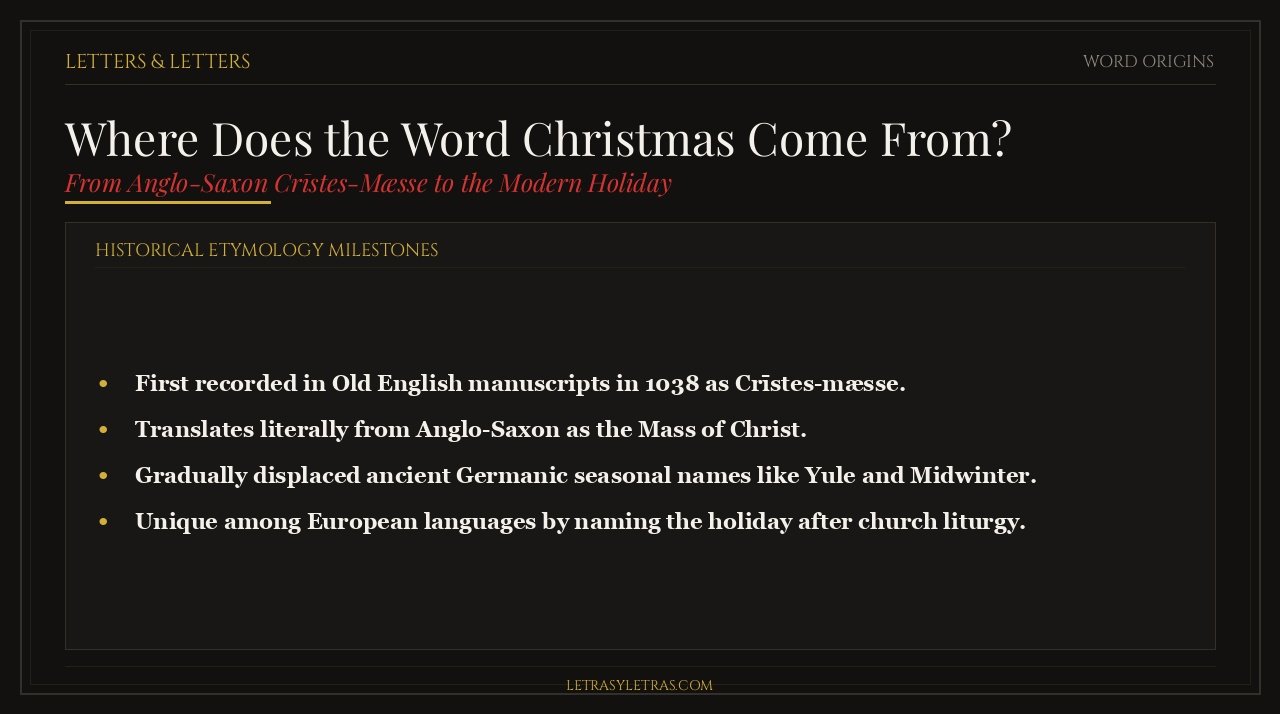
The word Christmas comes from Old English Crīstes-mæsse, translating to the Mass of Christ. First recorded in 1038 in the Anglo-Saxon Chronicle, it combines Greek Christos with Latin missa. Early English communities called the season Yule, while Xmas preserves the sacred Greek letter Chi.
Key Takeaways
- Christmas comes from the Old English Crīstes-mæsse, meaning Christ’s Mass.
- The phrase first appears in written English historical records in 1038 CE.
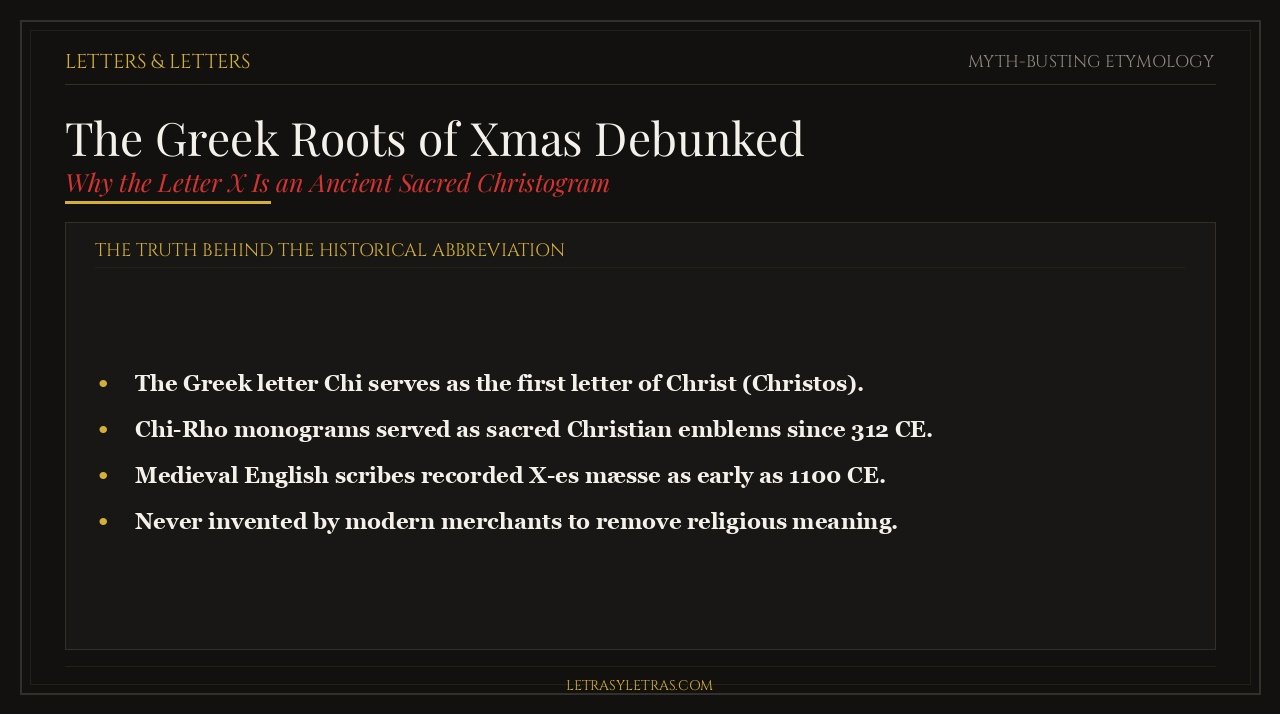
- Xmas comes from the Greek letter Chi, an ancient sacred monogram for Christ.
- Anglo-Saxons originally celebrated the winter season under the names Yule and Midwinter.
- English is unique among major European languages in naming the holiday after the Mass.
The Old English Compound: Crīstes-mæsse
The English name Christmas is a compound word formed during the late Anglo-Saxon era. Linguistic scholars trace its earliest documented written appearance to the year 1038.
An anonymous scribe recorded the phrase on Crīstes mæssan in an Old English manuscript. Today, this historic chronicle is preserved in the British Library Anglo-Saxon Chronicle archives.
The compound brings together two distinct linguistic traditions. One root springs from classical Greek, while the second root originates in ecclesiastical Latin.
The first component is Christ, derived from Old English Crīst. This title entered early Germanic speech through ecclesiastical Latin Christus.
Latin borrowed the word directly from ancient Greek Christos. In classical Greek, the term signified an individual rubbed or consecrated with holy oil.
Greek translators selected this word to render the Hebrew title Mashiah into Greek scriptures. Thus, the name carries thousands of years of sacred Mediterranean religious heritage.
The second element is mass, preserved in Old English as mæsse. This noun entered Anglo-Saxon speech from post-classical Church Latin missa.
In early liturgical rites, priests concluded services with the phrase Ite, missa est. The Latin verb mittere signified sending or releasing the gathered assembly.
Over centuries, the dismissal phrase expanded to label the entire Eucharistic communion liturgy. Therefore, Crīstes-mæsse denoted the specific church service held in honor of Christ.
Linguistic documentation in the Oxford Reference English Etymology confirms this ecclesiastical transition. The holy day was intimately bound to liturgical worship.
Rather than focusing on secular festivities, early records emphasized the solemn Eucharistic gathering. The congregation came together at midnight to celebrate the nativity.
How Middle English Shaped the Modern Spelling
Languages never remain static, and Anglo-Saxon speech underwent dramatic transformation following the Norman Conquest of 1066. French scribes and evolving vowel sounds reshaped everyday speech.
By 1131, the Peterborough Chronicle recorded the seasonal celebration under the spelling Cristes-messe. The grammatical genitive inflection began softening into shorter syllables.
Medieval parishioners spoke the two words rapidly in daily conversation. Over successive generations, the compound fused into a single rhythmic word.
During the fourteenth century, Geoffrey Chaucer wrote of Christemasse in his celebrated poetry. Scribes frequently varied spellings based on dialect, writing Chrystmasse or Cristenmasse across regional manuscripts.
The medial t sound gradually went silent in common speech. English speakers naturally dropped the crisp dental stop to ease spoken pronunciation.
By the sixteenth century, printer William Caxton and translator William Tyndale established regular forms. Early modern printing presses finally standardized the familiar spelling we use today.
Historical etymologists at the Online Etymology Dictionary note how pronunciation shifted over time. The original long vowel shortened into the familiar crisp sound.
Despite spelling shifts, the fundamental meaning endured across eight centuries. The compound remained a direct testament to English cultural history.
What Anglo-Saxons Called Midwinter Before Christmas
Long before priests celebrated Crīstes-mæsse, inhabitants of Britain marked the winter solstice with distinct customs. Early Germanic tribes followed a calendar closely tuned to seasonal cycles.
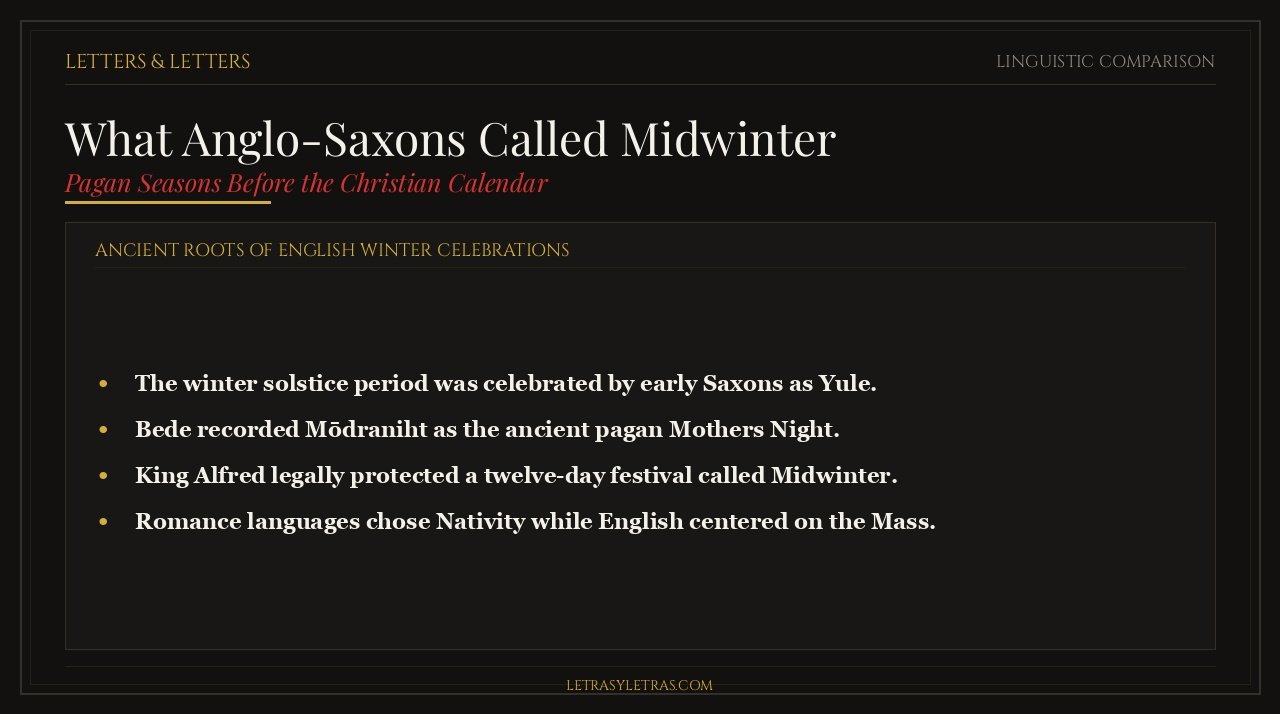
Anglo-Saxons originally designated the midwinter period by the ancient name Yule. In Old English texts, this festive season appeared as Gēol or Ġēōhel.
Fascinatingly, the name did not denote a single day. Yule spanned two full lunar months centered around the winter solstice.
Old English calendars divided this period into Ǣrra Gēola and Æftera Gēola. These descriptive phrases translated to Before Yule and After Yule.
Scholars trace the Germanic root to ancient seasonal feasting and ancestral gatherings. Families congregated to slaughter livestock, preserve food, and kindle immense wooden hearth logs.
The tradition offered warmth and solidarity against the harsh northern freeze. Traces of this terminology survive in modern English through festive poetry and rustic songs.
Another ancient title was recorded by the scholar monk known as the Venerable Bede. In 725, Bede completed his celebrated historical treatise on the measurement of time.
He noted that pagan Anglo-Saxons began their calendar year on the night of December twenty-fourth. They called this solemn observance Mōdraniht, which translated directly to Mothers Night.
Tribes held ceremonies honoring ancestral female spirits and fertility protectors. As Christian conversion spread across Britain, church leaders gradually redirected these folk observances.
Civil law codes also recognized the holiday under practical descriptive terms. In the late ninth century, King Alfred the Great issued formal statutory protections.
His royal statutes established twelve full rest days designated as Midwinter. Laborers received statutory relief from agricultural duties to celebrate with their local parishes.
Only in subsequent centuries did the liturgical title Crīstes-mæsse overtake these older folk designations. The religious compound eventually became the dominant cultural label across the English lands.
The Myth of Xmas: Debunking Modern Commercial Claims
Every winter, well-meaning critics express frustration over the abbreviated spelling Xmas. Many assume that commercial retailers or modern advertisers invented the term to secularize the holiday.
Popular belief claims the letter X crosses out the sacred name. However, historical manuscripts reveal that this widespread assumption is completely false.
The letter X represents the Greek letter Chi, an ancient sacred monogram. Early Christians used this character as a revered holy symbol for over seventeen centuries.
In the Greek alphabet, Chi is the initial letter of the sacred title Christos. Early believers frequently paired Chi with Rho to create the Chi-Rho monogram.
Roman Emperor Constantine adopted this emblem on military standards during the fourth century. Christian artisans carved the monogram into baptismal fonts, oil lamps, and sacred tombs.
Far from disrespecting the sacred name, the single letter served as shorthand for pious believers.
Medieval English monks adopted this Greek abbreviation into vernacular manuscripts. In an entry from 1100, the Anglo-Saxon Chronicle recorded the phrase X-es mæsse.
Monastic scribes labored by candlelight copying lengthy theological texts onto expensive animal vellum. Using sacred abbreviations saved scarce parchment and precious black ink.
Scholars regularly wrote Xt for Christ and Xpian for Christian. These abbreviations appeared in devotional literature and formal church records without controversy.
Distinguished English writers continued this practice throughout the seventeenth and eighteenth centuries. Poets like George Herbert and Samuel Taylor Coleridge used Xmas in personal letters.
Later in the twentieth century, Christian scholar C.S. Lewis frequently utilized the spelling in correspondence. Early commercial printers also welcomed the abbreviation to set tight headlines.
Knowing this history transforms our perspective on modern holiday greetings. The letter X remains an honorable historical tribute to Greek biblical scholarship.
Why English Is Unique Among European Languages
When comparing European languages, the English word Christmas stands out as a linguistic anomaly. Most neighboring nations chose names reflecting birth rather than liturgical mass.
Romance languages drew their seasonal titles directly from Latin terms for birth. In Spanish, the holiday is celebrated under the name Navidad.
This melodious word derives from classical Latin Nativitas, meaning birth. Italian speakers celebrate Natale, while Portuguese families gather for Natal.
French speakers observe the winter season under the cherished name Noël. Etymologists link Noël to Old French Nael, which also traces back to Latin Natalis.
These Romance cultures centered their vocabulary on the historical birth of Jesus. They focused on nativity imagery rather than Eucharistic service.
Germanic and Scandinavian neighbors followed their own distinct cultural paths.
In Germany, families celebrate the season under the poetic title Weihnachten. This expressive compound traces back to Middle High German wīhe naht.
The German phrase translates directly to holy night, evoking serene nocturnal contemplation. Meanwhile, Scandinavian nations never abandoned their pre-Christian terminology.
In Sweden, Norway, and Denmark, the holiday is universally known as Jul. Icelandic speakers preserve the ancient Nordic pronunciation Jól with pride.
English alone merged the title of Christ with the ecclesiastical service of the mass. Why did Anglo-Saxon culture take this unique path?
Historians note the profound monastic influence on Old English civic administration. Monks acted as royal secretaries, legal draftsmen, and cultural chroniclers.
These religious scholars naturally elevated the midnight Eucharistic celebration into the defining title. Just as evening bells shaped the origin of the word curfew, church rites shaped our holiday vocabulary.
Chronological Timeline: The Evolution of Christmas
Tracking the historical evolution of our holiday vocabulary illustrates how linguistic traditions shift over centuries. This chronological timeline summarizes major textual milestones across English history.
| Year | Historical Source | Linguistic Milestone |
|---|---|---|
| 725 CE | Venerable Bede | Records Mōdraniht (Mothers Night) as pagan Anglo-Saxon solstice observance. |
| 871 CE | King Alfred Statutes | Codifies twelve days of statutory rest under the legal name Midwinter. |
| 1038 CE | Anglo-Saxon Chronicle | First recorded appearance of Old English compound Crīstes-mæsse. |
| 1100 CE | Monastic Scribes | First recorded appearance of abbreviated spelling X-es mæsse using Greek Chi. |
| 1131 CE | Peterborough Chronicle | Compound transitions into early Middle English spelling Cristes-messe. |
| 1387 CE | Geoffrey Chaucer | Middle English literature standardizes Christemasse across poetry and stories. |
| 1526 CE | William Tyndale | Early modern printing presses standardize familiar modern spelling Christmas. |
Other Holiday Words: Yule, Mistletoe, and Wassail
The vocabulary surrounding December includes numerous other fascinating etymological gems. Each seasonal word preserves echoes of ancient folklore and domestic rituals.
Consider the botanical origin of mistletoe, an evergreen shrub hung in doorways. Anglo-Saxons formed the compound misteltān from two descriptive components.
The initial element mistel meant dung, while tān meant twig. Birds spread the parasitic plant seeds through droppings left upon high oak branches.
The merry tradition of wassailing also carries rich linguistic history. Revelers went door to door singing songs and drinking spiced cider from communal wooden bowls.
The greeting derived from Old Norse ves heill and Old English wes hāl. This phrase translated literally to be in good health or be whole.
Hosts replied with the traditional formula drinc hāl, meaning drink in health. For similar historical traditions, review our guide to the origin of the phrase bless you.
Even the term holiday shares this sacred linguistic ancestry. In Old English, haligdæg designated a holy day reserved for worship and communal rest.
Over centuries of social evolution, the sacred day broadened into any period of festive vacation. Linguistic drift continually reshapes ancient expressions to serve contemporary communities.
To discover more colorful expressions from historical records, explore our curated archive of english idioms and meanings.
Frequently Asked Questions
What does the word Christmas literally mean?
The word Christmas literally translates to Christ’s Mass from Old English Crīstes-mæsse. It designated the special Eucharistic communion service celebrated by the church in commemoration of the birth of Jesus.
When was the word Christmas first recorded in history?
The phrase first appears in written historical records in the year 1038 in the Anglo-Saxon Chronicle. An anonymous scribe recorded the spelling on Crīstes mæssan in an Old English manuscript now held in the British Library.
Why do people write Xmas instead of Christmas?
Specifically, the letter X represents the Greek letter Chi, the initial letter of Christos. Christian monks used this sacred abbreviation as early as 1100 to save scarce parchment.
What did ancient Anglo-Saxons call the holiday before Christianity?
Early Anglo-Saxons celebrated the winter solstice season under the names Yule (Old English Gēol) and Midwinter. The historian Bede also noted that pagan tribes celebrated Mōdraniht, or Mothers Night, on the evening of December twenty-fourth.
Why do Spanish and French use different words for Christmas?
Romance languages drew their seasonal names from Latin words for birth and nativity like Nativitas and Natalis. English uniquely named the holiday after the Eucharistic liturgy.
The Living Heritage of Our Winter Words
Language acts as a living archive of human culture, faith, and daily community life. When we speak the name Christmas, we carry forward a thousand-year-old Anglo-Saxon compound.
The name echoes the quiet work of medieval monastic scribes writing by candlelight. It connects ancient Greek biblical titles with early English church customs.
Remembering these roots enriches our festive gatherings each December. It reminds us that our words connect us across centuries of shared human story. For reflections on human striving, browse our collection of quotes about perfection.
Alan Sledge is the lead writer at letrasyletras.com. He uncovers the true historical etymologies behind our favorite words and phrases.


Alan Sledge is the writer and founder behind Letters & Letters. A lifelong lover of words, Alan has always been drawn to the small mysteries hidden in everyday language, why we say what we say, where our favorite sayings came from and the quotes that manage to put feelings into words better than we ever could ourselves.