
Buying a home is a stressful process. A thirty-year loan can feel like signing your life away. Ironically, the legal term confirms this fear.
Quick Answer: Origin of the Word Mortgage
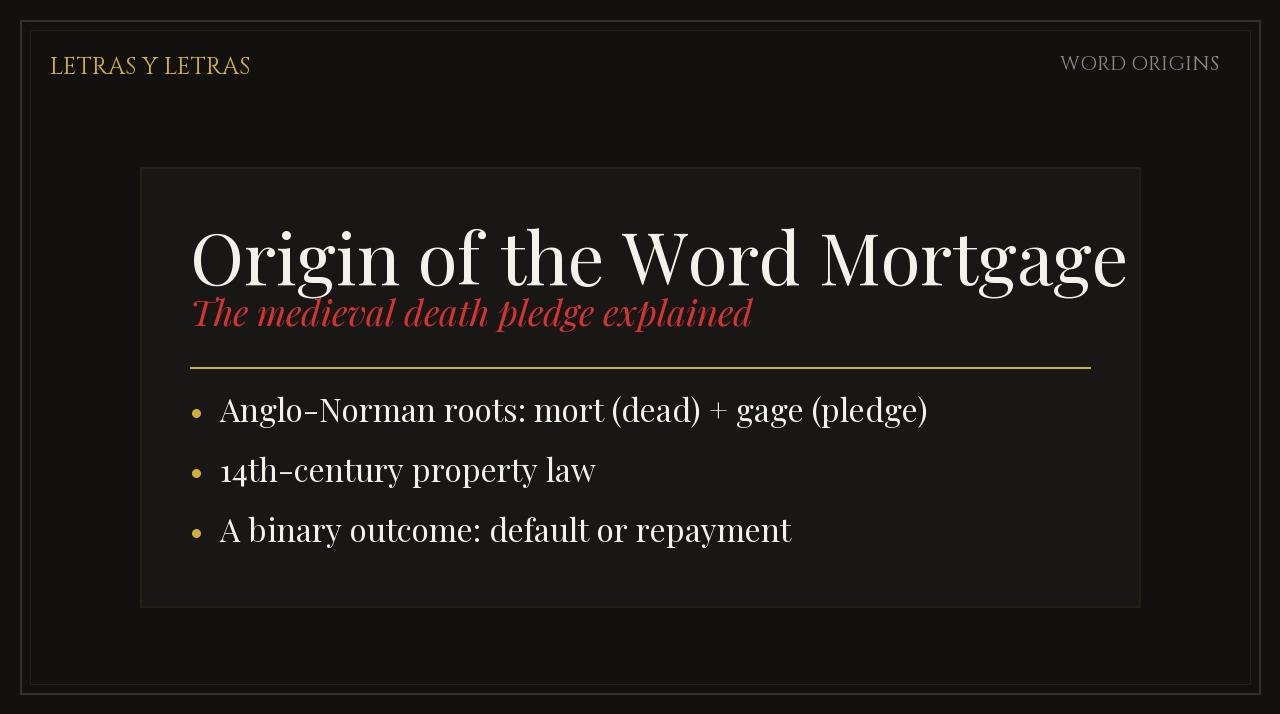
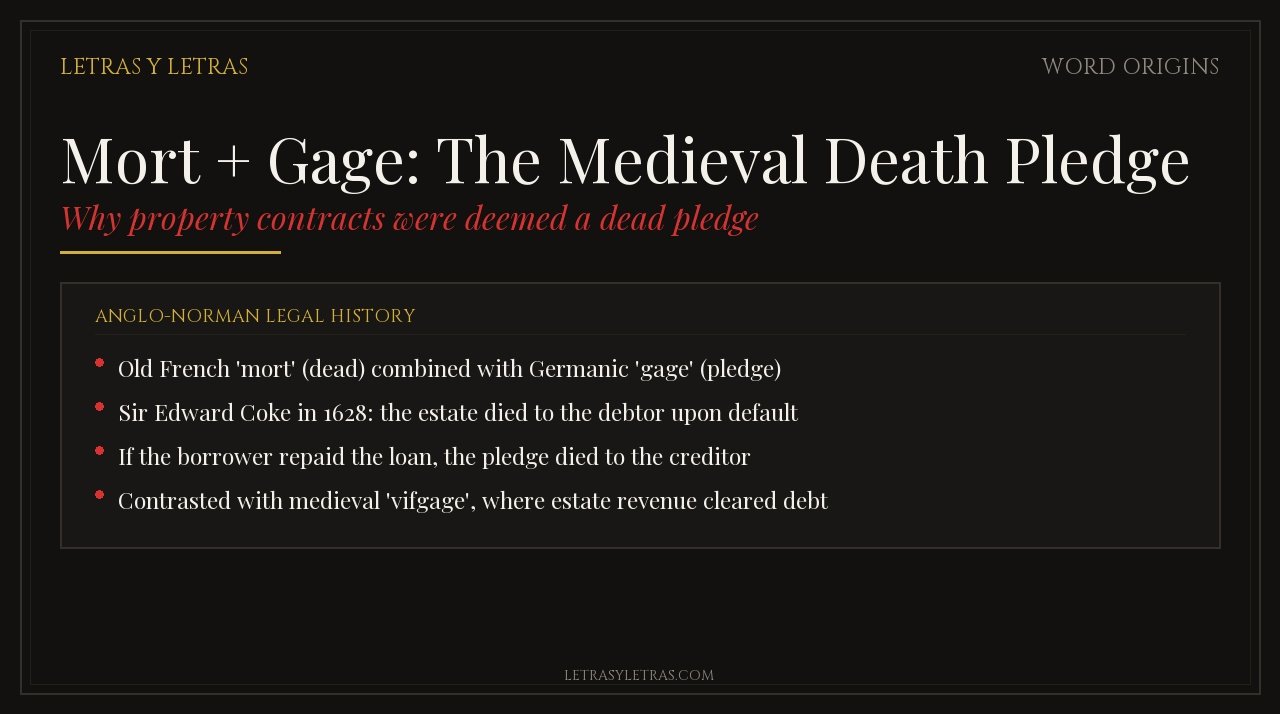
The word mortgage comes from the Anglo-Norman Old French terms “mort” (dead) and “gage” (pledge). It translates literally to “dead pledge.” This 14th-century property law concept referred to a specific legal arrangement. The pledge died in one of two ways. If the borrower failed to repay the debt, the land died to the debtor and became the creditor’s property permanently. If the borrower successfully repaid the debt, the pledge itself died to the creditor. Sir Edward Coke documented this dual meaning in his 17th-century legal commentary. It contrasts with a “vifgage,” which was a living pledge where the land’s profits paid the debt.
Key Takeaways
- The word mortgage combines French roots mort (dead) and gage (pledge).
- It translates literally to “dead pledge” in 14th-century property law.
- The pledge died upon default (property lost) or repayment (debt voided).
- Sir Edward Coke clarified this binary legal outcome in 1628.
- It contrasts with a vifgage (living pledge) where profits paid the debt.
The word mortgage translates directly to a death pledge.
This concept connects to the origin of the word salary.
It entered the English language in the late 14th century. Property law in medieval England was ruthless.
The Anglo-Norman Roots of Mortgage
Our legal system owes much to the Normans. After the 1066 invasion, French terms flooded the courts. Securing a loan with property required a specific legal vocabulary.
The Online Etymology Dictionary confirms the root terms. “Mort” translates to dead. “Gage” refers to a pledge or security.
Together, they form a “mort gage.” This term appears in texts around 1390. It represented a serious legal commitment.
The stakes were incredibly high for landowners. If you study the english idioms and meanings, you see similar trends. Words carry their historical weight.
A dead pledge sounds dramatic today. But medieval law required precise distinctions.
Why Was It Called a Dead Pledge?
This strange term relies on a legal metaphor. Sir Edward Coke explained this in his 17th-century commentaries. He was a prominent English jurist.
His writings codified much of English common law. According to Coke, the pledge dies in two distinct ways. A binary result depends entirely on the borrower’s payment ability.
First, consider a case of default. When a borrower cannot repay the loan on time, a legal death occurs. The property is lost to the debtor forever.
The Second Form of Legal Death
Another scenario involves successful repayment. A borrower meets all financial obligations. They pay back the principal and interest.
In this situation, the pledge itself dies. A creditor loses all claim to the land. This security agreement is voided permanently.
Property returns fully to the original owner. This legal mechanism was quite strict with no middle ground. The Merriam-Webster definition still reflects this history.
It remains a conditional transfer of property. You can compare this to the origin of the phrase caught red handed. Legal vocabulary often stems from vivid situation descriptions.
The Contrast With a Vifgage
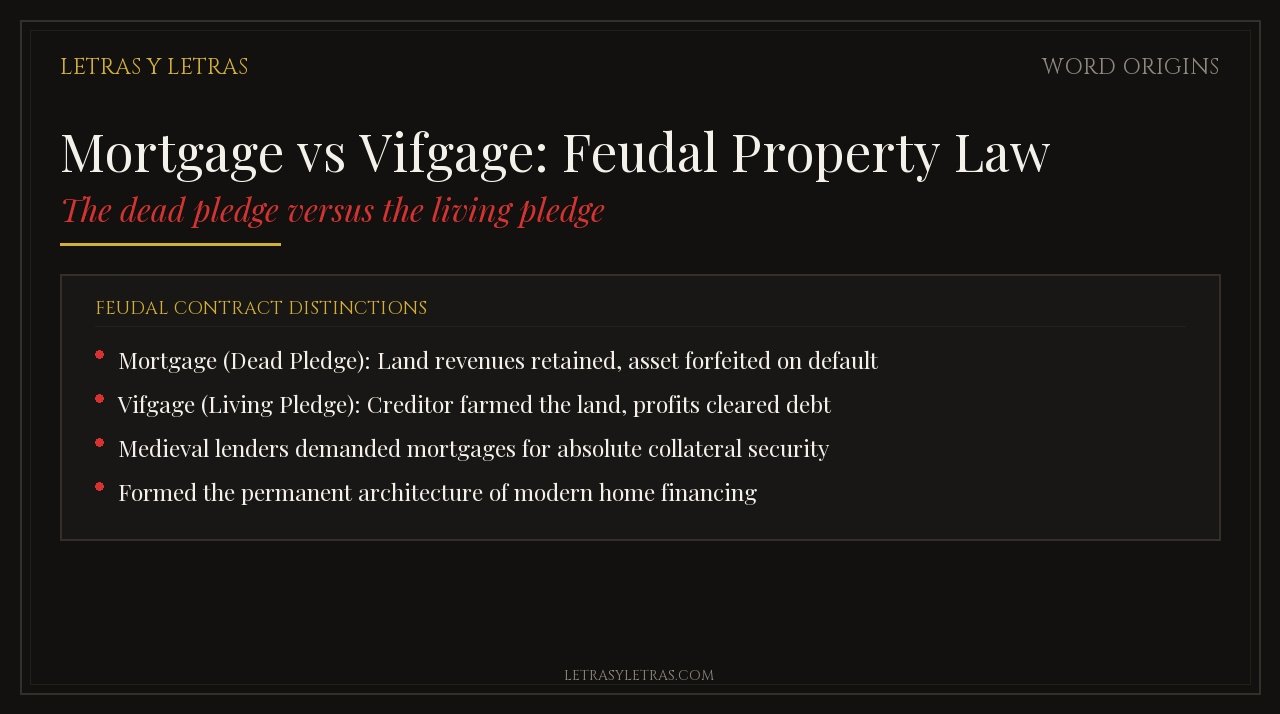
To fully grasp this concept, we must examine its opposite. Medieval law also recognized a “vifgage.” This translates directly to a “living pledge.”
A vifgage operated on a different principle. Borrowers still pledged land for a loan. However, lenders took possession of the estate immediately.
These creditors then collected profits from the land. This included rents from tenants and agricultural yields. All profits were applied directly to the loan principal.
How the Living Pledge Worked
Because land generated income to pay debt, the pledge was “alive.” An estate actively worked to satisfy the obligation. Debts shrank automatically over time.
This was considered a fairer system in some respects. However, church authorities had strong opinions on lending. Usury laws complicated these living arrangements.
The origin of the phrase bite the bullet shows how people faced difficult choices. Choosing between a mort gage and a vifgage was a serious financial decision.
The Decline of the Vifgage
Over time, vifgages became less common. The mort gage became the standard instrument for property loans. It offered clearer legal boundaries for lenders.
Creditors preferred the security of a dead pledge. Most did not want the burden of managing an estate. They simply wanted cash returned with interest.
When a borrower defaulted, creditors gained a valuable asset. Financial risk was placed firmly on the borrower’s shoulders. This shift shaped modern property law.
Historical Citations and Early Usage
Linguists trace the first written use to the late 14th century. It appears in legal documents from the reign of King Richard II.
Spelling varied greatly in Middle English. You might see “morgage” or “morte gage” in texts. A silent “t” was added back much later.
This change attempted to align spelling with its Latin root. The Latin word for death is “mortuus.” The origin of the word berserk also involves interesting linguistic shifts.
Words often evolve to reflect their perceived ancestry.
Sir Edward Coke’s Commentary
Sir Edward Coke published his Institutes of the Lawes of England in 1628. This text cemented the definition of a mortgage. Coke was a master of legal theory.
He wrote extensively on the dead pledge concept. Law students still cite his clear explanation today. It remains a foundational legal text.
Coke clarified the binary nature of this agreement. His focus was on the exact moment a pledge died. Such clarity was essential for resolving property disputes.
Myths and Misconceptions
Some people believe this means a loan you hold until you die. This is a very common misconception. “Death” refers to the pledge, not a person.
Others think it connects to the origin of the phrase kick the bucket. They assume it implies a lifetime burden. While housing loans take decades to pay, the term is purely legal.
Focus is placed entirely on the status of land. It represents a strict contractual death. Mortality of the borrower is irrelevant.
The Legacy of the Word
Today, we use this word without thinking of its dark origins. It serves as a standard financial product. Millions of people have a mortgage.
Yet core mechanics remain exactly the same. Property is still used as a security. Failing to pay means the bank forecloses.
Your land dies to you. You can read more about historical terms in our collection of famous quotes and quotations. Language preserves important history.
Modern Implications
Transitioning from medieval law to modern finance is fascinating. Required paperwork is vastly different now. But underlying concepts are nearly identical.
Signing those documents engages you in an ancient ritual. Borrowers are creating a modern dead pledge. Lenders are betting future income against your property.
The origin of the phrase bless you also involves old superstitions. We carry these linguistic relics of the past into the present.
How the Law Evolved
Courts eventually softened the harsh edges of a mort gage. Judges introduced the “equity of redemption” concept. Borrowers gained a chance to reclaim property even after default.
This represented a massive shift in property law. It recognized the inherent unfairness of a strict dead pledge. Rights of both creditor and debtor were balanced.
However, the specific word remained unchanged. It was too deeply embedded in the legal lexicon. The term survived the reforms that changed its very nature.
Language as a Legal Record
Words function as cultural artifacts. They tell us how ancestors structured their societies. This origin reveals a rigid, agrarian economy.
Land was the ultimate source of wealth. Losing an estate was a form of financial death. Language reflects the gravity of that loss.
The origin of the word sandwich might be lighter fare. But legal etymology is often quite grim. It deals directly with risk and consequence.
The Etymological Path
This term traveled from Latin to French. Then it moved from Norman French to Middle English. Finally, it arrived in our Modern English.
Each step left a mark on its spelling and pronunciation. That silent “t” is a ghost of its Latin past. It serves as a reminder of the word’s true meaning.
Next time you pay your housing bill, remember this history. Buyers are maintaining a centuries-old tradition. Mortgagors are keeping a pledge alive.
FAQ: Common Questions About Mortgages
What is the literal translation of the word mortgage?
The literal translation is “dead pledge.” It combines the Old French words “mort” (dead) and “gage” (pledge). This reflects the legal nature of the agreement.
Why was it called a dead pledge?
An agreement ended in one of two “deaths.” Defaults meant the property died to borrowers forever. Repayment meant the pledge died to creditors.
What is a vifgage?
A vifgage was a “living pledge.” Creditors took over land and used profits to pay down debt. A pledge was alive because it actively reduced loans.
Who explained the true meaning of a mortgage?
Sir Edward Coke explained this meaning in his 17th-century legal commentaries. He detailed how a pledge died upon repayment or default. His writings remain foundational to English common law.
When was the word mortgage first used?
This term first appeared in English around 1390. Clerks used it in legal documents during King Richard II’s reign. Spelling varied greatly during this period.
A Final Note on the Dead Pledge
Property law history is embedded in our everyday vocabulary. A housing loan is more than just a financial tool. It provides a direct link to 14th-century England.
Concepts of the dead pledge shaped modern real estate. Contrasting this with living pledges highlights how finance has evolved. We continue to use these ancient terms daily.
They remind us of the serious nature of debt. Thank you for reading about this fascinating legal etymology.
Property rights shifted significantly over the centuries. Landowners sought better protections against predatory lending practices.
Legal scholars debated these issues endlessly. Courts established new precedents to handle complex land disputes.
Evolution of common law was a slow process. It required careful documentation and strict procedures.


Alan Sledge is the writer and founder behind Letters & Letters. A lifelong lover of words, Alan has always been drawn to the small mysteries hidden in everyday language, why we say what we say, where our favorite sayings came from and the quotes that manage to put feelings into words better than we ever could ourselves.

Alan Sledge
Alan Sledge is the founder and lead researcher behind Letters & Letters. A lifelong student of linguistic history, he cross-references every word origin, idiom, and quote against primary archival manuscripts, the Oxford English Corpus, and 18th-century print lexicons.