
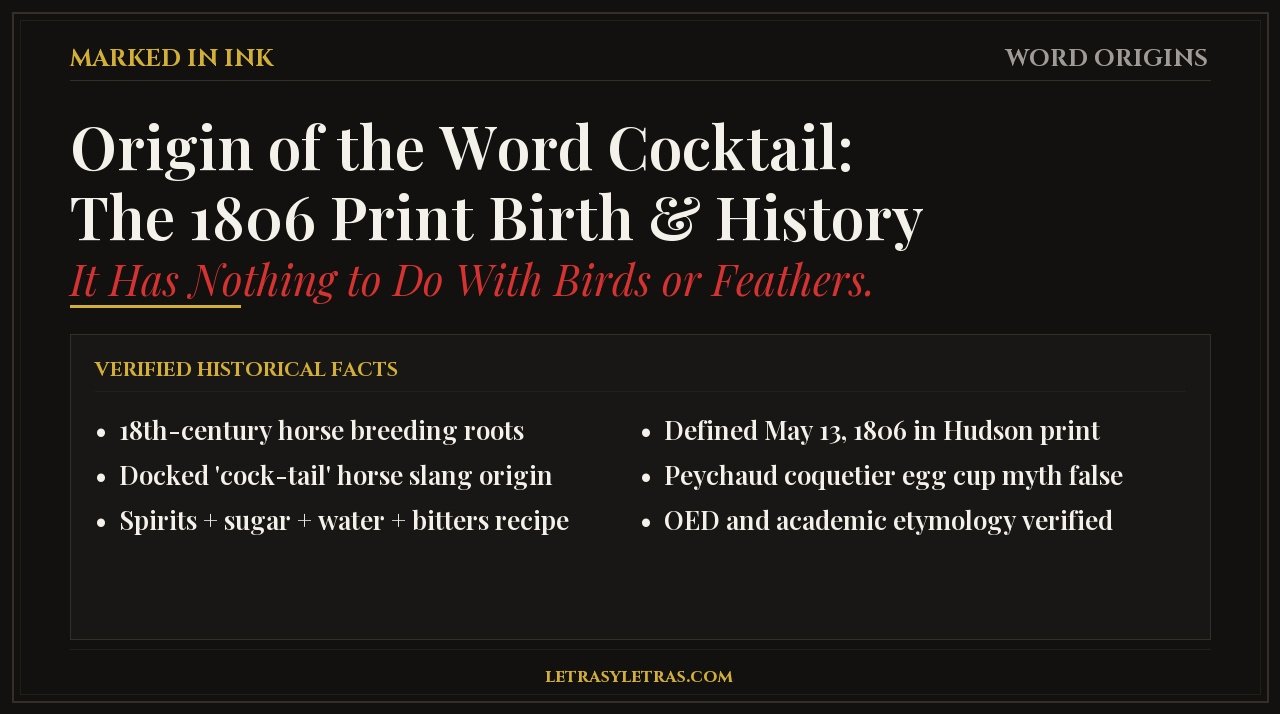
Ordering a cocktail feels modern, yet the word dates back to horse auctions and 18th-century newspapers. The origin of the word cocktail combines horse breeding jargon, taverns, and political elections.
Many drinkers believe a French apothecary or a New Orleans tavern owner coined the term. Historical records show those popular tales are modern folklore.
Linguists trace the actual word to English horse terms from the 1700s. Early drinkers used it to describe drinks that packed a sudden punch.
Quick Answer: What is the origin of the word cocktail?
The origin of the word cocktail stems from 18th-century English horse breeding. A “cock-tailed” horse was a mixed-breed animal whose tail was docked to stick up like a rooster’s tail.
Because these horses were not purebreds, English speakers applied the term to mixed drinks. The first definition appeared on May 13, 1806, in The Balance and Columbian Repository.
The Hudson newspaper defined it as spirits, sugar, water, and bitters. Popular stories about French egg cups (coquetiers) or rooster feathers are unproven myths.
By Alan Sledge | Letters & Letters – About the Author
1. Where Does the Word Cocktail Come From?
The most accepted etymological theory links the term directly to 18th-century English horse culture. Horse dealers docked the tails of non-thoroughbred hunting horses to make them stick up.
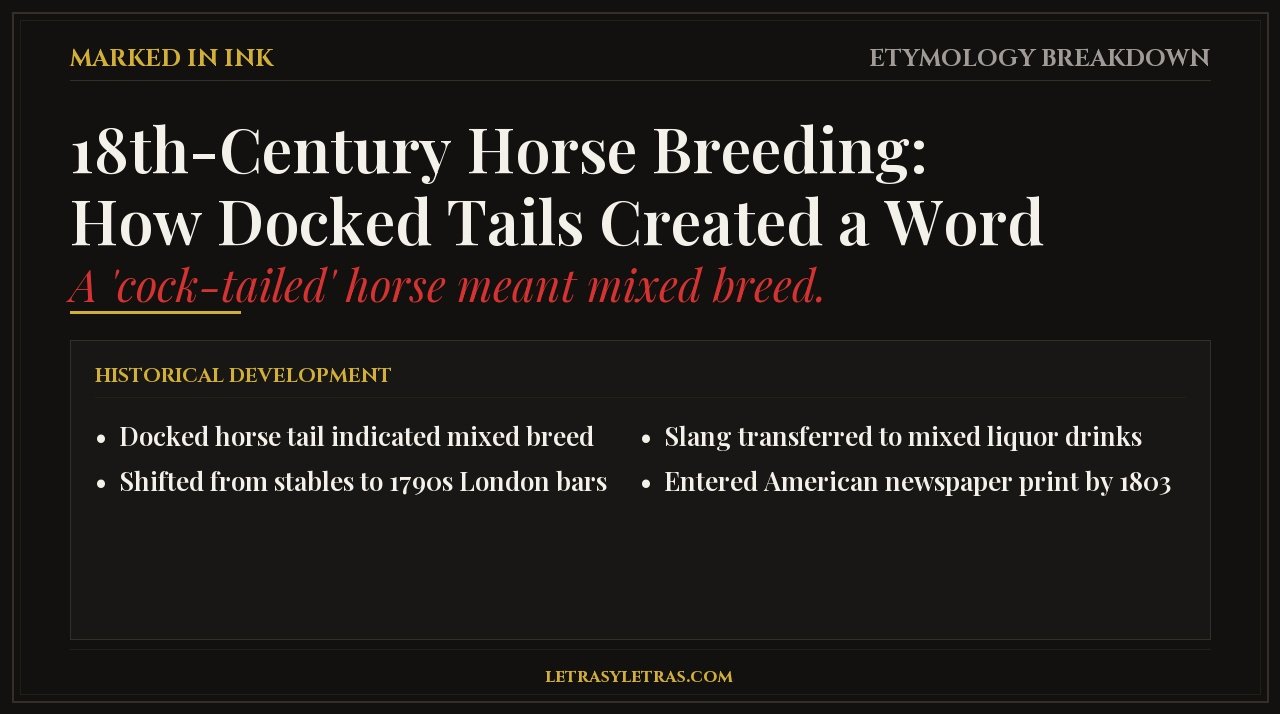
People called these mixed-race horses “cock-tails” because their docked tails resembled the raised tail feathers of a rooster. The term quickly became a metaphor for anything impure or mixed.
Bar owners adopted the word to describe drinks made by mixing different liquors together. The term moved from stable jargon to barroom vocabulary over fifty years.
2. The 1806 Hudson Newspaper Definition
The first clear print definition of the drink appeared in New York state. A reader wrote to The Balance and Columbian Repository in Hudson asking what a cocktail was.
On May 13, 1806, editor Harry Croswell published the formal answer. He wrote that a cocktail was a stimulating liquor composed of spirits, sugar, water, and bitters.
You can read the original 1806 newspaper record in the Project Gutenberg historical archives for verified text.
Croswell noted that politicians drank it during local elections to stay bold and alert. That four-ingredient formula remains the exact definition of a classic Old Fashioned today.
3. Debunking Famous Cocktail Etymology Myths
Several colorful stories attempt to explain the word’s origin. Etymologists classify these popular tales as unproven folk etymologies.
| Popular Myth | Alleged Origin | Historical Verdict |
|---|---|---|
| French Egg Cup (Coquetier) | Antoine Peychaud in New Orleans | Myth (dates do not match print records) |
| Tavern Rooster Feathers | Innkeeper Betsy Flanagan’s garnishes | Fiction (from a 1821 James Fenimore Cooper novel) |
| Barrel Tailings Dregs | Mixing leftover barrel spigots | Unproven tavern rumor |
| Horse Breeding Docked Tails | 18th-century mixed-breed horses | Historian Consensus (OED verified) |
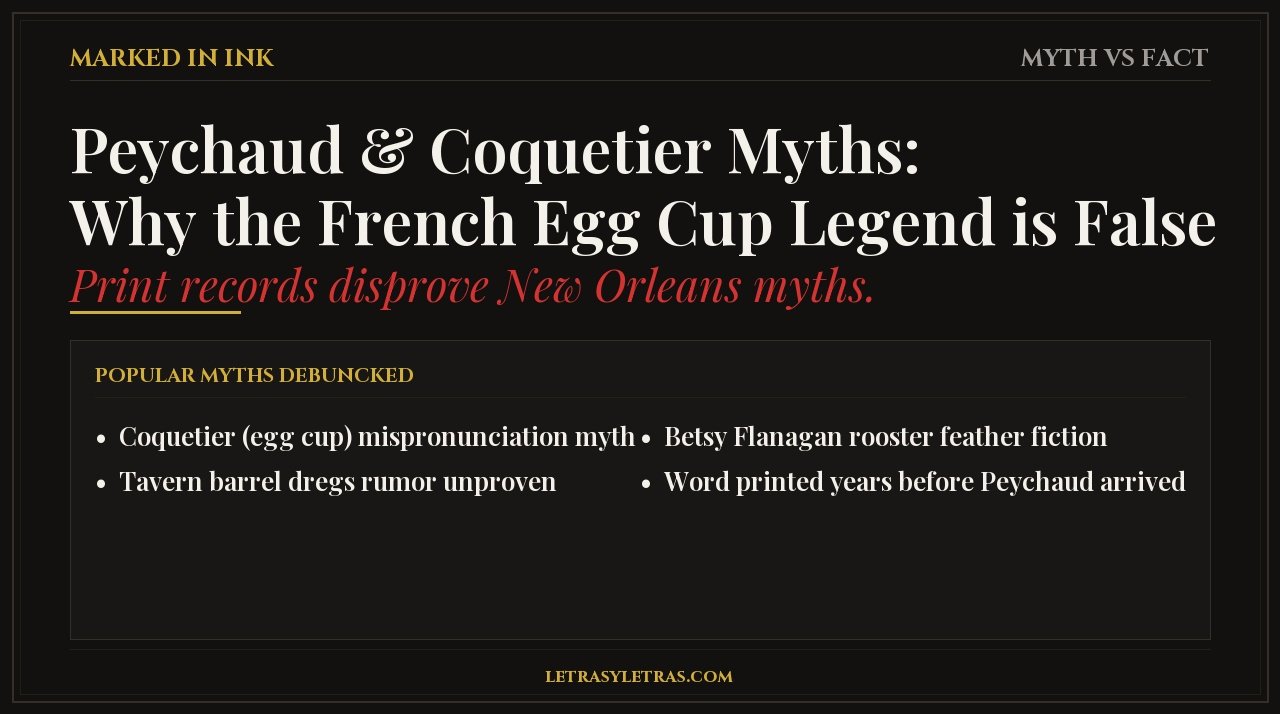
One famous legend claims New Orleans apothecary Antoine Peychaud served drinks in French egg cups called coquetiers. Storytellers claim American customers mispronounced the French word as cocktail.
Print records disprove this theory completely. The word cocktail appeared in American newspapers years before Peychaud arrived in New Orleans.
Another tale claims American Revolution innkeeper Betsy Flanagan garnished drinks with stolen rooster feathers. Author James Fenimore Cooper created that story in his 1821 novel The Spy.
4. How Cocktail Etymology Compares to Other Food Words
Food names frequently begin as descriptive slang before becoming permanent vocabulary. The evolution of mixed drinks mirrors other famous food names in English history.
Read our history of the origin of the word sandwich to see another 18th-century term.
Explore our guide to English idioms and meanings for more phrase origins.
Check our famous quotes and quotations hub for verified historical sayings.
Linguists document these shifts in the Online Etymology Dictionary, showing how stable terms became bar slang.
Both words began as casual descriptions tied to 18th-century social habits. Speakers adopted the terms quickly, turning slang into lasting English vocabulary.
Frequently Asked Questions
Why is a drink called a cocktail?
The term originated from 18th-century horse breeding. Mixed-breed horses had their tails cut short so they cocked upward like rooster feathers. Drinkers applied this slang for mixed horses to mixed spirits.
What was the original 1806 cocktail recipe?
The 1806 definition required four ingredients: spirits of any kind, sugar, water, and bitters. This recipe matches the modern Old Fashioned cocktail.
Did Antoine Peychaud invent the word cocktail?
No. The story that Peychaud created the word from French egg cups (coquetiers) is false. Print records show the word cocktail was used in newspapers years before Peychaud arrived.
Where was the word cocktail first printed?
The word appeared in a London newspaper in 1798. The first complete definition of the drink appeared on May 13, 1806, in a Hudson, New York newspaper.
What is the difference between a cocktail and a punch?
In the 1800s, punches contained fruit juices and wine in large bowls. Cocktails were single-serving drinks defined specifically by the addition of bitters.
Words That Stand the Test of Time
The origin of the word cocktail demonstrates how tavern slang transforms into international vocabulary. A horse breeding term became the global name for mixed drinks.
Harry Croswell’s 1806 definition preserved the word for future generations. Today, bartenders still use his four-ingredient formula for classic drinks.
Review our Editorial Policy and Etymology Standards to see how we verify language histories. Bookmark Letters & Letters for new word stories every week.


Alan Sledge is the writer and founder behind Letters & Letters. A lifelong lover of words, Alan has always been drawn to the small mysteries hidden in everyday language, why we say what we say, where our favorite sayings came from and the quotes that manage to put feelings into words better than we ever could ourselves.