
The origin of the word hazard begins in the twelfth century during the Crusades. Before it signified dangerous chemicals or road obstacles, hazard was an addictive medieval game of chance.
Quick Answer: Origin of the Word Hazard
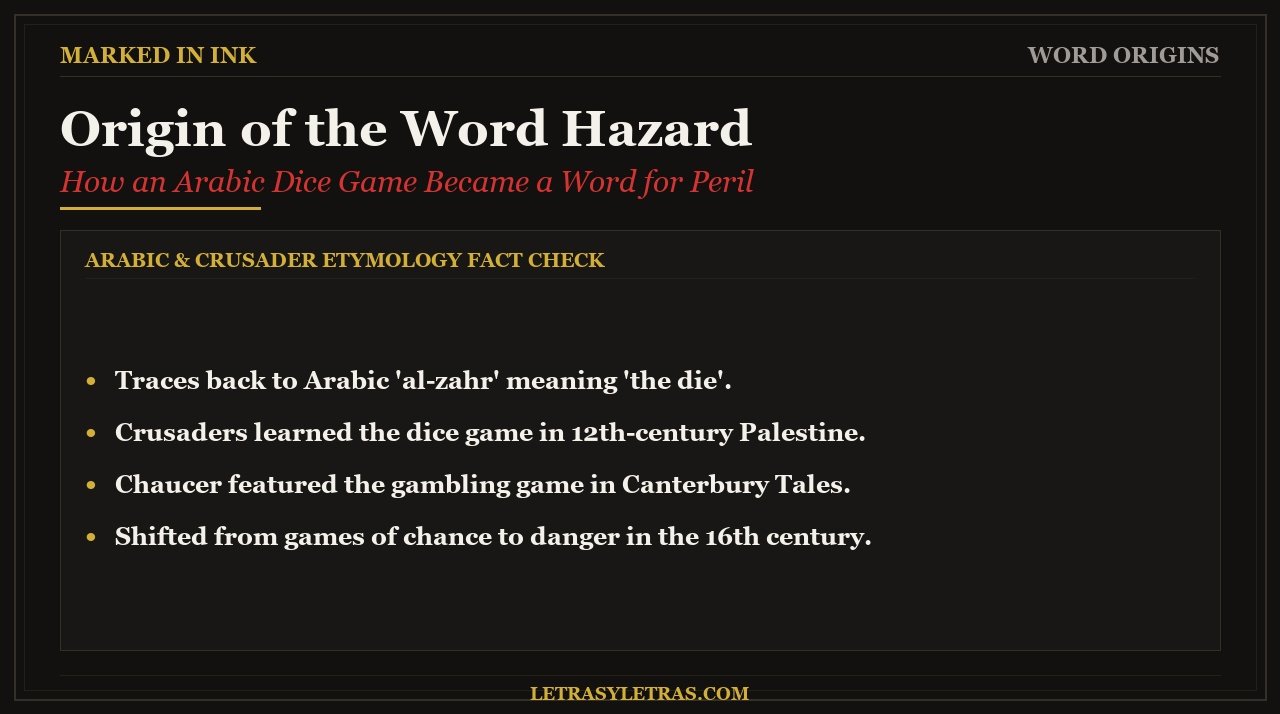
The word “hazard” comes from the Arabic word al-zahr, meaning “the die” or “the flower” (referring to the floral design stamped on ancient dice). European Crusaders learned the popular dice gambling game at the siege of Castle Hazart in twelfth-century Palestine. Entering Old French as hasart and Middle English in the 1300s, the word gradually shifted from a game of chance to unpredictable financial risk, and finally to modern danger and peril.
Key Takeaways
- Derived from the Arabic word al-zahr (the die).
- Crusaders learned the game in twelfth-century Palestine.
- Prominently featured in Geoffrey Chaucer fourteenth-century *Canterbury Tales*.
- Evolved from a gambling game into a term for unpredictability and risk.
- By the sixteenth century, hazard had become a universal synonym for peril.
The Arabic Roots: Al-Zahr and The Flower
The linguistic lineage of hazard begins in the medieval Middle East. Arabic scholars and mathematicians played complex dice games using numbered cubes.
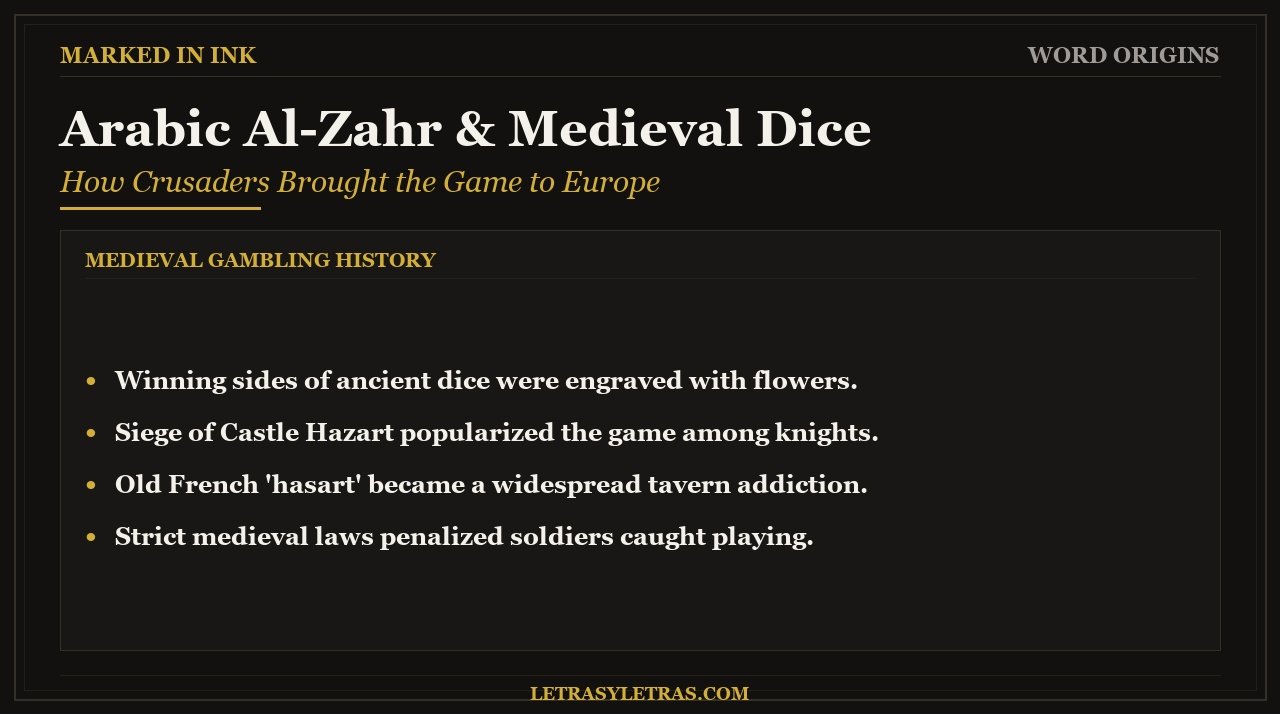
The Arabic word *al-zahr* meant the die. Some etymologists note that ancient dice makers stamped a delicate flower on the winning face. Rolling that flower brought victory.
During the twelfth-century Crusades, European knights encountered Arab culture across the Levant. Gambling with dice quickly became a favorite pastime among soldiers.
Knights, Dice, and Castle Hazart
Legend holds that English and French Crusaders learned the game during a protracted siege at Castle Hazart. Returning knights brought the game back to Western Europe.
The game entered Old French as *hasart*. In medieval England, hazard became the most popular tavern game among nobles and commoners alike.
Geoffrey Chaucer wrote extensively about the dice game in *The Canterbury Tales* around 1387. In *The Pardoner’s Tale*, he warned that hazardry caused ruin, false oaths, and wasted fortunes.
The Semantic Shift: From Dice to Risk and Danger
Over two centuries, the meaning of hazard underwent a fascinating semantic shift. Because dice rolls were inherently unpredictable, people began using hazard to describe any risky venture.
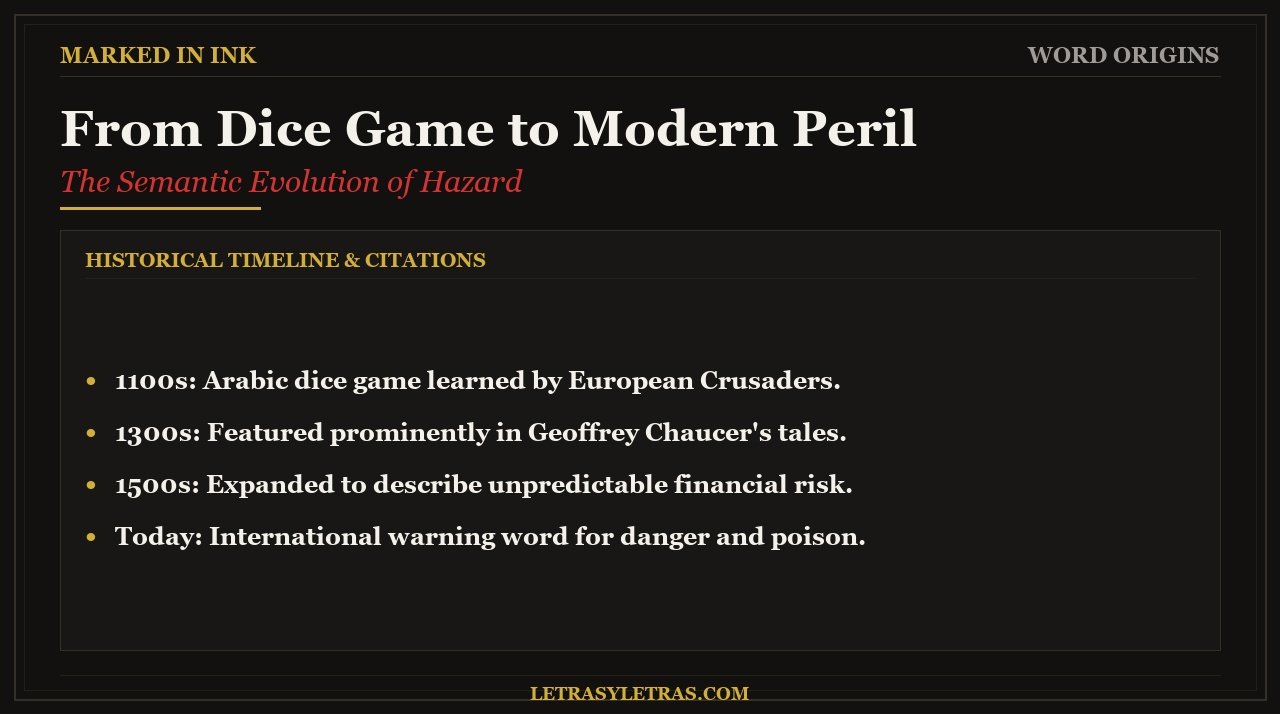
Merchants began talking about the hazards of maritime trade. By the sixteenth century, the word detached from dice entirely. It came to mean exposure to danger, peril, or physical harm.
Lexicographers at the Online Etymology Dictionary track this semantic evolution across centuries. Dictionaries like Merriam-Webster now classify hazard as a primary word for danger.
How Medieval Words Shape Modern Safety
Today, warning signs across the world display the word hazard. From biohazard symbols to roadside hazard lights, the word alerts us to immediate danger.
Few people looking at a hazard warning realize they are looking at a linguistic relic from medieval Crusader gambling. Explore more words rooted in antiquity in our guide on the origin of the word salary.
Frequently Asked Questions
What is the original meaning of the word hazard?
Hazard originally meant a game of chance played with dice, derived from the Arabic word al-zahr meaning the die.
How did Crusaders contribute to the word hazard?
Crusaders learned the Arabic dice game during twelfth-century sieges in Palestine and popularized it in European taverns upon their return.
When did hazard begin meaning danger?
The word shifted from a dice game to unpredictable commercial risk in the 1500s, and to physical danger by the late 16th century.
Did Chaucer write about hazard?
Yes. Geoffrey Chaucer featured the dice game prominently in his 14th-century *Canterbury Tales*, warning against the vices of hazardry.
Every time you encounter a hazard warning, you look upon a word born on medieval gaming tables. Language transforms games into universal warnings over centuries of cultural exchange.
Alan Sledge is the founder and lead writer at letrasyletras.com, dedicated to uncovering the true etymological histories behind our favorite words and phrases.