Say “the bread is on the table” and you have spoken almost pure Old English. Only one word in that sentence arrived later, and it came with the Normans. The rest would have made sense, in older dress, to a farmer in eighth-century Wessex.
This guide looks at Anglo-Saxon words and the ones you use every day. It also asks why they feel so plain and strong beside their Latin cousins.
Along the way it corrects three stubborn myths. One is about the name, one about a pronoun, and one about a sign outside a tea shop.
Quick Answer: Anglo-Saxon Words
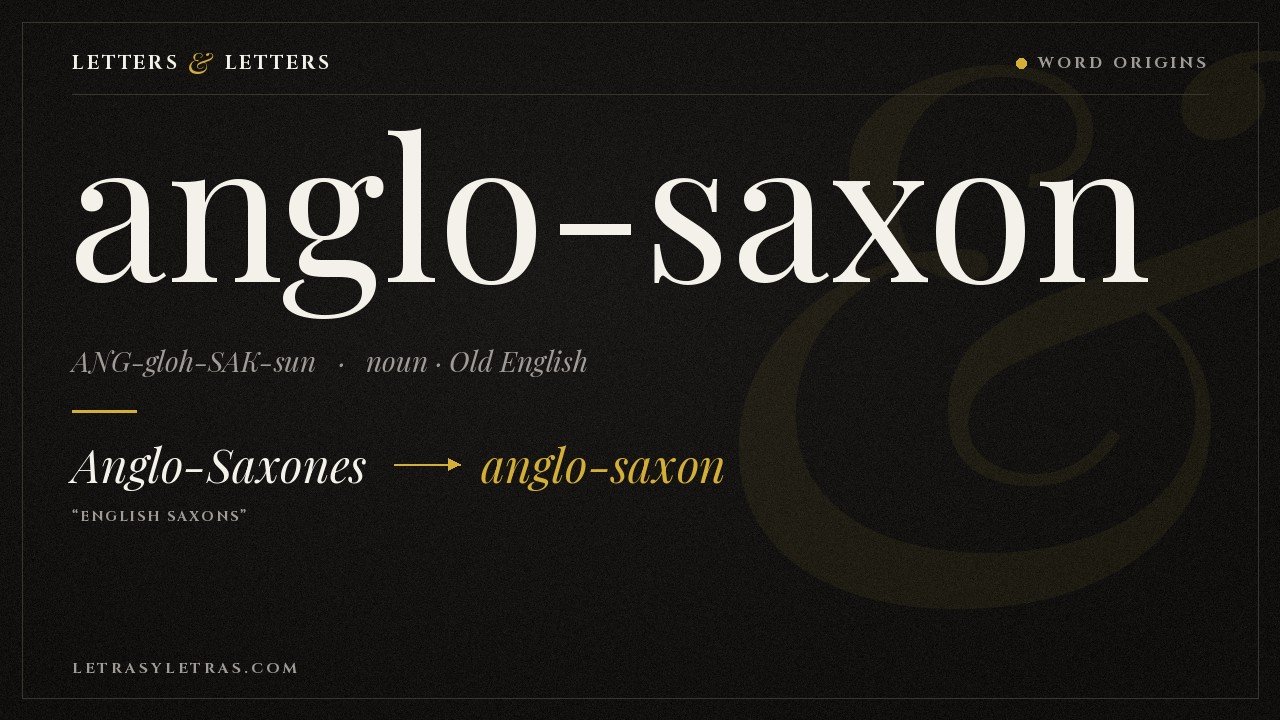
Anglo-Saxon words are English words inherited from Old English, the Germanic language spoken in England from roughly 450 to 1150. These words form the everyday core of modern English: the, and, house, bread, water, mother, eat, sleep and love. Most are short, concrete and blunt. Later Latin and French loans sound longer and more formal (ask beside inquire, kingly beside regal). The name itself comes from Latin Anglo-Saxones, meaning “English Saxons” as opposed to the Saxons of the Continent. It was revived for the language in the late 1500s and became standard in the 1700s. Some words people think are Anglo-Saxon, like they, them and their, were actually borrowed from Old Norse around 1200.
Key Takeaways
- Old English was spoken in England from about 450 until about 1150.
- Most of the words you use every hour, from the to water, come straight from it.
- Anglo-Saxon originally meant “English Saxons”, not a blend of Angles and Saxons.
- They, them and their are Old Norse loans that replaced the native forms.
- The “ye” in “ye olde” is a misread letter thorn and was always pronounced “the”.
What Are Anglo-Saxon Words?
Anglo-Saxon words are the part of English inherited directly from Old English. That was the language of the Germanic peoples who settled in Britain from about 450. It lasted, changing all the while, until roughly 1150, when it shaded into Middle English.
Old English belonged to the West Germanic family. Its closest living relatives are Frisian, Dutch and German. That is why “water” is Wasser in German and “house” is huis in Dutch.
Linguists call these inherited words “native” vocabulary. Everything else, from French, Latin, Greek, Norse and dozens of other tongues, counts as borrowed.
Modern English holds far more borrowed words than native ones in the dictionary. In ordinary speech the balance flips, because the native words are the ones we repeat all day.
Anglo-Saxon Words You Use Every Day
Start with the small words. Little workhorses like the, and, but, in, of, with, he, we, this and that all trace back to Old English. So do the verbs be, have, do, go, come, see and say.
Next come the words for the things nearest to hand. Body parts, close family, the house, the weather and basic food are overwhelmingly native. Here is a sample, with the Old English form beside each word.
| Theme | Modern word | Old English form |
|---|---|---|
| Body | hand, foot, head, heart | hand, fot, heafod, heorte |
| Family | mother, father, son, daughter | modor, fæder, sunu, dohtor |
| Home | house, door, floor, bed | hus, duru, flor, bedd |
| Nature | sun, moon, earth, water | sunne, mona, eorþe, wæter |
| Food | bread, meat, milk, honey | hlaf (loaf), mete, meolc, hunig |
| Actions | eat, drink, sleep, love | etan, drincan, slæpan, lufian |
Scholars at St Andrews keep a list of Old English core vocabulary of some 600 words. It was built as a learning aid for readers of Old English poetry.
Plenty of entries still look familiar. Others have died out completely, a reminder that languages lose words too.
One small detail rewards a second look. Bread was usually hlaf in Old English, the word that became loaf. Our “bread” comes from the rarer Old English bread, which seems at first to have meant a piece or morsel.
Where the Name Anglo-Saxon Comes From
Most people assume the name glues together two tribes, the Angles and the Saxons. That is not how it began. The early form was Latin, Anglo-Saxones, and the “Anglo” part worked as an adjective.
Dictionaries tracing the etymology of Anglo-Saxon give the original sense as “English Saxons”. The label set the Saxons of England apart from the Saxons who stayed on the Continent. Those continental cousins are now called the Old Saxons.
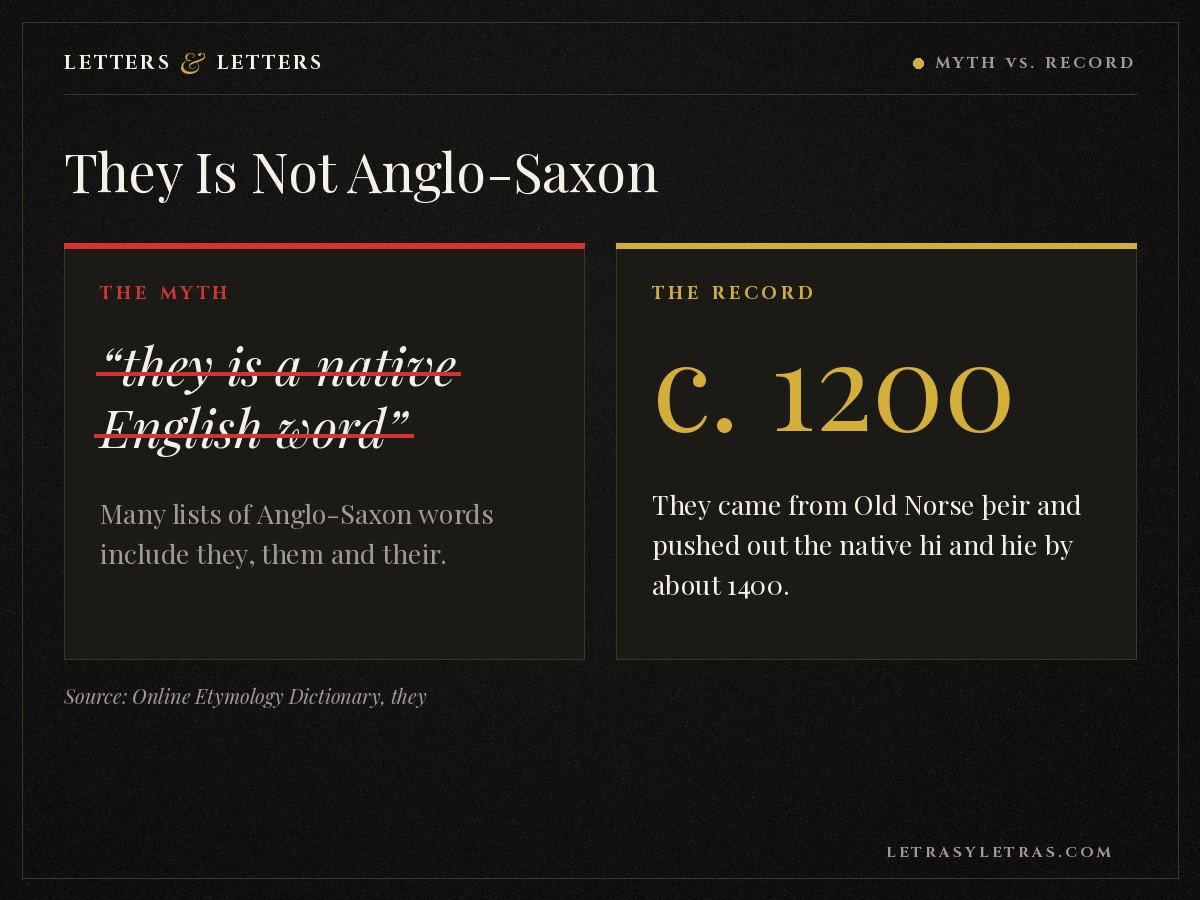
After 1066, Latin-writing scribes used Anglo-Saxones for the people of England before the Conquest. The term faded and then returned in the late 1500s. William Camden, the antiquarian, revived it and wrote of the lingua Anglosaxonica, the language of England before the Normans.
For the next century scholars mostly said “English Saxon”.
In the 1700s “Anglo-Saxon” took over as the usual name for the language. The newer reading as “Angle plus Saxon” came later still. It grew once the word was used loosely for Englishness in general.
The speakers themselves called their language Englisc. Today most specialists prefer the term Old English for the language and keep Anglo-Saxon for the people and the period.
The Days of the Week Are Anglo-Saxon
Every time you check your calendar, you are reading a list of Anglo-Saxon gods. Old English copied the Roman habit of naming days after planets and gods. Where it could, it swapped in Germanic gods.
| Day | Old English | Named after |
|---|---|---|
| Sunday | Sunnandæg | the sun |
| Monday | Monandæg | the moon |
| Tuesday | Tiwesdæg | Tiw, a god of war |
| Wednesday | Wodnesdæg | Woden, chief of the gods |
| Thursday | Þunresdæg | Thunor, the thunder god |
| Friday | Frigedæg | Frige, a goddess linked with love |
| Saturday | Sæternesdæg | Saturn, a Roman borrowing |
Saturday is the odd one out. It kept the Roman god Saturn rather than finding a Germanic stand-in. The other six still carry their Old English shape under centuries of spelling change.
Why Anglo-Saxon Words Feel Blunt
Put a native word beside its borrowed equivalent and the difference is obvious. English often has a three-step ladder for the same idea. The native word sits at the bottom, a French loan in the middle and a Latin one at the top.
| Anglo-Saxon | French | Latin |
|---|---|---|
| kingly | royal | regal |
| ask | question | interrogate |
| fear | terror | trepidation |
| begin | commence | initiate |
| help | aid | assist |
The native words are short, often one syllable, and concrete. The Latin words are longer and sound like they belong in a report. French tends to sit between, warm but a little formal.
The reason is social history. After 1066, French became the language of the court, the law and the church hierarchy.
Latin was already the language of scholarship. English stayed the tongue of the kitchen, field and street, so its words kept the feel of daily life.
Good writers use this on purpose. A sentence built from native words hits harder and reads faster. Stack it with Latin words instead and it can sound learned or, used badly, evasive.
The Pig and Pork Story
The most famous example is the farmyard. Swine, cow and sheep are Old English. Pork, beef and mutton came from French, the words used when the meat reached a Norman table.
The idea was made famous by Walter Scott’s novel Ivanhoe in 1819. Early on, the jester Wamba notes that a live animal keeps its Saxon name while Saxon serfs tend it. Once it is served to Norman lords, it becomes French.
The pattern is real, but the line was never clean. Pork appears in English around 1300, and in Middle English it could also mean a live pig. The neat split between the field and the table is a tidy summary, not an exact rule.
Words People Wrongly Call Anglo-Saxon
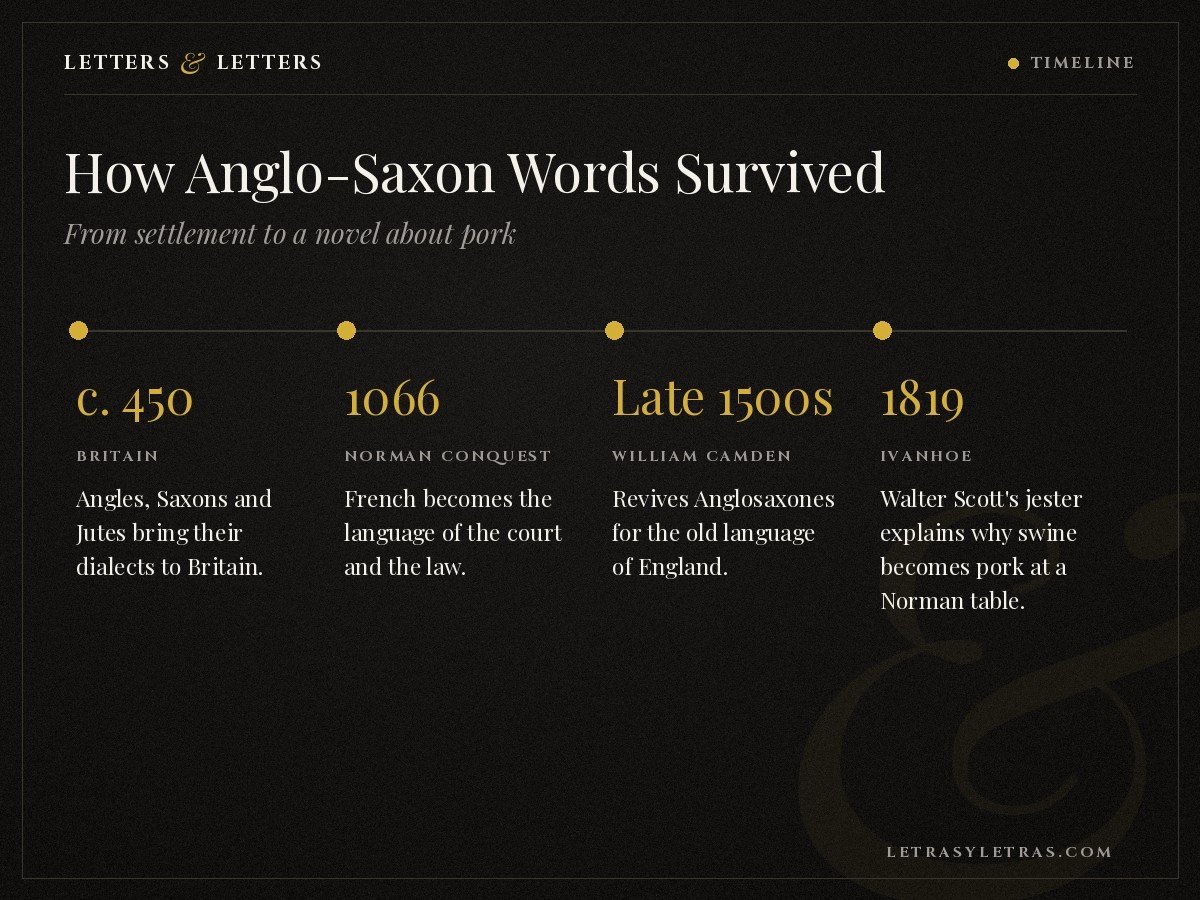
Many online lists include “they” among the core Anglo-Saxon words. It feels native, but it was borrowed.
The origin of the word they is Old Norse þeir. It shows up in English around 1200.
Old English used hi and hie for the plural, which sounded far too close to he, him and her. The Norse forms were clearer, and by about 1400 they had pushed the old words out. Them and their followed the same path.
Old Norse gave English plenty more everyday words through Viking settlement in the north and east. Sky, egg, skin, window and husband all have Norse roots. If you want a more dramatic example, the origin of the word berserk is pure Viking.
The Ye Olde Myth
Signs reading “Ye Olde Tea Shoppe” invite people to say “yee”. That pronunciation never existed. The Y is a stand-in for an Old English letter.
Old English used the letter thorn, written þ, for the “th” sound. In late handwriting thorn came to look like a y.
Early printers, whose type came from the Continent, had no thorn, so they used y instead. “Ye” was simply a way of writing “the”, and readers said “the”.
The Old English Alphabet
Old English was written mostly in the Latin alphabet, brought by Christian missionaries. A few extra letters covered sounds Latin lacked.
- Þ þ (thorn): the “th” sound, as in thin
- Ð ð (eth): also “th”, used freely alongside thorn
- Æ æ (ash): the vowel in modern cat
- Ƿ ƿ (wynn): a “w” sound, borrowed from runes
Thorn, wynn and the name of ash come from the older runic alphabet, the futhorc. By the end of the Middle Ages all four had dropped out of standard English spelling. Only the ghost of thorn survives, in that misread “ye”.
Old English Word Building
Old English loved compounds. Instead of borrowing a new word, speakers often joined two old ones. That habit gave poets kennings, short riddle-like names for familiar things.
In the poem Beowulf, the sea is the hronrad, the “whale-road”. Old English poets also called the body a banhus, a “bone-house”. The habit survives in plain modern words such as daylight, earthquake and household.
Suffixes did the same work. Old English -dom and -ship still build new words today, as our guide to suffix meaning explains. Even some of our darkest words are native compounds, as the origin of the word nightmare shows.
Timeline of Anglo-Saxon Words in English
| Date | Source or event | What happened |
|---|---|---|
| c. 450 | Germanic settlers | Angles, Saxons and Jutes bring their dialects to Britain. |
| 1066 | Norman Conquest | French becomes the language of the court and law. |
| c. 1200 | Old Norse influence | They, a Scandinavian pronoun, appears in English. |
| c. 1400 | Middle English | They has pushed out the native hi and hie. |
| Late 1500s | William Camden | Revives Anglosaxones and names the old tongue lingua Anglosaxonica. |
| 1700s | Philologists | “Anglo-Saxon” replaces “English Saxon” as the language name. |
| 1819 | Walter Scott, Ivanhoe | A jester explains why swine becomes pork at a Norman table. |
Frequently Asked Questions
What are examples of Anglo-Saxon words?
Common examples include the, and, house, bread, water, mother, eat, sleep and love. Most body parts, family words and days of the week come from Old English as well.
Is Anglo-Saxon the same as Old English?
In everyday use, yes. Anglo-Saxon was the usual name for the language from the 1700s. Most scholars now prefer Old English, though its speakers called it Englisc.
How do you say hello in Anglo-Saxon?
One recorded formula is “wes þu hal”, literally “be thou healthy”. The toast wassail looks like its child. In fact it came from the Old Norse version, ves heill, used by Danes in England.
Are swear words Anglo-Saxon?
Some are, but the idea is often overstated. Several famous four-letter words are Germanic yet only appear in English writing centuries after the Old English period. Being short and blunt does not make a word Anglo-Saxon.
How many Anglo-Saxon words are still used today?
Counts vary, but only a few thousand native words survive. They punch far above their number, because they include nearly all of the most frequent words in English.
Why do Anglo-Saxon words sound blunt?
They are usually short, often one syllable, and tied to physical things. After 1066, French and Latin took over formal speech, so native words kept the feel of daily life.
Read Your Own Sentences for Their Roots
Next time you write something that matters, look at which words carry the weight. The ones that hit hardest are usually Anglo-Saxon: home, love, death, fight, hope.
Latin and French gave English its range, and nobody should give those up. The old native words give it its backbone. Knowing which is which lets you choose, and choosing is most of what good writing is.


Alan Sledge is the writer and founder behind Letters & Letters. A lifelong lover of words, Alan has always been drawn to the small mysteries hidden in everyday language, why we say what we say, where our favorite sayings came from and the quotes that manage to put feelings into words better than we ever could ourselves.

Alan Sledge
Alan Sledge is the founder and lead researcher behind Letters & Letters. A lifelong student of linguistic history, he cross-references every word origin, idiom, and quote against primary archival manuscripts, the Oxford English Corpus, and 18th-century print lexicons.