
Human communication is rarely straightforward. We listen to diplomatic speeches and search for subtle hints. Readers scan polite corporate emails and look for hidden frustrations.
When people detect unstated intentions, they say they are reading between the lines. Modern speakers treat this expression as a psychological metaphor. They believe it describes emotional intuition or social perception.
The origin of the phrase read between the lines was completely literal. It was forged in sixteenth-century diplomatic spycraft and covert wartime correspondence. Spies physically wrote secret messages in the empty spaces on parchment.
Quick Answer: Origin of the Phrase Read Between the Lines
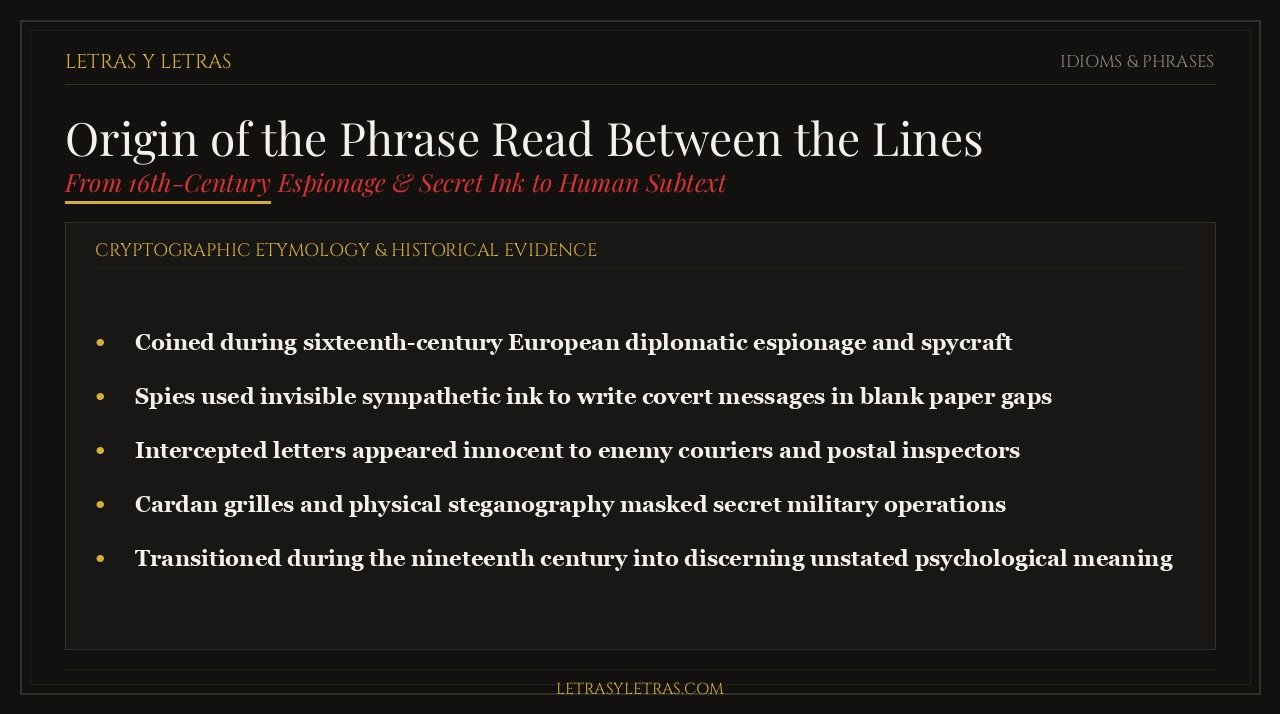
The origin of the phrase read between the lines comes from sixteenth-century diplomatic espionage and steganography. During the Renaissance, spies and diplomats used invisible sympathetic inks, such as lemon juice, milk, or chemical solutions, to write secret intelligence in the blank spaces between lines of ordinary letters. Intercepted correspondence appeared to discuss mundane domestic topics like crop yields or family health. When the intended recipient received the letter, applying candle heat or a chemical reagent exposed the concealed writing. By the mid-nineteenth century, the phrase transitioned from literal spycraft into a universal metaphor for perceiving unstated meaning and psychological subtext.
Key Takeaways
- Originates from sixteenth-century Renaissance espionage and secret diplomatic correspondence.
- Spies used invisible organic inks to write hidden text in the physical gaps on paper.
- Gentle heating over candle flames caused organic sugars to oxidize into dark brown script.
- Italian mathematician Girolamo Cardano popularized physical grille ciphers during the 1550s.
- Shifted during the 1840s into a common figurative idiom for discerning unstated intentions.
The Dangerous World of Renaissance Diplomatic Espionage
To uncover where this phrase began, we must step into the turbulent courts of sixteenth-century Europe. Monarchs, popes, and rebel nobles plotted against one another in continuous power struggles. Espionage was vital for political survival.
Diplomats were not merely peaceful ambassadors. Foreign envoys functioned as chief intelligence officers who recruited informants and stole military plans. Every courier carrying state dispatches faced immense personal danger.
Armed guards inspected travelers at city gates and river crossings. If guards captured an envoy, they searched every saddlebag and garment seam. A suspicious letter resulted in immediate imprisonment or execution for treason.
In early modern capitals like Paris and Vienna, postal authorities maintained clandestine rooms called Black Chambers. Technicians carefully melted wax seals over steam and copied sensitive letters. Any overt cryptographic symbol alerted these inspectors instantly.
Standard ciphers offered only partial protection. When inspectors discovered complex rows of numbers or scrambled alphabets, suspicion flared immediately. Even if guards could not decipher the code, they confiscated the paper.
Intelligence handlers needed a superior method called steganography. Unlike cryptography, which scrambles a message, steganography hides the existence of the message entirely. Covert writing had to look completely innocent.
Sympathetic Inks: Writing in the Physical Gaps
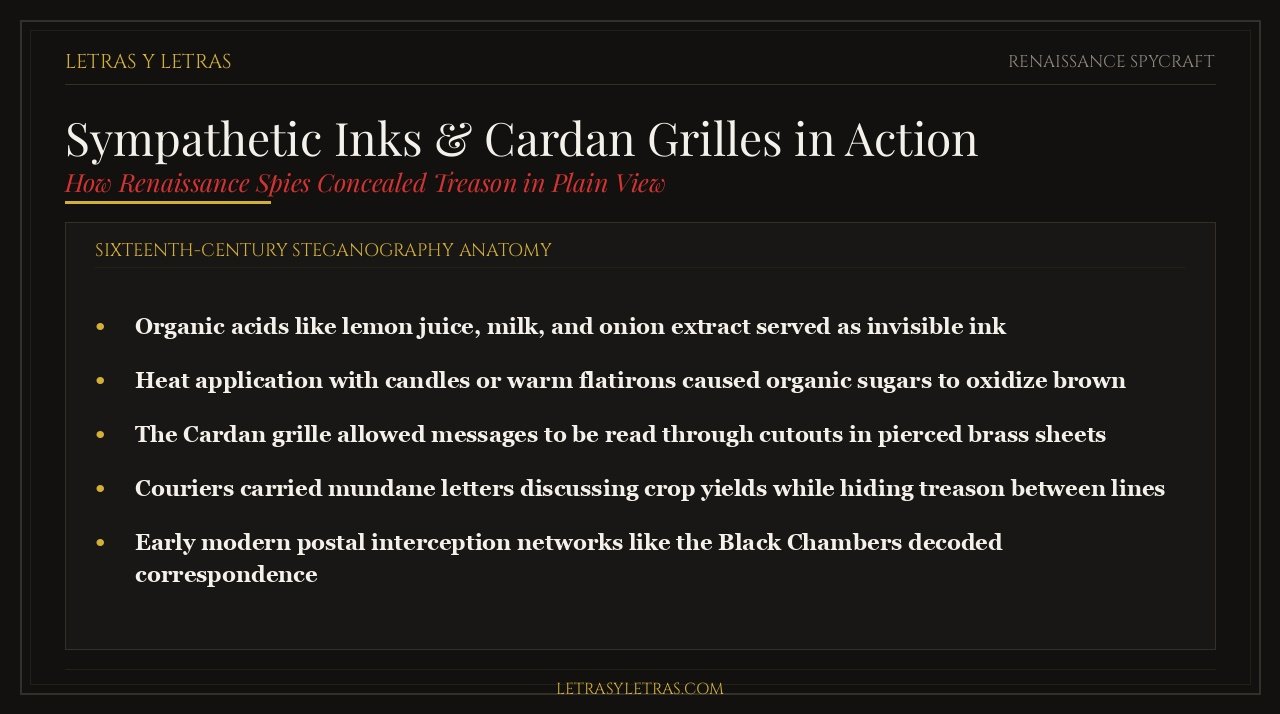
The primary tool of Renaissance steganography was sympathetic ink. Spies used mild organic liquids that dried completely clear on paper. Popular choices included citrus juice, raw milk, onion extract, and vinegar.
A covert agent began by drafting an ordinary cover letter using permanent black gall ink. The visible text discussed dull topics like weather, wool prices, or minor health updates. Lines were spaced widely apart on purpose.
Once the visible black ink dried, the writer prepared a clean quill pen. Dipping the feather into lemon juice, the spy penned secret intelligence directly between the visible lines. The liquid soaked cleanly into paper fibers.
Within minutes, the moisture evaporated without leaving visible stains or glossy residue. To hostile border guards, the sheet appeared to be a boring letter between elderly relatives. Couriers passed checkpoints without raising suspicion.
The recipient knew precisely what to do upon delivery. Holding the parchment carefully above a candle flame or warm hearth heated the paper. Heat caused the organic citric acids and sugars to caramelize into brown script.
Suddenly, bold military intelligence emerged directly inside the blank gaps. The recipient literally read between the lines to uncover treasonous plots or troop movements. This physical action birthed the phrase.
The Cardan Grille: Steganography in Plain Sight
Sympathetic inks were not the only technique requiring readers to inspect the spaces between lines. In 1550, brilliant Italian polymath Girolamo Cardano introduced an ingenious physical encryption device. Historians call this invention the Cardan grille.
Cardano took a rectangular sheet of stiff parchment or thin brass and cut rectangular holes at irregular intervals. Two correspondents kept identical copies of this matching mask. One copy remained with the spy, while another stayed with the spymaster.
To draft a dispatch, the sender placed the perforated mask over blank paper. The writer penned the secret message through the rectangular holes. Removing the mask left isolated words scattered across the blank page.
Next, the writer filled the empty spaces with fluent prose. The agent crafted a coherent, grammatical letter about family business or legal affairs. Covert words blended seamlessly into the surrounding cover sentences.
Cardano designed rotating variations of his grille to evade detection. Senders rotated the physical grid ninety degrees across four successive passes to encode longer paragraphs. Without the exact physical matrix, deciphering the scattered words was practically impossible.
Enemy couriers could read the entire sheet without spotting an obvious code. When the intended recipient received the correspondence, placing the physical grille on top masked the filler words. The secret message leaped out through the apertures.
Walsingham and Elizabeth I: Spies Who Mastered the Gap
Nowhere was covert writing more vital than in Elizabethan England during the late 1500s. Queen Elizabeth I faced constant assassination conspiracies from domestic Catholic factions and Spanish agents. Her survival depended on effective counter-intelligence.
Her principal secretary, Sir Francis Walsingham, built Europe’s most sophisticated intelligence apparatus. Walsingham employed codebreakers, forgers, and double agents across London, Paris, and Rome. His agents intercepted diplomatic correspondence routinely.
During the infamous Babington Plot of 1586, conspirators sought to assassinate Elizabeth and install Mary, Queen of Scots. Plotters smuggled messages into Mary’s residence hidden inside hollowed wooden beer barrels. Many letters featured invisible ink between lines.
Walsingham’s skilled cryptanalyst, Thomas Phelippes, intercepted every barrel dispatch. Phelippes possessed special chemical reagents to reveal sympathetic writing. He deciphered the hidden lines, copied the text, and resealed the correspondence with counterfeit wax seals.
Phelippes was a master forger as well as an expert decipherer. He added a forged postscript to Mary’s decoded letter requesting the identities of all conspirators. The plotters walked directly into Walsingham’s trap, sealing their legal fate.
Evidence collected from between the lines proved decisive at trial. Mary was convicted of high treason against the Crown. Her execution at Fotheringhay Castle altered the balance of European power.
The American War of Independence and the Culper Spy Ring
Covert writing between lines continued into the eighteenth century. During the American War of Independence, General George Washington faced overwhelming British military power in New York. Washington recognized that intelligence would decide the war.
Major Benjamin Tallmadge organized the famous Culper Spy Ring on Long Island. American agents gathered crucial intelligence on British troop numbers and fleet movements. Passing this information to Washington required absolute secrecy.
To secure communications, physician James Jay invented a sophisticated chemical sympathetic stain. Unlike simple lemon juice, Jay’s formula did not reveal itself when heated over candles. It required a specific chemical counter-agent to expose.
Agent Robert Townsend routinely drafted routine business invoices or legal agreements in black ink. Between the rows of commerce, Townsend used Jay’s invisible stain to report British fortifications. Washington kept the second chemical vial at headquarters.
Washington brushed the liquid across the blank paper gaps to uncover urgent tactical warnings. This network uncovered British plans to surprise French allies in Rhode Island. Reading between lines altered military history.
From Wartime Espionage to Victorian Social Subtext
How did a dangerous military technique evolve into a casual figure of speech? The transition occurred gradually throughout the early nineteenth century. As postal networks became public, people associated letters with privacy and scrutiny.
During the Victorian era, social etiquette demanded intense emotional restraint. Polite men and women avoided expressing strong disagreements, romantic feelings, or financial worries directly. Direct speech was considered crude and ill-mannered.
Letter writers mastered the subtle art of implication. Writers praised an acquaintance with cool formality to signal disapproval. Suitors dropped veiled hints about affection without risking humiliating rejection.
Readers recognized that the true message rarely resided in explicit words. Recalling historical spy techniques, speakers began urging friends to read between the lines. The phrase became a metaphor for discerning unspoken subtext.
By 1850, the physical parchment gaps were forgotten. The expression now described an analytical habit of mind. People applied it to spoken conversation, political speeches, and romantic encounters alike.
Earliest Documented Printed Records in the English Press
Linguistic archives track how the idiom entered mainstream print. Early nineteenth-century newspapers offer a clear window into its public adoption. Earliest printed records show writers consciously borrowing the spycraft metaphor.
One of the earliest recorded appearances occurred in British periodicals during the 1840s. Journalists covering parliamentary debates warned voters that politicians concealed their real intentions behind flowery rhetoric. Editors urged readers to examine the subtext.
In 1848, an English regional newspaper explicitly used the phrase when analyzing foreign treaties. The journalist noted that skilled diplomats always read between the lines when evaluating peace declarations. Civic analysis had permanently adopted the spycraft idiom.
American publications adopted the phrase rapidly throughout the 1850s. Periodicals in Boston and New York used it in literary reviews and theater criticism. Critics praised novelists whose dialogue allowed audiences to infer unspoken motives.
The Online Etymology Dictionary records this mid-nineteenth-century transition. English conversation welcomed the phrase permanently alongside other Victorian linguistic idioms.
Chronological Evolution of Read Between the Lines
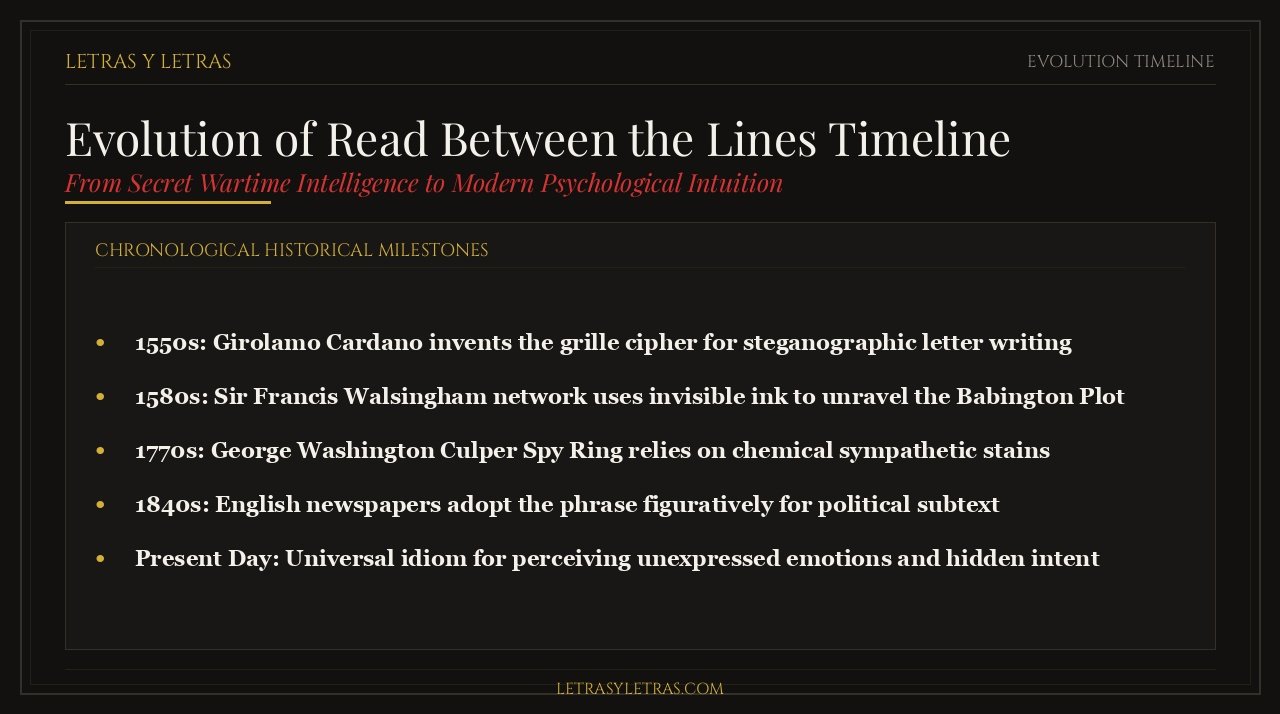
The historical timeline below summarizes the major cryptographic and linguistic milestones tracing the phrase from Renaissance espionage to modern speech:
| Historical Era | Setting and Source | Cryptographic Milestone |
|---|---|---|
| c. 1550 | Girolamo Cardano (Italy) | Invented the Cardan grille to hide secret words within cover text. |
| 1586 | Sir Francis Walsingham (England) | Exposed invisible ink between lines in the Babington Conspiracy dispatches. |
| 1778 | Culper Spy Ring (New York) | James Jay invented chemical stain to write invisible reports for Washington. |
| 1840s | British Victorian press | Journalists popularized phrase as a political metaphor for unstated intent. |
| 1850s | American literature and media | Became standard English idiom for perceiving unspoken psychological subtext. |
| Present Day | Global English conversation | Universal phrase describing social intuition, body language, and subtext. |
Debunking False Myths: Medieval Monks and Musical Staffs
Whenever an idiom possesses an intriguing history, folklore invents alternative origins. We observed similar myths in our study of the origin of the word sincere. Popular internet folklore offers two common false explanations for read between the lines.
The first false claim connects the phrase to medieval Christian monks. Proponents claim that copyist scribes wrote Latin glosses and commentaries between lines of scripture. According to this myth, reading between the lines meant studying theological commentary.
While interlinear glosses were real medieval artifacts, scribes never referred to them with this phrase. Scribes called interlinear notes glossa interlinearis. The practice produced no idiom in medieval Latin, French, or English.
The second false theory points to classical sheet music notation. This myth claims that musicians reading musical staffs had to distinguish notes sitting on lines from notes sitting between lines. Supporters argue that learning musical spaces birthed the saying.
Musical historians have completely dismantled this music staff theory. Musicians say playing in the spaces, never reading between lines. Authoritative records accessible via Oxford Reference resources corroborate that the phrase stems solely from Renaissance espionage.
Cognitive Linguistics: Why Spatial Metaphors Dominate Speech
Why did this specific spycraft phrase take such deep root in English speech? Cognitive linguists point out that human minds map abstract concepts onto physical spaces. We experience social nuance as a physical landscape.
We say someone is beating around the bush, going over our heads, or being behind the scenes. Similarly, we visualize text as a solid architecture made of horizontal rows. The words are solid walls, while the gaps are open corridors.
The physical space between lines represents the unspoken emotional world. We intuitively grasp that polite words often act as a protective fence. The real truth hides in pauses, hesitations, and micro-expressions.
When we say we read between lines, we claim the power to see past defenses. We become psychological detectives uncovering hidden motives. The sixteenth-century spy lives on every time we decode a subtle glance.
Other Espionage and Secret Idioms in the English Language
Read between the lines is part of a rich family of idioms born from secrecy and deception. Throughout history, military conflict and secret intelligence contributed colorful phrases to common conversation.
Consider the famous expression cloak and dagger. The phrase originated from sixteenth-century Spanish swashbuckling theater, where spies concealed rapiers under heavy cloaks. Today, it describes thrilling espionage adventures.
Another common idiom is letting the cat out of the bag. We also explore clandestine secrets in our detailed guide to the origin of the phrase spill the beans. Inspect maritime phrases in our analysis of the origin of the phrase under the weather.
To discover broader idiomatic histories, browse our detailed guide to english idioms and meanings. Language continuously repurposes military and political tools into tools for emotional connection.
Frequently Asked Questions
What is the literal origin of read between the lines?
The literal origin comes from sixteenth-century espionage. Spies used invisible sympathetic inks to write covert dispatches in the blank spaces between lines of ordinary letters. Heating the paper exposed the hidden intelligence.
When did read between the lines become a common idiom?
The phrase transitioned into a common figurative idiom during the 1840s and 1850s in Victorian England and America. Journalists and literary critics adopted it to describe unstated political agendas and psychological subtext in polite society.
What was a Cardan grille?
A Cardan grille was a perforated mask invented by Italian mathematician Girolamo Cardano in 1550. Placing the sheet over paper allowed writers to hide secret words revealed by matching recipient masks.
Did George Washington use invisible ink between lines?
Yes, George Washington relied extensively on invisible ink during the American Revolution. The Culper Spy Ring used a chemical stain invented by James Jay to write covert dispatches between commercial invoices.
Does the phrase come from musical sheet music?
No, the sheet music theory is a common folk etymology myth. Although musical notation places notes between staff lines, historical records confirm that the idiom stems strictly from Renaissance espionage.
What does reading between the lines mean in modern psychology?
In modern psychology, reading between the lines describes social perception and emotional intuition. It refers to inferring unspoken thoughts, motives, or subtle feelings from tone of voice, body language, and context.
Alan Sledge is the lead writer at letrasyletras.com, uncovering the true historical origins behind everyday words.


Alan Sledge is the writer and founder behind Letters & Letters. A lifelong lover of words, Alan has always been drawn to the small mysteries hidden in everyday language, why we say what we say, where our favorite sayings came from and the quotes that manage to put feelings into words better than we ever could ourselves.

Alan Sledge
Alan Sledge is the founder and lead researcher behind Letters & Letters. A lifelong student of linguistic history, he cross-references every word origin, idiom, and quote against primary archival manuscripts, the Oxford English Corpus, and 18th-century print lexicons.