
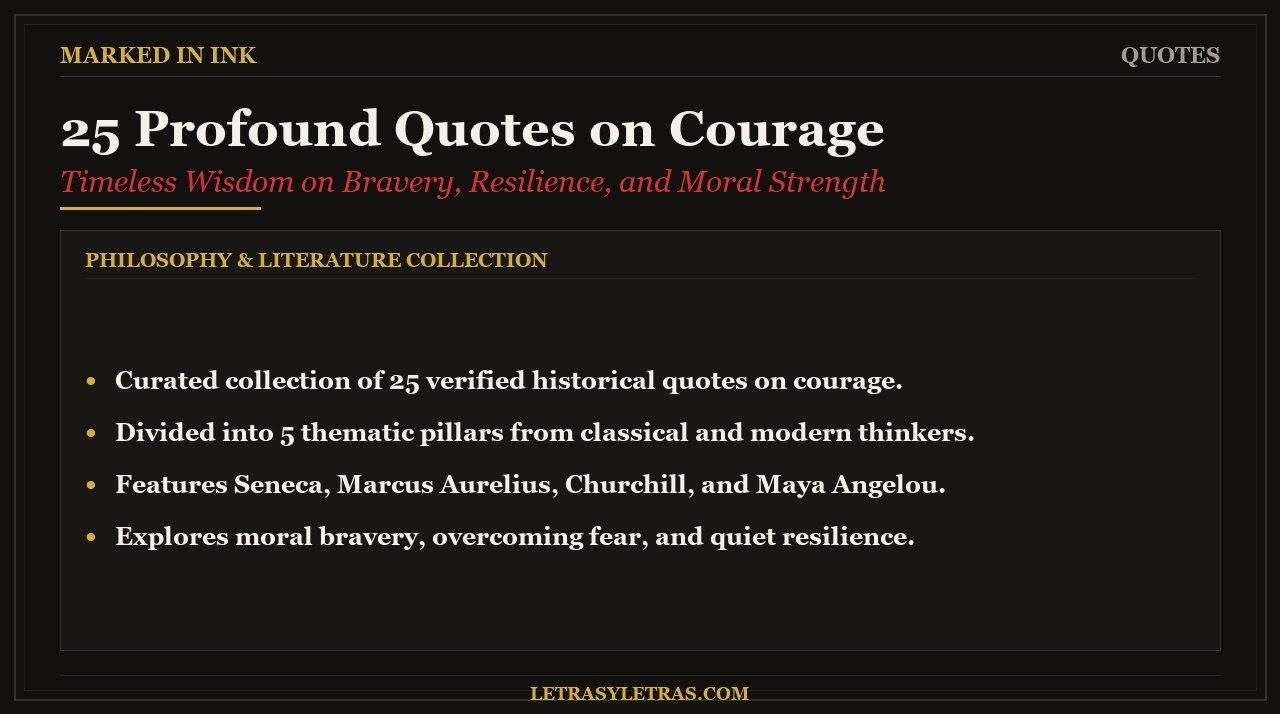
Courage is rarely a loud roar or a theatrical display of fearlessness. Real courage is often the quiet voice at the end of the day saying you will try again tomorrow. Here are 25 verified quotes on courage from history’s greatest thinkers.
Quick Answer: What Is True Courage?
True courage is not the total absence of fear, but the conscious decision that something else is more important than fear. Throughout history, philosophers, leaders, and writers from Aristotle and Seneca to Winston Churchill and Maya Angelou have defined courage as the foundational virtue that makes all other virtues possible in moments of testing.
Key Takeaways
- Courage is the mastery and containment of fear, not its absence.
- Aristotle called courage the first virtue because it protects all others.
- Stoics viewed bravery as an internal mental discipline over external events.
- Moral courage often requires standing alone against popular opinion.
- Quiet daily persistence is as valuable as dramatic battlefield heroism.
Pillar 1: Moral Courage and Standing Alone
Moral courage requires defending principles when doing so comes at personal cost. These quotes emphasize integrity when public consensus opposes you.
“Courage is the most important of all the virtues because without courage, you cannot practice any other virtue consistently.” – Maya Angelou
Angelou understood that honesty, kindness, and justice require strength when tested by adversity.
“It is curious that physical courage should be so common in the world and moral courage so rare.” – Mark Twain
Twain recognized that confronting societal disapproval is often harder than facing physical danger.
“The ultimate measure of a man is not where he stands in moments of comfort, but where he stands at times of challenge.” – Martin Luther King Jr.
King emphasized that true conviction reveals itself during periods of intense social friction.
“Have the courage to say no. Have the courage to face the truth. Do the right thing because it is right.” – W. Clement Stone
Clear boundaries and ethical resolve form the bedrock of moral character.
“To see what is right and not do it is the worst cowardice.” – Confucius
Ancient Eastern philosophy viewed passive inaction during injustice as a complete failure of virtue.
Pillar 2: Classical and Stoic Bravery
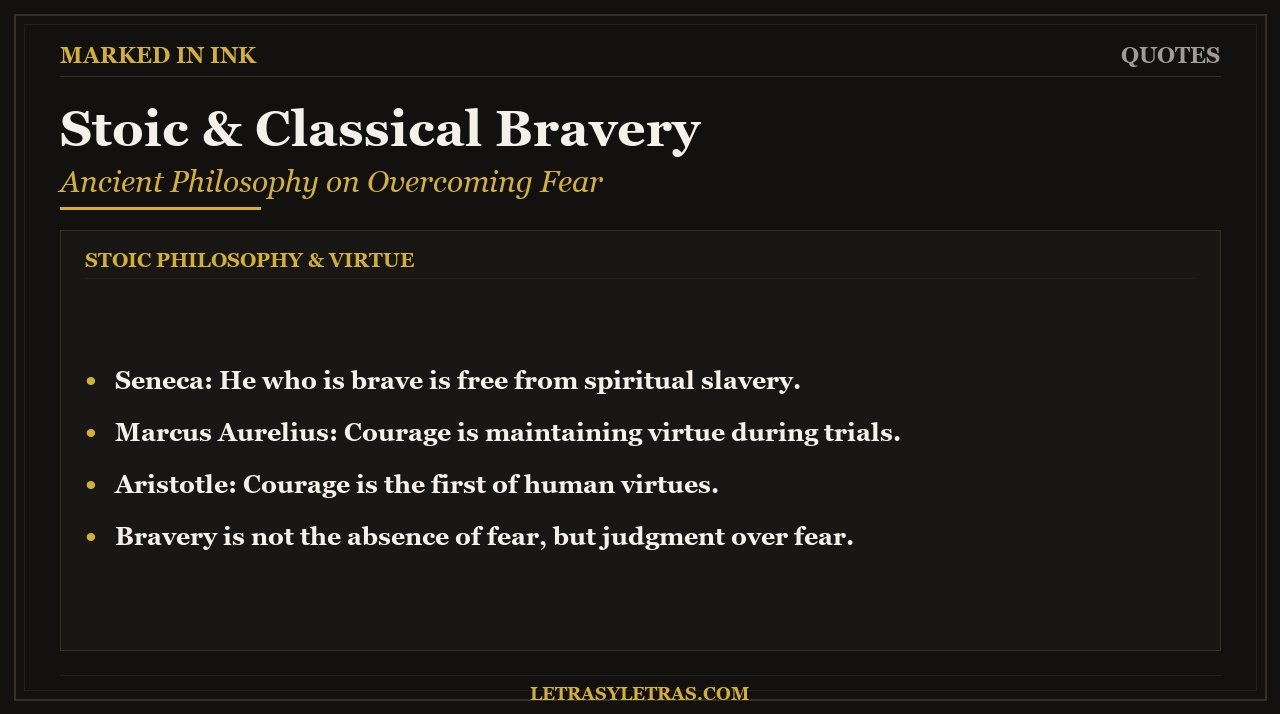
Ancient Roman and Greek philosophers analyzed courage as a rational virtue. Stoics separated physical sensations from mental judgments.
“He who is brave is free.” – Seneca
Seneca believed that conquering internal fear was the only true pathway to spiritual liberty.
“You have power over your mind, not outside events. Realize this, and you will find strength.” – Marcus Aurelius
The Roman Emperor reminded himself in *Meditations* that courage begins with controlling one thoughts. Explore more ancient reflections in our guide to stoic quotes on pain.
“Courage is knowing what not to fear.” – Plato
Plato defined bravery as intellectual clarity about what truly threatens the soul.
“Courage is the first of human qualities because it is the quality which guarantees all others.” – Aristotle
Aristotle established that virtues cannot survive without the fortitude to practice them under pressure.
“It is not because things are difficult that we do not dare; it is because we do not dare that they are difficult.” – Seneca
Perceived difficulty is often a product of our hesitation rather than external reality.
Pillar 3: Overcoming Fear and Taking Action
Bravery is not feeling fearless. It is choosing forward action despite genuine anxiety.
“I learned that courage was not the absence of fear, but the triumph over it. The brave man is not he who does not feel afraid, but he who conquers that fear.” – Nelson Mandela
Mandela forged this insight during twenty-seven years of imprisonment under apartheid.
“Courage is resistance to fear, mastery of fear, not absence of fear.” – Mark Twain
Action taken in the presence of fear defines genuine valor.
“Courage is being scared to death, but saddling up anyway.” – John Wayne
The American actor captured the necessity of physical resolve in the face of dread.
“Fear is a reaction. Courage is a decision.” – Winston Churchill
Churchill highlighted the deliberate choice required to lead during national peril.
“Do one thing every day that scares you.” – Eleanor Roosevelt
Roosevelt advocated for daily micro-courage as the best way to expand personal capacity.
Pillar 4: Resilience in the Face of Adversity
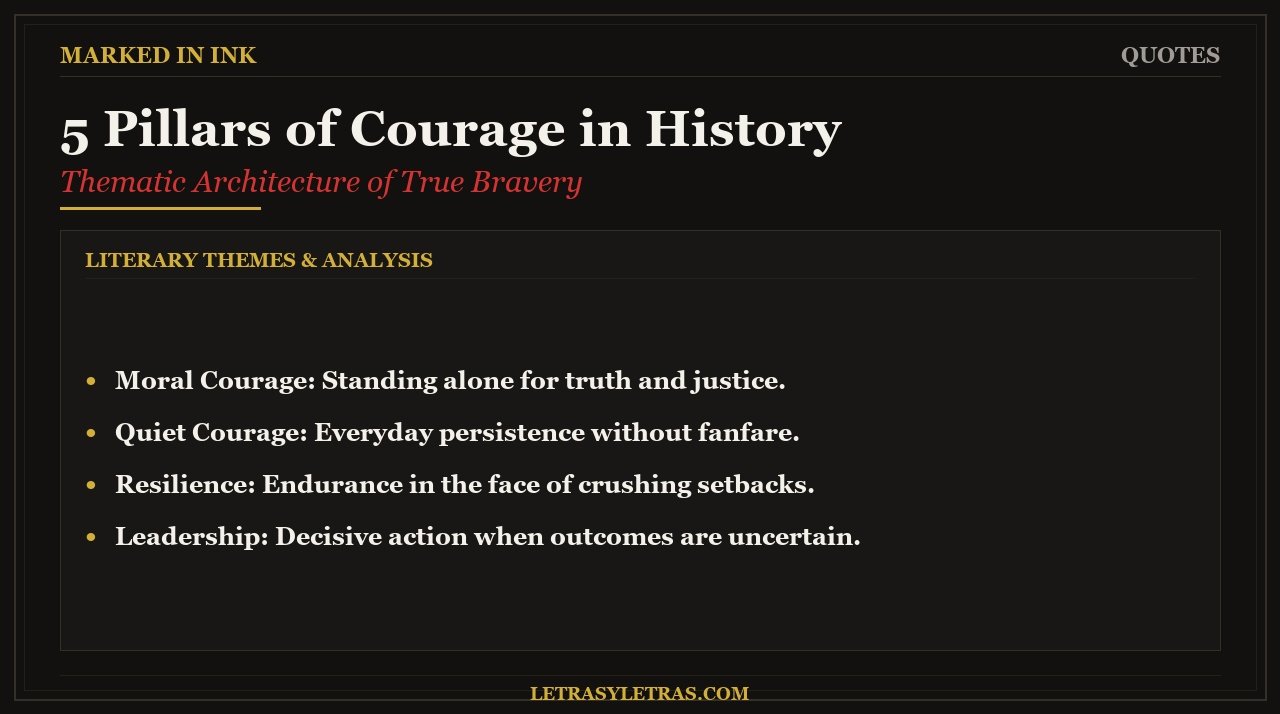
Enduring hardship requires psychological stamina. These thinkers focused on survival and recovery after severe defeat.
“Success is not final, failure is not fatal: it is the courage to continue that counts.” – Winston Churchill
Churchill famous wartime philosophy reminded citizens that persistence outlasts temporary setbacks.
“Courage doesn’t always roar. Sometimes courage is the quiet voice at the end of the day saying, ‘I will try again tomorrow.'” – Mary Anne Radmacher
Radmacher celebrated the quiet, unheralded resilience that sustains ordinary people through grief.
“He who loses wealth loses much; he who loses a friend loses more; but he that loses his courage loses all.” – Miguel de Cervantes
The Spanish author of *Don Quixote* viewed courage as the final defense of the human spirit.
“Out of suffering have emerged the strongest souls; the most massive characters are seared with scars.” – Kahlil Gibran
Gibran observed that profound strength often develops through surviving deep emotional pain.
“Life shrinks or expands in proportion to one’s courage.” – Anaïs Nin
Nin recognized that the boundaries of personal experience match our willingness to take risks.
Pillar 5: Quiet Courage and Leadership
Leadership requires decisiveness when the path ahead is obscured. These quotes address quiet authority and steadfast commitment.
“Courage is what it takes to stand up and speak; courage is also what it takes to sit down and listen.” – Winston Churchill
Listening with humility often demands more emotional discipline than public speaking. Explore similar insights in our collection of quotes about silence.
“Real courage is when you know you’re licked before you begin, but you begin anyway and see it through no matter what.” – Harper Lee (*To Kill a Mockingbird*)
Atticus Finch immortalized the principle that duty supersedes the certainty of winning.
“Only those who dare to fail greatly can ever achieve greatly.” – Robert F. Kennedy
Kennedy noted that meaningful progress requires accepting the possibility of failure.
“It takes courage to grow up and become who you really are.” – E.E. Cummings
Cummings addressed the quiet bravery needed to resist social conformity.
“You gain strength, courage, and confidence by every experience in which you really stop to look fear in the face.” – Eleanor Roosevelt
Every small act of confrontation builds long-term psychological resilience. For more literary reflections, visit our famous quotes and quotations archive.
Frequently Asked Questions
What is the difference between courage and bravery?
Bravery is often the spontaneous display of fearlessness in physical danger, while courage is the deliberate, reasoned decision to face fear or moral opposition.
Who said courage is resistance to fear, not absence of fear?
Mark Twain wrote this famous definition in his 1894 novel *Pudd’nhead Wilson*.
What did Aristotle say about courage?
Aristotle stated that courage is the first of human virtues because it guarantees the practice of all other virtues under pressure.
Why is quiet courage important?
Quiet courage represents daily persistence, emotional resilience, and personal integrity without the need for public applause or recognition.
Courage is an internal muscle built through daily choices. When fear arises, remember that history greatest minds chose to move forward anyway.
Alan Sledge is the founder and lead writer at letrasyletras.com, dedicated to uncovering the true etymological histories behind our favorite words and phrases.