
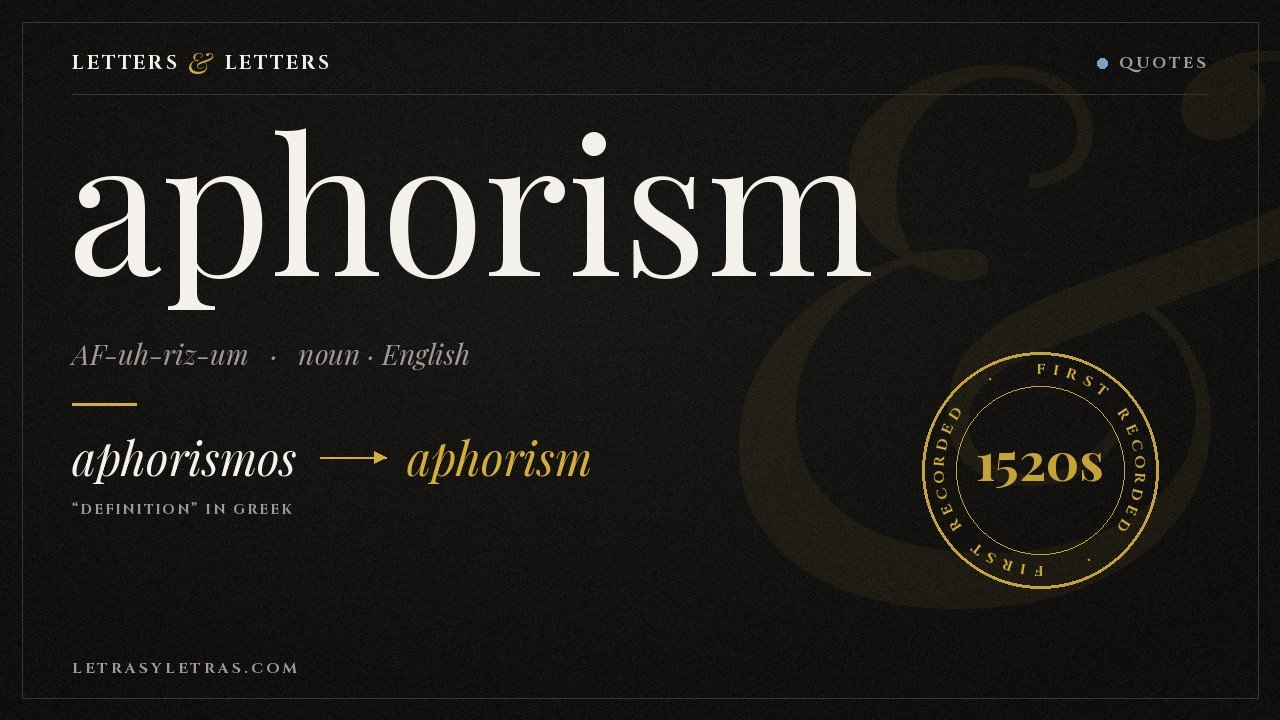
The word aphorism began life as a plain Greek term for a definition. Then a physician used it as the title of a medical handbook, and the name stuck to every short, sharp saying that came after.
So when you ask someone to define aphorism, you are asking a question the word itself answers. This guide covers what it means, where it came from, how it differs from a proverb or a maxim, and which famous examples actually trace back to a named writer.
Quick Answer: Define Aphorism
An aphorism is a short, memorable statement of a general truth, usually brief enough to quote in one breath and deep enough to need some interpretation. The word comes from Greek aphorismos, “definition,” built from aphorizein, “to mark off.” It entered English in the 1520s through French, first in reference to the Aphorisms of Hippocrates, whose opening line is “Life is short, the craft long.” The wider sense of any pithy statement of truth is recorded from the 1580s. An aphorism differs from an axiom, which is self-evident, and from an epigram, which is wit without general import. Famous named examples include Hippocrates, Francis Bacon, La Rochefoucauld and Oscar Wilde.
Key Takeaways
- Aphorism comes from Greek aphorismos, meaning “definition,” and is a cousin of the word horizon.
- English first used it in the 1520s for the Aphorisms of Hippocrates, and the general sense followed in the 1580s.
- “Ars longa, vita brevis” is a Latin reversal of the Greek, and Greek tekhne means craft, not fine art.
- An axiom is self-evident, an epigram is witty, and an aphorism is a general truth that asks to be interpreted.
- Many “ancient” aphorisms are later inventions, so check the earliest source before you quote one.
What Does Aphorism Mean?
An aphorism is a concise, memorable expression of a general truth or principle. It is short on purpose. Most run a single sentence, and almost none run more than three.
Brevity is only half the test. Philosopher Andrew Hui, in A Theory of the Aphorism, defines it as “a short saying that requires interpretation.” That second clause is what separates an aphorism from a slogan. A slogan tells you what to do. An aphorism makes you stop and work out what it means.
The standard teaching example is Heraclitus: “You cannot step into the same river twice.” Read it once and it is a remark about water. On a second pass it becomes a claim about time, identity and change.
Where the Word Aphorism Comes From
The Online Etymology Dictionary entry for aphorism traces it through French aphorisme, Late Latin aphorismus and Greek aphorismos. In Greek the word meant “definition” or “a short, pithy sentence.”
Underneath sits the verb aphorizein, “to mark off, divide.” It joins apo (“from”) to horizein (“to bound”). That is the same horizein that gave English horizon. An aphorism and a horizon are both lines that mark a boundary, one around a thought and the other around the sky.
The word did not start as a literary term. It was first used for the Aphorisms of Hippocrates, a long series of short propositions about symptoms, diagnosis and treatment. Each one fenced off a piece of medical knowledge in a sentence.
The line everyone quotes
The first sentence of the Hippocratic Aphorisms is the most famous opening in the history of the form. Its Greek text reads ho bios brakhus, he de tekhne makre. A standard Latin rendering runs: vita brevis, ars longa, occasio praeceps, experimentum periculosum, iudicium difficile. In plain English, life is short, the craft is long, the moment is fleeting, experiment is risky and judgment is hard.
You can read the original text in the Perseus Digital Library edition of the Aphorisms. Notice what the physician was actually saying. He was warning doctors that the time to learn medicine is short and the work is long, and that a wrong call can cost a life.
Why “ars longa, vita brevis” misleads
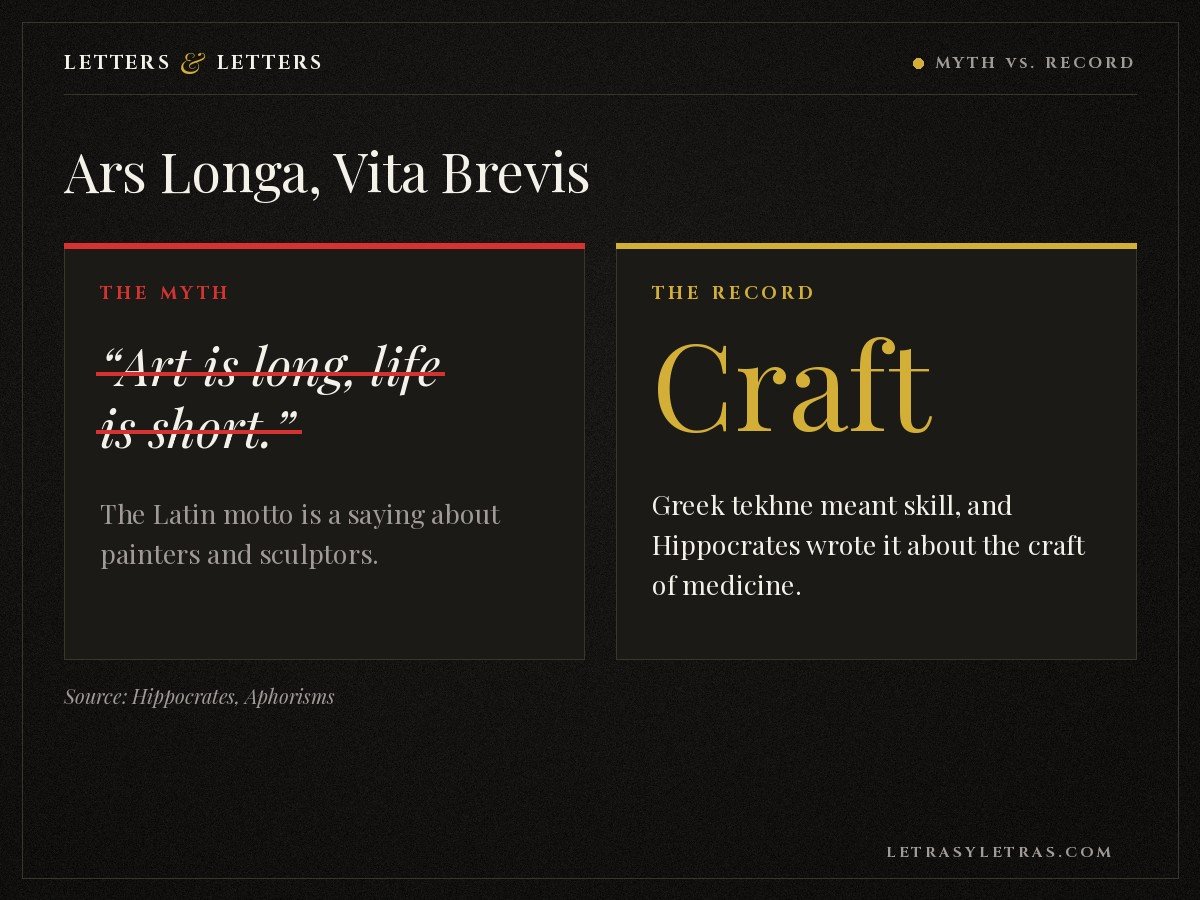
The popular Latin slogan reverses the original order. It puts ars longa first and vita brevis second, which makes it sound like a motto for artists. That is the first myth.
The Greek word behind ars is tekhne, which means craft or skill, the root of our word technique. Hippocrates meant the craft of medicine. Latin ars shifted into English “art,” and the saying drifted from a doctor’s warning into a poet’s sigh.
Chaucer helped. In the late 1300s he opened his Parlement of Foules with “The lyf so short, the craft so long to lerne.” He kept the word craft, which is closer to what Hippocrates meant than the modern “art.”
How Aphorism Moved From Medicine to Everything
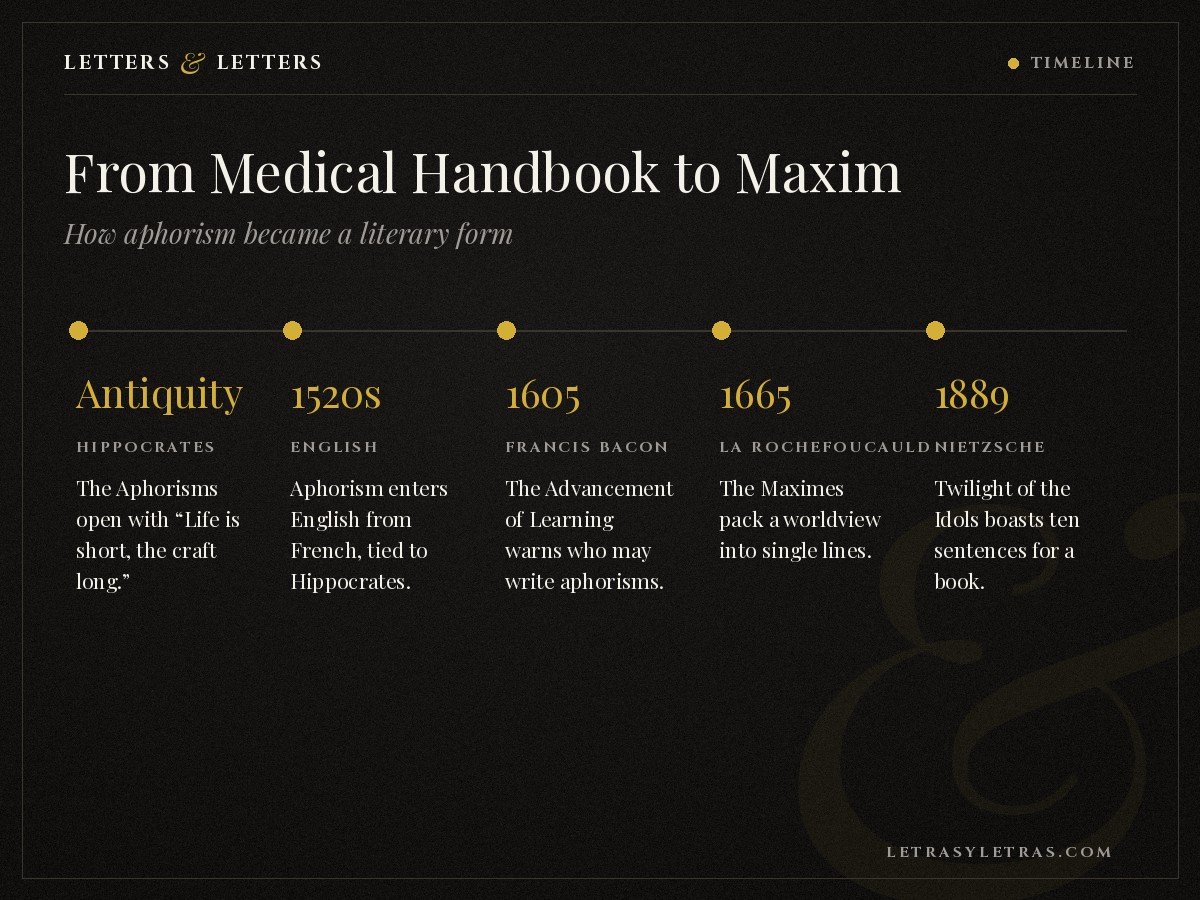
English took the word from French in the 1520s, with the meaning of a concise statement of a principle. At first it still pointed mostly at Hippocrates. By the 1580s writers were using it for any short, pithy statement of general truth.
Francis Bacon did the most to widen it. In The Advancement of Learning (1605) he argued that aphorisms “cannot be made but of the pith and heart of sciences,” because a short form leaves no room for examples, connecting arguments or illustrations. His warning was blunt. Only someone who is “sound and grounded” in a subject can write aphorisms worth reading.
Bacon then practised what he preached. His Novum Organum (1620) lays out its method as a numbered series of aphorisms.
The great collectors
The first well-known published collection of the form was the Adagia of Erasmus, first printed in 1500. Later came the French moralist La Rochefoucauld, whose Maximes (1665) packed a worldview into single lines. Baltasar Gracián and Blaise Pascal belong to the same tradition.
Nietzsche made the form a boast. In Twilight of the Idols (1889) he wrote, “It is my ambition to say in ten sentences what everyone else says in a book.”
Aphorism vs Proverb, Axiom, Maxim and Epigram
These words overlap, and dictionaries do not always agree on the boundaries. The Online Etymology Dictionary offers the cleanest working distinctions. An axiom states a self-evident truth. Epigrams resemble aphorisms but lack general import. A maxim tends to be practical, while a saying tends to be commonplace.
| Term | What it does | Example |
|---|---|---|
| Aphorism | States a general truth that needs interpretation | “Life is short, the craft long.” |
| Axiom | States something self-evident, with no proof needed | Things equal to the same thing are equal to each other. |
| Epigram | Delivers a witty turn, with no wider truth required | Coleridge: “Its body brevity, and wit its soul.” |
| Maxim | Gives a practical rule of conduct | Measure twice, cut once. |
| Proverb | Passes folk wisdom down through use, usually unattributed | A stitch in time saves nine. |
The proverb row is the one readers confuse most. A proverb belongs to everyone and nobody. We rarely know who first said “a stitch in time saves nine,” and we do not need to. An aphorism usually has a name attached, such as Bacon, Wilde or La Rochefoucauld, and part of its force comes from that voice.
Keats gave the axiom a nice test in a letter of May 1818: “Axioms in philosophy are not axioms until they are proved upon our pulses.” The same test applies to aphorisms. They only work if you can feel the truth in them.
If you want more of the proverb side of the family, our guide to old-fashioned phrases and the broader hub on english idioms and meanings cover the sayings that belong to nobody.
Famous Aphorisms With Real Sources
Quote sites attach famous names to anything that sounds clever. These examples have a traceable source, and each one shows a different way the form can work.
Hippocrates: the original
“Life is short, the craft long” opens the Aphorisms and gives the genre its name. Of everything on this list, it is the oldest named example.
Francis Bacon: knowledge as power
Bacon’s line “knowledge itself is power” comes from the Latin ipsa scientia potestas est in his Meditationes Sacrae (1597). It is a good case of an aphorism that survived translation and still needs interpreting. Power over what, and for whom?
La Rochefoucauld: the cynic’s eye
La Rochefoucauld wrote that hypocrisy is the homage vice pays to virtue. The line is typical of his Maximes: a neat reversal, aimed at human motives, with one extra turn of the knife in the final word.
Oscar Wilde: wit with a sting
“I can resist everything except temptation” is from Lady Windermere’s Fan (1892), where Lord Darlington speaks it. It sits on the border between aphorism and epigram, since it is more clever than universal. You can read the full play at Project Gutenberg’s Lady Windermere’s Fan.
A word of caution on Wilde. Dozens of lines are credited to him that he never wrote. Before you quote one, check it against the text. We apply the same rule in our guide to quotes about perfection.
How to Write a Good Aphorism
You do not need to be Bacon to try. A few habits separate a real aphorism from a greeting-card line.
- Compress a real observation. Start with something you have seen hold true many times, then cut it until one more cut would break it.
- Leave a gap. Hui’s test says an aphorism must require interpretation. Do not explain it inside the sentence.
- Use a turn. La Rochefoucauld and Wilde both reverse an expected phrase. The reversal is what makes it stick.
- Keep it general. If it only works for one person or one situation, it is an anecdote or an epigram, not an aphorism.
Bacon’s warning still stands. A short sentence cannot hide a thin idea. Only a writer who knows the subject well can compress it without losing it.
Frequently Asked Questions
What is the simplest way to define aphorism?
An aphorism is a short, memorable statement of a general truth. It is brief enough to quote and rich enough that a reader has to think about what it means.
What is the difference between an aphorism and a proverb?
A proverb is folk wisdom handed down through use, and its author is usually unknown. An aphorism is typically a crafted sentence tied to a named writer, and it often needs interpretation to make sense.
Where does the word aphorism come from?
It comes from Greek aphorismos, “definition,” from aphorizein, “to mark off.” It reached English in the 1520s through French and Late Latin, first for the Aphorisms of Hippocrates.
What is the oldest named aphorism?
The best candidate is the opening of the Hippocratic Aphorisms: life is short, the craft long. Older sayings exist in wisdom literature, but this is the text that gave the genre its name.
Is an aphorism the same as a quote?
No. A quote is any words repeated from a source. An aphorism is a specific kind of short statement. Many quotes are not aphorisms, and many aphorisms circulate as unattributed sayings.
Keep the Line, Check the Source
An aphorism earns its place by making a reader slow down. The best ones, from Hippocrates to Bacon to Wilde, fit a whole argument into a few words and trust you to fill in the rest.
That compression makes them easy to misquote and misattribute. Keep the line, but check the source first, because the real history is usually better than the myth.


Alan Sledge is the writer and founder behind Letters & Letters. A lifelong lover of words, Alan has always been drawn to the small mysteries hidden in everyday language, why we say what we say, where our favorite sayings came from and the quotes that manage to put feelings into words better than we ever could ourselves.

Alan Sledge
Alan Sledge is the founder and lead researcher behind Letters & Letters. A lifelong student of linguistic history, he cross-references every word origin, idiom, and quote against primary archival manuscripts, the Oxford English Corpus, and 18th-century print lexicons.