
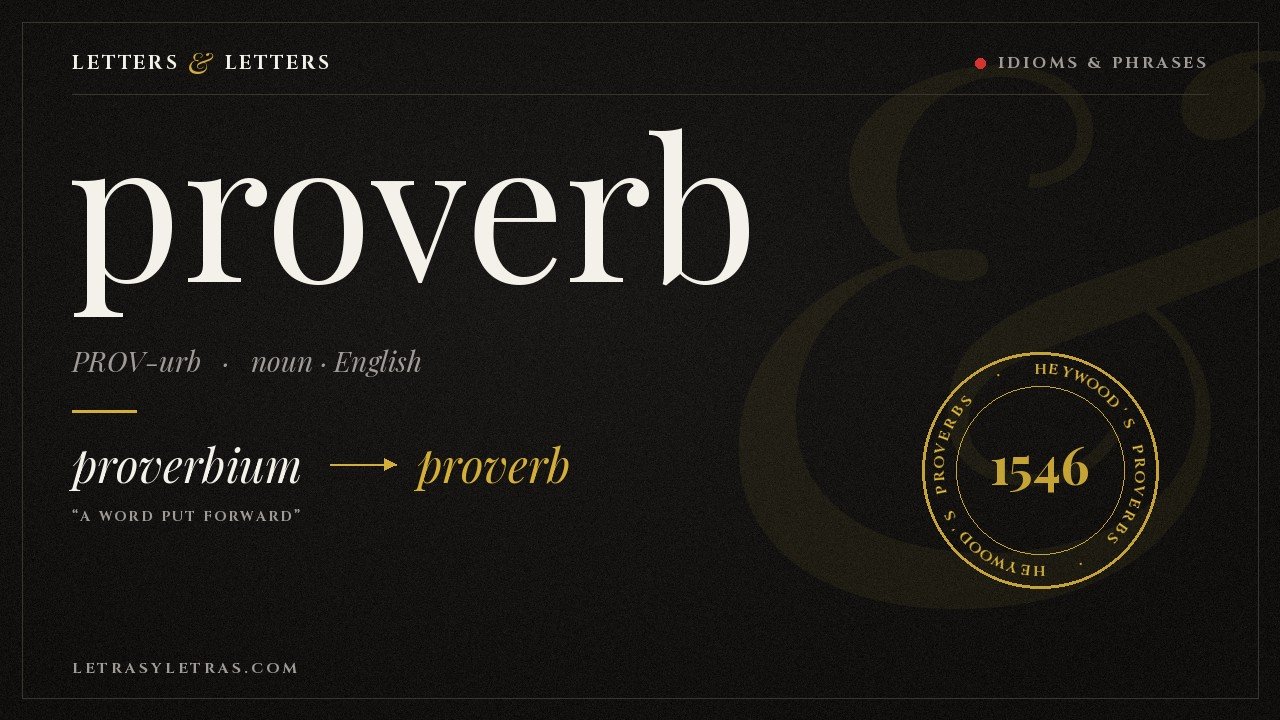
In 1546 a court entertainer named John Heywood packed a whole marriage comedy with the sayings of ordinary English people. Haste maketh waste. Look ere ye leap. Two heads are better than one. Almost five centuries later, we still say most of them without knowing who wrote them down.
That is the heart of any proverb definition. A proverb is a saying that has outlived its first speaker. This guide explains what the word means, how a proverb differs from an idiom or an adage, and where some famous examples were first recorded.
Quick Answer: Proverb Definition
A proverb is a short, traditional saying that states a general truth or gives practical advice drawn from common experience. The word comes from Latin proverbium, built from pro (forth) and verbum (word): a word put forward for everyone to use. Proverbs are fixed in form, usually anonymous, and passed down by repetition. Examples include “Haste makes waste” and “Two heads are better than one,” both printed in John Heywood’s 1546 collection of English proverbs. A proverb differs from an idiom, whose meaning cannot be worked out from its words, and from an aphorism, which is credited to a known author. Folklorist Wolfgang Mieder defines a proverb as a short, generally known sentence of the folk that carries wisdom in a fixed, memorable form handed down through generations.
Key Takeaways
- A proverb is a short, fixed, traditional saying that offers advice or states a common truth.
- The word traces to Latin proverbium, from pro and verbum, “a word.”
- John Heywood printed dozens of English proverbs in 1546, including “Look ere ye leap.”
- Not every proverb is ancient: “An apple a day” grew from a Welsh saying recorded in 1866.
- Idioms hide their meaning, aphorisms have authors, and proverbs belong to everyone.
Proverb Definition: What the Word Actually Means
Most dictionaries agree on the core. Merriam-Webster’s entry for proverb calls it “a brief popular epigram or maxim,” and lists adage as a synonym. Other dictionaries stress age and familiarity: a short statement known by many people for a long time.
Scholars have found the word harder to pin down. The American folklorist Archer Taylor argued that a precise definition was too difficult to repay the effort. In his view, some quality we cannot fully describe tells us one sentence is proverbial and another is not.
Wolfgang Mieder, who taught folklore at the University of Vermont for fifty years, offered a working version that most researchers now quote. A proverb, he wrote, is “a short, generally known sentence of the folk” that carries wisdom and traditional views in a fixed, memorable form handed down from generation to generation.
From Latin proverbium
The English word came through Old French from Latin proverbium. Noah Webster’s 1828 dictionary breaks it down as pro and verbum, “a word.” The sense is a word set forward in public, a phrase that belongs to the crowd.
Webster also recorded a darker meaning. A proverb could be “a by-word,” a name repeated so often it became a reproach. When an old text says a person became a proverb among the nations, it means they turned into a cautionary tale.
What Makes a Saying a Proverb
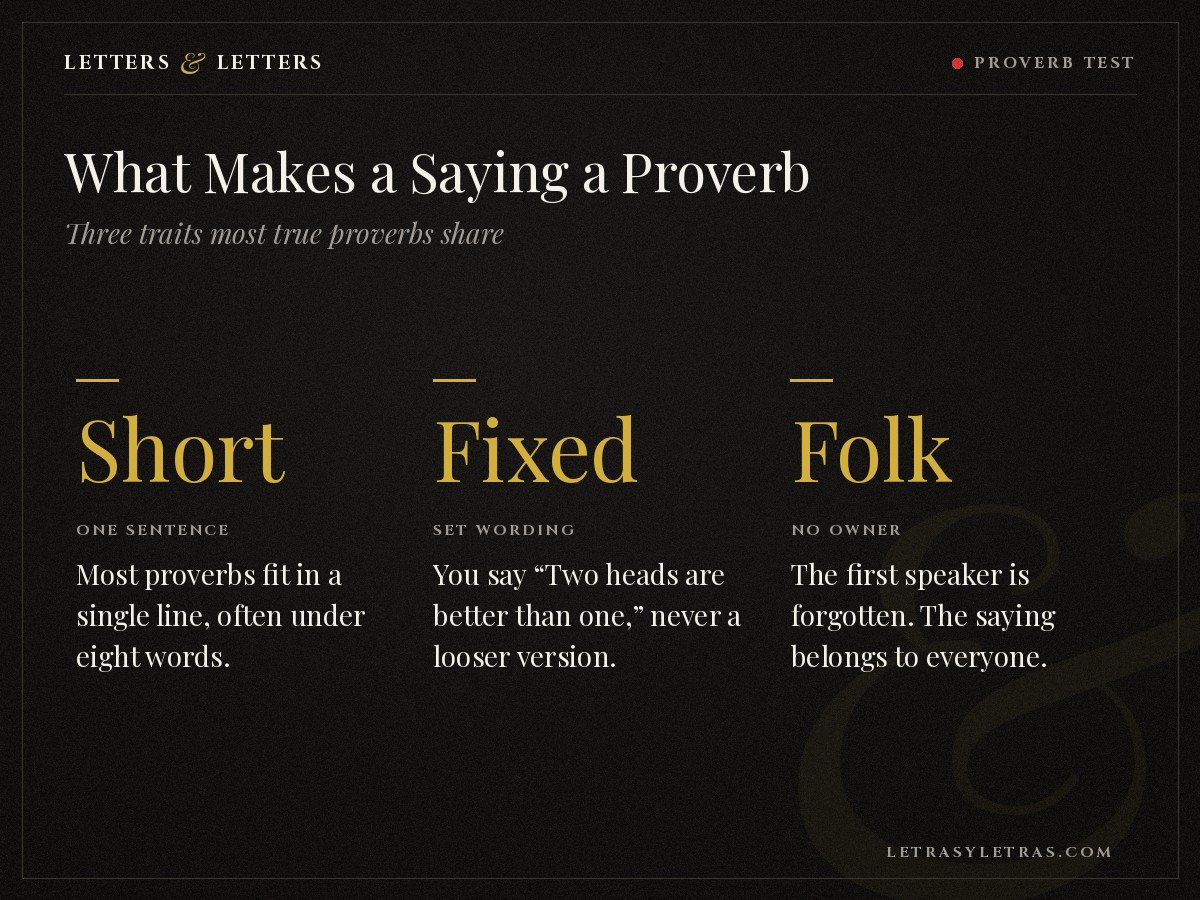
No single test works for every case, but true proverbs tend to share five traits. You can check almost any saying against them.
- Short. Most fit in one sentence, and many in under eight words.
- Fixed. The wording stays put. You say “Two heads are better than one,” not “Two brains beat one brain.”
- Anonymous. Nobody owns it. The first speaker has been forgotten, even if a collector wrote it down.
- General. It describes how life usually goes, not a single event.
- Memorable. Rhyme, rhythm or a vivid picture keeps it alive. Think of “Haste makes waste.”
That fixed form separates a proverb from a proverbial phrase. “The fat is in the fire” can bend to fit a sentence (“now the fat was really in the fire”). A full proverb resists that kind of editing.
Lord John Russell put the idea neatly around 1850. A proverb, he said, is “the wit of one, and the wisdom of many.” One person coins the line, and thousands of people keep it.
Proverb vs Idiom, Adage and Aphorism
These four words get swapped constantly, and the confusion is understandable. Each names a short saying. The differences lie in who made it, how literal it is, and how long it has been around.
| Term | Author | What it does | Example |
|---|---|---|---|
| Proverb | Usually unknown | Gives advice or a common truth in a complete sentence | Haste makes waste. |
| Idiom | Unknown | Means something its words do not literally say | Break a leg |
| Adage | Unknown | A proverb respected for its long use | Out of sight, out of mind. |
| Aphorism | A named writer | A sharp, original observation | Life is short, art is long (Hippocrates) |
| Maxim | Often a named thinker | A rule of conduct | Know thyself |
An idiom is the trickiest neighbour. “Break a leg” has nothing to do with bones, and you cannot guess its meaning from the words (our piece on the origin of the phrase break a leg shows how strange that history gets). A proverb, by contrast, usually says what it means, even when it uses a picture to say it.
Aphorisms are the opposite case. They have a known author and a writer’s polish. If you want the full story of that word, from a Greek medical handbook onward, see our guide to the define aphorism question. Over centuries, a famous aphorism can lose its author and slide into proverb status.
The synonyms adage, byword and saw all orbit the same idea. A “wise saw” is simply an old proverb, and Shakespeare’s audiences would have heard the word that way.
Where English Proverbs Came From
English proverbs grew from three main streams. Some came from Scripture, some from classical Latin, and many from plain farm and household talk.
The Bible and Erasmus
The Book of Proverbs gave Western culture a whole library of wise sayings. One scholar has counted between three and five hundred proverbs that stem from the Bible in cultures where it is the main spiritual book.
Its reach has limits, though. Another study looked at the 106 most common proverbs across Europe and found that only 11 came from the Bible. The rest came from elsewhere, much of it from Latin.
That Latin wave owed a great deal to one Dutch scholar. Erasmus published his first collection of classical sayings, Collectanea Adagiorum, in Paris in 1500 with around eight hundred entries. By 1508 the expanded edition held over 3,000, many with notes on their source and meaning. Schoolboys across Europe learned their Latin from it, and the sayings travelled into every vernacular.
Heywood’s 1546 collection
English got its own landmark in 1546. John Heywood, a playwright and singer at the Tudor court, published a long verse dialogue with a title only a Tudor printer could love: A Dialogue Conteinyng the Nomber in Effect of All the Prouerbes in the Englishe Tongue.
Heywood did not invent these sayings. He collected them and stitched them into a story about two kinds of marriage. His book is the earliest printed home for many proverbs we still use, which makes it a priceless record of everyday Tudor speech.
Famous Proverb Examples and Their First Records
Dating a proverb is a strange task, because the spoken version is almost always older than the first written one. The dates below mark the earliest record in print, not the moment someone first said it.
| Year | Author / Source | Context and Milestone |
|---|---|---|
| 1500 | Erasmus, Collectanea Adagiorum | Around 800 classical sayings printed in Paris |
| 1508 | Erasmus, expanded Adagia | Collection grows past 3,000 annotated proverbs |
| 1542 | Heywood, epigrams | “Out of sight out of mind” recorded |
| 1546 | Heywood, Dialogue | “Haste maketh waste,” “Look ere ye leap,” “Two heads are better than one” |
| 1828 | Noah Webster’s dictionary | Defines proverb from Latin pro and verbum |
| 1866 | Pembrokeshire saying | “Eat an apple on going to bed” version recorded |
| 1887 | Print sources | Early examples of “An apple a day keeps the doctor away” |
Heywood’s book alone supplies a remarkable list. Here are several proverbs it holds, with the spelling modernised:
- Haste makes waste. Rushing causes mistakes that cost more time than they save.
- Make hay while the sun shines. Heywood’s form was “When the sun shineth, make hay.” Use good conditions while they last.
- Look before you leap. Printed as “Look ere ye leap.” Think before acting.
- Two heads are better than one. A shared problem is easier to solve.
- Love me, love my dog. Accept a person along with what comes attached to them.
- Beggars can’t be choosers. Heywood wrote “Beggars should be no choosers.”
- All’s well that ends well. A good outcome excuses a rough road.
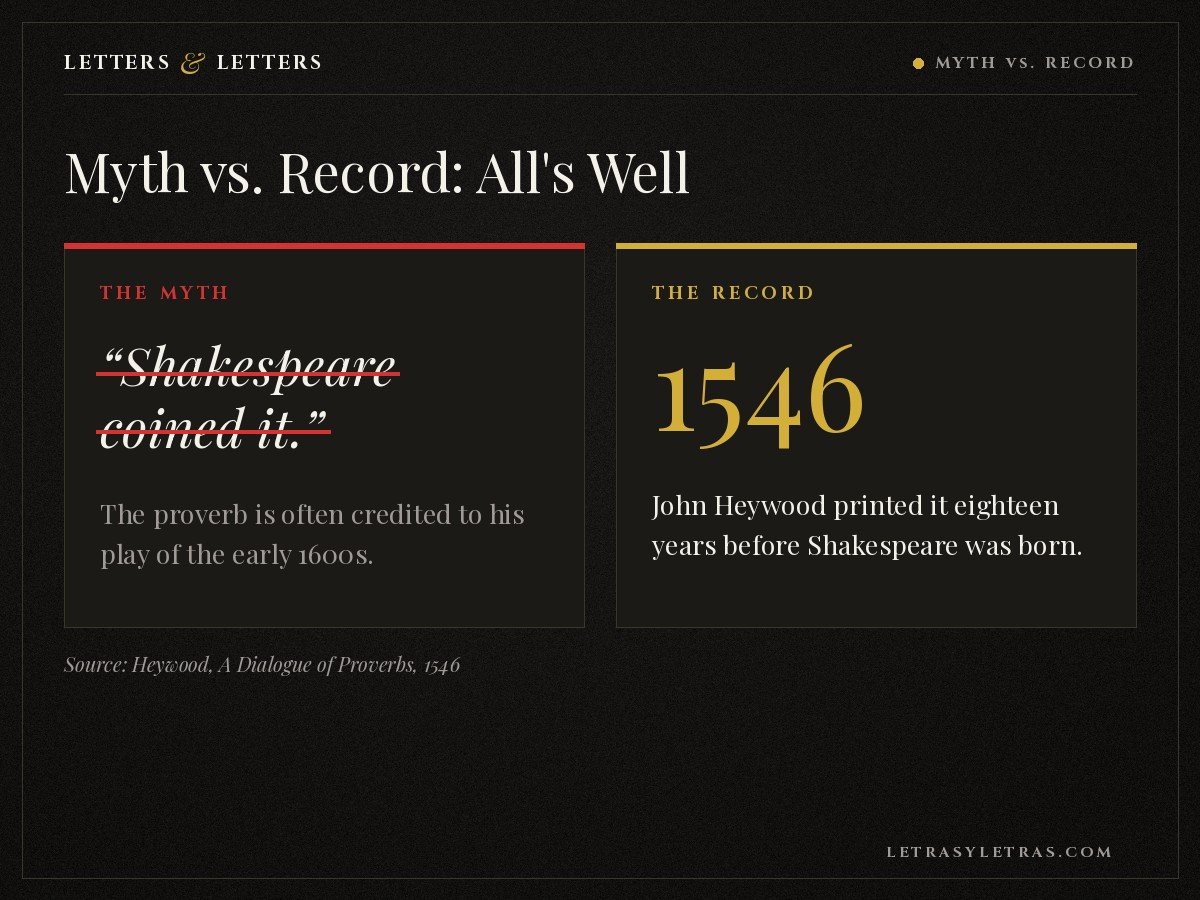
That last one carries a surprise. Many readers assume Shakespeare coined it, since he used it as the title of a play in the early 1600s. Heywood had printed it in 1546, eighteen years before Shakespeare was born. The playwright borrowed a phrase his audience already knew, which is exactly why it worked as a title.
The myth of the ancient proverb
People often assume every proverb is old folk wisdom from the mists of time. Some are surprisingly young. “An apple a day keeps the doctor away” sounds medieval, but its first recorded ancestor is a Pembrokeshire saying from 1866: “Eat an apple on going to bed, and you’ll keep the doctor from earning his bread.”
The tidy modern phrasing turns up in print from 1887. So a saying that feels timeless is in fact Victorian, younger than the railway. Proverbs keep being born, and many of today’s catchphrases may become tomorrow’s.
For more sayings that sound older than they are, our list of old fashioned phrases traces twenty-five of them back to their real first records.
Proverbs That Contradict Each Other
Proverbs are not laws of nature. They describe how life usually goes, and life goes in more than one direction. That is why so many proverbs come in opposing pairs.
- “Look before you leap” sits awkwardly beside “He who hesitates is lost.”
- “Many hands make light work” argues with “Too many cooks spoil the broth.”
- “Absence makes the heart grow fonder” collides head-on with Heywood’s “Out of sight, out of mind.”
Folklorists call these counter proverbs. They are not a flaw. A culture keeps both sayings ready, and the speaker picks the one that fits the moment.
Mieder also studied a playful cousin, the anti-proverb. He describes these as parodied, twisted or fractured proverbs that make fun of traditional wisdom. “Look before you sleep” or “Where there’s a will, there’s a lawsuit” both lean on the original for their joke.
The Biblical Meaning of Proverb
Many people searching for a proverb definition want the biblical sense. Webster’s 1828 dictionary gives two. The first is a moral saying “that is enigmatical,” a “dark saying of the wise that requires interpretation.”
The second is the Book of Proverbs itself, a book of the Old Testament collecting short rules for daily conduct. These sayings were meant to be chewed on rather than simply obeyed. A biblical proverb often works like a small riddle, pairing two lines so the reader has to work out the link.
That older sense explains why Webster tied the word to interpretation. For centuries a proverb was not a throwaway line but a compact piece of teaching.
How to Use a Proverb Well
A well-placed proverb can settle an argument in five words. A badly placed one sounds like a fridge magnet. A few habits make the difference.
- Use one, not three. A single proverb lands. A string of them sounds like a lecture.
- Know the real meaning. “The proof of the pudding” is about testing, so check the full sense before you lean on it.
- Mind the audience. Proverbs depend on shared culture. A saying that is obvious in English may puzzle a listener from elsewhere.
- Twist it on purpose. In writing, a bent proverb often grabs more attention than the straight one.
The Britannica overview of proverbs is a good next stop if you want the folklore side in more depth. For the phrases that sit next door to proverbs, our guide to english idioms and meanings covers the sayings that refuse to mean what they say. Sayings with named authors live in our collection of famous quotes and quotations.
Frequently Asked Questions
What is an example of a proverb?
“Haste makes waste” is a classic example. It is short, fixed in form, anonymous, and gives practical advice. John Heywood printed it as “Haste maketh waste” in 1546.
What is the synonym of proverb?
The closest synonyms are adage, saw and byword. Maxim and saying overlap too, though a maxim usually states a rule of conduct rather than a general truth.
What is the biblical meaning of proverb?
In Scripture a proverb is a wise saying that often needs interpretation, which Webster’s 1828 dictionary called “a dark saying of the wise.” The word also names the Book of Proverbs in the Old Testament.
What is the difference between a proverb and an idiom?
A proverb is a complete sentence that gives advice or states a truth, such as “Two heads are better than one.” An idiom is a phrase whose meaning cannot be worked out from its words, such as “break a leg.” Proverbs teach, while idioms simply describe.
Are proverbs always true?
No. Proverbs describe what usually happens, and many contradict each other. “Many hands make light work” and “Too many cooks spoil the broth” both survive because each fits different situations.
Who studies proverbs?
The study of proverbs is called paremiology, and its scholars are paremiologists. Wolfgang Mieder of the University of Vermont and the American folklorist Archer Taylor are two of the best known.
A Word Put Forward, Then Kept
The Latin root says it best. A proverb is a word put forward, offered to the crowd and kept only if the crowd finds it useful. Heywood’s 1546 sayings survived because people kept finding them true.
Next time a saying slips out of your mouth, ask where it came from. Its first record may be older than you think, or surprisingly young.


Alan Sledge is the writer and founder behind Letters & Letters. A lifelong lover of words, Alan has always been drawn to the small mysteries hidden in everyday language, why we say what we say, where our favorite sayings came from and the quotes that manage to put feelings into words better than we ever could ourselves.

Alan Sledge
Alan Sledge is the founder and lead researcher behind Letters & Letters. A lifelong student of linguistic history, he cross-references every word origin, idiom, and quote against primary archival manuscripts, the Oxford English Corpus, and 18th-century print lexicons.