
Every month, millions of professionals watch direct deposit notifications light up smartphone screens. Human resources departments issue digital pay slips detailing gross earnings, tax withholdings, and pension contributions. Employees celebrate bonuses and negotiate annual contracts using the familiar noun salary.
If you ask coworkers where the word originated, someone will confidently cite Roman history. They will explain that Roman legionaries received payment in coarse bags of table salt. Corporate speakers love repeating this historical anecdote during motivational business seminars.
Yet the true origin of the word salary is far more interesting than the salt myth. Roman legionaries never walked home carrying sacks of seasoning after conquering Gaul. Historical documents reveal how an ancient allowance for salt evolved into our modern financial system.
Quick Answer: Origin of the Word Salary
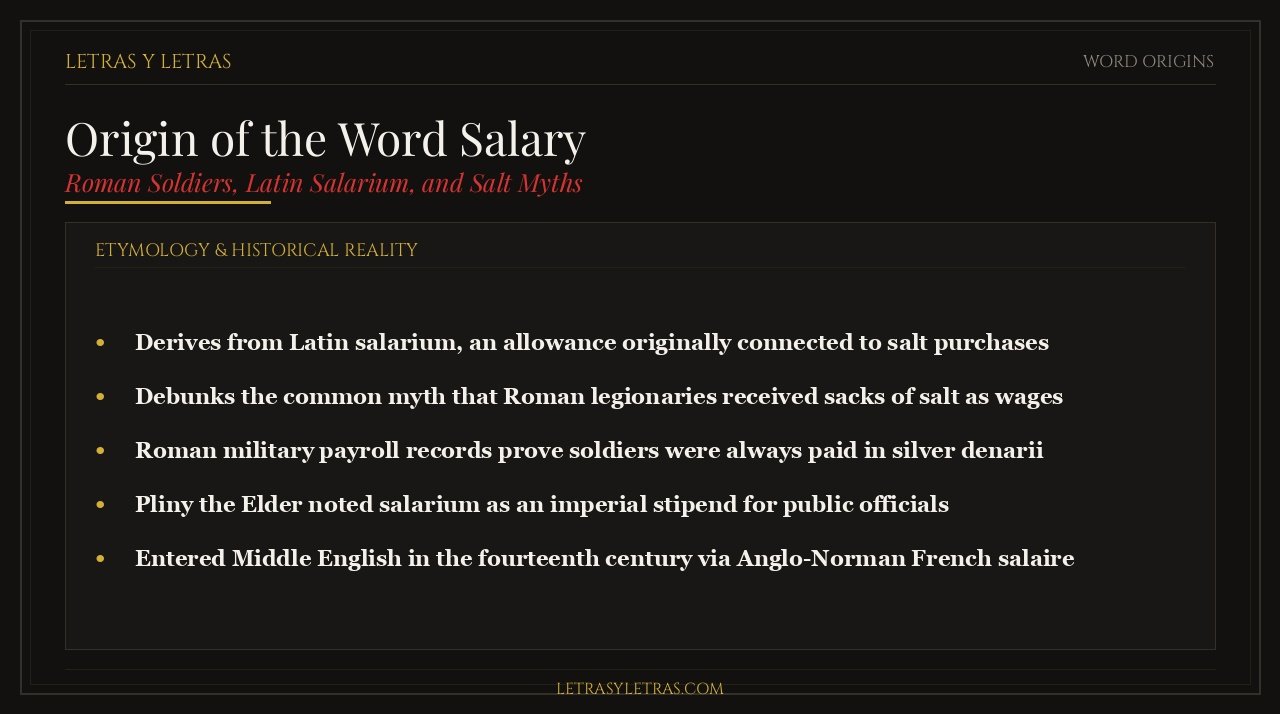
The word salary derives from the Latin noun salarium, which originated as an adjective meaning of salt. In ancient Rome, salarium was a stipend given to soldiers and magistrates to purchase essential provisions, including salt. Roman legionaries were paid in metallic currency such as silver denarii, never in physical bags of salt. The popular legend claiming soldiers received salt as wages is a debunked folk etymology. Anglo-Norman French brought the term into Middle English around 1300 to describe fixed payments for professional services.
Key Takeaways
- Derives from Latin salarium, originally an allowance for purchasing salt and provisions.
- Debunks the popular myth that Roman soldiers received salt rather than money.
- Roman military payroll records prove legionaries received cash wages in silver denarii.
- Adopted into Middle English around 1300 via Anglo-Norman French legal terminology.
- The phrase worth your salt originated in nineteenth-century English print, not ancient Rome.
The Modern Paycheck: White-Collar Salaries and Working Life
Modern labor economics draws a sharp distinction between wages and salaries. Hourly wages compensate workers directly for time spent performing manual or industrial labor. By contrast, a salary represents a fixed annual sum paid to managers, professionals, and executives.
Salaried employees enjoy steady predictability regardless of weekly fluctuations in production schedules. That financial stability helped forge the middle-class professional identity throughout the twentieth century. Contracts, benefit packages, and retirement pensions all revolve around salaried compensation.
Our culture views a salary as a hallmark of professional dignity and respect. We treat regular monthly paychecks as normal features of civilized economic existence. However, ancient civilizations organized military and civil compensation in vastly different ways.
Tracing our modern paycheck back to its linguistic roots transports us to ancient Italy. To understand how seasoning gave us our primary word for income, we must confront a persistent classroom myth.
The Enduring Myth: Did Roman Soldiers Really Get Paid in Salt?
Almost everyone has encountered the popular tale of Roman salt wages. School teachers, trivia websites, and finance podcasts frequently repeat the story as established historical fact. The narrative claims that salt was so rare and valuable that emperors used it as money.
According to this folklore, victorious legionaries lined up on paydays with outstretched hands. Quartermasters supposedly measured out cups of crystalline sea salt into leather satchels. The soldiers then traded those salt crystals in village markets for bread, wine, and weapons.
The story is charming, evocative, and undeniably memorable for history students. It provides a tidy physical explanation for an everyday abstract financial noun. Unfortunately for trivia enthusiasts, historians and classical archaeologists universally reject the story as pure fantasy.
Roman legionaries were professional fighting men who conquered empires across three continents. They marched across burning deserts and freezing alpine passes under strict discipline. No army commander would insult battle-tested soldiers by offering perishable seasoning instead of spendable silver coins.
Roman soldiers demanded hard cash that could be spent in taverns across the Mediterranean. They had zero interest in dragging heavy sacks of table salt across muddy battlefields. The true connection between salt and wages was institutional rather than physical.
The True Latin Root: Sal, Salarium, and Roman Allowances
The word salary originates from the classical Latin noun sal, meaning common salt. Roman grammarians created the neuter adjective salarius, meaning related to or pertaining to salt. Over time, the substantive form salarium took on a specialized administrative meaning.
Linguistic research in the Online Etymology Dictionary entry on salary outlines this administrative evolution. Rather than meaning physical salt, salarium designated an allowance of money. It was cash granted to soldiers, magistrates, or officials to purchase necessary provisions, including salt.
Salt was an indispensable dietary necessity for ancient humans and working livestock. Legionaries marching twenty miles daily under heavy packs lost vital electrolytes through perspiration. Roman cooks also required plentiful salt to preserve meats and season bland military grain rations.
In his monumental encyclopedia Naturalis Historia, Roman author Pliny the Elder discussed the cultural honor of salt. Pliny noted that the term salarium was applied to official stipends because salt was essential to life. The scholar pointed out the linguistic association without claiming soldiers received physical salt at pay tables.
During the Roman Empire, salarium expanded into a formal annual pension or stipend for public officials. Provincial governors, judges, and civil administrators received a salarium from the imperial treasury. The word had shifted from a modest dietary allowance into a prestigious public salary.
What Roman Soldiers Were Actually Paid: Papyri, Denarii, and Deductions
Surviving archaeological discoveries provide definitive evidence of how Roman soldiers were compensated. Archaeologists have uncovered preserved papyrus records from Egypt and wooden writing tablets from Roman Britain. These authentic ancient documents preserve real payroll ledgers from active military units.
Historical analysis in the Oxford Reference entry on Roman military stipends details these accounting methods. Roman legionaries received a regular monetary wage known as the stipendium. Under Emperor Augustus, a standard legionary earned 225 silver denarii each year, paid in three installments.
Emperor Domitian later increased military pay to 300 denarii, distributing the wages across four installments. Paymasters did not simply hand over bags of silver coins without accounting. Military clerks maintained precise balance sheets recording deductions for equipment, clothing, rations, and funeral club dues.
Preserved papyri from Karanis Egypt show that quartermasters subtracted costs for wheat, boots, and armor repairs. After deductions, soldiers received their net balance in copper and silver coinage. There is zero mention of salt rations acting as wage payments in any surviving military document.
Roman soldiers also received occasional imperial gifts called donativa following major victories or accessions. These military bonuses were invariably paid in gleaming silver denarii or gold aurei. The Roman military ran on sophisticated metallic finance, not primitive salt bartering.
The Geography of Roman Salt: The Via Salaria and Ostia Salt Pans
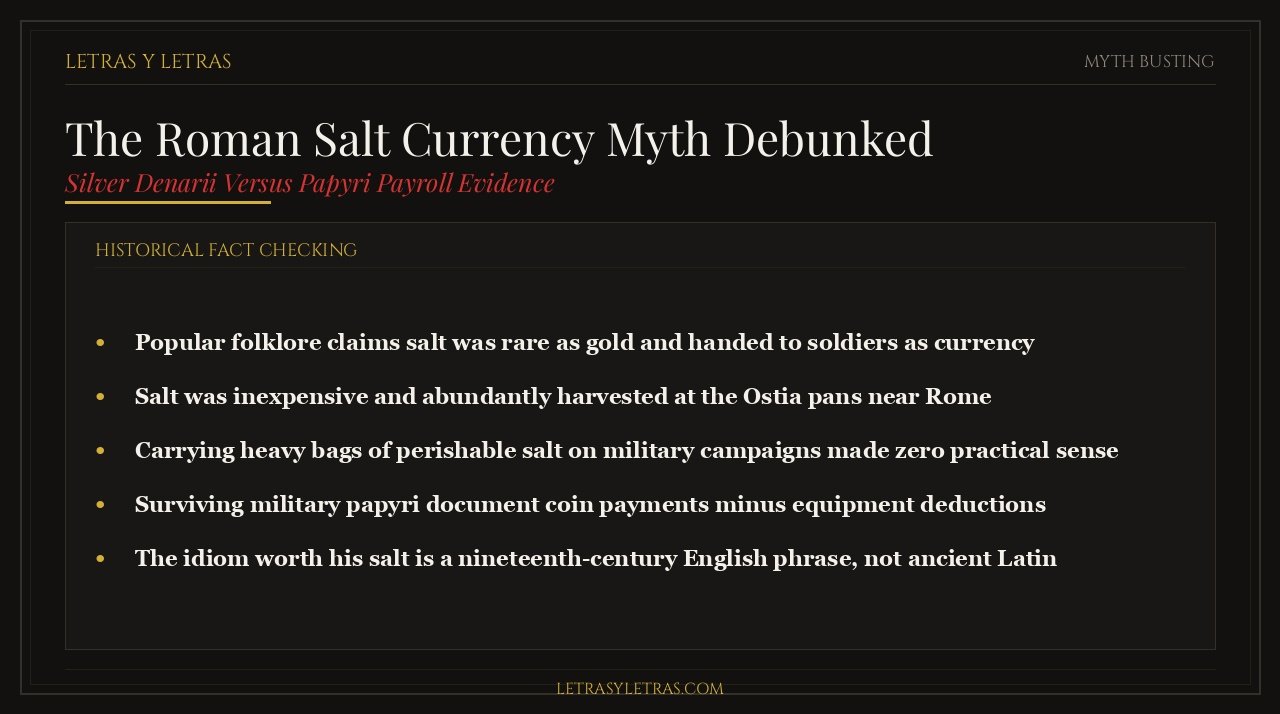
To grasp why salt was never used as currency, one must understand Roman geography. Folk myths assume salt was as rare and costly as precious gold dust. In reality, central Italy possessed some of the most productive salt extraction centers in the ancient world.
Long before Rome became an empire, early settlers harvested salt at the mouth of the Tiber River. The coastal marshes near Ostia provided prime conditions for shallow solar evaporation ponds. Workers channeled Mediterranean seawater into clay pans, harvesting crystalline salt as coastal heat evaporated moisture.
The Romans built one of their earliest paved highways, the Via Salaria, to distribute this mineral. The Salt Road stretched from coastal salt pans through Rome and into the mountainous Sabine interior. Sabine herders drove sheep along the road, exchanging upland wool for coastal salt needed for curing meats.
The Roman Senate considered salt so critical to public welfare that it regulated retail prices. During wartime shortages, magistrates subsidized salt prices to protect poor plebeian families from price gouging. Salt was an affordable, everyday staple, making it wholly impractical as high-value currency.
Transporting tons of cheap salt across provinces to pay legions would have been logistical madness. Rain would dissolve the wages, and damp carts would ruin monthly pay. Silver coins were portable, durable, and universally accepted, making them the only sensible compensation for Roman troops.
From Imperial Rome to Medieval England: The Evolution of Salarium
As the Western Roman Empire collapsed, Latin legal vocabulary survived within Christian church chanceries and legal courts. Late Latin scholars continued using salarium to describe fixed compensation for educated clerks and advocates. The word gradually filtered into early Romance languages across Western Europe.
In medieval France, the Latin term transformed into Old French and Anglo-Norman salaire. French feudal lords used the word to describe regular payments made to household stewards, bailiffs, and court officials. The term carried prestigious connotations of educated, non-manual service.
Economic history in the Britannica overview of salary and wages traces its Middle English arrival. Following the Norman Conquest of 1066, Anglo-Norman legal vocabulary permeated English administration. Middle English adopted the term around 1300 as salari or salarye.
Early English records used salary to designate periodic payments made to parish priests and magistrates. Geoffrey Chaucer and John Wycliffe used the noun in fourteenth-century manuscripts to describe official stipends. Unlike seasonal farm wages, a salary implied ongoing employment under a formal contract.
By the time of the Industrial Revolution, English businesses firmly distinguished salaried staff from wage laborers. Office clerks, accountants, and engineers earned monthly salaries, while factory hands received weekly wages. The ancient Latin allowance for salt had become the universal badge of professional employment.
Unraveling the Phrase: Where Does Worth One’s Salt Actually Come From?
Another widespread linguistic misconception closely accompanies the salary myth. Popular culture asserts that the common idiom worth one’s salt dates back to ancient Roman legionaries. Fans of the phrase claim centurions evaluated recruits based on if they justified their salt wages.
Classical Latin literature contains no such expression. Scholars searching Latin texts from Cicero, Caesar, and Livy have found zero instances of a comparable phrase. The ancient Romans praised loyal service, but they never measured military value against seasoning rations.
In truth, the idiom worth one’s salt is a much later English creation. The Oxford English Dictionary records its earliest known print appearance in 1805 in an educational publication. British writers used the expression to describe an efficient worker who earned his keep.
Nineteenth-century writers drew upon the vital household necessity of salt when framing the idiom. If an employee was not worth even cheap table salt, he was entirely useless to an employer. Retrospective storytellers later projected this modern idiom onto ancient legionaries to manufacture a catchy etymology.
Readers studying labor language will enjoy our guide to the origin of the word robot. That famous technology term also began with compulsory servitude before transforming modern speech.
Chronological Milestones in the History of Salary
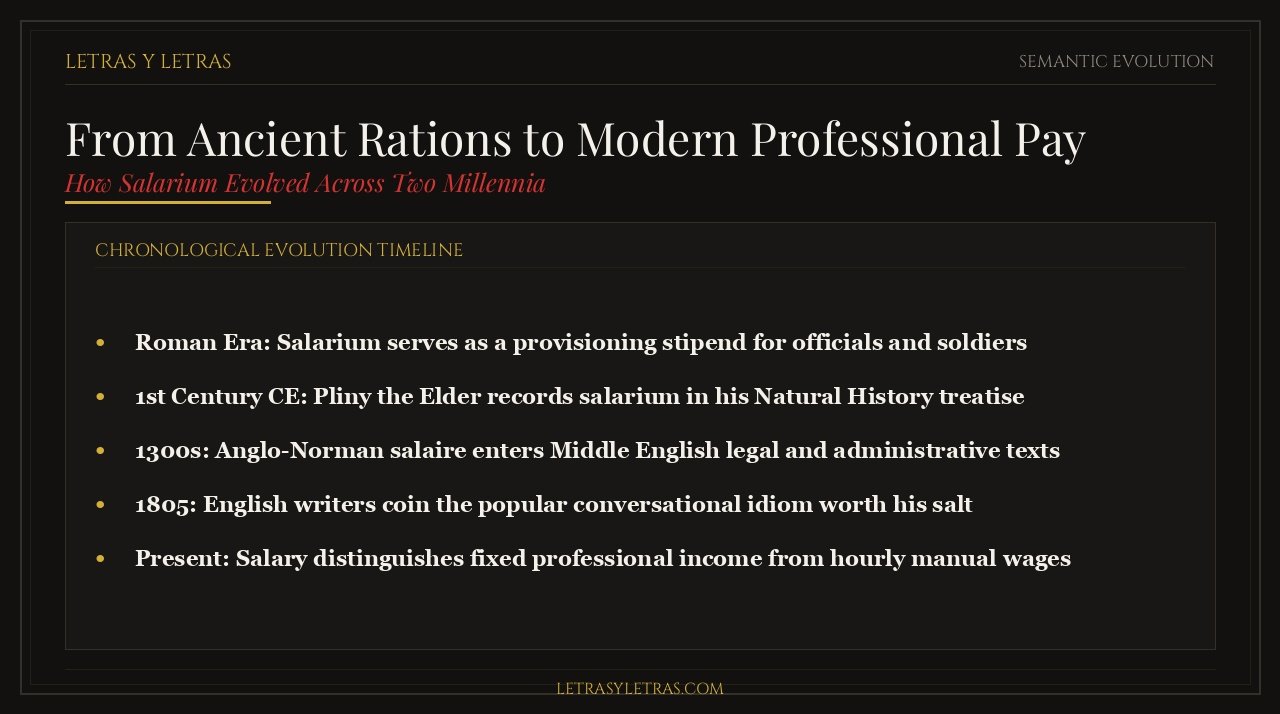
The word salary traveled across two millennia of Mediterranean history and European legal development. The following responsive table details each crucial linguistic and cultural milestone along the path.
| Historical Era | Source or Culture | Administrative Context | Linguistic Development |
|---|---|---|---|
| 500 to 100 BCE | Early Roman Republic | Ostia Salt Works and Via Salaria | Salarius functions as an adjective meaning of salt, describing salt trade routes. |
| 1st Century CE | Pliny the Elder | Naturalis Historia Book 31 | Salarium denotes an imperial stipend or provisioning allowance granted to public officials. |
| 27 BCE to 300 CE | Roman Imperial Army | Military Payroll Ledgers | Legionaries receive stipendium in silver denarii minus deductions for equipment and grain. |
| 1100 to 1200s | Anglo-Norman Administration | Feudal European Courts | Latin salarium shifts into Old French salaire, designating pay for official services. |
| Around 1300 | Middle English Legal Texts | Chancery Court Documents | Enters English as salari or salarye to describe regular payments to priests and clerks. |
| 1805 | British Literature | Popular Colloquial English | The phrase worth his salt appears in print, measuring human competence against basic food. |
| 20th Century | Modern Labor Economics | Corporate Corporate Payrolls | Salary solidifies as a fixed annual income distinguishing professional roles from hourly wages. |
Debunking Common Myths About the Word Salary
Because folk etymology loves dramatic physical tales, multiple misconceptions continue to circulate around the word salary. Internet blogs, trivia games, and cocktail party conversations frequently spread these historical errors. Examining each myth against documentary evidence clarifies authentic history.
The first myth claims that Roman legionaries received sacks of table salt as their regular monthly wages. As proven by surviving military papyri, Roman soldiers were always paid in metallic currency such as silver denarii. Salt was an essential supply item, not spendable military currency.
The second myth asserts that salt was as costly as gold in ancient Mediterranean commerce. While valuable for health and meat preservation, salt was abundantly harvested at Ostia and along Italian coasts. The Roman Senate kept salt prices low to ensure ordinary citizens could afford it.
The third myth maintains that the idiom worth one’s salt was invented by ancient Roman officers. Classical Latin literature contains zero evidence of this expression in any military or philosophical text. The phrase is a nineteenth-century English creation that first appeared in print in 1805.
The fourth myth suggests that salarium originally designated manual farm labor wages. In imperial Rome, salarium specifically designated stipends paid to magistrates, provincial governors, and public officials. The term has always carried associations of administrative service and professional responsibility.
Readers curious about other workplace resistance terms will appreciate our article on the origin of the word sabotage. That term also arose from tensions between industrial laborers and factory managers.
Frequently Asked Questions
Did Roman soldiers really get paid in salt?
Roman soldiers were never paid in salt. Surviving military records prove legionaries received cash wages in silver denarii, with deductions taken for rations, boots, and armor.
What did salarium actually mean in ancient Rome?
In ancient Rome, salarium was a monetary allowance or stipend granted to soldiers and public officials. The allowance helped recipients purchase salt and other essential personal provisions.
When did the word salary enter the English language?
The word salary entered Middle English around 1300 through Anglo-Norman French salaire. It originally described regular stipends paid to parish priests, magistrates, and administrative clerks.
Where does the phrase worth your salt come from?
The phrase worth your salt is an English idiom first recorded in print in 1805. It did not originate in ancient Rome, despite frequent claims by popular trivia websites.
Why was salt so important to the Roman military?
Salt was vital for legionaries because heavy marching caused dangerous electrolyte loss through sweat. Roman army cooks also required large amounts of salt to cure meats and season daily wheat rations.
The Enduring Dignity of Compensation: Reflections on Work and Reward
More than two thousand years after Roman clerks balanced military ledgers, we still use salarium every single payday. The word connects our digital bank deposits with ancient supply roads and solar evaporation ponds along the Tiber. It reminds us that human societies have always sought fair methods to reward honest labor.
When employers negotiate compensation packages today, they participate in an ancient linguistic tradition. A salary is not merely an exchange of hours for currency. It represents a mutual commitment of trust, professional duty, and personal security between organizations and working people.
Every financial term in our vocabulary preserves forgotten struggles, logistical innovations, and cultural values. Every time you review your paycheck, you touch a linguistic thread stretching back to Roman legionaries along the Mediterranean. Behind every ordinary word lies an extraordinary story of human civilization.
Readers can explore more community protest stories in our study of the origin of the word boycott. Every chapter in etymological history reveals how human experiences shape our everyday vocabulary.


Alan Sledge is the writer and founder behind Letters & Letters. A lifelong lover of words, Alan has always been drawn to the small mysteries hidden in everyday language, why we say what we say, where our favorite sayings came from and the quotes that manage to put feelings into words better than we ever could ourselves.

Alan Sledge
Alan Sledge is the founder and lead researcher behind Letters & Letters. A lifelong student of linguistic history, he cross-references every word origin, idiom, and quote against primary archival manuscripts, the Oxford English Corpus, and 18th-century print lexicons.