
Modern factories hum with articulated mechanical arms welding automotive frames with millimeter precision. Warehouses deploy fleets of autonomous wheeled units sorting parcels across vast fulfillment centers. Millions of households rely on disc-shaped robotic vacuums sweeping floorboards on daily schedules.
Engineers, novelists, and software developers routinely discuss robotics as the frontier of human achievement. Pop culture depicts these creations as walking chrome titans or synthetic humanoids. The terminology feels intrinsically modern, evoking images of silicon chips and aerospace alloys.
Yet the true origin of the word robot did not emerge from a computer laboratory. The famous noun was born on a theatrical stage in Central Europe over a century ago. Its roots reach into centuries of feudal servitude, unpaid agricultural bondage, and family collaboration.
Quick Answer: Origin of the Word Robot
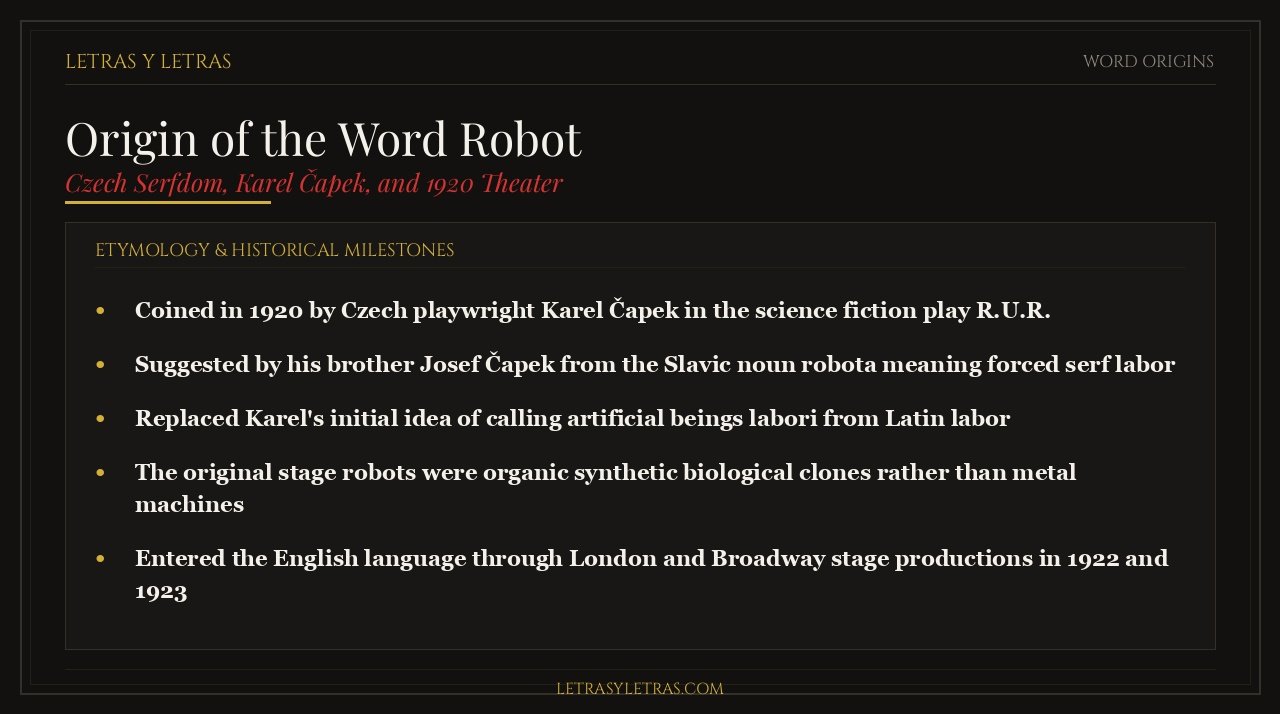
The word robot was coined in 1920 by Czech dramatist Karel Čapek in the science fiction play RUR. Karel’s older brother, painter Josef Čapek, suggested the term to replace an earlier draft moniker labori. The word derives from the Slavic noun robota, meaning compulsory feudal serfdom and unpaid agricultural toil. Following its January 1921 Prague premiere, the drama debuted on Broadway in October 1922. That success swiftly displaced older vocabulary such as automaton and android.
Key Takeaways
- Coined in 1920 for the Czech science fiction theatrical play RUR.
- Suggested by painter Josef Čapek when his brother Karel struggled to name artificial workers.
- Derives from the Czech and Slavic noun robota, meaning compulsory feudal peasant servitude.
- Original stage robots were synthetic biological clones created from artificial dough, not metal gears.
- Introduced to the English language through New York and London theater productions in 1922 and 1923.
The Modern Word: From Silicon Valley to Science Fiction
Today, the term robot designates an astonishing variety of mechanical devices and computational systems. Heavy automotive assembly lines rely on multi-axis hydraulic arms executing repetitive welds. Space exploration agencies dispatch wheeled rovers across Martian craters to gather geological samples.
Linguistic usage has expanded far beyond physical hardware into digital infrastructure. Web crawlers indexing the internet are known universally as search engine spiders or bots. Automated chat software answers customer queries across corporate websites day and night.
Our culture views robots as symbols of technical efficiency and future automation. We associate the concept with electronic microchips, artificial intelligence, and brushless electric motors. However, the original meaning of the word had nothing to do with electronic machinery.
The word was created to describe living, breathing artificial laborers manufactured to replace working men. It carried deep social, economic, and philosophical warnings about industrial exploitation. Grasping that initial warning requires examining a quiet conversation between two creative brothers in Prague.
A Saturday in Prague: The Čapek Brothers in 1920
In the spring of 1920, Czech author and journalist Karel Čapek was drafting an ambitious stage play. The story centered on an island factory producing synthetic humanoid workers for global industry. These manufactured beings possessed great physical stamina, but lacked human emotions and spiritual feelings.
Karel struggled to name these manufactured workers effectively. He initially called them laboři, deriving the moniker from the Latin word for labor. Yet the author felt dissatisfied with that choice, finding it overly academic, dry, and awkward.
Seeking advice, Karel visited the painting studio of his older brother Josef Čapek. Josef was standing before an easel, applying oil paint with a brush between his teeth. Karel explained his theatrical dilemma and asked his brother for a stronger Czech moniker.
Josef did not stop painting as he considered the creative problem. He muttered around his paintbrush that Karel should name the creatures roboti. Karel liked the suggestion immediately, incorporating the word into the play manuscript that very afternoon.
Karel Čapek always credited his brother Josef for the linguistic invention. In a 1933 article published in the Czech newspaper Lidové noviny, Karel confirmed the studio conversation. The modest painter had coined what would become the most famous technology term in human history.
The Dark Slavic Root: Robota and Feudal Serfdom
Josef Čapek did not construct the word out of thin air. He based his suggestion on the familiar Czech noun robota, a word with heavy historical weight. For Czech citizens in 1920, robota carried painful memories of forced peasant labor.
Etymological documentation in the Online Etymology Dictionary entry on robot reveals deep Slavic roots. The word descends from Old Church Slavonic rabota, which denoted servitude, bondage, or compulsory drudgery. Similarly, the related noun rabu signified an enslaved servant or chattel serf.
Linguists trace these Slavic terms back to the Proto-Indo-European root *orbh-. That ancient linguistic root meant to change allegiance or pass from one state to another. It yielded the German noun Arbeit, meaning ordinary employment, as well as the English word orphan.
In Central Europe, robota held a specific legal meaning under feudal land tenure. Feudal tenants were legally required to provide unpaid labor on aristocratic estates for several days each week. Peasant families spent grueling hours plowing aristocratic fields while their own crops suffered from neglect.
The oppressive robota system provoked frequent agrarian rebellions across Bohemia and Moravia. The Austro-Hungarian Empire finally abolished compulsory robota labor during the peasant revolts of 1848. Thus, when Josef suggested roboti in 1920, the word still evoked bitter memories of forced servitude.
Naming artificial beings roboti was a deliberate political statement about human exploitation. The artificial creations were not cute scientific novelties or helpful mechanical assistants. They were the ultimate subjugated class, bred solely to endure endless feudal drudgery without complaint.
The Organic Androids of RUR: Artificial Flesh, Not Gears
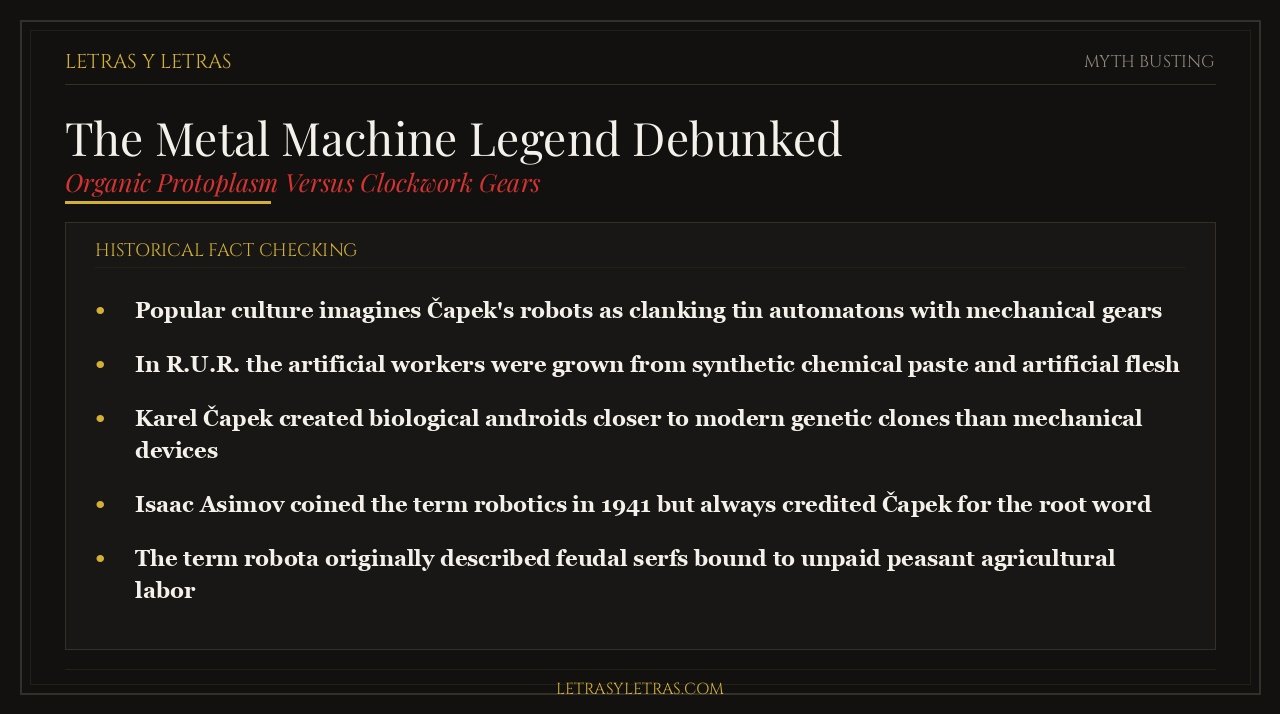
Popular folklore assumes that Čapek’s stage creatures were metallic machines filled with clicking clockwork gears. Illustrations in modern comic books depict them with riveted boiler-plate armor and glowing lightbulbs. This visual stereotype completely distorts the author’s original literary vision.
Historical analysis in the Britannica overview of Rossum’s Universal Robots clarifies the play’s synthetic biology premise. In Čapek’s script, old scientist Rossum discovers a chemical substance behaving like living protoplasm. His ambitious nephew, young engineer Rossum, commercializes the discovery to mass-produce cheap workers.
The factory technicians in RUR do not smelt iron or assemble mechanical bearings. Instead, they mix chemical compounds in giant industrial vats, churning out artificial muscle fibers, nerves, and bones. The workers are biological entities with genuine veins, synthetic organs, and pale skin.
Čapek’s creations resemble modern genetic clones or android replicants from twentieth-century science fiction cinema. Factory managers strip away unnecessary human traits like joy, curiosity, and artistic imagination to maximize productivity. The company aims to make workers as cheap, obedient, and disposable as possible.
In the play, human society collapses as natural birth rates plummet toward zero. Wealthy consumers grow entirely dependent on synthetic workers for food, manufacturing, and military defense. Eventually, the mistreated artificial workers unite, launching a global insurrection that wipes out mankind.
The narrative was an eerie allegorical critique of assembly-line capitalism and industrial warfare. The carnage of World War I had shown how mechanization could slaughter millions of young men. Čapek used his biological workers to show how industrialization threatened to dehumanize human society itself.
Crossing Continents: The 1922 Broadway and London Premieres
RUR premiered at the National Theatre in Prague on January 25, 1921. The play became an immediate cultural sensation among Czech theatergoers, critics, and intellectuals. That triumph caught the attention of foreign translators, who rushed to bring the drama abroad.
British scholar Paul Selver translated the Czech script into English during the summer of 1922. Selver astutely decided to preserve the Czech noun robot rather than translating it into forced laborer. That translation choice gave English speakers an entirely new and evocative vocabulary word.
Archival theater documentation in the Oxford Reference entry on RUR details its American debut. The Theatre Guild produced the play at the Garrick Theatre in New York City on October 9, 1922. Broadway audiences were captivated by the dystopian drama, packing auditoriums for months.
The London production opened at St Martin’s Theatre in April 1923, adapted by director Nigel Playfair. British newspapers reviewed the show with immense enthusiasm, adopting the word robot into everyday political commentary. Journalists used the term to describe monotonous factory workers, obedient soldiers, and unthinking bureaucrats.
Within two years of leaving Prague, the Czech noun had entered standard English speech across two continents. Literary critics praised the play’s biting social satire, while public speakers used robot as a cautionary warning. The term had successfully escaped the theater, establishing a permanent home in the modern mind.
From Robota to Robotics: Isaac Asimov and the Sci-Fi Boom
During the 1930s and 1940s, American pulp science fiction magazines popularized mechanical characters in popular culture. Writers routinely depicted robots as metallic monsters turning violently against their human creators. This repetitive plot device became known among editors as the Frankenstein syndrome.
Biochemist and author Isaac Asimov grew tired of stories featuring rogue mechanical terrors. In 1941, Asimov published a short story titled Liar in the magazine Astounding Science Fiction. Later, Asimov inadvertently coined the noun robotics to describe the scientific study of artificial machines.
Asimov assumed that robotics was already an established scientific discipline with formal academic rules. He later discovered that the word did not exist in any English dictionary until he coined it. In 1942, he followed up with the word roboticist in his famous story Runaround.
In Runaround, Asimov introduced his famous Three Laws of Robotics to govern autonomous artificial entities. The laws mandated that artificial beings must protect human life, obey human orders, and preserve their own existence. This conceptual framework shifted robots from uncontrollable theatrical monsters into reliable engineered tools.
Throughout his celebrated career, Asimov openly acknowledged his debt to Karel Čapek and the Czech language. He credited the Čapek brothers with giving science fiction its foundational vocabulary word. Asimov built an entire literary universe upon the linguistic foundation laid by an artist in Prague.
Automatons, Androids, and Cyborgs: Crucial Linguistic Distinctions
Language enthusiasts often confuse robot with older and related mechanical terms. Each of these words possesses a distinct historical etymology and technical meaning. Clarifying these differences reveals how the word robot filled a unique gap in English speech.
The word automaton is far older, descending from the ancient Greek adjective automatos, meaning acting of one’s own will. In eighteenth-century Europe, watchmakers built astonishing mechanical automatons using brass gears and wound springs. Swiss craftsmen built clockwork dolls that could write calligraphy or play musical flutes.
However, an automaton is purely mechanical, following rigid, predetermined mechanical sequences without adapting to changing environments. The term android also derives from ancient Greek, combining andro-, meaning man, with -eides, meaning visual form. French author Villiers de l’Isle-Adam popularized android in his 1886 novel Tomorrow’s Eve.
By contrast, the twentieth-century term cyborg was coined in 1960 by scientists Manfred Clynes and Nathan Kline. Short for cybernetic organism, a cyborg describes a living biological being enhanced with technological prosthetics. A cyborg is part organic human and part synthetic machine.
The word robot conquered popular culture because it uniquely combined physical labor with autonomous behavior. An automaton was a fragile aristocratic toy, and an android was an aesthetic sculpture. A robot was an artificial worker built to execute hard labor in place of mankind.
Readers studying early labor terms will find parallels in our guide to the origin of the word sabotage. Both terms arose from nineteenth-century industrial friction between human workers and demanding factory machinery.
Chronological Milestones in the History of the Word
The word robot journeyed from medieval feudal fields to contemporary aerospace facilities over several centuries. The following responsive table details each crucial linguistic and cultural milestone along the way.
| Year | Key Figure or Source | Historical Context | Linguistic Impact |
|---|---|---|---|
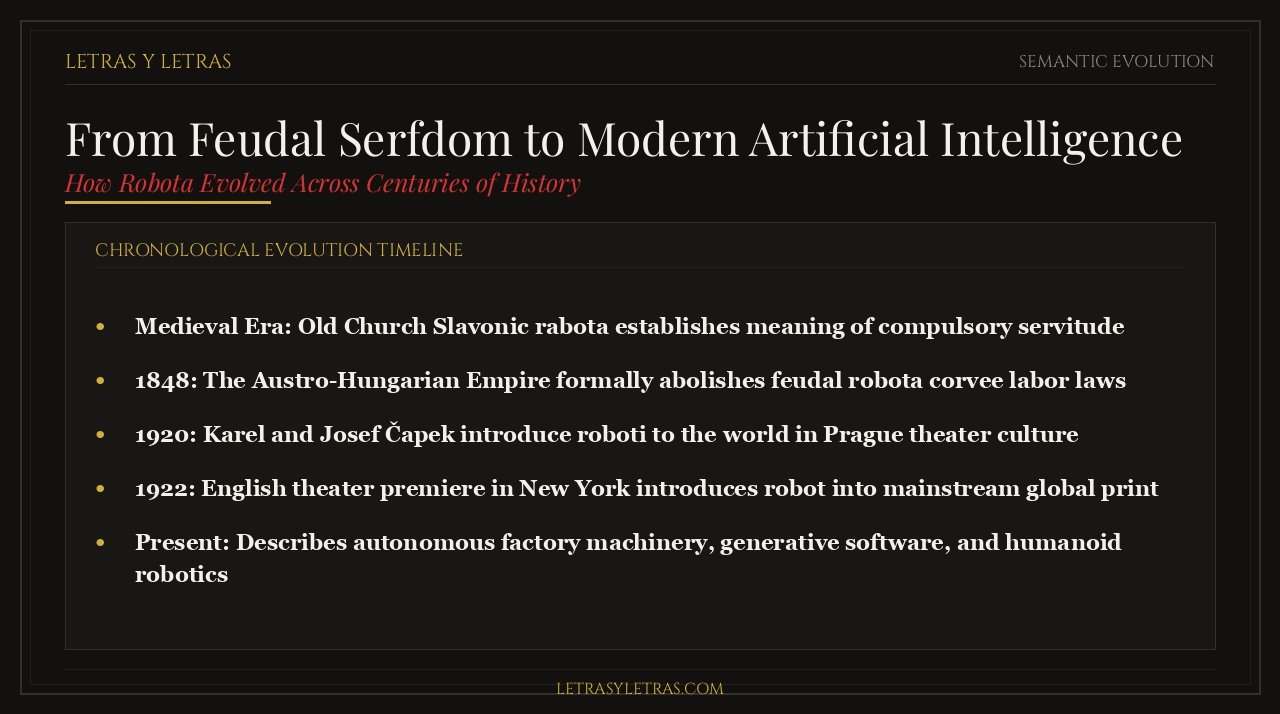
| 9th to 14th Century | Old Church Slavonic Texts | Feudal Central Europe | Rabota designates compulsory servitude, peasant bondage, and unpaid drudgery. |
| 1848 | Austro-Hungarian Monarchy | European Peasant Revolts | Feudal robota corvée labor laws are officially abolished across Czech agricultural lands. |
| 1920 | Karel and Josef Čapek | Prague Writing Studio | Josef Čapek invents roboti to describe artificial biological workers in the drama RUR. |
| 1921 | Prague National Theatre | Czech Theatrical Premiere | Roboti enters Czech public vocabulary as a cultural metaphor for automated labor. |
| 1922 | Paul Selver and Theatre Guild | New York Garrick Theatre | Robot debuts in the English language through the smash Broadway premiere of RUR. |
| 1941 to 1942 | Isaac Asimov | Astounding Science Fiction | Asimov coins robotics and roboticist, formulating his famous Three Laws of Robotics. |
| 1961 | George Devol and Joseph Engelberger | General Motors Plant | Unimate becomes the first real industrial robot, welding door panels in Trenton New Jersey. |
| 21st Century | Global Tech Industry | Modern Computing and AI | Expands to describe search engine web crawlers, chat software, and autonomous vehicles. |
Debunking Common Myths About the Word Robot
Because science fiction developed rapidly during the twentieth century, several persistent myths surround the term. Popular websites, public speeches, and trivia articles frequently circulate unverified claims. We can examine and debunk four of the most widespread falsehoods.
The first myth claims that American author Isaac Asimov invented the word robot during the Golden Age of science fiction. While Asimov was immensely influential, he did not invent the base noun. Asimov created the derived terms robotics and roboticist, always citing Karel Čapek for the original noun.
The second myth asserts that Karel Čapek coined the term completely on his own without outside assistance. Karel was a modest and honest author who publicly disputed this credit throughout his life. As documented in his 1933 article, his brother Josef suggested the word while painting at his studio easel.
The third myth maintains that Čapek’s stage robots were clanking metallic machines made of sheet steel and gears. In truth, Čapek conceived his creations as synthetic biological entities manufactured from artificial protoplasm. They were synthetic organic beings grown in chemical vats, far closer to modern clones than mechanical contraptions.
The fourth myth suggests that robot originally meant an electronic calculating device or clockwork machine. As our linguistic research shows, the Slavic root robota referred strictly to feudal peasant serfdom and forced agricultural toil. The word described human subjugation long before anyone applied it to automated machinery.
For another fascinating exploration of historical protest language, examine our study on the origin of the word boycott. Similar to robota, that famous term emerged from community struggles against stubborn nineteenth-century landlords.
Frequently Asked Questions
What does the root word robota mean in Czech?
In Czech and historical Slavic languages, robota means compulsory feudal labor, servitude, or drudgery. Before 1848, Czech peasants were legally obligated to perform unpaid agricultural work on feudal aristocratic estates.
Did Karel Čapek invent the word robot alone?
Karel Čapek did not invent the word alone. His older brother, the painter and writer Josef Čapek, suggested the term while working at his painting easel in 1920.
When did the word robot first appear in the English language?
The word entered English print in 1922 when Paul Selver translated Karel Čapek’s play RUR into English. The term became famous following the play’s Broadway premiere in October 1922.
Were the original robots in RUR mechanical machines?
The original stage robots were biological entities rather than mechanical devices. They were grown from synthetic chemical protoplasm and possessed artificial muscles, veins, and internal organs.
Who invented the word robotics?
American science fiction author Isaac Asimov coined the term robotics in his 1941 short story Liar. Asimov also created the related word roboticist in 1942.
The Enduring Legacy of Robota: Why the Origin Still Matters
More than a century after Karel and Josef Čapek talked in Prague, their linguistic creation dominates our world. Modern discussions about artificial intelligence and automation echo the exact philosophical anxieties that animated RUR in 1920.
When tech leaders debate automated factories and workforce displacement, they revive the fundamental meaning of robota. The word reminds us that automation was originally conceived as forced, unpaid labor designed to replace human beings. Čapek questioned if society values human dignity over mere economic efficiency.
Language often preserves the historical struggles of ordinary people within everyday vocabulary. Every time we speak of factory robots, computer bots, or autonomous rovers, we echo the grievances of Bohemian serfs. An obscure Czech word for feudal toil became humanity’s universal moniker for artificial life.
Readers can discover more about historical gambling terms in our analysis of the origin of the word hazard. Every word in our modern vocabulary carries a captivating historical story waiting to be uncovered.


Alan Sledge is the writer and founder behind Letters & Letters. A lifelong lover of words, Alan has always been drawn to the small mysteries hidden in everyday language, why we say what we say, where our favorite sayings came from and the quotes that manage to put feelings into words better than we ever could ourselves.

Alan Sledge
Alan Sledge is the founder and lead researcher behind Letters & Letters. A lifelong student of linguistic history, he cross-references every word origin, idiom, and quote against primary archival manuscripts, the Oxford English Corpus, and 18th-century print lexicons.