
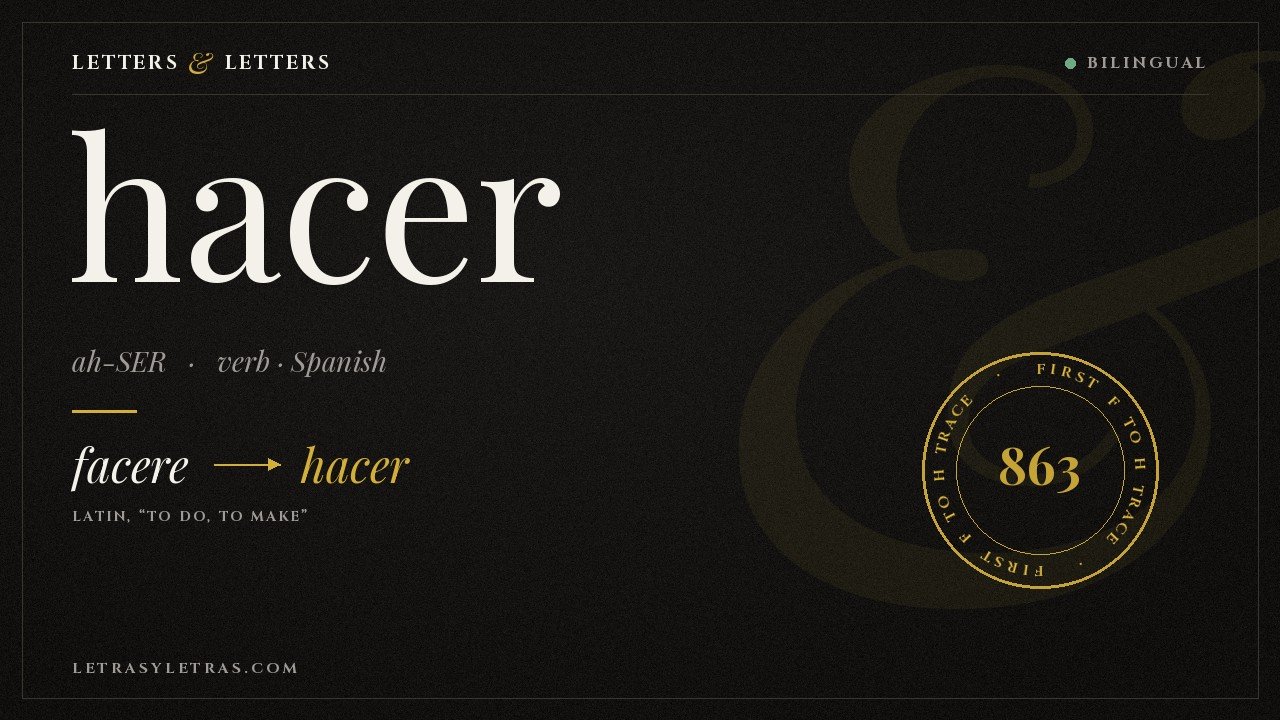
Say hola to a Spanish speaker and you never touch the first letter. The H sits there in ink, completely mute. Most Spanish words that start with H carry a secret: about a thousand years ago, many of them began with an F.
Below you will find the everyday H words learners need, sorted by type with English meanings. Along the way, each list shows where its silent H came from. Once you see the pattern, the spelling stops feeling random.
Quick Answer: Spanish Words That Start With H
Common Spanish words that start with H include hola (hello), hombre (man), hijo (son), hacer (to do or make), hablar (to speak), hoy (today), hasta (until), huevo (egg), hielo (ice) and hermoso (beautiful). In standard Spanish the H is silent, so hacer sounds like “ah-SER.” Many of these words began with F in Latin: facere became hacer, farina became harina and ferrum became hierro. Castilian speakers turned that F into a breathy H sound, and the Real Academia Española notes it was still pronounced in such words until the middle of the 16th century. Other H words kept a Latin H (hora, haber), while huevo and hueso gained an H in spelling before their opening diphthong.
Key Takeaways
- The Spanish H has no sound of its own in standard Spanish, except inside the digraph CH.
- A large group of H words began with Latin F: hacer, hijo, harina, hierro, hoja, humo and hablar.
- The earliest written hint of the F to H shift dates from 863, when Forticius was spelled Ortiço.
- Words opening with ue or ie take an H in spelling: huevo, hueso, hielo, hierba.
- Some loanwords keep a breathy H, such as hámster, hachís and hándicap.
Why the Spanish H Makes No Sound
The letter is called hache, a feminine noun, so you say la hache. Spanish took the name from Old French ache. Its plural is haches.
The Real Academia guide to h states it plainly: in standard modern Spanish, this letter represents no sound at all. Hola and ola (wave) are pronounced the same way. Only spelling tells them apart.
That raises a fair question. Why keep a letter nobody pronounces? The answer is history, and it begins with a different consonant.
From Latin F to Spanish H
In the Latin of northern Castile, a word-initial F before a vowel slowly softened. Linguists describe it moving from a lip sound to a breathy [h], then fading out altogether. Italian kept the F. Compare Italian fumo and formica with Spanish humo (smoke) and hormiga (ant).
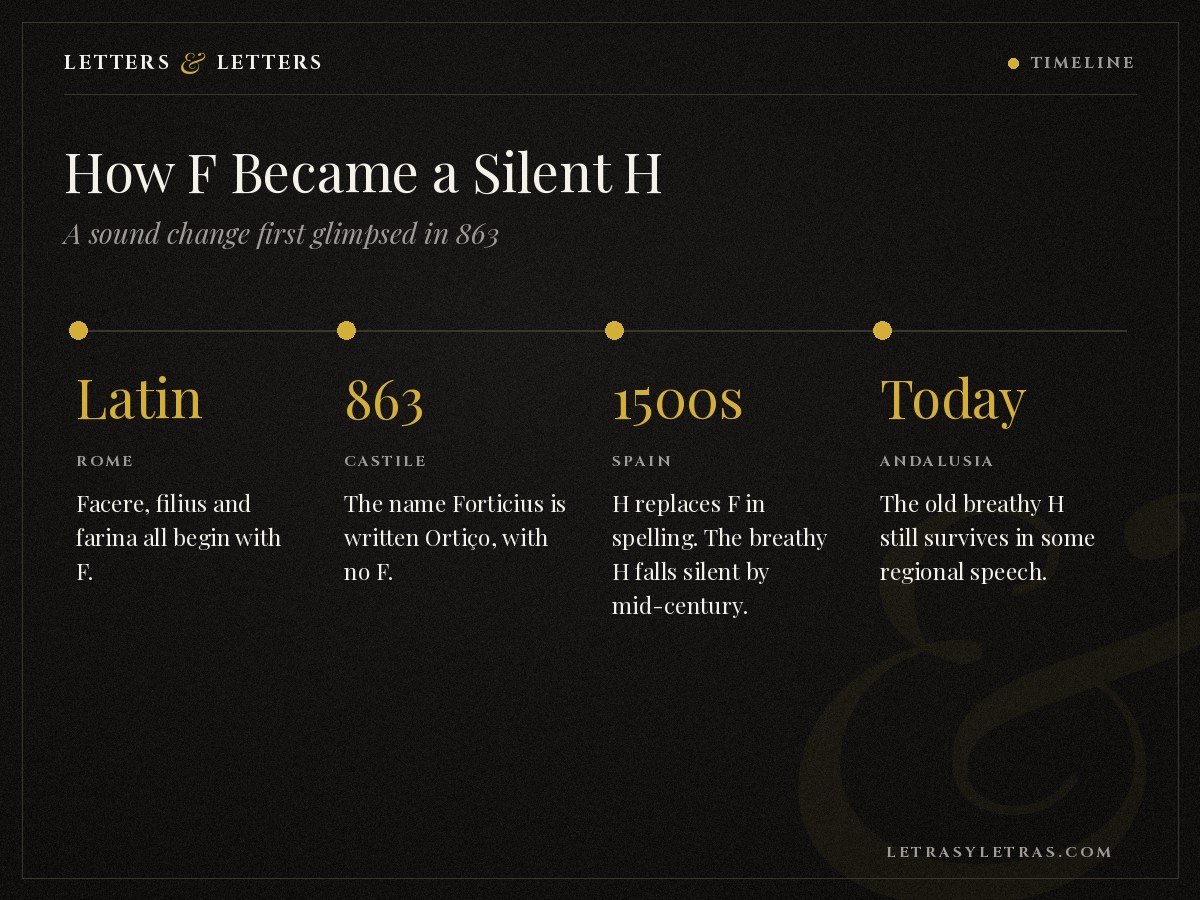
The first written trace appears in 863. A scribe wrote the Latin name Forticius as Ortiço, with no F at all. By 927, a document spells the same name Hortiço.
For centuries, though, scribes kept writing F even when they said H. Old Spanish texts give fazer, fijo and fablar for hacer, hijo and hablar. The H spelling took over in the 16th century. By then, learned Latin borrowings had brought a true F sound back into Spanish.
The Basque Theory
The F to H change happened in Old Castile, eastern Asturias and Gascony. Almost nowhere else nearby shared it. Much of that area was bilingual with Basque, which once had an [h] sound but no [f]. Many scholars suspect Basque speakers nudged the change along.
Others argue the shift grew from inside Castilian itself. The debate is still open, so treat any confident “Basque did it” claim with care.
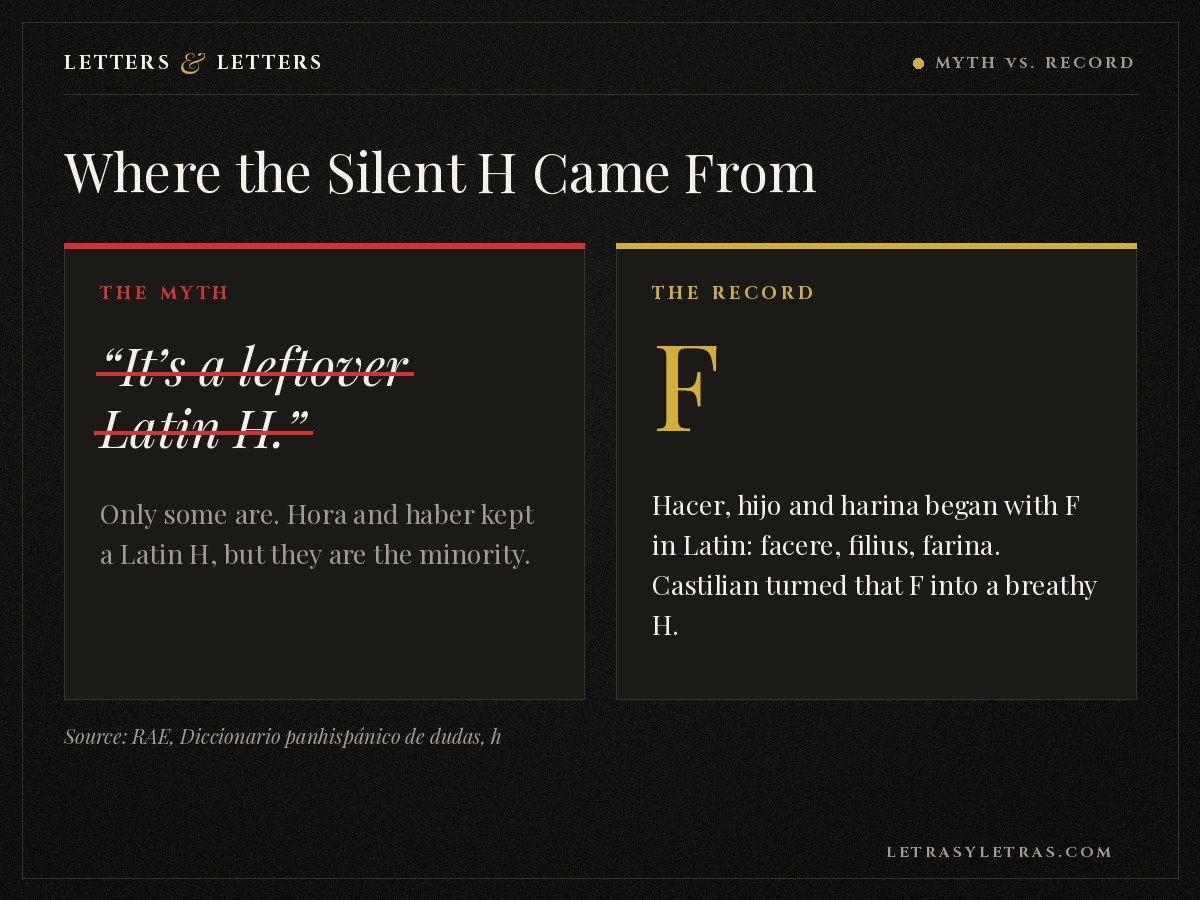
Spanish Words That Start With H From a Latin F
This is the group that explains the silent letter. Each word below began with F in Latin and passed through an Old Spanish F form. Notice how many English relatives kept the F.
| Spanish Word | Meaning | Latin Root (Old Spanish) |
|---|---|---|
| hacer | to do, to make | facere (fazer) |
| hijo / hija | son / daughter | filius (fijo) |
| hablar | to speak | fabulari, “to chat” (fablar) |
| harina | flour | farina (farina) |
| hierro | iron | ferrum (fierro) |
| hoja | leaf, sheet of paper | folia (foja) |
| humo | smoke | fumus (fumo) |
| hilo | thread | filum (filo) |
| horno | oven | furnus (forno) |
| hambre | hunger | fames (fambre) |
| higo | fig | ficus (figo) |
| hormiga | ant | formica (formiga) |
| hermoso | beautiful | formosus (fermoso) |
| hembra | female | femina (fembra) |
| hada | fairy | fata, “goddess of fate” (fada) |
| hoz | sickle | falx (foz) |
English speakers get a free memory trick here. Fig sits beside higo, filial beside hijo, and fumigate beside humo. Swap the H for an F and the meaning often surfaces.
Spanish even kept both versions of some words. Fernando is the learned form and Hernando the inherited one, both meaning Ferdinand. Fondo means “bottom” while hondo means “deep.” Satisfacer (to satisfy) still hides the old F of hacer.
Words that began with F plus a consonant or a diphthong mostly escaped the change. That is why Spanish still says flor, frente, fiesta and fuerte.
Everyday Spanish Nouns That Start With H
These are the H nouns you will meet in your first months of Spanish. The article in brackets tells you the gender.
| Spanish Word | Meaning | Where the H Comes From |
|---|---|---|
| la hora | hour, time | Latin hora, H kept |
| el hombre | man | Latin hominem, Old Spanish omne |
| el hermano | brother | Latin germanus, Old Spanish ermano |
| el huevo | egg | Latin ovum, H added in spelling |
| el hueso | bone | Latin ossum, H added in spelling |
| el hielo | ice | Latin gelu, earlier Spanish yelo |
| el hogar | home, hearth | Latin focus (hearth), via focaris |
| el hospital | hospital | Same Latin root as English |
| la historia | history, story | Latin historia, from Greek |
| el helado | ice cream | Related to hielo |
| el hongo | mushroom, fungus | Old Spanish fongo |
| el halcón | falcon | Late Latin falco |
| el huérfano | orphan | Latin orphanus, H added |
| el hotel | hotel | Borrowed, H still silent |
Look closely at hermano and hombre. Old Spanish wrote ermano and omne without any H. Hombre regained its H from Latin homo. Hermano gained one in spelling too, even though its Latin parent began with G.
Hielo shows a similar twist. It came from Latin gelu through an earlier form, yelo, so its H stands in for a G and a Y rather than an F.
Spanish Verbs That Start With H
Two of the most used verbs in Spanish start with H. Haber builds compound tenses (he comido, “I have eaten”) and gives you hay, “there is.” Hacer covers doing, making and even the weather: hace frío, “it is cold.”
| Spanish Verb | Meaning | Origin Note |
|---|---|---|
| haber | to have (auxiliary), there is | Latin habere, H kept |
| hacer | to do, to make | Latin facere |
| hablar | to speak, to talk | Latin fabulari |
| hallar | to find | Also hallarse, “to find oneself” |
| huir | to flee | Latin fugere, Old Spanish fuir |
| herir | to wound, to hurt | Latin ferire, Old Spanish ferir |
| hervir | to boil | Latin fervere, Old Spanish fervir |
| heredar | to inherit | Same root as English heredity |
| hundir | to sink | Used for ships and moods alike |
| honrar | to honor | Related to honor |
Hervir has a surprising English cousin. Latin fervere goes back to the same ancient root as English brew. Every pot of boiling soup in Spain is, in a distant sense, brewing.
Spanish Adjectives That Start With H
Spanish adjectives agree with their nouns, so most of these switch o to a for feminine forms. Hermoso becomes hermosa, and honesto becomes honesta.
- hermoso: beautiful (Old Spanish fermoso)
- honesto: honest
- humilde: humble
- húmedo: damp, humid
- hondo: deep (Old Spanish fondo, Latin fundus)
- harto: fed up, full
- hábil: skillful
- hambriento: hungry (from hambre)
- hueco: hollow
- horrible: horrible
Hondo carries a small piece of flamenco history. Andalusian speakers kept the breathy H, and the RAE notes that this pronunciation produced the spelling jondo. Cante jondo, the “deep song” of flamenco, is simply hondo said the southern way.
Small Words: Hoy, Hasta, Hacia and Hay
Some of the most frequent H words are tiny. You will use them in nearly every conversation.
- hoy: today (Latin hodie)
- hasta: until, up to, even. Hasta luego means “see you later.”
- hacia: toward
- hay: there is, there are
- hola: hello
Hasta was fasta in Old Spanish, and its deeper source is disputed. One proposal points to Arabic ḥattà (until), another to Latin ad ista (to this). Hola probably came from French holà, an exclamation close to “hey, stop!”
Hue and Hie Words: The Spelling Trick
Here is a rule that saves learners from many spelling mistakes. Spanish words that open with the diphthongs ue or ie take an H in front. Huevo, hueso, huele (it smells), hielo, hierba and hiedra all follow it.
None of these H letters is etymological. Huevo comes from Latin ovum and hueso from ossum, neither with an H. The usual explanation is visual: older writing used one letter for u and v, so the H told readers a vowel came next.
Speech has left marks too. The RAE notes that many speakers add a light G sound, saying something like [guébo] for huevo. Some words now have two accepted spellings because of it, such as marihuana and mariguana. The ie words pick up a Y sound instead, which is why yerba and yedra stand beside hierba and hiedra.
Silent H Homophones That Trip Up Learners
A silent letter creates pairs that sound identical but mean different things. Spanish speakers mix these up in writing, so learners are in good company.
| With H | Without H | Example |
|---|---|---|
| hola (hello) | ola (wave) | Hola, mira esa ola. |
| hecho (done, fact) | echo (I throw) | Ya está hecho. Echo la carta. |
| hay (there is) | ay (ouch, oh) | ¡Ay, hay una abeja! |
| hasta (until) | asta (flagpole, horn) | La bandera sube hasta el asta. |
| hora (hour) | ora (he or she prays) | Ora a la misma hora. |
| honda (deep, sling) | onda (wave, ripple) | Una onda en el agua honda. |
Hecho is a neat case. It descends from Latin factus, the same family as English fact. So when a Spaniard says “es un hecho,” the H is quietly standing in for the F of fact.
When the H Is Not Silent
The rule has three clear exceptions. Learners who know them sound far more natural.
The digraph CH. Paired with C, the H forms the sound in chorizo, chico and noche. That is a separate sound, not a pronounced H.
Foreign words. In loanwords from English, German, Arabic or Japanese, the H often sounds breathy, close to a Spanish J. The RAE lists dírham, hachís, haiku, hámster and hándicap, plus names like Hawái and Hegel.
Regional speech. The old aspirated H survives in parts of Andalusia, Extremadura, the Canary Islands and areas of Latin America. It sometimes moves into spelling: jalar, used in the Americas, is a variant of halar (to pull), and jolgorio now beats holgorio as the common spelling of “merrymaking.”
Timeline of the Spanish H
| Year | Author / Source | Context and Milestone |
|---|---|---|
| Classical Latin | Roman writers | Facere, filius and farina all begin with F |
| 863 | Castilian document | Forticius is written Ortiço, the first sign the F has gone |
| 927 | Castilian document | The same name appears as Hortiço |
| Medieval period | Old Spanish scribes | Fazer, fijo and fablar are still spelled with F but spoken with H |
| 16th century | Spanish printers and writers | H replaces F in spelling as learned Latin words bring F back |
| Mid 1500s | Real Academia Española (DPD) | The breathy H falls silent in standard Spanish |
| Today | Regional speech | Aspirated H survives in Andalusia, Extremadura and the Canaries |
How to Learn Spanish H Words Faster
Group the words by origin, not by alphabet. Put the F family (hacer, hijo, hierro, humo) on one card and the hue and hie family on another. Your brain keeps patterns longer than lists.
Try the F swap on any new H word. When hígado (liver) puzzles you, Italian fegato gives the clue. For hilo (thread), think of filament.
Finally, write the homophones in short sentences. “Hola, ola” on a sticky note costs nothing and prevents a classic spelling slip. Our guide to spanish cognates uses the same trick for thousands of shared words.
Frequently Asked Questions
Is the H always silent in Spanish?
In standard Spanish, yes, apart from the CH digraph. Loanwords such as hámster and hachís are often said with a breathy H, and some regions of Spain and Latin America still aspirate the old H.
What is the Spanish word for the letter H?
The letter is called hache, and it is feminine: la hache. The plural is haches. The name came into Spanish from Old French ache.
What are 10 common Spanish words that start with H?
Hola, hombre, hijo, hermano, hora, hoy, hacer, hablar, huevo and hasta. These cover greetings, family, time and the two busiest H verbs.
Why do so many Spanish H words have an F in English?
Many come from Latin words that began with F. Castilian softened that F into a breathy H and later dropped the sound, while English borrowed the Latin forms with F intact. Hijo and filial, or higo and fig, show the link.
Why does huevo start with H if the Latin was ovum?
Spelling, not sound. Spanish adds an H before an opening ue so the u is not misread as a v, as in huevo, hueso and huele.
What is h used for in Spanish?
It mostly records history. The H marks words that once had an F or a Latin H, separates homophones like hola and ola, and forms the CH sound.
Every Silent H Has a Story
A silent letter looks like dead weight, yet the Spanish H is a record. Behind hacer stands facere, behind hijo stands filius, and behind the flamenco word jondo stands a southern voice that never stopped breathing the old H.
Next time you write hola, you are spelling the outcome of a sound change first glimpsed in 863. For the history of the full Latin and Arabic vocabulary, see this history of the Spanish language, or trace single words in the Wiktionary entry for hablar.
The letter W tells the opposite story, a newcomer rather than a ghost, in our guide to spanish words that start with w. For words that came from the south, read about spanish words of arabic origin, or the origin of the word gringo.


Alan Sledge is the writer and founder behind Letters & Letters. A lifelong lover of words, Alan has always been drawn to the small mysteries hidden in everyday language, why we say what we say, where our favorite sayings came from and the quotes that manage to put feelings into words better than we ever could ourselves.

Alan Sledge
Alan Sledge is the founder and lead researcher behind Letters & Letters. A lifelong student of linguistic history, he cross-references every word origin, idiom, and quote against primary archival manuscripts, the Oxford English Corpus, and 18th-century print lexicons.