
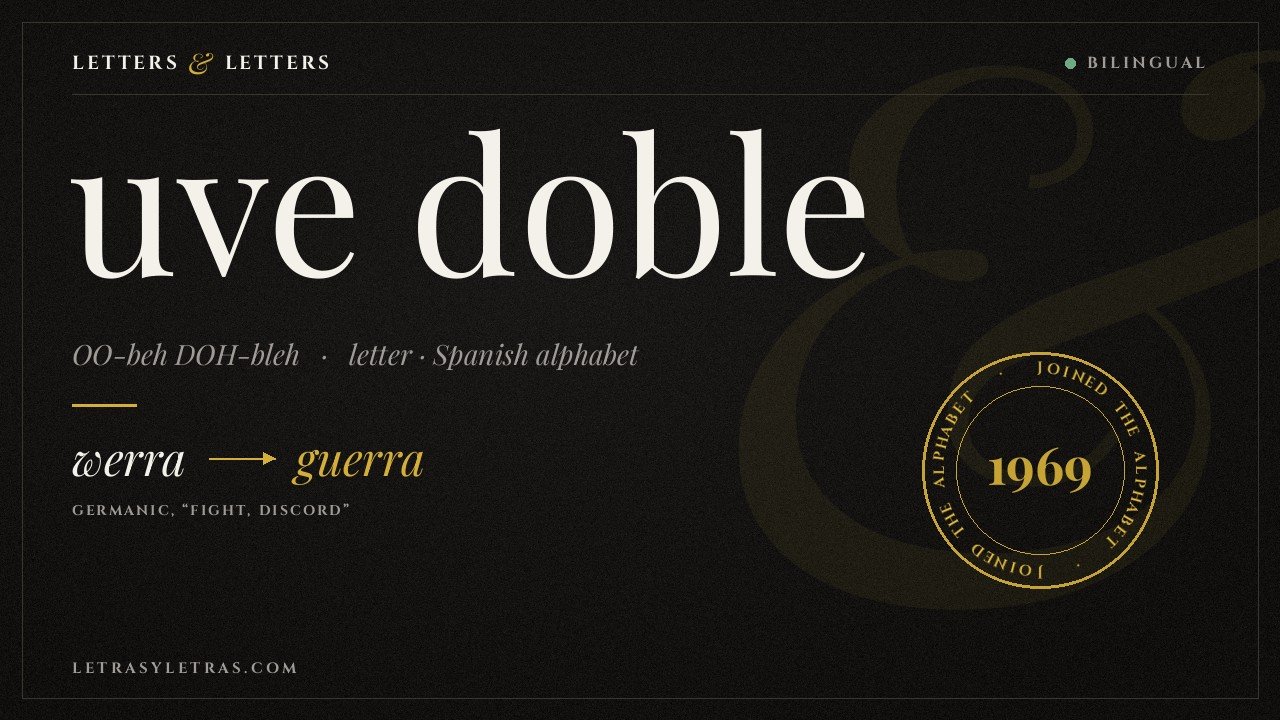
Open a Spanish dictionary at W and you will finish reading the section before your coffee cools. Spanish words that start with W are rare, and nearly every one arrived from another language. Latin, the parent of Spanish, never had the letter at all.
That short list hides a much bigger story. Spanish once met plenty of W words, from Visigothic kings to Germanic soldiers. It simply rewrote most of them, turning W into B, V or GU until nobody noticed.
Quick Answer: Spanish Words That Start With W
Spanish words that start with W are almost all loanwords, because Latin had no W. Common examples include web, wifi, waterpolo, windsurf, wok, whisky, wéstern, walkie-talkie, wolframio and wagneriano.
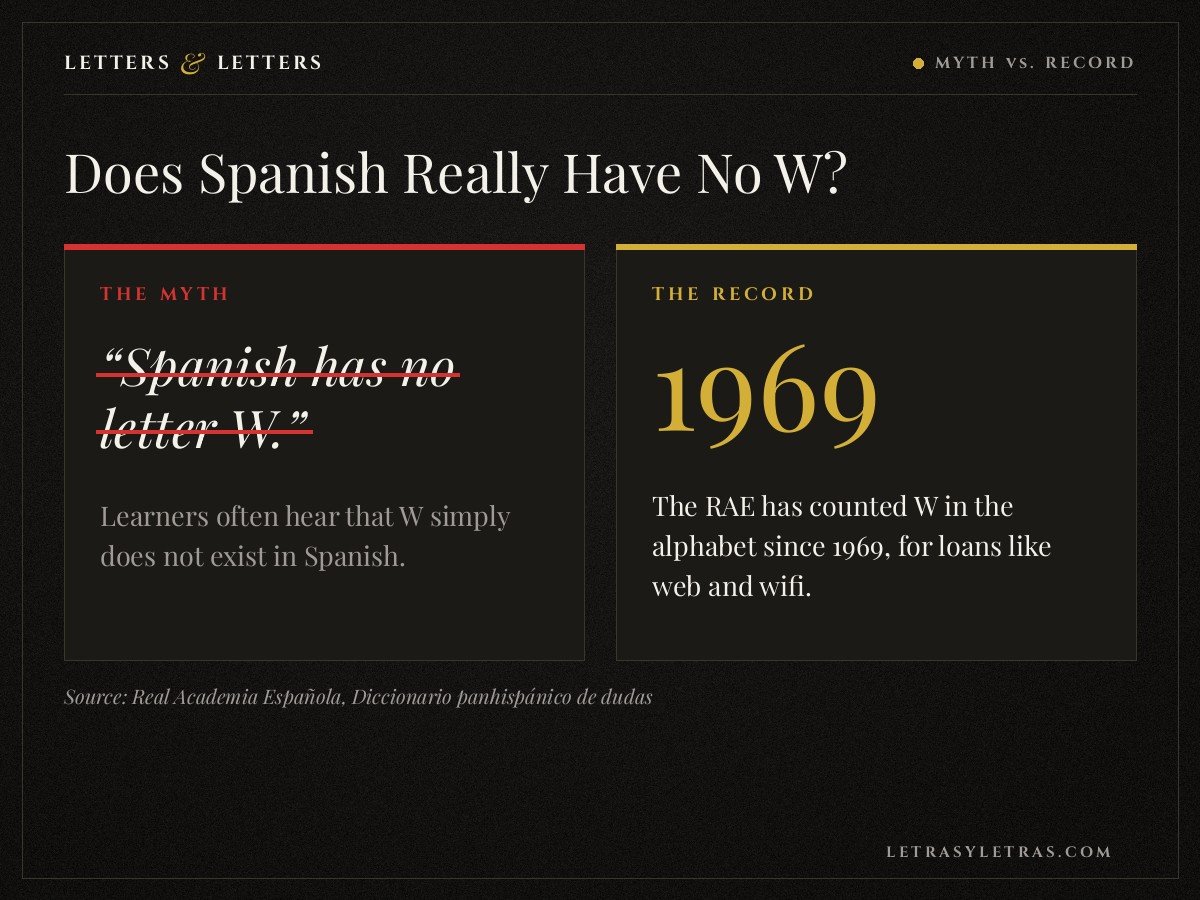
The Real Academia Española says W has been part of the Spanish alphabet since 1969. Its recommended name is uve doble.
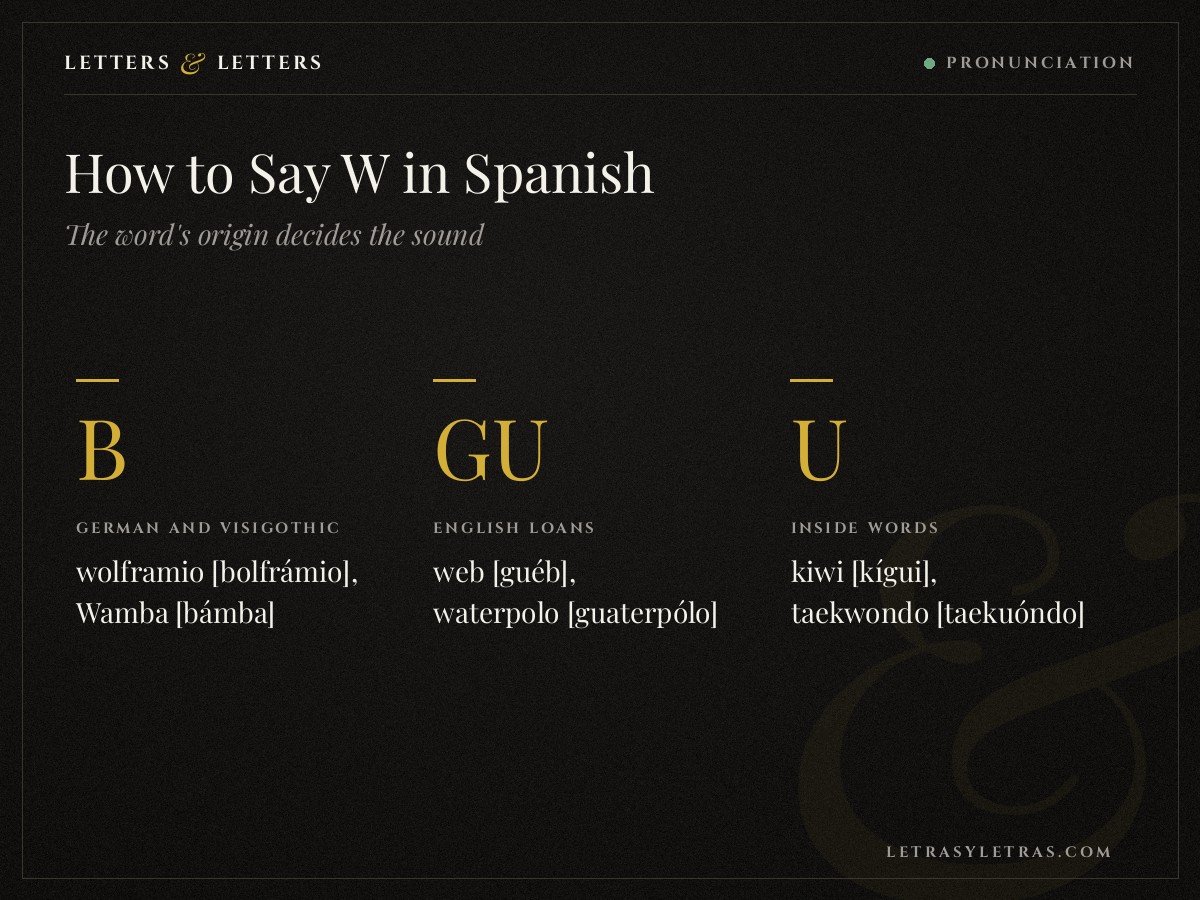
English loans pronounce W like a U or GU, as in web [guéb]. German and Visigothic words say it like a B, as in wolframio [bolfrámio].
Older Germanic W words were respelled long ago, which is why werra became guerra, meaning war. Other loans swapped W for V, giving vagón, vals and vatio. That is why the W section of a Spanish dictionary stays so short.
Key Takeaways
- Latin had no W, so native Spanish words never begin with it.
- The RAE counts W in the Spanish alphabet from 1969 and calls it uve doble.
- English loans say W like U or GU, while German and Visigothic words say it like B.
- Old Germanic W often became GU: werra gave guerra, and wîsa gave guisa.
- Other borrowings swapped W for V, which is how Watt became vatio.
Why Spanish Has So Few W Words
Spanish grew out of spoken Latin, and the Latin alphabet had no W. The sound existed in Latin speech, but Romans wrote it with V. When Latin evolved into Spanish, there was no W to inherit.
The letter only arrived with foreign words, and it waited a long time for official status. According to the Real Academia Española, W has formed part of the Spanish alphabet since 1969. It sits 24th in the modern abecedario.
Even its name took decades to settle. The 2010 Ortografía recommends uve doble, and the RAE’s Diccionario panhispánico de dudas entry for W lists the regional alternatives. Latin Americans may say doble ve, ve doble or, in Mexico, doble u.
Spanish Words That Start With W: The Dictionary List
The Diccionario de la lengua española contains only a small group of W headwords. Here are the ones you will meet most often, with their sources.
| Spanish Word | Meaning | Origin |
|---|---|---|
| web | the web, a website | English web, literally “net, mesh” |
| wifi | wireless internet | The registered brand Wi-Fi |
| waterpolo | water polo | English water polo |
| waterpolista | water polo player | Spanish derivative of waterpolo |
| windsurf | windsurfing | English wind plus surf |
| wok | wok pan, or a stir-fried dish | English, from Cantonese wok |
| whisky | whisky (also spelled güisqui) | English, from Gaelic uisce beatha, “water of life” |
| wéstern | a Western film | English western |
| walkie-talkie | portable two-way radio | English walkie-talkie |
| wolframio | tungsten, element 74 | German Wolfram, via scientific Latin |
| wagneriano | Wagnerian | The composer Richard Wagner |
| weber | unit of magnetic flux | German physicist W. E. Weber |
| wau | the U sound in a diphthong (linguistics) | Hebrew wāu |
Notice what is missing. You will not find wáter in the dictionary, because the Academy spells that word váter. The RAE also prefers the adapted spelling güisqui, although whisky remains common on bottles and bar menus.
Two Ways to Pronounce W in Spanish
Spanish gives W two different sounds, and the word’s origin decides which one you use. Think of it as a passport stamp.
W Sounds Like B in Germanic Words
Visigothic names and German-derived words take a B sound. Wamba is said [bámba], wolframio becomes [bolfrámio], and wagneriano sounds like [bagneriáno]. The RAE notes Spanish has no native V-like sound, so speakers use a soft B instead.
Kuwait follows the same rule for a different reason. Its W sits beside a U already, so speakers say [kubáit] to keep the sounds apart.
W Sounds Like U or GU in English Words
English loans keep something close to the English sound. At the start of a syllable, Spanish speakers add a little GU, so web is [guéb] and waterpolo is [guaterpólo]. Inside words, kiwi comes out as [kígui] and taekwondo as [taekuóndo].
Place names follow suit. Hawái and Taiwán both use the U sound, and so do the adjectives hawaiano and taiwanés.
Spanish Words That Contain W
W turns up inside a few more Spanish words, again always borrowed. Kiwi comes from Maori, and the dictionary also accepts the spelling kivi for the bird. Taekwondo comes from Korean tae, kwon and do, meaning kick, fist and way.
Sándwich keeps its W in the middle. Its source is the fourth Earl of Sandwich, who reportedly ate meat between bread to stay at the card table. The RAE even records the tale in its definition.
Gentilics carry W too. Someone from Kuwait is kuwaití, someone from Hawaii is hawaiano, and a person from Washington is washingtoniano.
W in Spanish Names and Places
Long before web or wifi, Spanish speakers met W in royal names. The Visigoths who ruled Hispania left kings called Wamba and Witiza. Spaniards still say those names with a B: [bámba] and [bitísa].
German places brought more examples. Weimar gives the adjective weimarés, and Westfalia gives westfaliano. Both also have rare V spellings, veimarés and vestfaliano, showing the same pull from W to V.
Surnames from Poland and the Netherlands complete the set. The RAE notes that Kowalski is usually pronounced [kobálski] in Spanish, with a B again.
Why New W Words Keep Arriving
Most new W words come from English, the dominant language of sport, technology and business. Windsurf and waterpolo arrived with the sports themselves. Web and wifi came with the internet.
Each one forces the same decision: keep the foreign spelling or adapt it. History suggests many will eventually gain a Spanish spelling, just as whisky gained güisqui. Until then, the short W section of the dictionary keeps growing slowly.
The Hidden W Words: How W Became GU
Here is the twist most word lists miss. Spanish absorbed dozens of Germanic words starting with W, but it rewrote them with GU. They look completely native today.
The clearest case is guerra, meaning war. According to the Academy, it comes from Germanic werra, “fight, discord”, the same root behind English war. French did the same thing, which is why it says guerre.
Guisa, meaning manner or way, comes from Germanic wîsa. English kept that root too, in words like otherwise and likewise. Guante, glove, probably came through Catalan from Frankish want.
The habit never stopped. Its dictionary of doubts points to guachimán, a watchman, from English watchman, and güelfo from German Welf. Even Guillermo is the Spanish form of the Germanic name we know as William.
Spanish has borrowed from many directions over the centuries. Arabic left an even larger mark, as our guide to spanish words of arabic origin shows.
When W Became V
A second group of borrowings swapped W for V. The RAE lists vagón, from English wagon, and vals, which reached Spanish through French valse from German Walzer, “to turn”. These words settled in so long ago that their W origins are invisible.
Vatio, the unit of power, honours the Scottish engineer James Watt. Its symbol is still W, a small fossil of the original spelling. Váter, the toilet, comes from English water-closet.
Some words still hover between spellings. The dictionary accepts both wolframio and volframio for tungsten, although wolframio is far more common.
Common Mistakes With W in Spanish
Learners often trip over the same few points. Here are the ones teachers correct most.
Writing Wáter for the Toilet
The dictionary spelling is váter, with a V. Signs in Spain sometimes show WC, but the written word has been adapted.
Using an English W Sound in German Words
Wolframio and wagneriano take a B sound in Spanish. Saying them with an English W sounds foreign to native ears.
Forgetting the Plural of the Letter Name
The letter is feminine: la uve doble. Its plural is las uves dobles, or las dobles uves in less common use.
Assuming Every W Word Is Modern
Wamba and Witiza are Visigothic names from over a thousand years ago. The W itself is old in Spain, even if dictionary entries came late.
Practice Sentences With W Words
Try reading these aloud, paying attention to the two W sounds.
- Busco una página web con recetas de wok. (I am looking for a website with wok recipes.)
- No hay wifi en la playa, pero sí hay windsurf. (There is no wifi on the beach, but there is windsurfing.)
- El wolframio tiene el número atómico 74. (Tungsten has the atomic number 74.)
- Mi hermano juega al waterpolo los sábados. (My brother plays water polo on Saturdays.)
In the first two sentences, web, wok and wifi start with a soft GU sound. Wolframio, in the third, starts with a B.
Timeline of W in Spanish
| Year | Author / Source | Context and Milestone |
|---|---|---|
| Classical era | Latin alphabet | No letter W exists; the sound is written with V. |
| 672 to 680 | Visigothic kingdom, Toledo | King Wamba reigns; Spanish still pronounces his name with a B. |
| Medieval period | Early Spanish | Germanic werra and wîsa become guerra and guisa. |
| 1969 | Real Academia Española | W becomes an official letter of the Spanish alphabet. |
| 2010 | RAE Ortografía | Recommends uve doble as the letter’s single name. |
| Today | Diccionario de la lengua española | Lists modern loans such as web, wifi and wok. |
How to Spell New W Words in Spanish
When English words enter Spanish, writers face a choice. They can keep the original spelling in italics or adopt an adapted form.
The Academy tends to accept both for a while, then nudge readers to the adapted version. That is how whisky gained the companion güisqui, and how water-closet ended up as váter.
Newer tech words follow a looser path. Look up wifi in the Real Academia dictionary and the W survives. The brand name is simply too familiar to respell.
Frequently Asked Questions
Are there any Spanish words that start with W?
Yes, but only a few, and almost all are loanwords. Common examples are web, wifi, waterpolo, windsurf, wok, whisky and walkie-talkie. Words from German, like wolframio and wagneriano, also appear in the dictionary.
Is W a letter in the Spanish alphabet?
Yes. The Real Academia Española says W has been part of the Spanish alphabet since 1969. It is the 24th letter and is officially called uve doble.
How do you pronounce W in Spanish?
It depends on the word’s origin. In English loans it sounds like U or GU, as in web [guéb]. German or Visigothic words use a B sound, as in wolframio [bolfrámio].
Why does guerra mean war?
Both words come from the same Germanic root, werra. Spanish turned the W into GU, while English kept the W. French made the same change and produced guerre.
Is wáter a Spanish word?
Not in that spelling. The Academy writes it váter, from English water-closet, and uses it for a toilet or bathroom.
What is the letter W called in Spanish?
The RAE recommends uve doble. Many Latin Americans say doble ve or ve doble, and Mexicans often say doble u.
A Letter That Arrived Late
W is the newest guest in the Spanish alphabet, and it still behaves like one. Its words are few, borrowed and pronounced two different ways.
Yet the old Germanic W never really left. It hides inside guerra, guisa and Guillermo, wearing a Spanish disguise.
For more crossings between the two languages, read about spanish idioms with food origins. The origin of the word gringo is another favourite of Alan Sledge.


Alan Sledge is the writer and founder behind Letters & Letters. A lifelong lover of words, Alan has always been drawn to the small mysteries hidden in everyday language, why we say what we say, where our favorite sayings came from and the quotes that manage to put feelings into words better than we ever could ourselves.

Alan Sledge
Alan Sledge is the founder and lead researcher behind Letters & Letters. A lifelong student of linguistic history, he cross-references every word origin, idiom, and quote against primary archival manuscripts, the Oxford English Corpus, and 18th-century print lexicons.