
Ask ten people about the origin of the phrase the whole nine yards and you will hear ten confident stories. Fighter pilots, cement trucks, Scottish kilts and sailing ships all get a turn. Almost none of them survive a trip to the newspaper archive.
The real trail leads somewhere far less glamorous: small-town Indiana and Kentucky, a baseball preview and a fishing yarn. Better still, the phrase once came in a cheaper size. Before it was nine yards, it was six.
Quick Answer: Origin of the Phrase the Whole Nine Yards
The whole nine yards means everything, the full amount. Its earliest idiomatic use appeared in the Mitchell Commercial, a newspaper in Mitchell, Indiana, on 2 May 1907. A baseball preview there said the writer could not promise “the full nine yards”.
From 1912, Kentucky and other Southern papers printed “the whole six yards” with the same meaning. That variant suggests the number was arbitrary rather than a real measurement.
Because the phrase predates both world wars, popular explanations about machine-gun belts, concrete mixers and kilts cannot be its source. Researchers Bonnie Taylor-Blake and Fred Shapiro uncovered these early citations between 2012 and 2013. What the yards first measured, if anything, remains unproven.
Key Takeaways
- The idiom first appears in an Indiana newspaper’s baseball preview on 2 May 1907.
- Kentucky papers used “the whole six yards” from 1912, so the number was never fixed.
- The phrase predates World War I, which rules out every machine-gun belt theory.
- Concrete trucks, kilts, sails and shrouds have no documentary support at all.
- Air Force and NASA slang spread the phrase nationally in the 1960s, which fed the military myth.
What “The Whole Nine Yards” Means
To go the whole nine yards is to give something everything you have. Ordering the whole nine yards means taking every option on the menu. The idiom sits in the same family as “the whole shebang” and “the whole kit and caboodle”.
Notice what those cousins have in common. Nobody can say what a shebang or a caboodle measures, and nobody needs to. That clue matters later, because the yards may be just as empty.
The Origin of the Phrase the Whole Nine Yards in Print
For decades, the trail went cold in the 1960s. Then digitised newspapers changed the game. Volunteers searching scanned pages began finding the phrase in places nobody had looked.
1855: A Shirt Joke in Indiana
The oldest printed match is a comic story in the New Albany Daily Ledger of Indiana, dated 30 January 1855. A judge orders a shirt, and the tailor complains about the seamstress. She “has put the whole nine yards into one shirt”, he grumbles.
Here the yards are real cloth, so this is not yet the idiom. Still, the Oxford English Dictionary cites it, and it shows the words sitting together in Indiana half a century early.
1907: A Baseball Preview in Mitchell
The first figurative use arrived on 2 May 1907 in the Mitchell Commercial of Mitchell, Indiana. Previewing a local baseball season, the writer admitted he could not promise “the full nine yards”. He meant a complete, flawless performance.
Baseball has nine innings, which is a tempting link. Yet the same paper soon used the phrase far from the diamond, so the sport was probably a coincidence.
1908 to 1914: The Idiom Settles In
In 1908, a Mitchell Commercial fishing story ended with “give him the whole nine yards”. That sentence matches modern usage closely. The paper used the phrase again in 1912 and 1914.
You can browse the paper yourself through the Hoosier State Chronicles newspaper archive, run by the Indiana State Library. Its scanned pages are where much of this detective work happened.
The Six Yards Problem
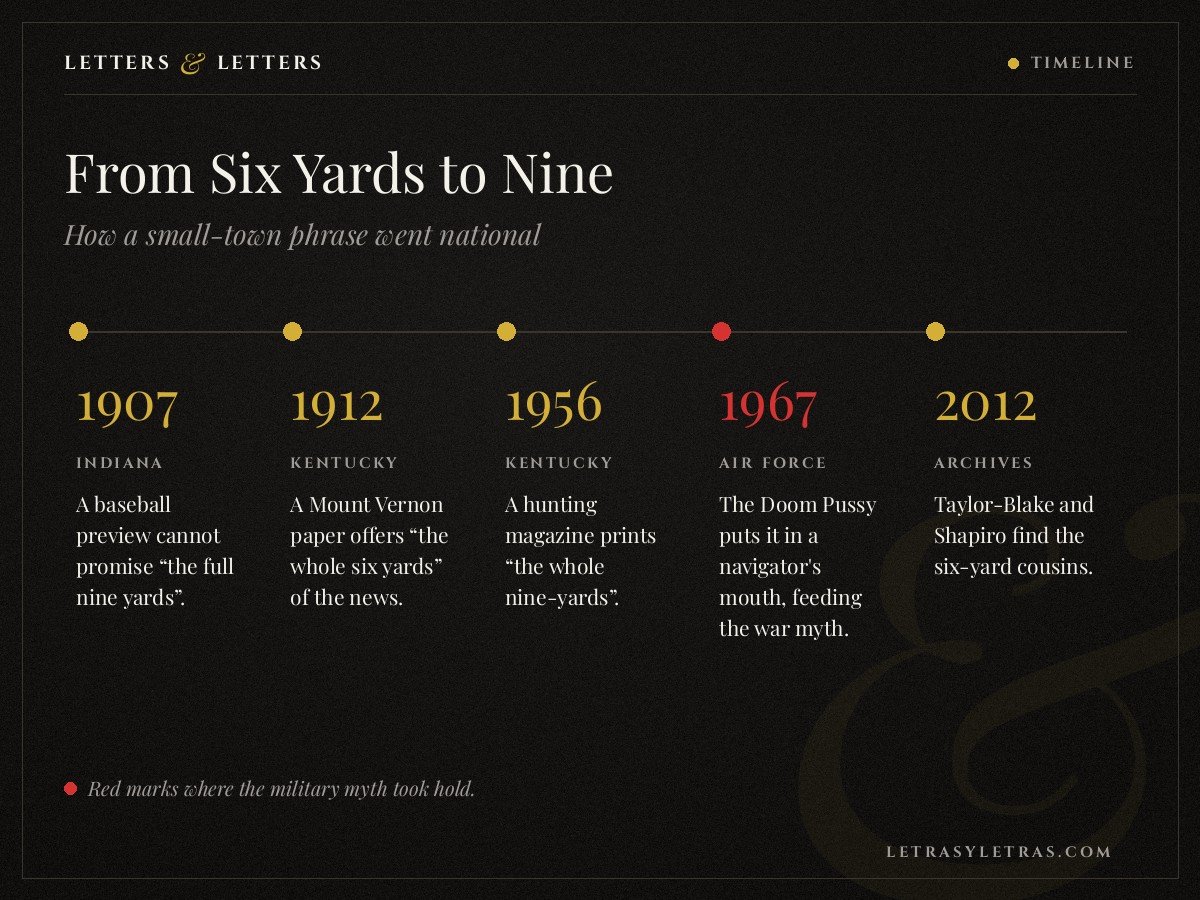
In 1912, something odd turned up in Kentucky. The Mount Vernon Signal promised readers “the whole six yards” of the news in its next issue. Its meaning was identical, but the number was smaller.
That variant spread for years. Papers in Arkansas, South Carolina, Georgia and Missouri printed “the whole six yards” between 1917 and 1927. A 1921 South Carolina headline even read “The Whole Six Yards of It”.
Fred Shapiro, editor of the Yale Book of Quotations, calls this pattern phrase inflation. Numbers in idioms tend to grow over time, just as “cloud nine” once competed with cloud seven and cloud eight. If the yards measured a real object, the count should never have changed.
So What Were the Yards?
If the yards were not cloth, bullets or concrete, what were they? Two serious answers have emerged from the people who found the evidence.
The first answer is that they were nothing at all. Lexicographers Jesse Sheidlower and Fred Shapiro point to the six-yard version as proof. A real object would not shrink and grow from one county to the next.
Taylor-Blake offers a second, gentler idea. In early examples, people “give” or “tell” someone the whole nine yards. A yard of talk could mean a long telling, so the phrase may first have described a complete, drawn-out account.
Her theory fits the 1908 fishing story and the 1912 news promise neatly. It has not been proved, but it starts from the citations rather than a good yarn.
Seven Theories That Don’t Survive the Evidence
Popular explanations share one fatal flaw: they all describe things that came later. Here is how each one fares against the 1907 citation.
1. World War II Machine-Gun Belts
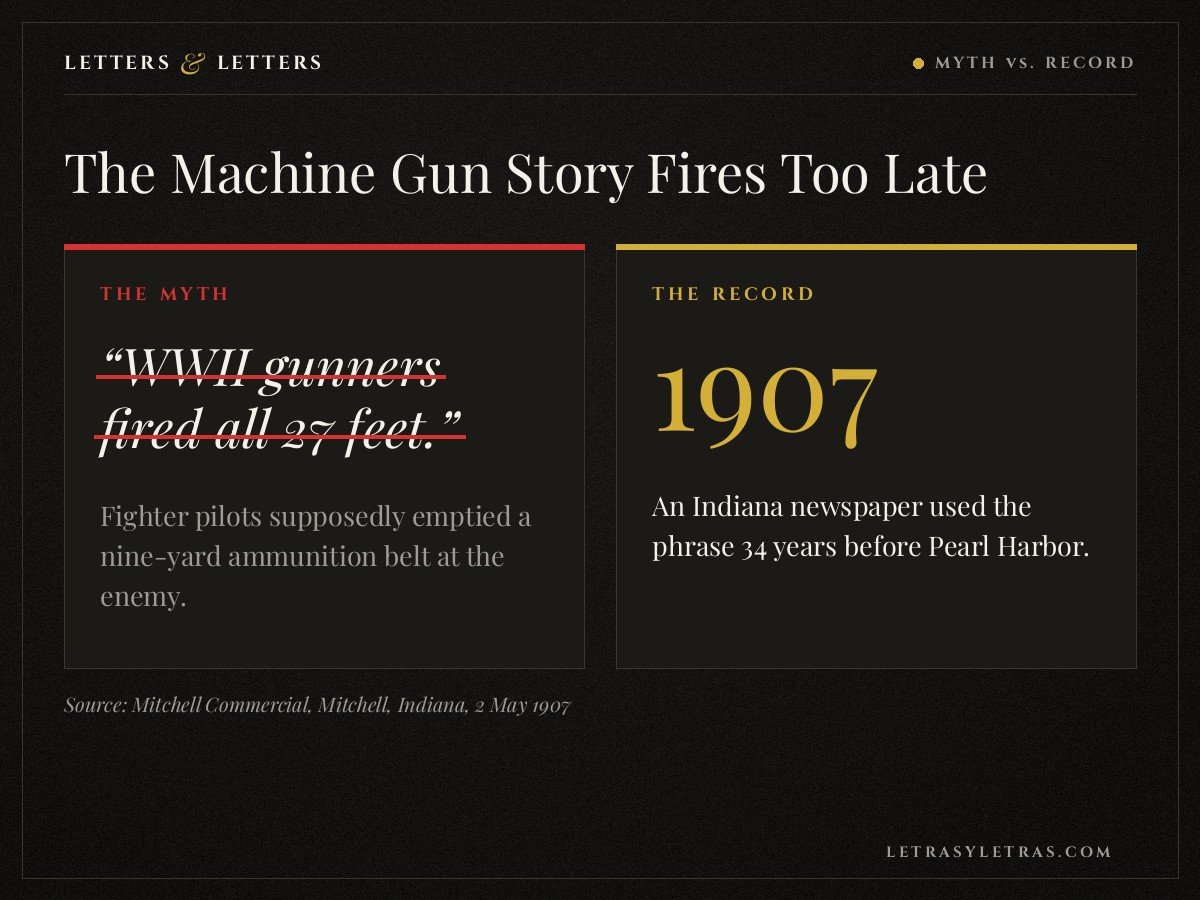
This is the favourite. Fighter pilots supposedly carried ammunition belts 27 feet long and gave the enemy “the whole nine yards”. The story is vivid and completely impossible, because Indiana readers saw the phrase 34 years before Pearl Harbor.
2. World War I Vickers Guns
A variant moves the belt back to World War I aircraft. That still misses the mark, since the 1907 baseball preview predates the war by seven years. No wartime source uses the phrase either.
3. Concrete Mixer Trucks
Newspaper columnists William Safire and James Kilpatrick both floated this one. Cement trucks supposedly held nine cubic yards. Early mixers held far less, and the six-yard variant makes no sense for a truck.
4. Kilts, Saris and Shrouds
Fabric stories are endless: a Scottish great kilt, an Indian sari or a burial shroud. None comes with a documented source. Cloth was often sold in multiples of three yards, which may explain why nine sounds plausible.
5. Square-Rigged Sailing Ships
Yards are also the horizontal spars on a ship’s mast. The theory says a three-masted ship carried nine of them. Not every ship did, and no sailing-era text uses the phrase.
6. American Football
Football seems natural, but it fails on arithmetic. A first down needs ten yards, so nine yards falls short of success. The early citations involve baseball and fishing instead.
7. Grave Depth and Other Oddities
Some claim nine cubic yards of soil fill a grave. Others point to shipyards or ritual disembowelment. Little or no evidence supports any of them.
How the Phrase Went National
After 1914, the idiom lived quietly in Kentucky and the rural South. A 1956 issue of Kentucky Happy Hunting Ground printed “So that’s the whole nine-yards”. By 1962, Car Life magazine praised a Chevrolet Impala for “all nine yards of goodies”.
Then the space and air age carried it everywhere. A 1964 syndicated story described “give ’em the whole nine yards” as NASA talk for a full report. Vietnam-era servicemen were quoted using it in 1965.
Elaine Shepard’s 1967 book The Doom Pussy put the phrase in an Air Force navigator’s mouth. Pilots used it so freely that people assumed pilots invented it. That assumption is where the machine-gun legend most likely took off.
How Researchers Finally Cracked It
In 1982, the columnist William Safire asked radio listeners about the origin, then spent years writing about it. The Oxford English Dictionary added the phrase in 1986 with a first citation from 1970. In 1997, a slang dictionary pushed the date back to Shepard’s 1967 book.
Real progress came in 2012. Bonnie Taylor-Blake, a neuroscience researcher and amateur word sleuth, found the 1956 and 1957 uses. Later that year, she and Shapiro uncovered the six-yard examples from Kentucky.
In 2013, Taylor-Blake posted the Mitchell Commercial citations from 1907 onwards. Shapiro called the phrase “the most prominent etymological riddle of our time”. Members of the American Dialect Society shared many of these finds on a public mailing list.
Timeline of the Whole Nine Yards
| Year | Author / Source | Context and Milestone |
|---|---|---|
| 1855 | New Albany Daily Ledger, Indiana | Shirt joke uses “the whole nine yards” for literal cloth. |
| 1907 | Mitchell Commercial, Indiana | Baseball preview cannot promise “the full nine yards”, the first idiomatic use. |
| 1908 | Mitchell Commercial, Indiana | Fishing story says “give him the whole nine yards”. |
| 1912 | Mount Vernon Signal, Kentucky | Promises “the whole six yards”, the smaller variant. |
| 1921 | Spartanburg Herald-Journal, South Carolina | Headline reads “The Whole Six Yards of It”. |
| 1956 | Kentucky Happy Hunting Ground | Prints “the whole nine-yards” in a hunting magazine. |
| 1967 | Elaine Shepard, The Doom Pussy | Air Force navigator uses the phrase, feeding the military myth. |
| 2012 to 2013 | Bonnie Taylor-Blake and Fred Shapiro | Digitised newspapers reveal the six-yard and 1907 citations. |
Using the Whole Nine Yards Today
The idiom works anywhere you mean “everything, no shortcuts”. A wedding with a band, fireworks and a carriage went the whole nine yards. Rewriting an essay three times counts as the whole nine yards too.
You will hear a few variants. People “go the whole nine yards”, “want the whole nine yards” or simply say “the whole nine”. Fittingly, the oldest 1907 version used “full” instead of “whole”.
The tone is casual and a little American. It suits conversation, sports writing and marketing copy better than a formal report.
The Merriam-Webster entry for the whole nine yards defines it as all of a related set of circumstances, conditions or details. For more sayings with surprising backstories, see our guide to english idioms and meanings.
Some phrases do have tidy, documented origins. The origin of the phrase mad as a hatter is a good example. Our list of old fashioned phrases collects many more.
Frequently Asked Questions
What is the true origin of the whole nine yards?
Nobody has proved what the yards referred to. The earliest idiomatic use appeared in an Indiana newspaper in 1907, and a “whole six yards” version followed in 1912. That variation suggests the number never measured anything specific.
Did the whole nine yards come from World War II machine guns?
No. The phrase was in print by 1907, decades before World War II. Fighter pilots helped popularise it in the 1960s, which is why the myth sounds believable.
Is the whole nine yards a football term?
No. A first down needs ten yards, so nine would fall short. The early citations come from baseball previews and fishing stories, not football.
Why was it once “the whole six yards”?
Kentucky and other Southern newspapers used six yards from 1912 to the late 1920s. Fred Shapiro calls the switch phrase inflation, where numbers in idioms grow over time. Cloud nine went through a similar climb.
What does it mean to go the whole nine yards?
It means doing something completely, with full effort and no shortcuts. A host who goes the whole nine yards provides every course, every decoration and every extra.
When did the whole nine yards become popular?
It stayed regional until the 1950s. NASA staff, Air Force pilots and Vietnam-era servicemen spread it nationally during the 1960s.
The Best Answer Is the Honest One
Machine guns, cement trucks and kilts all make better stories than the truth. What really happened is a small-town baseball preview, a fishing yarn and a number that wandered from six to nine. Those details are less cinematic, but every one of them can be checked.
That is the standard Alan Sledge holds for every phrase on this site. Tell the 1907 story next time someone mentions fighter pilots, and you will have gone the whole nine yards yourself.


Alan Sledge is the writer and founder behind Letters & Letters. A lifelong lover of words, Alan has always been drawn to the small mysteries hidden in everyday language, why we say what we say, where our favorite sayings came from and the quotes that manage to put feelings into words better than we ever could ourselves.

Alan Sledge
Alan Sledge is the founder and lead researcher behind Letters & Letters. A lifelong student of linguistic history, he cross-references every word origin, idiom, and quote against primary archival manuscripts, the Oxford English Corpus, and 18th-century print lexicons.