
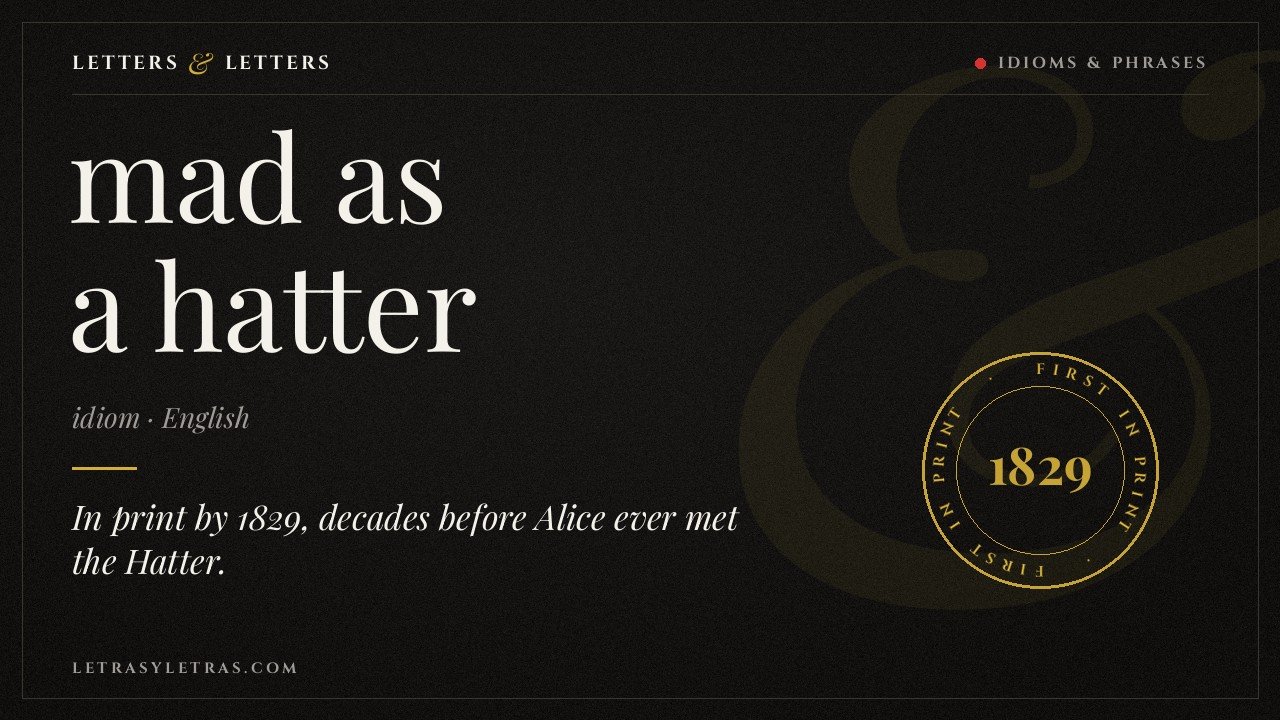
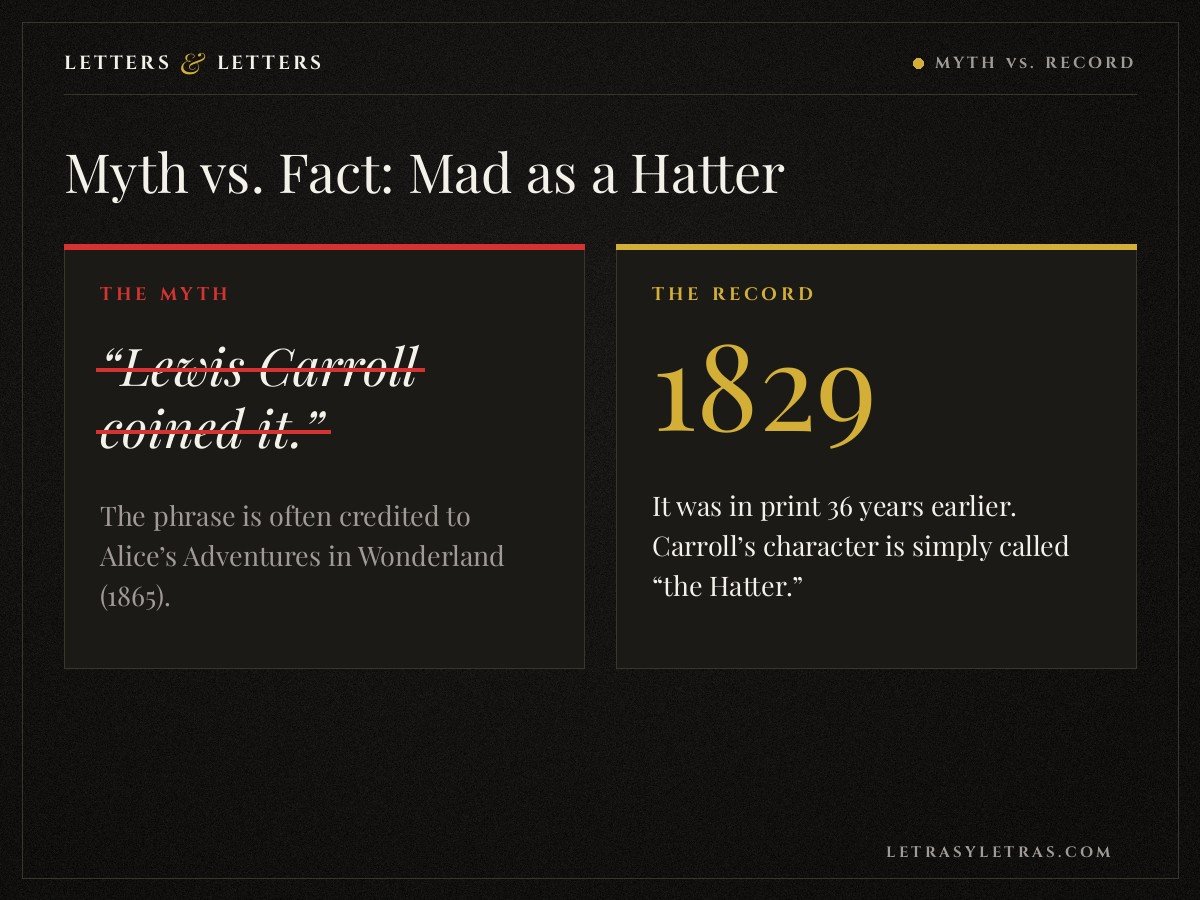
Ask about the origin of the phrase mad as a hatter, and most people point to Lewis Carroll’s tea party. The answer feels obvious. It also happens to be wrong by at least 36 years.
The expression was already in print in 1829, when Carroll was not yet born. By 1865, when his Hatter poured tea for Alice, Victorians had used the saying for a generation. The real story runs through a Scottish magazine, a poisoned trade and a quiet piece of literary borrowing.
Quick Answer: Origin of the Phrase Mad as a Hatter
The phrase “mad as a hatter” first appears in print in 1829, in the “Noctes Ambrosianae” dialogues of Blackwood’s Edinburgh Magazine. That is 36 years before Lewis Carroll published Alice’s Adventures in Wonderland (1865), so Carroll borrowed the saying rather than inventing it. The most widely accepted explanation links it to the felt hat trade. Hatters treated animal fur with mercury compounds, and years of breathing the vapour caused erethism, a nervous disorder marked by tremors, irritability, painful shyness and memory loss. In Danbury, Connecticut, the symptoms were common enough to earn the nickname “the Danbury shakes.” A rival theory claims “hatter” is a corruption of “atter” or “adder” (a venomous snake), but lexicographers have found no evidence for it. Today the phrase simply means wildly eccentric or crazy.
Key Takeaways
- The earliest known printed use dates to 1829, in Blackwood’s Edinburgh Magazine.
- Lewis Carroll never wrote the words “Mad Hatter.” He called his character simply “the Hatter.”
- Mercury used in felt making caused erethism, a real disease later nicknamed “mad hatter syndrome.”
- The “mad as an adder” theory is popular but lacks any documentary support.
- Thomas Hughes used the phrase in Tom Brown’s School Days (1857), eight years before Alice.
What Does “Mad as a Hatter” Mean?
In modern English, calling someone “mad as a hatter” means they are thoroughly eccentric, unpredictable or out of their senses. The tone is usually playful. You would say it about a brilliant inventor with odd habits, not about someone in genuine crisis.
That light touch hides a darker past. For most of the nineteenth century, a hatter’s “madness” could be a literal occupational injury. Readers who heard the phrase in 1850 may well have pictured a trembling, nervous workman, not a whimsical storybook figure.
The saying belongs to a family of English similes built on “mad as.” Older relatives include “mad as a March hare,” which was in use by the early 1500s and refers to the wild spring antics of hares in mating season. Carroll, as we will see, cleverly seated both animals of the proverb at the same table.
The 1829 Evidence: Blackwood’s Edinburgh Magazine
The earliest record sits in Volume 25 of Blackwood’s Edinburgh Magazine. It appears in a comic series called “Noctes Ambrosianae.” These pieces were fictional tavern conversations between recurring characters with names like North, Tickler and the Shepherd. Their talk was boozy, boastful and full of slang.
In installment 44, North boasts that he once ruled as the Sultan of Bello. Tickler whispers that he is raving, and the scene brands North “mad as a hatter.”
Two things stand out about this first sighting. The writers use the expression casually, which suggests readers already knew it from speech. Nothing in the joke hints at hats or chemistry.
Spoken English often runs years ahead of print. The true birth of the saying is probably earlier still.
Mercury and the Felt Hat Trade
The leading explanation for the origin of the phrase mad as a hatter comes from the workshop floor. Fashionable felt hats in the eighteenth and nineteenth centuries were made from animal fur, usually rabbit, hare or beaver. Getting those fibres to mat together into smooth, dense felt was the hard part.
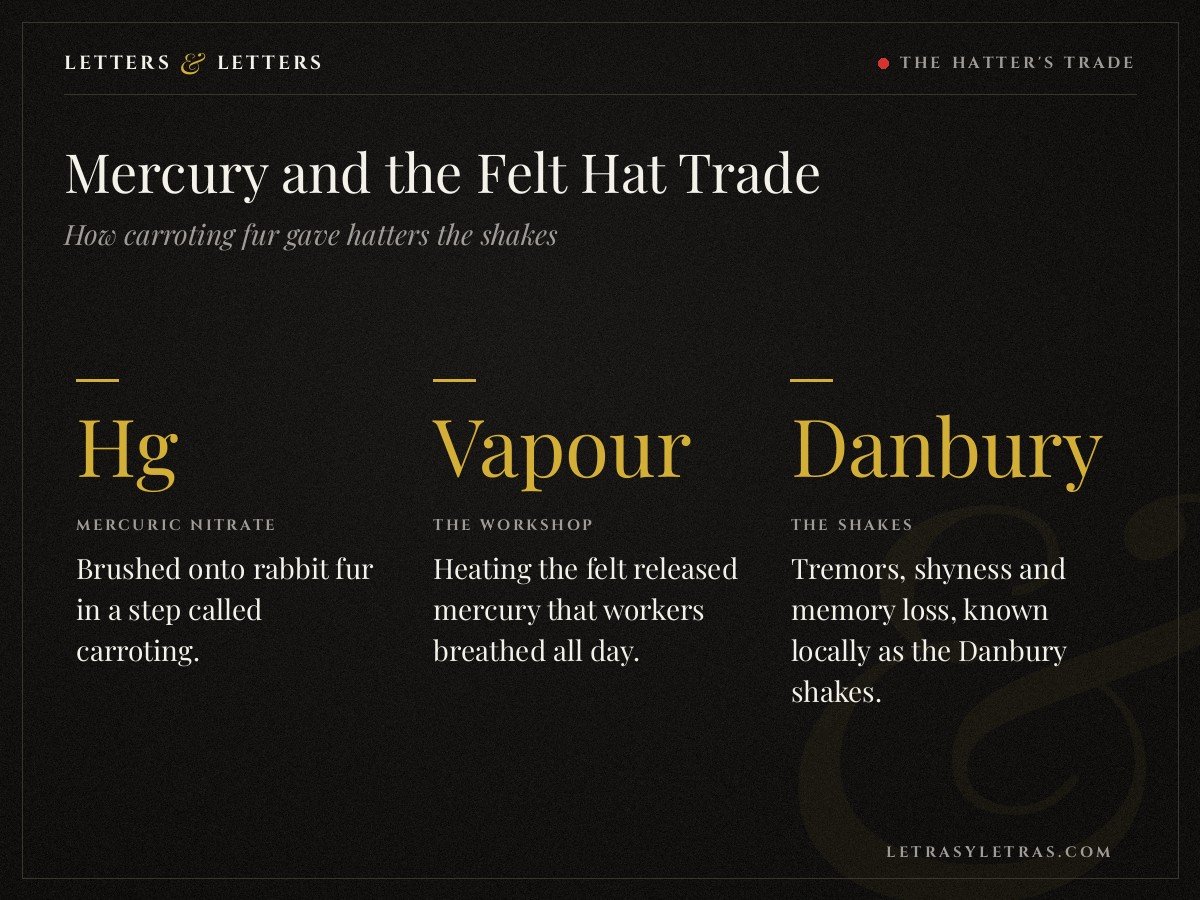
Hatters discovered that brushing the fur with a solution of mercuric nitrate roughened the hairs so they locked together. The treatment tinted the fur orange, so the trade called it “carroting.” Drying and steaming the felt then released mercury vapour into small, stuffy rooms.
Breathed day after day, that vapour attacked the nervous system. The World Health Organization’s mercury guidance still lists tremors and memory problems among its effects.
Victorian hatters had no such warnings. They simply worked, shook and grew strange.
Erethism: The Real “Mad Hatter Disease”
Doctors eventually gave the condition a formal name: erethism, or erethismus mercurialis. Its signature was not raving lunacy but something quieter and sadder. Sufferers became painfully shy, easily irritated, anxious around strangers and forgetful.
As exposure continued, a fine tremor appeared in the hands. It could spread to the eyelids, lips and tongue. Severe cases brought delirium and hallucinations.
Medical writers still call the illness “mad hatter syndrome.” Few trades have been so tightly fused with a disease.
The Danbury Shakes
Nowhere was the damage clearer than in Danbury, Connecticut. The town led American hat making in the nineteenth century and proudly called itself “Hat City.” Thousands of residents worked in the factories, and many carried the trade home in their bodies.
Locals named the tremors “the Danbury shakes.” Slurred speech, stumbling and twitching hands were familiar sights on town streets. Mercury was not removed from American felt making until the early 1940s, long after the link to illness was understood.
The Rival Theories (and Why They Fail)
A phrase this colourful naturally attracts competing stories. Some are clever. None has the evidence that the mercury explanation enjoys, though it is fair to say that even the hat theory rests on strong circumstantial links rather than a signed confession from 1829.
Myth 1: “Mad as an Atter”
The most persistent alternative claims that “hatter” is a garbled form of “atter,” from Old English ātor, meaning poison. A related version swaps in “adder,” the venomous viper. On this reading, “mad” once meant “venomous,” and the original phrase meant “as poisonous as a snake.”
The theory found champions in William and Mary Morris’s Morris Dictionary of Word and Phrase Origins (1977). Its weakness is simple. No one has ever produced a written example of “mad as an atter” or “mad as an adder” that predates the hatter version. Modern dictionaries record the snake connection as unproven, and without a paper trail it remains a guess dressed as history.
Myth 2: Samuel Johnson’s Verb “To Hatter”
Samuel Johnson’s famous Dictionary of the English Language (1755) lists “hatter” as a verb meaning to harass or wear out with fatigue. He even quotes John Dryden: “He’s hatter’d out with pennance.” Some writers suggest a worn-out, harassed person might be “mad as a hatter” in that older sense.
It is a charming footnote, but the grammar does not cooperate. The 1829 phrase clearly treats “hatter” as a noun, a type of person. Nothing connects Johnson’s obscure verb to the later simile.
Myth 3: Roger Crab, the Hermit Hatter
A third story points to Roger Crab, a seventeenth-century English radical who worked briefly as a hatter. He gave his goods to the poor, ate a strict plant diet and wore sackcloth. Crab makes a lively candidate for Carroll’s inspiration, yet nearly two centuries separate his life from the first printed use of the phrase.
Lewis Carroll and the Hatter Who Was Never Called “Mad”
Here is the twist that surprises most readers. In Alice’s Adventures in Wonderland, Carroll never once writes the words “Mad Hatter.” His character is simply “the Hatter,” and the famous scene is titled “A Mad Tea-Party.”
The madness comes from the Cheshire Cat, who gives Alice directions. In one direction lives a Hatter, the Cat explains, and in the other a March Hare: “Visit either you like: they’re both mad.” Carroll had taken two old proverbs, “mad as a hatter” and “mad as a March hare,” and turned them into dinner guests.
Victorian readers would have caught the joke instantly. You can read the full chapter in the original 1865 text of Alice’s Adventures in Wonderland, which is free on Project Gutenberg. Sir John Tenniel’s illustrations gave the Hatter his towering top hat with its price ticket, “In this Style 10/6,” a sly reminder that he was a tradesman.
Was Carroll’s Hatter Poisoned?
Modern readers love to diagnose the Hatter with erethism, but the text gives little support. He is rude, restless and fond of riddles without answers. Shyness is not his problem, and he trembles from fear of the Queen rather than from mercury.
Carroll did know about mental illness among workers. His uncle, Robert Wilfred Skeffington Lutwidge, served as a Commissioner in Lunacy and inspected asylums. Still, most scholars see the Hatter as a comic creation built on a proverb, not a medical portrait. One popular claim names Theophilus Carter, an eccentric Oxford furniture dealer known for wearing a top hat, as a possible model.
Hatta and Haigha in the Sequel
Carroll brought the pair back in Through the Looking-Glass (1871) under the names Hatta and Haigha. They serve as the White King’s messengers. Hatta is in prison, punished before committing any crime, which is the kind of logic Carroll adored.
The renaming was a pun on pronunciation. Carroll explained that “Haigha” should rhyme with “mayor,” producing “hare,” just as “Hatta” echoes “hatter.” Even in the sequel, the old proverb hides in plain sight.
Timeline: How “Mad as a Hatter” Evolved
| Year | Author / Source | Context and Milestone |
|---|---|---|
| Early 1500s | Tudor English | “Mad as a March hare” is already in use, the older sibling of the hatter simile. |
| 1755 | Samuel Johnson’s Dictionary | Lists “to hatter” as a verb meaning to harass or exhaust. Unrelated, but often cited. |
| 1829 | Blackwood’s Edinburgh Magazine | Earliest known printed use, in the “Noctes Ambrosianae” dialogues. |
| 1857 | Thomas Hughes, Tom Brown’s School Days | A schoolboy nicknamed Madman is described as “mad as a hatter.” |
| 1865 | Lewis Carroll, Alice’s Adventures in Wonderland | The Hatter and March Hare host “A Mad Tea-Party.” The phrase “Mad Hatter” never appears. |
| 1871 | Lewis Carroll, Through the Looking-Glass | The pair return as Hatta and Haigha, the White King’s messengers. |
| Late 1800s | Danbury, Connecticut | Mercury tremors among hat workers become known as “the Danbury shakes.” |
| 1939 | Agatha Christie, And Then There Were None | The phrase remains everyday English in popular fiction. |
| Early 1940s | American hat industry | Mercury is finally removed from felt making in the United States. |
Mad as a Hatter in Literature Before and After Alice
The phrase did not need Carroll to survive. In 1857, Thomas Hughes put it into Tom Brown’s School Days, describing a boy called Madman who tamed snakes and kept hedgehogs in his cupboard. The line treats eccentricity with real affection.
Writers kept reaching for it long after Wonderland. Arthur Conan Doyle, G. K. Chesterton and Agatha Christie all used “mad as a hatter” in their fiction. In each case it signals a person whose behaviour defies ordinary logic, sometimes with a hidden method underneath.
If you enjoy tracing sayings like this one, our guide to english idioms and meanings collects dozens more. You may also like the stories behind these old fashioned phrases, many of which share the same Victorian roots.
Similar Phrases With Surprising Histories
“Mad as a hatter” is part of a wider pattern. Many cheerful English sayings began with something grim, practical or superstitious. Theatre gave us the origin of the phrase break a leg, which carries its own tangle of myths.
Plague-era fears lie behind the origin of the phrase bless you, at least according to popular legend. In each case, the modern meaning feels light while the history underneath is heavy. Language softens its scars over time.
How to Use “Mad as a Hatter” Today
The phrase works best in warm, informal speech. It suits a quirky relative, a genius professor or a friend with a wild plan. The phrase sounds affectionate rather than cruel when the target is clearly in on the joke.
Some care is wise. Because the saying grew from real suffering, and because “mad” can sting, avoid using it about anyone facing genuine mental illness. A few examples of natural modern use:
- “Our chemistry teacher was mad as a hatter, but nobody ever forgot his lessons.”
- “She wants to sail around the world alone. Mad as a hatter, and I admire her for it.”
- “Grandpa keeps forty clocks in the attic, all set to different times. Mad as a hatter.”
Frequently Asked Question
Where did the phrase “mad as a hatter” come from?
It first appears in print in 1829, in Blackwood’s Edinburgh Magazine. Most historians connect it to hat makers who suffered mercury poisoning from treating felt, which caused tremors, anxiety and odd behaviour.
Did Lewis Carroll invent the phrase “mad as a hatter”?
No. The saying was in use at least 36 years before Alice’s Adventures in Wonderland appeared in 1865. Carroll borrowed it, and he never actually wrote the words “Mad Hatter” in his books.
Why did hatters go mad?
Felt makers brushed fur with mercuric nitrate and then heated it, releasing toxic mercury vapour. Long exposure caused erethism, a disorder marked by shaking, irritability, shyness and memory loss.
What is the “Danbury shakes”?
It was the local name for mercury tremors among hat workers in Danbury, Connecticut, the hub of American hat making. Symptoms included shaking hands, slurred speech and stumbling.
Is “mad as an adder” the real origin?
Probably not. The theory that “hatter” comes from “atter” or “adder” (a poisonous snake) has no written evidence behind it. No early text uses “mad as an adder” before the hatter version appears.
Is it offensive to say “mad as a hatter”?
It is generally heard as playful, describing eccentric rather than ill people. Still, it is best avoided when speaking about someone with a real mental health condition.
A Hat, a Poison and a Tea Party
The origin of the phrase mad as a hatter is a reminder that idioms often outlive the hardships that shaped them. A Scottish magazine caught the phrase in 1829, mercury gave it a grim credibility and Lewis Carroll turned it into the most famous tea party in literature. Next time someone calls a friend mad as a hatter, you can tell them about the Danbury shakes, the missing word “Mad” in Carroll’s text and the snake theory that never had a leg to stand on.


Alan Sledge is the writer and founder behind Letters & Letters. A lifelong lover of words, Alan has always been drawn to the small mysteries hidden in everyday language, why we say what we say, where our favorite sayings came from and the quotes that manage to put feelings into words better than we ever could ourselves.

Alan Sledge
Alan Sledge is the founder and lead researcher behind Letters & Letters. A lifelong student of linguistic history, he cross-references every word origin, idiom, and quote against primary archival manuscripts, the Oxford English Corpus, and 18th-century print lexicons.