
Have you ever watched a promising startup burn through millions of dollars in venture capital only to disappear within months? Or seen a rookie athlete dominate a single game and then vanish from the league? We often describe these brief bursts of glory as a flash in the pan.
The phrase sounds energetic and dramatic. It evokes images of brief fire and sudden spectacle. Yet the origin of the phrase flash in the pan is rooted in pure military frustration.
Long before it described one-hit wonders or failed businesses, it was a mechanical failure on seventeenth-century battlefields. When an infantryman pulled his trigger, a violent misfire could leave him completely defenseless before an oncoming cavalry charge.
Quick Answer: Origin of the Phrase Flash in the Pan
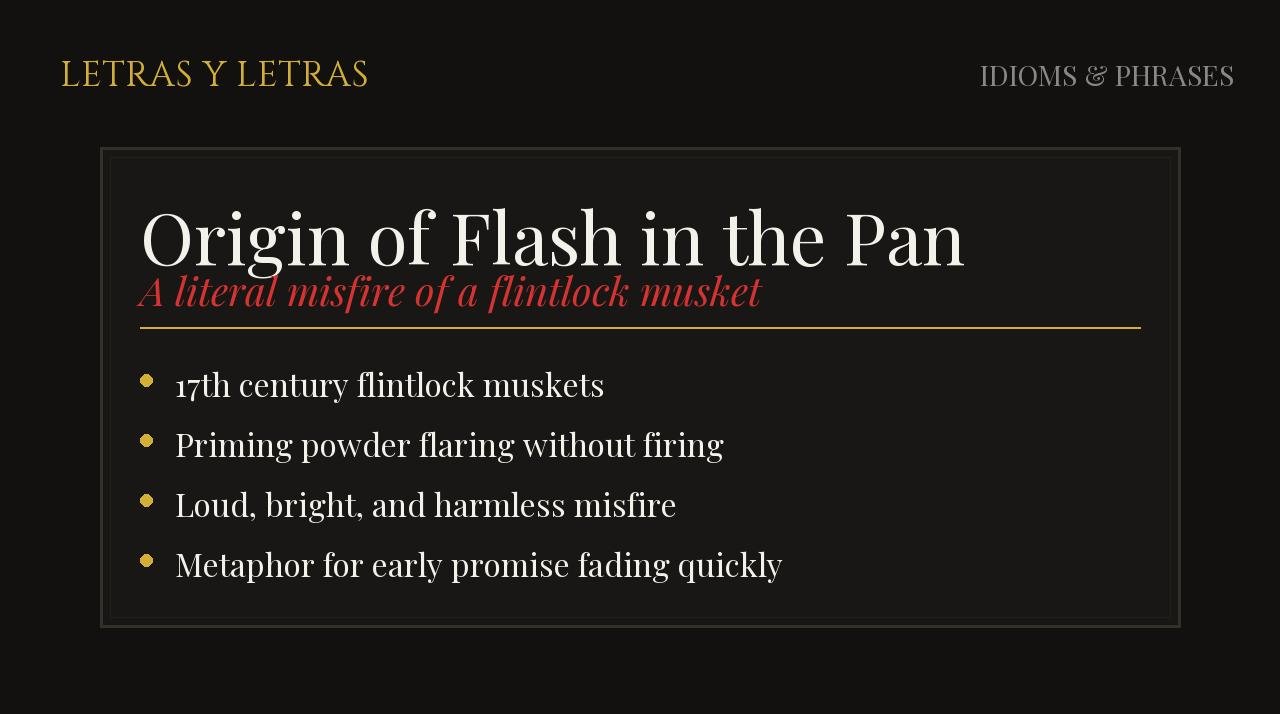
The phrase flash in the pan originates from seventeenth-century flintlock muskets and black powder firearms. Before modern cartridges existed, flintlock muskets used a small external metal depression called the priming pan to hold fine gunpowder. When a soldier pulled the trigger, the flint struck a piece of steel called the frizzen, showering sparks into the pan. If the priming powder flared up with a bright flash and cloud of smoke, but the flame failed to travel through the touchhole to ignite the main powder charge inside the barrel, the musket misfired with no bullet released. It was a dramatic, noisy failure with zero physical effect. By the late 1600s, British writers adopted the misfire as a metaphor for any venture that promises brilliance but fails to produce lasting results.
Key Takeaways
- Originates from seventeenth-century flintlock muskets and black powder weapons.
- Describes priming powder igniting in the external pan without firing the main barrel charge.
- Completely unrelated to the 1849 California Gold Rush and prospectors’ gold pans.
- First recorded in British military records and late seventeenth-century literature.
- Widely used today in business, startups, sports, and entertainment for fleeting success.
The Mechanical Anatomy of a Flintlock Musket
To grasp the true origin of this idiom, we must explore early firearm mechanics. Flintlock muskets dominated European warfare from roughly 1620 until the mid-nineteenth century. These heavy weapons replaced earlier matchlock systems and transformed battlefield infantry tactics.
Unlike modern rifles, flintlock firearms did not use self-contained brass bullets. A soldier had to load his weapon manually through a complex multi-step ritual. Loading required measured amounts of gunpowder, a lead ball, and wadding rammed down the barrel.
The ignition system rested entirely on the exterior of the weapon. Beside the barrel sat a small metal cup or shallow tray known as the priming pan. A hinged steel cover called the frizzen protected this pan from wind and rain.
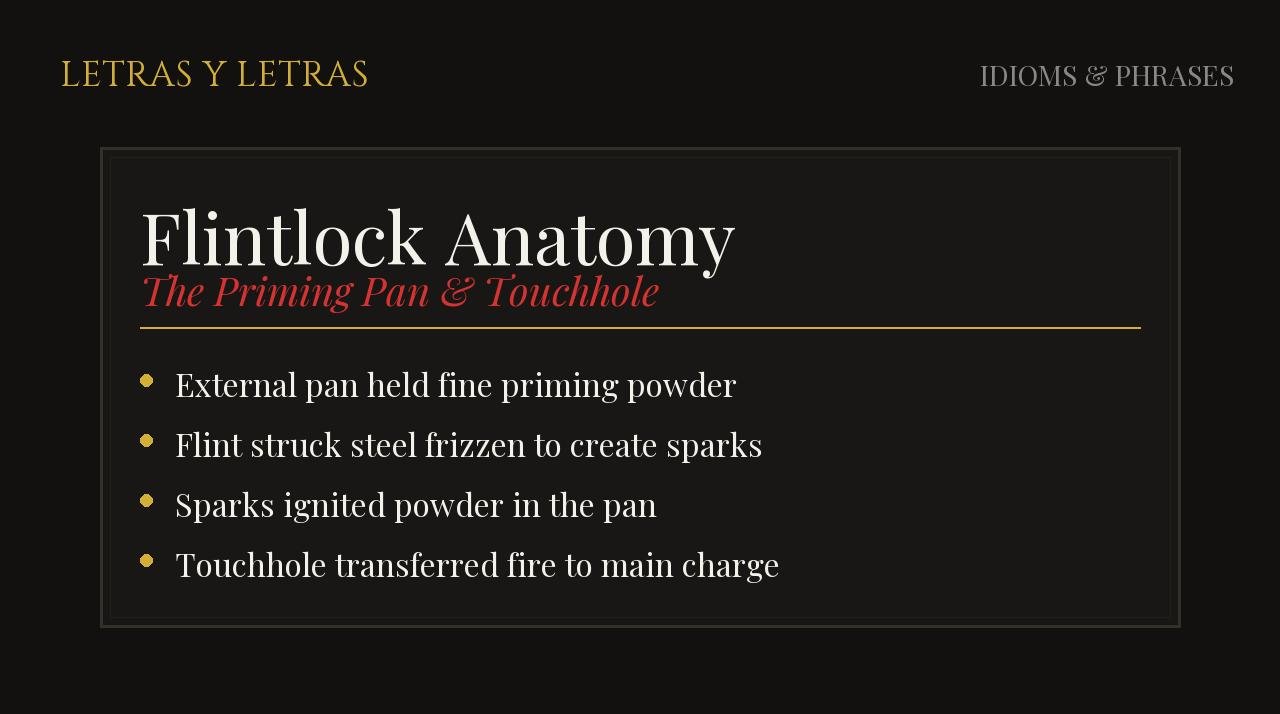
Before firing, the infantryman poured a tiny pinch of fine black powder into the priming pan. He snapped the steel frizzen shut over the powder. Next, he pulled the cock back to the fully cocked position.
When the soldier pulled the trigger, a strong spring drove the cock forward. The flint clamped in the cock scraped down the textured face of the steel frizzen. This friction shaved off glowing metal sparks that rained down into the priming pan.
A microscopic channel called the touchhole connected the external priming pan to the interior of the barrel. In a successful discharge, the burning priming powder flashed and sent a jet of flame through the touchhole. That flame ignited the main powder charge, propelling the heavy lead ball down the barrel.
When the Spark Fails: The Anatomy of a Battlefield Misfire
Early black powder weapons were notoriously unreliable in damp weather. Black powder absorbs moisture from humid air rapidly. Sweat, morning dew, or light drizzle could ruin hours of military preparation.
Several mechanical issues could disrupt the firing sequence. If the soldier used low-quality powder, it might burn too slowly. When carbon fouling clogged the tiny touchhole, flame could not enter the main barrel.
When this breakdown occurred, the flint struck the frizzen correctly. The sparks ignited the priming powder in the pan. Immediately, the pan exploded with a blinding white flash, a loud crack, and a dense cloud of sulfurous smoke.
To anyone watching from fifty yards away, the musket appeared to fire normally. The flash was brilliant and spectacular. But inside the barrel, nothing happened.
The main charge never ignited. The lead ball never left the muzzle. The infantryman stood choking on white smoke with an empty, useless club in his hands.
In combat, this misfire was terrifying. An infantryman faced charging cavalry or advancing bayonets with a loaded musket that refused to fire. The dramatic display in the pan had produced zero military impact.
From Military Failure to English Literature
Soldiers and officers in seventeenth-century Britain lived in close contact with these weapons. The visceral image of a noisy, smokey misfire became an immediate metaphor for human disappointment.
When an individual made grand promises but failed to deliver results, peers recognized the dynamic. He was creating a lot of smoke and noise without discharging any substance. In reality, he was merely a flash in the pan.
Linguistic scholars trace early written variations to late seventeenth-century British texts. In military diaries, commanders noted that raw recruits frequently suffered flashes in the pan due to sloppy loading procedures.
By the early eighteenth century, the expression moved into political satire and popular essays. London satirists applied it to boastful politicians who gave fiery speeches but passed zero legislation.
Playwrights used the term to mock pompous suitors who courted wealthy heiresses with lavish gifts but possessed no real fortune. The metaphor was intuitive because everyone had witnessed the spectacle of burning gunpowder.
Over the following decades, the phrase shed its strictly martial context. It became an essential component of english idioms and meanings. Military technology gifted everyday speech with permanent vitality, much like the origin of the phrase passing with flying colors.
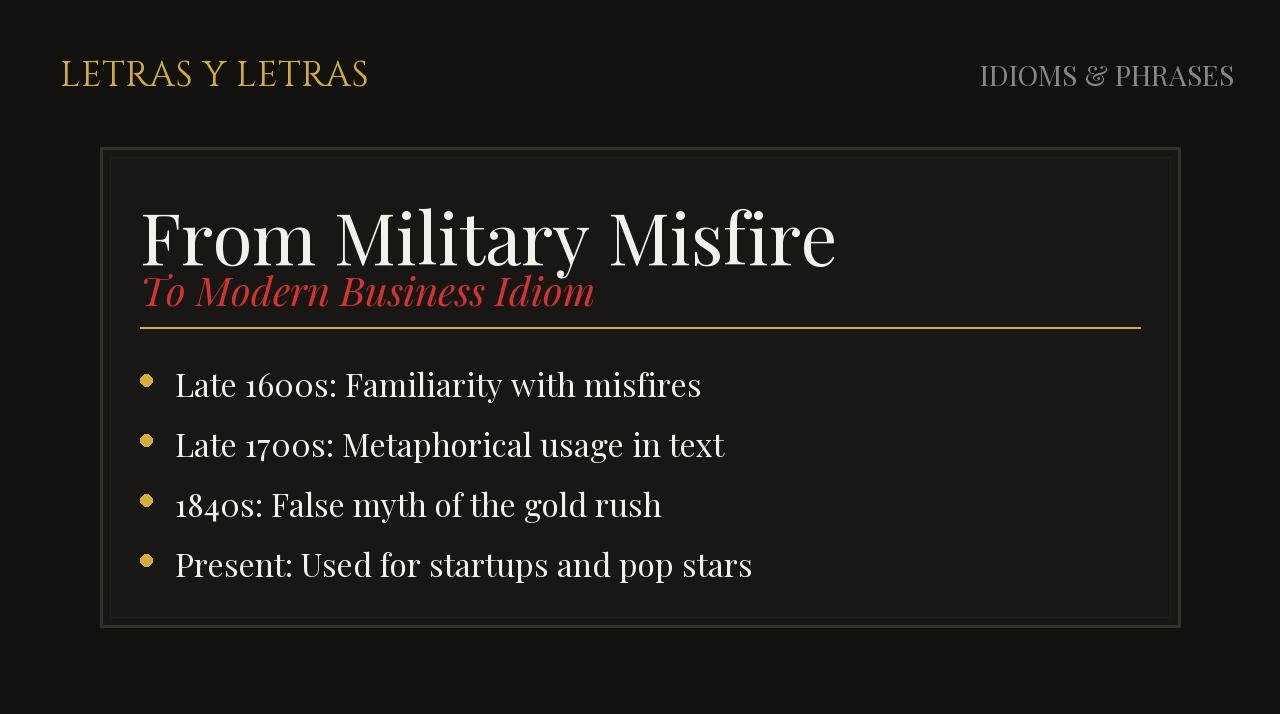
| Historical Period | Cultural Setting | Evolutionary Milestone |
|---|---|---|
| Early 1600s | European Armies | Invention of the flintlock firing mechanism with an external priming pan. |
| Late 1600s | British Military Circles | First recorded use describing mechanical musket misfires in training and combat. |
| Mid-1700s | London Literary Circles | Transition into literary satire describing failed businesses and boastful leaders. |
| 1800s to Present | Global English | Universal idiom for fleeting fame, one-hit wonders, and short-lived startup success. |
Debunking the California Gold Rush Myth
One of the most persistent false etymologies on the internet connects this phrase to the California Gold Rush of 1849. Many amateur history blogs claim that prospectors panning for gold coined the phrase.
According to this folk story, a prospector would swirl gravel and river water in his metal pan. Occasionally, sunlight catching a flake of iron pyrite or fool’s gold created a shiny flash. When the prospector examined the pan closely, the gold disappeared.
The story sounds neat and poetic. Prospectors did indeed use gold pans, and fool’s gold often fooled weary miners. However, historical chronology destroys this myth completely.
As documented by the Online Etymology Dictionary and the Oxford English Dictionary, the phrase was already common in British print by the 1700s. It was widely published more than a century before James Marshall discovered gold at Sutter’s Mill in 1848.
This error is a classic example of retroactive folk etymology. People encounter an old phrase containing the word pan. They connect it to the most famous historical event involving pans that they can recall.
Linguistic history requires rigorous documentary evidence rather than convenient assumptions. The idiom belongs exclusively to gunsmiths, just as the origin of the phrase bury the hatchet traces to peacemaking rituals.
Related Firearm Expressions in the English Language
Black powder weapons were messy, dangerous, and mechanically demanding. Because millions of men served in citizen militias and standing armies, flintlock terminology saturated the wider language.
Several other common expressions share the exact same mechanical ancestry as flash in the pan. Studying them illustrates how early technology shaped our everyday speech patterns.
Consider the idiom to go off half-cocked. On a flintlock musket, the half-cock position was a mechanical safety notch. The trigger was locked so the weapon could not fire while being loaded or carried.
If the internal tumbler was worn, the hammer might slip from the half-cock position and drop. The gun discharged prematurely before the soldier aimed. Today, acting half-cocked means rushing into a project without adequate preparation.
Another popular phrase is lock, stock, and barrel. These three components formed the entire physical structure of a musket. The lock was the firing mechanism, the stock was the wooden frame, and the barrel was the iron tube.
When purchasing a complete firearm rather than spare parts, a buyer acquired the lock, stock, and barrel. Over time, the phrase expanded to mean the entirety of anything.
Similarly, the command to keep your powder dry originated with military officers warning troops against rainfall. Wet gunpowder meant sudden death in combat. Today, keeping your powder dry means reserving resources until an optimal opportunity arrives.
Modern Usage in Business, Tech, and Sports
In modern corporate culture, the flash in the pan remains one of the sharpest metaphors for unsustainable momentum. Venture capital investors study business models specifically to avoid funding them.
During the tech boom, hundreds of mobile apps gained millions of users within weeks. They raised tens of millions of dollars and captured global headlines. Yet within a year, users abandoned them, and the companies folded.
The business showed dazzling early light, but lacked the underlying fuel to sustain momentum. It was an explosive flash in the pan. Investors lost their capital because they confused early hype with long-term durability.
The sports world uses the phrase with equal frequency. Every season, an unknown rookie has an astonishing debut weekend. Commentators hail him as the next superstar.
Opposing coaches soon study his game footage and expose his weaknesses. If the athlete lacks versatility, his performance collapses permanently. Fans lament that his brilliant debut was merely a temporary misfire.
In the arts and entertainment industries, one-hit wonders suffer the same fate. An infectious summer pop single dominates radio airwaves worldwide. The artist fails to produce a follow-up album and disappears into obscurity.
The enduring power of this seventeenth-century idiom lies in its honesty. It reminds us that beginnings are easy, but sustained execution is difficult. True achievement requires not just an initial flash, but the power to propel the bullet home.
Frequently Asked Questions
What is the exact meaning of a flash in the pan?
A flash in the pan refers to a sudden, brief success or display of potential that fails to produce lasting results or genuine impact. It describes someone or something that shows early promise but quickly fizzles out.
Did the phrase flash in the pan originate from the California Gold Rush?
No, the connection to gold panning is a widespread folk myth. The phrase was already common in British print throughout the 1700s, more than a century before the 1849 California Gold Rush began.
What was the pan on a flintlock musket?
The pan was a small external metal tray positioned beside the barrel of a flintlock firearm. It held a pinch of fine gunpowder that ignited when struck by sparks from the flint.
What caused a musket to flash in the pan?
A misfire occurred when the priming powder in the pan ignited, but the flame failed to travel through the touchhole into the main barrel. This was usually caused by damp powder or carbon fouling clogging the touchhole.
What are other common phrases that come from flintlock guns?
Several common idioms come from early black powder weapons, including going off half-cocked, lock, stock, and barrel, and keeping your powder dry.
Alan Sledge is the founder and lead writer at letrasyletras.com, dedicated to uncovering the true etymological histories behind our favorite words and phrases.