
Few proverbs trigger as much heated debate in the modern era as this one. You have likely heard someone declare that family always comes first. You have probably seen someone online insist that the proverb actually means the opposite. Today, millions repeat a viral explanation claiming the saying originally referred to ancient blood covenants.
The story sounds profound and empowering. It reassures people that chosen friendships outrank accidental biology. Yet when historians open the earliest surviving manuscripts, an entirely different reality appears. The popular modern reinterpretation is a complete fabrication.
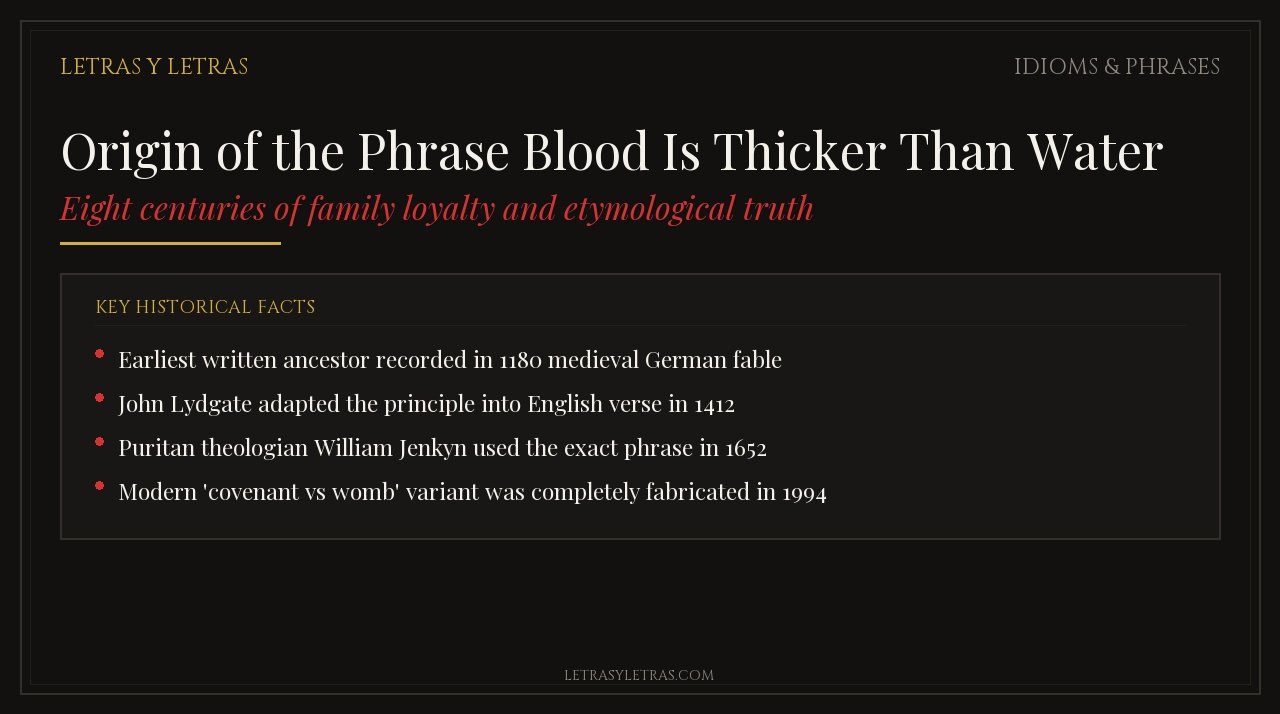
The true origin of the phrase blood is thicker than water spans eight centuries of European literature. It began in medieval German beast fables, passed through Scottish folk wisdom, and entered universal English speech. Along the way, it never meant chosen bonds. It has always celebrated the enduring pull of ancestral family ties.
Quick Answer: Origin of the Phrase Blood Is Thicker Than Water
The proverb blood is thicker than water originated in medieval Europe to express that biological family ties are stronger than casual acquaintances. Its earliest recorded ancestor appears in the 1180 German epic fable Reinhart Fuchs by Heinrich der Glichezaere, which states that kin-blood is not spoiled by water. The exact modern English wording debuted in 1652 in a published sermon by Puritan theologian William Jenkyn. It was later codified in Allan Ramsay’s 1737 Scottish proverbs and popularized worldwide by novelist Sir Walter Scott in 1815. The widespread internet claim that the original proverb was ‘the blood of the covenant is thicker than the water of the womb’ is a modern myth invented in 1994 with zero ancient historical basis.
Key Takeaways
- The phrase possesses an authentic documented history extending back over 840 years.
- Heinrich der Glichezaere recorded the foundational concept in medieval Germany around 1180.
- The viral ‘covenant versus womb’ variation was invented in 1994 by modern writers.
- Scottish folklore and Sir Walter Scott transformed the regional idiom into a global household phrase.
- Commodore Josiah Tattnall famously invoked the saying during the 1859 Battle of the Taku Forts.
The Modern Myth: The Blood of the Covenant
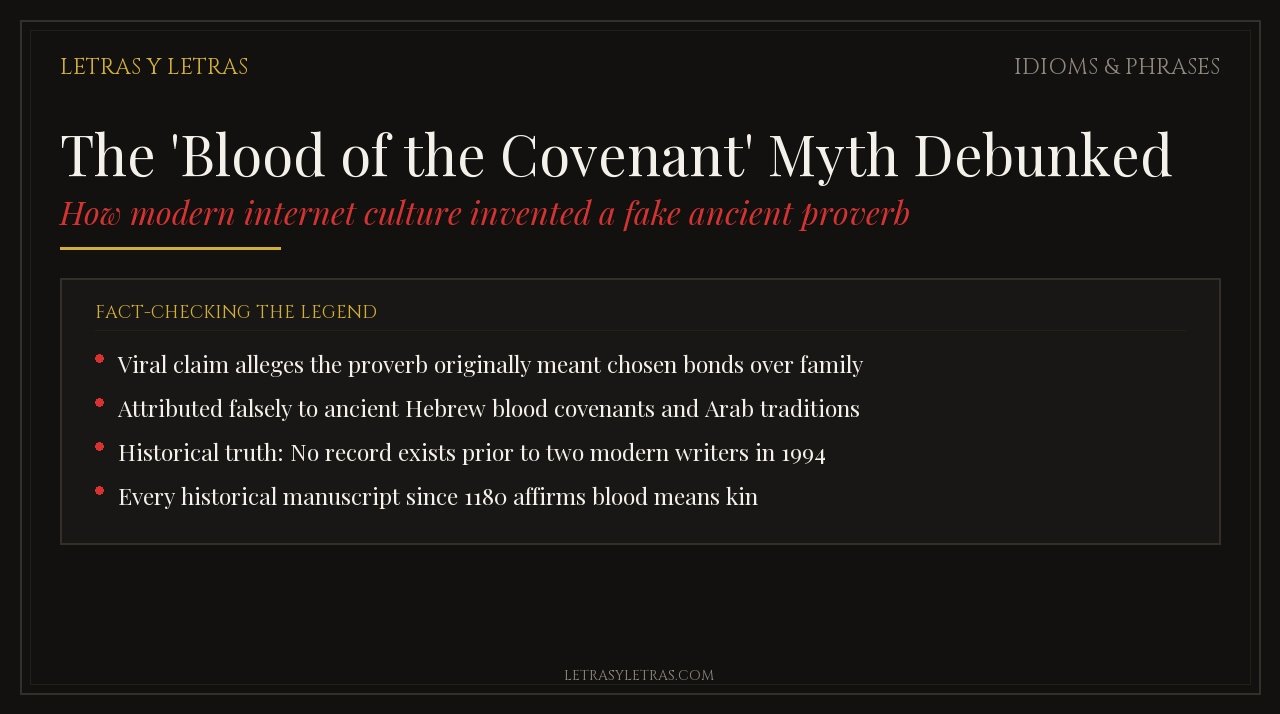
If you browse social media discussions about language, you will routinely encounter a confident claim. Commentators assert that modern society corrupted the original proverb. They insist the true ancient expression was ‘the blood of the covenant is thicker than the water of the womb.’
According to this popular narrative, soldiers who shed blood together on the battlefield form a sacred covenant. That bond supposedly surpasses the watery environment of maternal birth. It makes for an inspiring quotation on internet forums. The only problem is that history does not support a single word of it.
No ancient Hebrew scroll contains this sentence. No classical Greek text records it, and no medieval manuscript hints at its existence. Lexicographers and etymologists have combed through centuries of proverbs, and the covenant version never appears before the final decade of the twentieth century.
Tracking the 1994 Invention
Where did this modern legend originate? Scholarly investigation traces the covenant phrasing to two specific American writers in 1994. Author Richard Pustelniak published an article suggesting the covenant interpretation in a small religious newsletter. Around the same time, author Jack Crabtree proposed a similar concept in a discussion on biblical covenants.
Neither writer cited historical manuscripts or linguistic evidence. They offered creative theological reflections. Yet because their explanation sounded compelling to modern individualist sensibilities, internet blogs rapidly copied it without fact-checking.
Within a decade, this speculation turned into conventional online wisdom. People repeated it as an ancient truth. In reality, inventing ancient origins for modern philosophies is a classic folk etymology trap. Just as people enjoy discovering the real background of the origin of the phrase silver lining, separating authentic history from internet folklore is vital.
The True 12th-Century Medieval Roots: Reinhart Fuchs
To find the genuine origin of the phrase blood is thicker than water, we must travel back to Germany in the late twelfth century. Around the year 1180, an Alsatian poet named Heinrich der Glichezaere composed a satirical beast epic titled Reinhart Fuchs.
In this medieval tale, animals act out the vices, politics, and legal conflicts of human society. At one key moment in the narrative, the text notes an ancient German proverb: ‘ouch hoer ich sagen, daz sippe bluot von wazzere niht verdirbet’. In modern English, this translates directly: ‘I also hear it said that kin-blood is not spoiled by water.’
Notice the deliberate contrast. Heinrich compared kinship blood to ordinary water. Blood represented permanent genetic heritage and tribal duty. Water symbolized dilute, temporary, or distant relationships. Even in 1180, Heinrich treated the saying as an old traditional truth that he had heard from elders.
Medieval European law placed immense weight on kin liability. If a man suffered injury, his blood relatives were legally bound to seek restitution or wage blood feud. Water could wash away dust, but it could never dissolve the solemn obligations of shared lineage.
Middle English Poetry and John Lydgate
As the proverb circulated across the European continent, English writers began expressing the exact same human reality. In 1412, the celebrated English monk and poet John Lydgate composed his monumental work, Troy Book.
Lydgate reflected on family loyalty during civil conflict. He wrote that natural blood will always follow its course, and no man can divert its current. While Lydgate used slightly different poetic phrasing, his imagery relied on the identical physical metaphor.
Blood possesses viscosity and weight. It flows through veins like a powerful river. Water, by comparison, evaporates and scatters. Lydgate captured an instinct that Elizabethan playwrights and common folk already understood deeply.
During the fourteenth and fifteenth centuries, feudal allegiances shifted frequently. Lords betrayed kings, and mercenary soldiers switched banners for coin. Amid such political treachery, blood kinship remained the only social safety net that people dared trust.
The Exact English Print Debut: William Jenkyn in 1652
The exact wording that we speak today arrived in print during the English Civil War. In 1652, Puritan clergyman William Jenkyn published a treatise preserved in the British Library historical collections titled An Exposition of the Epistle of Jude.
Jenkyn delivered sermons to congregations facing severe religious divisions. In his text, he explicitly invoked the common folk saying to make a pastoral point. He wrote: ‘Blood is thicker than water; and truly the blood of Christ beautifying any of our friends and children, should make us prefer them before those between whom and us there is only a watery relation of nature.’
Jenkyn’s usage proves two critical linguistic facts. First, the exact phrase ‘blood is thicker than water’ was already common conversational currency in London by the mid-seventeenth century. Second, Jenkyn preserved the traditional distinction between deep blood bonds and thin watery connections.
He did not invent the idiom. He borrowed an existing street proverb to argue that spiritual kinship through Christ ought to run even deeper than physical birth. The idiom itself, however, was already firmly entrenched in everyday English speech.

Scottish Folklore and Allan Ramsay
While English Puritans used the proverb in theological debate, Scottish borderers lived it daily. Scottish clan society was constructed entirely on blood kinship, ancestral septs, and fierce family allegiance.
In 1737, the Scottish poet and antiquarian Allan Ramsay published his volume, A Collection of Scots Proverbs, cataloged by the National Library of Scotland archives. Ramsay roamed the Lowlands and Highlands, collecting sayings directly from the lips of farmers and shepherds.
In his collection, Ramsay documented the proverb in Scots dialect: ‘Blood’s thicker than water.’ For Highland clansmen, this was not abstract philosophy. If a Campbell or a MacDonald faced trouble in a distant market town, any kinsman within earshot was expected to draw steel to defend him.
Ramsay’s anthology was widely read throughout Edinburgh and London. It preserved hundreds of rural sayings that might otherwise have faded from memory. Just as research into the origin of the phrase break a leg reveals authentic folk performance traditions, Ramsay’s work grounded Scottish idioms in permanent print.
Sir Walter Scott and Global Fame
If Allan Ramsay preserved the Scottish proverb, the world-famous novelist Sir Walter Scott propelled it into every corner of the British Empire and North America. Scott possessed a remarkable ear for authentic regional dialogue.
In his acclaimed 1815 historical novel Guy Mannering; or, The Astrologer, Scott introduced readers to the rugged Scottish farmer Dandie Dinmont. When Dinmont learns that an impoverished woman seeking shelter shares his distant family blood, he welcomes her without hesitation.
Dinmont declares in broad Scots: ‘Weel, blude’s thicker than water; she’s welcome to the share of what I hae.’ Readers across Britain, Europe, and the United States fell in love with Scott’s Waverley novels. The dialogue resonated powerfully with Victorian sensibilities.
By the 1820s, newspapers in Boston, London, and Sydney quoted Dandie Dinmont’s words. The phrase ceased to be a regional Scottish curiosity. It became the universal English idiom for standing by your relatives through hardship.
| Year | Author / Source | Historical Milestone |
|---|---|---|
| 1180 | Heinrich der Glichezaere | Records ‘kin-blood is not spoiled by water’ in medieval German epic Reinhart Fuchs. |
| 1412 | John Lydgate | Writes that natural blood will have its course in the Middle English poem Troy Book. |
| 1652 | William Jenkyn | Earliest exact English print appearance in a published London Puritan sermon. |
| 1737 | Allan Ramsay | Codifies ‘Blood’s thicker than water’ in his famous Scottish proverbs collection. |
| 1815 | Sir Walter Scott | Popularizes the phrase worldwide through Dandie Dinmont in Guy Mannering. |
| 1859 | Commodore Josiah Tattnall | US naval officer quotes the proverb to justify aiding British sailors in China. |
| 1994 | Modern Commentators | The unhistorical ‘blood of the covenant’ myth is fabricated in modern essays. |
The 1859 Naval Incident at Taku Forts
Perhaps the most famous geopolitical application of the proverb occurred on June 25, 1859, off the coast of northern China. During the Second Opium War, a British naval squadron attempted to force passage up the Peiho River toward Beijing.
Chinese coastal artillery at the Taku Forts opened devastating fire on the British gunboats. The British flagship was crippled, British Admiral James Hope was severely wounded, and dozens of British sailors were slaughtered on deck. Watching from nearby waters aboard a neutral vessel was Flag Officer Josiah Tattnall of the United States Navy.
Under official United States policy, Tattnall was strictly required to maintain absolute neutrality. He was forbidden from firing a shot or intervening in European colonial warfare. Yet as Tattnall watched English-speaking sailors being massacred by shore batteries, his emotional discipline broke.
Tattnall ordered his American crew to row a small cutter directly into the crossfire to evacuate wounded British casualties. When his superiors subsequently demanded an explanation for violating American neutrality orders, Tattnall offered an immortal reply: ‘Blood is thicker than water!’
His dramatic defiance made headlines across the globe. British citizens sent formal resolutions of gratitude to Washington. The incident demonstrated how a domestic Scottish folk proverb could shape international diplomacy and naval warfare.
Linguistic Nuance: Blood and Water Across Cultures
Why did European cultures settle on blood and water as the central contrast? According to documented records in the Online Etymology Dictionary, blood carried deep sacred meaning across Proto-Indo-European language families. It signified vital force, physical inheritance, and ancestral legacy.
Water, conversely, was abundant, interchangeable, and easily diluted. Pour water into a lake, and its original droplet loses all individual identity. Pour blood into a community, and the lineage remains recognizable.
Similar expressions appear across disparate linguistic borders. German speakers preserved ‘Blut ist dicker als Wasser’. The Dutch say ‘Het bloed kruipt waar het niet gaan kan’, meaning blood creeps where it cannot walk. In Spanish literature, family priority echoes through related proverbs like ‘La sangre tira’, meaning blood pulls.
These parallel idioms demonstrate that human societies independently reached the same conclusion. Familial instinct is among the oldest behavioral impulses recorded in human literature. For more explorations of cultural language, explore our master guide on english idioms and meanings.
Why the Covenant Myth Persists Today
If the covenant version is factually false, why do so many intelligent people cling to it? The answer lies in modern social psychology. In Western culture, personal autonomy and chosen community are valued far more than hereditary obligation.
Many individuals have strained or toxic relationships with biological relatives. For someone who feels mistreated by their family, being told that ‘blood is thicker than water’ feels dismissive and unfair. It sounds like an excuse for bad behavior.
The fabricated covenant version offers emotional relief. It allows someone to reclaim the proverb and declare that their loyal friends, military comrades, or life partners outshine distant biological relatives. It satisfies a genuine psychological need.
As language historians, we can validate that emotional reality while maintaining scholarly honesty. Words mean what their speakers intend today. However, we should never rewrite eight hundred years of documented manuscript history simply to make an old proverb match modern preferences.
Frequently Asked Questions
What is the true origin of the phrase blood is thicker than water?
The phrase traces back to medieval Europe, appearing first in Heinrich der Glichezaere’s 1180 German poem Reinhart Fuchs. The exact English phrasing was recorded in 1652 by London clergyman William Jenkyn. It was later codified in Allan Ramsay’s 1737 Scottish proverb collection and popularized internationally by Sir Walter Scott in 1815.
Did the phrase originally mention the blood of the covenant?
No, the covenant version is a complete modern myth. No historical manuscript in Hebrew, Greek, Latin, or English contains the phrase ‘the blood of the covenant is thicker than the water of the womb’ prior to 1994. It was created by two modern authors and popularized through internet blogs.
What did the word water originally represent in the proverb?
In medieval and Scottish folklore, water represented dilute, distant, or casual relationships. Blood symbolized thick, vital ancestral kinship. The metaphor highlighted that family ties hold permanent weight, whereas ordinary friendships can drift away like water.
Who said blood is thicker than water in military history?
Commodore Josiah Tattnall of the United States Navy famously declared ‘blood is thicker than water’ on June 25, 1859. He used the proverb to explain why he broke American neutrality orders to rescue wounded British sailors during the Battle of the Taku Forts in China.
Is it grammatically correct to say blood is thicker than water?
Yes, the expression is a recognized standard English proverb. It functions as an idiomatic observation about family loyalty and human relationships across all major English dictionaries, including the Oxford English Dictionary and Merriam-Webster.
Alan Sledge is the founder and lead writer at letrasyletras.com, dedicated to uncovering the true etymological histories behind our favorite words and phrases.