
Every time you call someone friendly, you are using a piece of an Old English word for a corpse. That small “-ly” on the end began life as a word for a body. It is one of the stranger stories hiding in plain sight at the back of our words.
This guide answers the suffix meaning question in two parts. First comes what a suffix is and where the word came from.
Then come the real histories of everyday suffixes. Two popular explanations, it turns out, are not supported by the records.
Quick Answer: Suffix Meaning
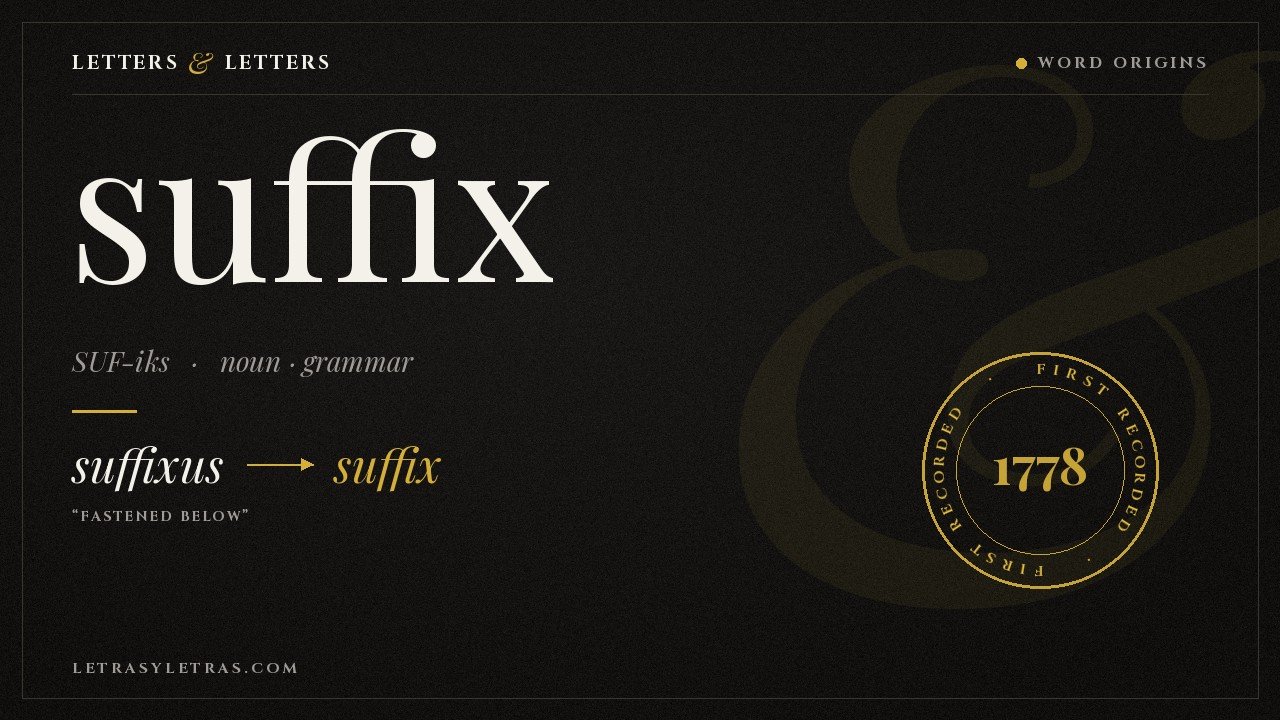
A suffix is a word part added to the end of a word to make a new word or form. Examples are -ness in kindness and -ly in quickly. English grammar adopted the word in 1778. It comes from Latin suffixus, “fastened below”. Its verb suffigere joins sub, “under”, and figere, “to fasten”. Fix, prefix and crucifix share that ancient root. Many English suffixes were once separate words: -dom meant “judgment” and -ful was simply full. Others, like -ment and -ism, came from Latin and Greek through French.
Key Takeaways
- A suffix is a word-forming element added to the end of a word or stem.
- Suffix comes from Latin suffixus, “fastened below”, and entered English grammar in 1778.
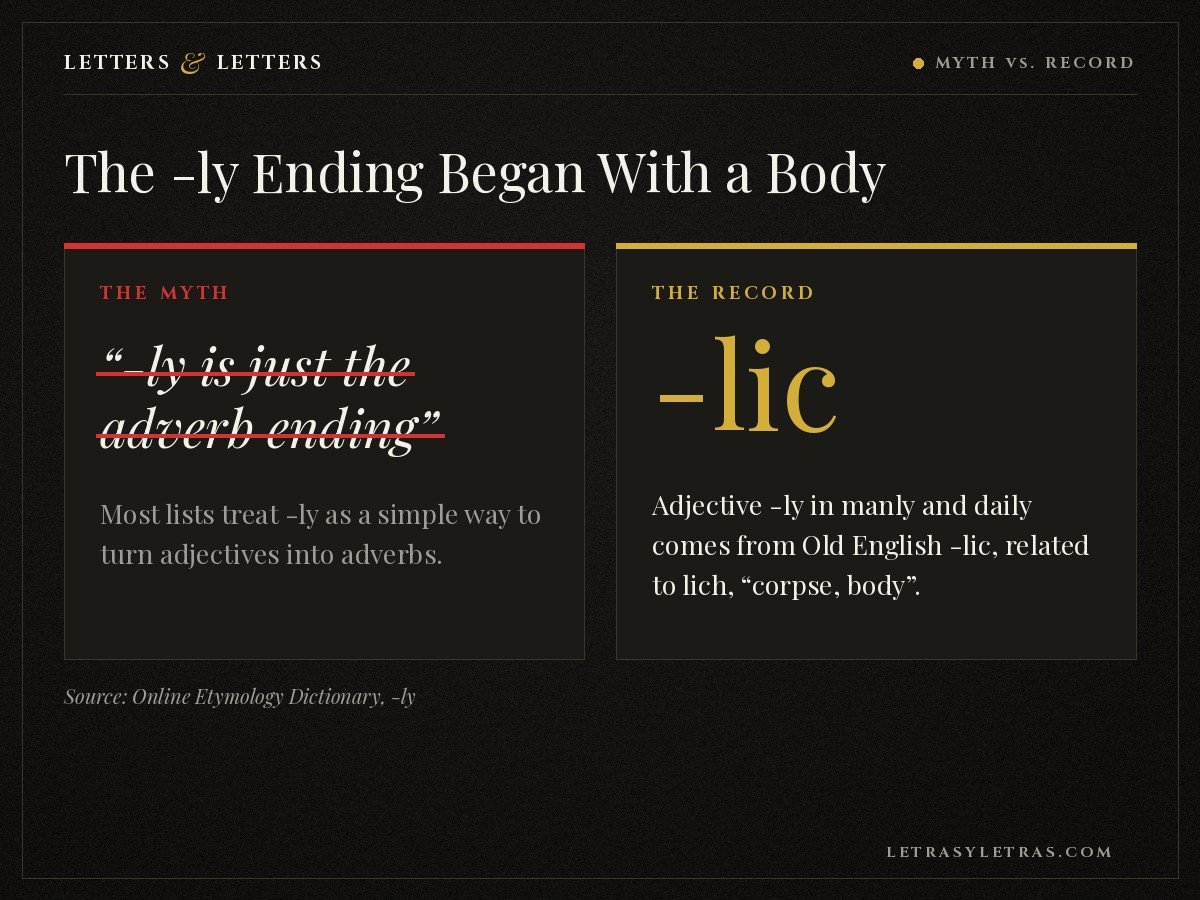
- The adjective suffix -ly descends from Old English -lic, related to lich, “corpse, body”.
- -dom, -hood and -ful began as separate Old English words before they became suffixes.
- Strictly, the Greek element is -logy; the -o- in “-ology” belongs to the word before it.
Suffix Meaning: What a Suffix Actually Is
A suffix is a letter or group of letters fixed to the end of a word or stem. It changes the meaning, the word class, or the grammatical form.
Kind becomes kindness, a noun. Add -ly to quick and you get quickly, an adverb.
Grammarians split suffixes into two broad kinds. Derivational suffixes build new words, as in teach, teacher. Inflectional suffixes change the form of the same word, as in walk, walked, or dog, dogs.
A suffix cannot stand alone in modern English. You will never see “-ness” on its own in a sentence. Yet, as we will see, several of them could stand alone a thousand years ago.
Where the Word “Suffix” Comes From
The word suffix is younger than most people expect. The Online Etymology Dictionary entry for suffix dates the grammatical noun to 1778. It came from Modern Latin suffixum, a noun use of Latin suffixus, “fastened”.
Behind that sits the Latin verb suffigere, “to fasten below”. Break it apart and you get sub, “under”, plus figere, “to fasten, fix”. A suffix, quite literally, is a tail pinned to a word.
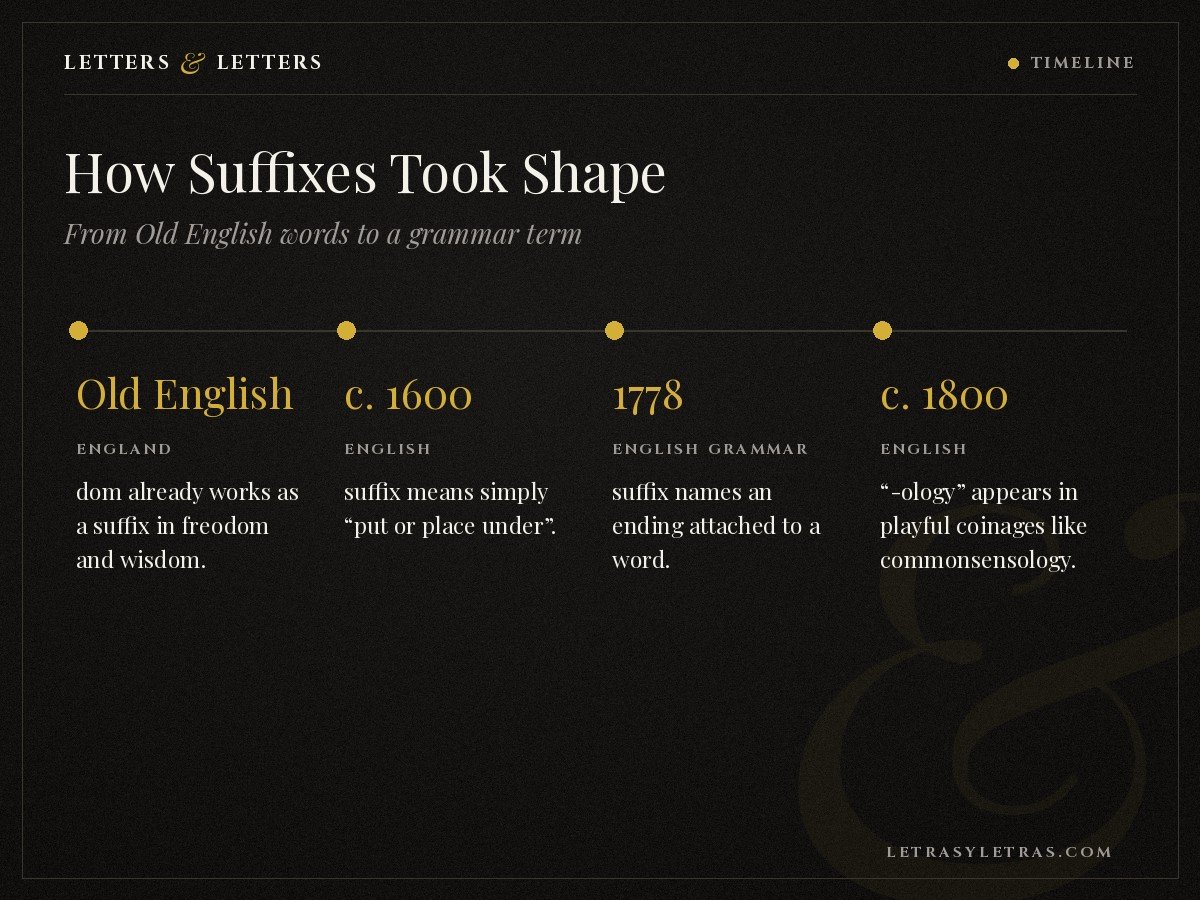
English had borrowed the idea once before. Around 1600, suffix meant simply “put or place under”.
Architects kept the image in soffit (1610s), a ceiling’s underside. It comes from Italian soffitto, “fixed beneath”.
A family of fixed things
Latin figere grows from a reconstructed Proto-Indo-European root, *dheigw-, “to stick, fix”. This root has a sprawling family in English. It may form all or part of fix, fixture, affix, prefix, transfix, crucifix and crucify.
The same root may also sit behind dig, dike and ditch. So a prefix, a suffix and a ditch may be distant cousins. Each one is about pressing or fixing something into place.
Suffixes and Their Meanings: A Quick Reference
Here are the suffixes most readers search for, with what each one means and where it came from.
| Suffix | Meaning | Origin | Examples |
|---|---|---|---|
| -ly | having the qualities of; in a certain manner | Old English -lic | friendly, daily, quickly |
| -ness | state or quality | Old English -nes(s) | kindness, darkness |
| -dom | state, condition, domain of rule | Old English dom, “judgment” | freedom, wisdom, kingdom |
| -hood | state or condition of being | Old English -had | childhood, priesthood |
| -ship | quality, office, skill, relation | Old English -sciepe, -scip | friendship, craftsmanship |
| -ful | full of; amount held | Old English full | hopeful, handful |
| -less | lacking, without | Old English -leas, “free from” | fearless, endless |
| -er | a person or thing that does | Old English -ere | teacher, baker |
| -ment | result, product or means of an action | Latin -mentum, via French | payment, commencement |
| -able | capable of, worthy of | Latin -abilis, via French | readable, lovable |
| -ism | practice, system, doctrine | Greek -ismos, via Latin | realism, heroism |
| -ess | female form of a noun | Greek -issa, via Latin and French | actress, deaconess |
The Old English Suffixes That Were Once Words
Several of our busiest suffixes started out as words with full meanings of their own. Over centuries, they wore down into endings.
-dom: from judgment to freedom
The suffix -dom comes from Old English dom, “statute, judgment”, the same word that gives us doom. Old English speakers already used it as a suffix, in freodom and wisdom.
From “judgment” it drifted into “province, state, condition”. That is how kingdom and boredom share an ending.
-hood: a bright appearance
The ending -hood comes from Old English -had, “condition, quality”. It appears in cildhad (childhood), preosthad (priesthood) and werhad (manhood). Its Germanic ancestor traces to a root meaning “bright, shining”, so a state of being began as an outward appearance.
-ship: shaping a condition
Friendship and hardship carry Old English -sciepe, meaning “state of being”. Its roots lie in a Germanic verb meaning “to create, ordain”, related to shape. German -schaft and Dutch -schap are its close cousins.
-ful and -less: full and loose
The suffix -ful is just the adjective full, fused onto the noun before it. That is why handful and bellyful can still mean an amount held. Its opposite, -less, comes from Old English leas, “free from, devoid of”, and is related to loose.
The -ly Surprise: A Suffix Born From a Body
Ask most people about -ly and they will say it is the adverb ending, as in quickly. That is only half the story. English actually has two -ly suffixes, and the adjective one has the stranger past.
The adjective -ly in manly, lordly, bodily and daily descends from Old English -lic.
Its source is a Germanic form related to *likom-, “appearance, form”. The etymology of the suffix -ly traces this in detail.
Its Old English cousin is lich, “corpse, body”.
So “manly” once meant roughly “having the form of a man”. Shape or form became “having the qualities of”. German -lich and Dutch -lijk carry the same ancestry, and so does the English word like.
The adverb -ly, as in quickly, grew from the related Old English adverb ending -lice. That is why one small ending can make friendly an adjective and quickly an adverb.
Latin and Greek Suffixes in English
After the Norman Conquest, French poured Latin and Greek endings into English. Many now feel just as native as the Old English ones.
-ment
Latin added -mentum to verb stems to name the result, product or means of an action. French carried it into English in words like commencement, where French inserts an e between the verb and the ending.
-able
The ending -able means “capable, worthy”. It comes from French -able and directly from Latin -abilis, properly the ending -bilis. The everyday word able looks like a match, but the suffix arrived by its own route.
-ism and -ess
The ending -ism names a practice, system or doctrine.
It travelled from Greek -ismos through Latin and French, and it is tied to verbs ending in -izein. The feminine ending -ess came from Greek -issa through Late Latin and French. Church words like diakonissa, “deaconess”, helped spread it.
The “-ology” Myth: Why the Suffix Is Really -logy
Many lists teach “-ology” as the Greek suffix for “the study of”. The record tells a slightly different story.
Strictly, the Greek element is -logy. In geology and mythology, the o belongs to the word in front.
Speakers heard geo-logy and myth-o-logy as geo-ology and myth-ology. Around 1800 that form began to appear in playful one-off words, such as commonsensology. From there it gained legitimacy and became a suffix in its own right.
So “-ology” is not wrong today. It is simply a modern English creation built on a misheard boundary. And it is far younger than the Greek words behind it.
A Timeline of Suffixes in English
| Year | Author / Source | Context and Milestone |
|---|---|---|
| Old English | Anglo-Saxon writers | dom already works as a suffix in freodom and wisdom; -had forms cildhad |
| c. 1600 | English borrowing of Latin suffixus | suffix used in a non-grammatical sense, “put or place under” |
| 1610s | Architecture, from Italian soffitto | soffit names the underside of an arch or ceiling, “fixed beneath” |
| 1778 | English grammar, from Modern Latin suffixum | suffix appears as a noun and verb for an ending attached to a word |
| c. 1800 | Playful coinages such as commonsensology | “-ology” starts life as a free-standing English suffix |
What Is a Suffix in a Name?
Searchers often mean something else entirely: the suffix on a person’s name. Here a suffix is a short title placed after the name, like Jr. or III.
The abbreviation for junior comes from Latin iunior, “younger”. Its partner, senior, is Latin for “older”. Roman numerals like II and III mark later generations who share the same name.
The logic matches the grammar sense neatly. Each one is something fastened on after the main word.
How to Use Suffix Meanings to Decode New Words
Knowing a handful of suffix meanings lets you read words you have never seen. Try this three-step habit:
- Cover the ending. Find the root word underneath.
- Read the ending. Ask what the suffix adds: a state (-ness), a person (-er) or a lack (-less).
- Put them back together. “Fearlessness” becomes “the state of being without fear”.
Watch for look-alikes, though. Not every word ending in -ly is an adverb, and not every -er is a person. Corner and water simply end in those letters.
Suffixes also leave fingerprints in borrowed words. The origin of the word nostalgia shows a Greek ending for pain at work. Meanwhile the origin of the word sincere shows how a tidy story can outrun the evidence.
Frequently Asked Questions
What is the meaning of a suffix?
A suffix is a word part added to the end of a word or stem. It creates a new word or a new form, such as kindness from kind or walked from walk.
What are 10 examples of suffixes?
Common examples are -ly, -ness, -dom, -hood, -ship, -ful, -less, -er, -ment and -able. Words like friendly, kindness, freedom and payment show them in action.
What does the suffix -ly mean?
As an adjective ending, -ly means “having the qualities of”, as in friendly or manly. On adverbs, it means “in a certain manner”, as in quickly.
What suffix means a person?
The ending -er usually marks a person who does something, as in teacher or baker. It comes from Old English -ere, “man who has to do with”.
What is the difference between a prefix and a suffix?
A prefix is fastened to the front of a word, as in undo. By contrast, a suffix is fastened to the end, as in kindness. Both words share the Latin root figere, “to fasten”.
What is a suffix in a name?
It is a title written after a person’s name, such as Jr. or III. The short forms stand for junior, “younger”, and senior, “older”.
Read Words From the Tail End
The quickest way to understand a long word is often to start at the end. A suffix tells you what kind of word you are holding and what it has been asked to do.
The history is the bonus.
Behind -dom stands a judge, behind -ful a full cup, and behind friendly an Old English body. Next time an unfamiliar word appears, read its tail first. For quick definitions, the Merriam-Webster definition of suffix is a solid starting point.


Alan Sledge is the writer and founder behind Letters & Letters. A lifelong lover of words, Alan has always been drawn to the small mysteries hidden in everyday language, why we say what we say, where our favorite sayings came from and the quotes that manage to put feelings into words better than we ever could ourselves.

Alan Sledge
Alan Sledge is the founder and lead researcher behind Letters & Letters. A lifelong student of linguistic history, he cross-references every word origin, idiom, and quote against primary archival manuscripts, the Oxford English Corpus, and 18th-century print lexicons.