
Every English speaker who opens a Spanish book for the first time gets a small gift. Words like hospital, chocolate and animal sit on the page looking exactly like home. Others, such as información or famoso, take half a second to decode.
These are Spanish cognates, and there are a great many of them. The usual guides hand you a long list and wish you luck. This one explains why the lists exist at all, why the spelling patterns work, and why the most famous “false friend” in Spanish is not quite as false as you were told.
Quick Answer: Spanish Cognates
Spanish cognates are Spanish words that share a root, spelling and meaning with an English word, such as animal, familia (family) and información (information). Researchers put the total at 10,000 to 15,000. Most come from Latin. Spanish inherited Latin directly as it slowly changed into a new language. English got its share mostly second hand, through Norman French after 1066 and later through scholarly borrowing. That shared ancestry produces regular spelling patterns: English -tion becomes -ción, -ty becomes -dad, -ous becomes -oso and -ly becomes -mente. False friends are cognates whose meanings drifted apart. Éxito comes from Latin exitus and now means “success,” not “exit.” Embarazada means “pregnant,” yet it shares a root with English embarrassed.
Key Takeaways
- English and Spanish share an estimated 10,000 to 15,000 cognates.
- Most reached English through Norman French after 1066, while Spanish inherited them straight from Latin.
- The spelling patterns (-tion to -ción, -ty to -dad) are fossils of Latin endings worn down in two different ways.
- Embarazada and embarrassed share a root: English took the word from French, which took it from Spanish.
- Much and mucho look like twins but come from two unrelated roots.
What Spanish Cognates Really Are
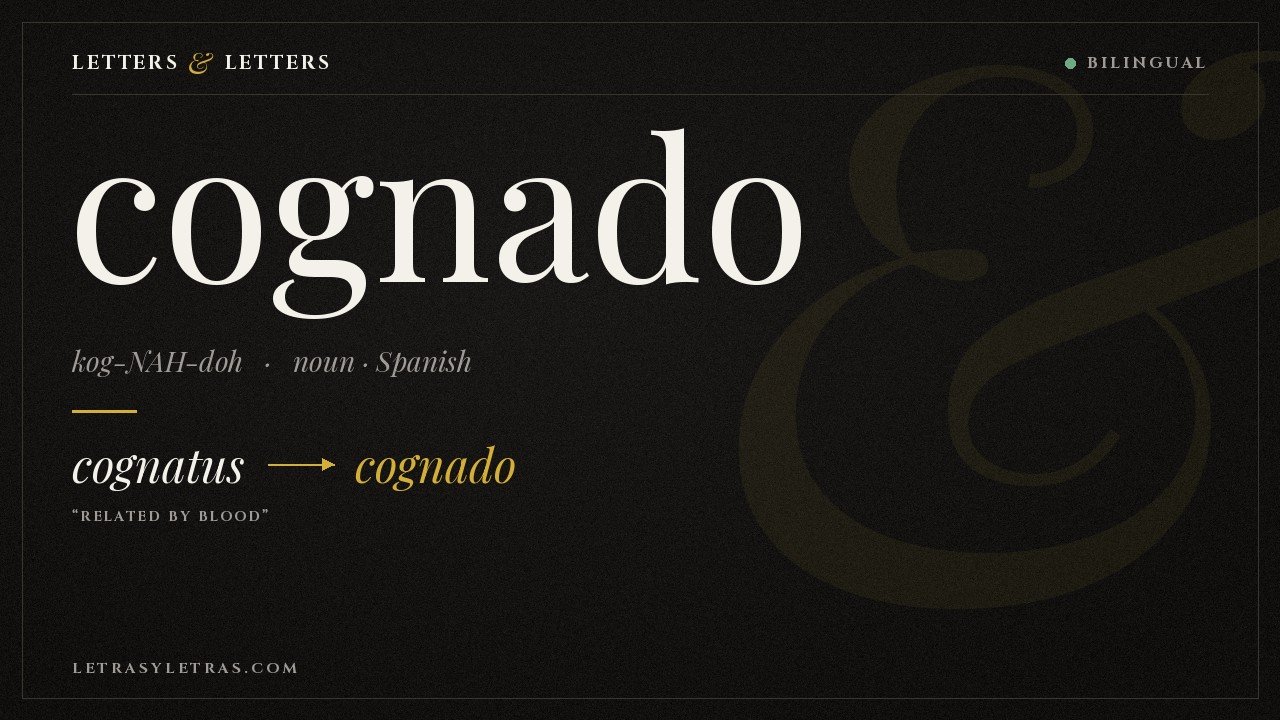
The word cognate comes from Latin cognatus, “related by blood,” built from co- (together) and gnatus (born). Spanish has the same word, cognado. A cognate, in the strict sense, is a word that was born in the same family as another.
Linguists use that strict meaning. For them, Spanish ocho and French huit are cognates because both descend from Latin octo, even though they share almost no letters.
Language teachers use a looser meaning. To them, a cognate is any word that looks alike and means the same thing in two languages, whatever route it took. This guide uses the teachers’ sense for the lists and the linguists’ sense for the stories, and says which is which.
Why English and Spanish Share So Many Words
Spanish and English sit on different branches of the family tree. Spanish is a Romance language, a direct descendant of the Latin spoken in Roman Hispania. English is Germanic, a cousin of Dutch and German. On paper, they should not share much.
History rearranged that. In 1066 William of Normandy took the English throne, and French became the language of court, law and church for roughly three centuries. French is Latin’s daughter too, so thousands of Latin words entered English with a French accent.
Later waves added more. Renaissance scholars borrowed straight from Latin and Greek to name new ideas in science, medicine and philosophy. Spanish drew on the same classical stock, so the two languages kept meeting at the same words.
That figure of 10,000 to 15,000 shared words comes from a Bilingual Research Journal study, and it is the number teachers quote most often. Most of those words are long, formal and Latinate. The short everyday words of English rarely have Spanish twins. You can meet them in our guide to Anglo-Saxon words.
The register gap
This has a useful side effect. Formal English is easier to translate into Spanish than casual English. “Commence” has a Spanish cognate (comenzar), while “start” has none.
When a plain English word fails you in Spanish, try its fancier Latin synonym. “Ask” is preguntar, but “request” gets you close to requerir, and “begin” gives way to “initiate” and iniciar.
The Spelling Patterns Behind Spanish Cognates
Most cognate guides list patterns as rules to memorize. They make more sense as history. Each pattern is a Latin ending that wore down in two ways. One path led to Spanish, the other through French to English.
-tion becomes -ción
Latin nouns like nationem and informationem lost their final syllables in both languages. French and English kept the spelling -tion. Spanish spelled the same sound with a c and added an accent: nación, información, dirección.
Hundreds of words follow this one rule. Note the change in gender, too: almost all of them are feminine in Spanish, so it is la nación.
-ty becomes -dad or -tad
Latin libertatem became French liberté and then English liberty. In Spanish, the t between vowels softened to d, giving libertad. The same process produced ciudad (city), universidad and necesidad.
These nouns are almost always feminine in Spanish. If you know the English word ends in -ty, you can usually guess the Spanish one, along with its article.
-ous becomes -oso
Latin adjectives ending in -osus meant “full of.” Spanish kept them close to the original: famoso, generoso, curioso. English got them through Old French, which flattened the ending to -ous.
Watch the small consonant shift in some pairs. “Ambitious” becomes ambicioso, with the same t to c swap you saw in -ción.
-ly becomes -mente
This pattern is a family resemblance, not a shared root. English -ly comes from Old English -lice, “having the body or form of.” Spanish -mente is Latin mente, “with a mind.” So clara mente once meant “with a clear mind.”
The two endings do the same job, which is why “finally” maps neatly onto finalmente and “exactly” onto exactamente. Our guide to suffix meaning traces more endings like these.
s plus consonant becomes es-
Spanish speakers have never liked starting a word with s followed by another consonant. Over centuries they added a vowel in front. Latin schola became escuela, and the same habit gives especial, estómago and escándalo.
Drop the opening e in your head and the English word often appears: estudiante, student; espía, spy; estado, state. This is also why Spanish speakers learning English sometimes say “espanish.”
-ic becomes -ico
Spanish prefers words that end in a vowel, so it kept the Latin -icus as -ico. Hence básico, pánico, público and romántico. Many take a written accent, because the stress falls three syllables from the end.
Identical Cognates You Already Know
Some words crossed over with no change in spelling at all. Pronunciation follows Spanish rules, so the stress and vowels shift, but you will recognize them on sight.
| Type | Spanish | English |
|---|---|---|
| Identical | animal, hospital, chocolate, error, hotel, piano | same spelling, same meaning |
| Accent only | café, área, región, cáncer | cafe, area, region, cancer |
| Near cognates | familia, teléfono, dinosaurio, oficina | family, telephone, dinosaur, office |
| Pattern cognates | nación, libertad, famoso, finalmente | nation, liberty, famous, finally |
A few identical words are newer arrivals in Spanish rather than shared Latin. Hotel came from French, and words like wifi came from English itself. We looked at that second group in our piece on Spanish words that start with W.
Cognates That Do Not Look Alike
The oldest cognates are the hardest to spot. English and Spanish both descend from Proto-Indo-European, a language spoken thousands of years before writing reached Europe. Some words survived in both branches and changed beyond easy recognition.
Spanish padre comes from Latin pater. English father comes from the same ancestor, but Germanic speakers turned the opening p into f. The same shift links pie (foot) and “foot,” and pez (fish) and “fish.”
Noche, from Latin nox, noctis, is a cousin of “night.” Nuevo matches “new,” and madre matches “mother.” These words are cognates in the strictest sense, even though no teacher would put them on a list for beginners.
False Friends: Spanish Cognates That Drifted
A false friend looks like an English word but means something else. Most false friends are real cognates that drifted apart over centuries. The root is shared; the meaning wandered.
Embarazada and embarrassed
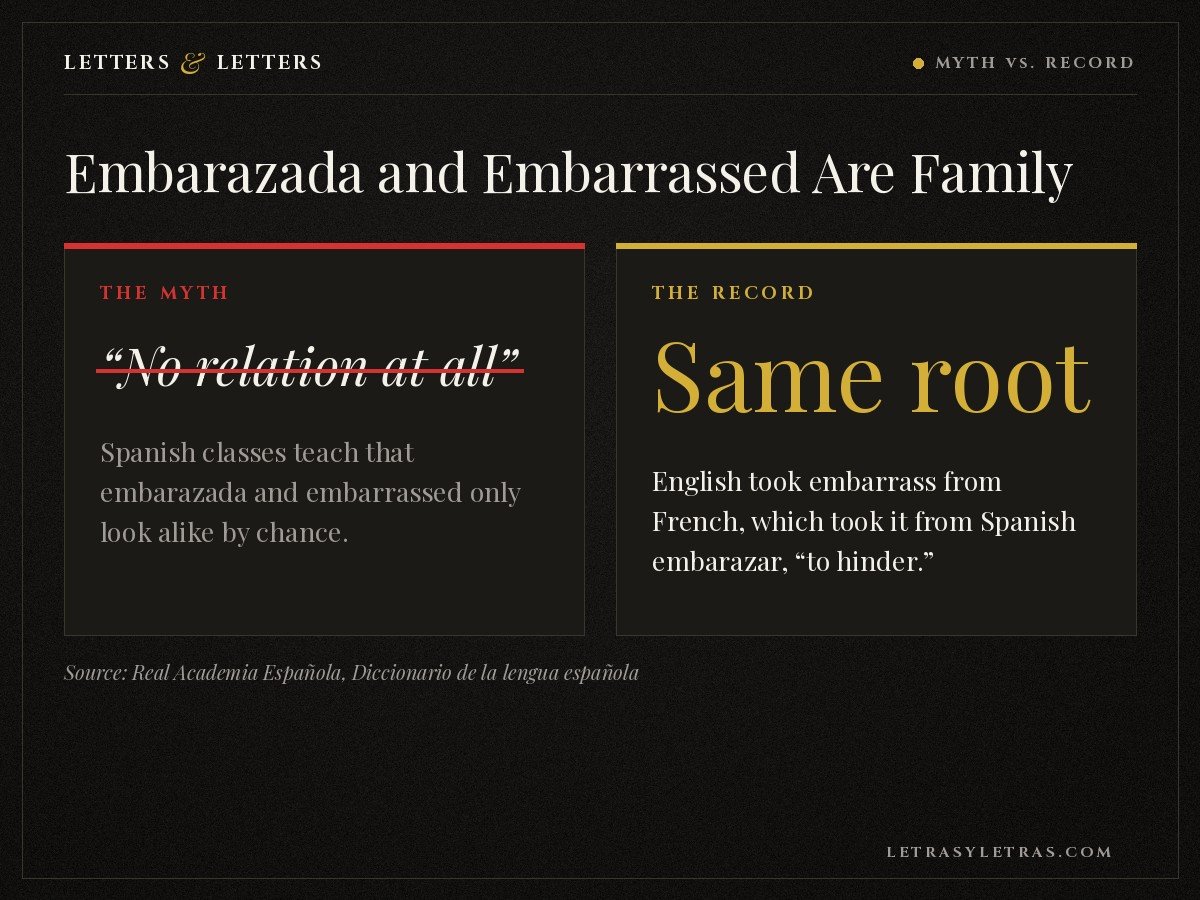
Every Spanish class tells the story of the student who announced estoy embarazada, meaning “I’m embarrassed,” and in fact said “I’m pregnant.” The usual lesson is that the two words have nothing to do with each other. That lesson is wrong.
English embarrass was borrowed from French embarrasser in the 1600s. French had taken it from Spanish embarazar. According to the Real Academia Española dictionary, the Spanish verb comes from Portuguese or Leonese embaraçar, built on baraça, a word for a cord or noose.
The core idea was being tied up or hindered. The RAE still lists “to impede, hinder or delay something” as a meaning of embarazar. English took the hindrance and made it social awkwardness. Spanish took the hindrance and applied it to pregnancy. Same rope, two directions.
Éxito, actual and librería
Éxito comes from Latin exitus, which the RAE glosses as salida, “a way out.” English kept “exit” as a door. Spanish kept the idea of how things come out, and a good outcome became success. A Spanish exit sign says salida.
Actual means “current” in Spanish, so el presidente actual is the sitting president. “Actually” in the English sense is en realidad. Librería is a bookshop (from libro, book), while a library is a biblioteca.
Others to keep an eye on: ropa means clothing, not rope. Asistir means to attend, not to assist. Constipado means having a cold, which has saved many travelers from a very awkward pharmacy visit.
True False Cognates: Lookalikes With No Shared Root
A small group of word pairs look related, mean nearly the same thing, and have no family connection at all. Linguists call these true false cognates. They are coincidences.
English much and Spanish mucho are the classic pair. “Much” comes from Old English mycel, “great,” from a root meaning “big.” Mucho comes from Latin multus, “many.” The Wiktionary etymology for mucho spells out the split.
The twist is that English “much” does have a Spanish cousin. It hides inside tamaño (size), from Latin tam magnus, “so big.” Latin magnus grew from the same ancient root as “much.”
Timeline: How the Twins Were Made
| Year | Author / Source | Context and Milestone |
|---|---|---|
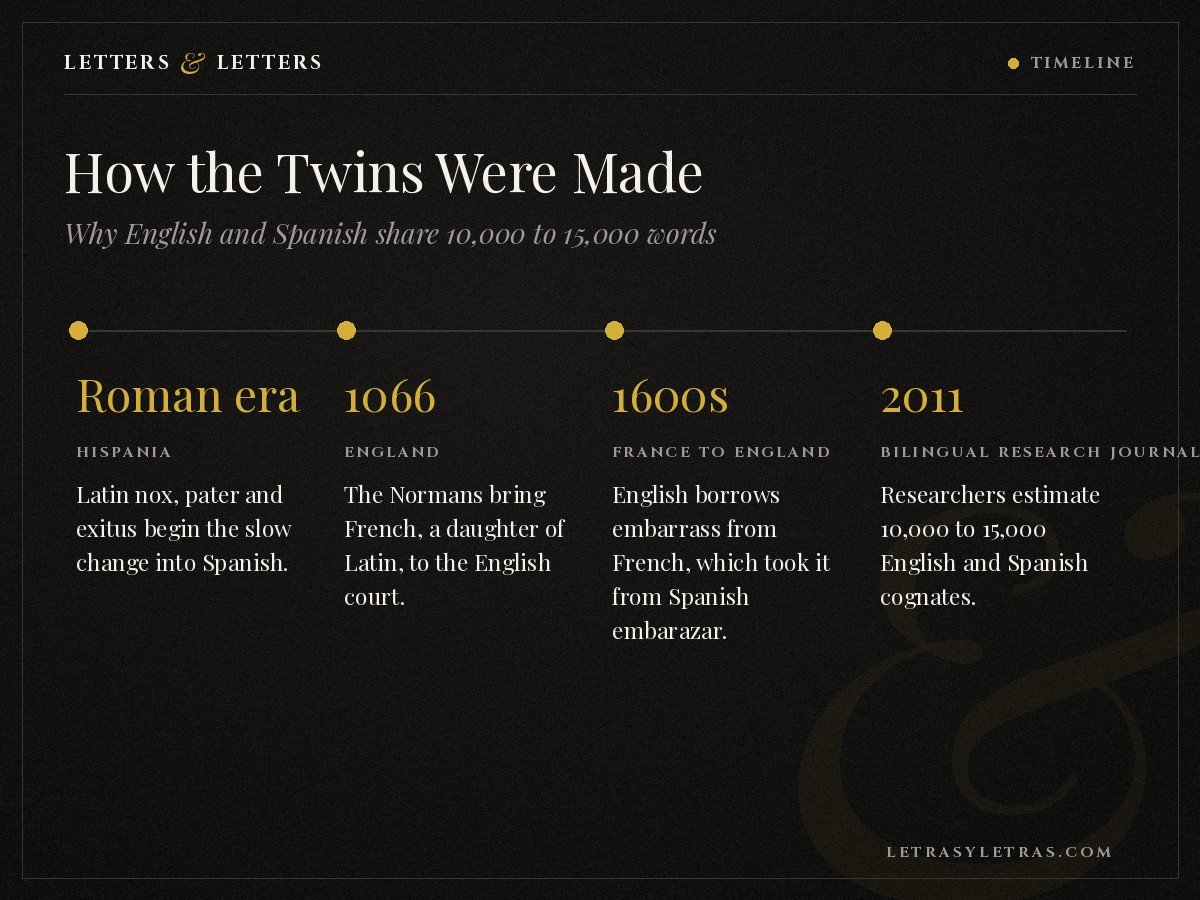
| Roman era | Latin speakers in Hispania | Words like nox, pater and exitus begin the slow change into Spanish. |
| 1066 | Norman Conquest | French, a daughter of Latin, becomes the language of the English court and law. |
| 1500s and 1600s | Renaissance scholars | English borrows directly from Latin and Greek, adding learned words Spanish already shared. |
| 1600s | French embarrasser | English borrows embarrass from French, which had taken it from Spanish embarazar. |
| 2011 | Bilingual Research Journal | Researchers estimate English and Spanish share 10,000 to 15,000 cognates. |
How to Use Spanish Cognates Without Getting Caught
Treat cognates as a strong first guess, not a certainty. If a Spanish word looks like an English one, assume the meaning is close and let the sentence confirm it. Context catches most false friends before they cause trouble.
When speaking, try the pattern rules out loud. Need “possibility”? Swap -ty for -dad and you get posibilidad, which is correct. Native speakers will forgive a near miss far faster than silence.
Pronounce cognates the Spanish way. Hospital drops its h and stresses the last syllable. Chocolate has four syllables. Many learners recognize a cognate in writing and then miss it completely in speech.
Keep a short list of the false friends that matter for your own life. A traveler needs constipado and salida. A student needs asistir and librería. For the deeper Latin and Arabic layers of the language, our guide to Spanish words of Arabic origin picks up where Latin leaves off.
Frequently Asked Questions
What are identical cognates in Spanish?
They are words spelled the same in both languages with the same meaning, such as animal, hospital, chocolate, error and hotel. Pronunciation still follows Spanish rules, so the stress and vowel sounds change.
What are 10 false cognates in Spanish?
Common ones are embarazada (pregnant), éxito (success), actual (current), librería (bookshop), ropa (clothing), asistir (to attend), constipado (having a cold), sensible (sensitive), molestar (to bother) and carpeta (folder). Most of them share a root with the English word but drifted in meaning.
How many cognates do English and Spanish share?
The most widely cited estimate is 10,000 to 15,000, from research published in the Bilingual Research Journal. Most are formal words of Latin origin that reached English through French.
Is embarazada really a false cognate?
It is a false friend, since the meanings differ, but it is a true cognate. English embarrass came from French embarrasser, which came from Spanish embarazar, “to hinder.”
What is the difference between a cognate and a loanword?
A loanword is borrowed directly from another language, like Spanish wifi from English. A cognate, in the strict sense, descends from a shared ancestor. Teachers often use “cognate” for both.
Why do Spanish words add an e before s?
Spanish does not allow a word to begin with s plus a consonant, so a vowel was added in front over time. Latin schola became escuela, which is why “special” is especial.
Read Every New Word as a Family Member
The lists are useful, but the history is what makes Spanish cognates stick. Once you see that -dad is a worn-down Latin -tatem, you stop memorizing and start predicting. Learn that embarazada and “embarrassed” were tied by the same cord, you will never mix them up again.
Spanish and English are not sisters. They are distant cousins who spent a few centuries in the same house, thanks to a Norman duke and a lot of Latin scholars. The family resemblance is real, and you can use it.


Alan Sledge is the writer and founder behind Letters & Letters. A lifelong lover of words, Alan has always been drawn to the small mysteries hidden in everyday language, why we say what we say, where our favorite sayings came from and the quotes that manage to put feelings into words better than we ever could ourselves.

Alan Sledge
Alan Sledge is the founder and lead researcher behind Letters & Letters. A lifelong student of linguistic history, he cross-references every word origin, idiom, and quote against primary archival manuscripts, the Oxford English Corpus, and 18th-century print lexicons.