
You spoke Latin before breakfast this morning. Cheese, street and agenda are all Latin. Some of those words have lived in English for well over a thousand years. They arrived with Roman traders, with monks, and with scientists who needed a name for a molecule.
This guide gathers the Latin words worth knowing, from everyday loans to lovely words for tattoos and vows. I have also checked every famous phrase against its real source. A few were never spoken by the person they are pinned on.
Quick Answer: Latin Words in English
Latin is the direct source of roughly 28 per cent of modern English vocabulary, and French, itself a daughter of Latin, supplies about another 28 per cent. The borrowing came in waves. Germanic tribes picked up street, wine, cheese and kitchen from Roman traders before they ever reached Britain. Missionaries added about 600 church and scholarly words in the Old English period. The Normans brought roughly 10,000 words after 1066, and the Renaissance (about 1500 to 1650) added 10,000 to 12,000 more, many taken straight from Latin. Famous Latin phrases still in use include carpe diem (Horace, 23 BC) and veni, vidi, vici (Caesar, around 47 BC). Et tu, Brute? comes from Shakespeare, not from Caesar.
Key Takeaways
- About 28 per cent of English words come directly from Latin, and another 28 per cent arrive through French.
- Street, wine, cheese, mile and kitchen are Latin loans older than English itself.
- Carpe diem literally means “pluck the day,” a gardening image from the poet Horace.
- There is no evidence Julius Caesar ever said “Et tu, Brute?” The line is Shakespeare’s.
- English often pairs a plain Germanic noun with a Latin adjective: hand and manual, dog and canine, moon and lunar.
Latin Words You Already Use Every Day
The oldest Latin words in English are so ordinary that nobody notices them. Long before the Angles and Saxons crossed to Britain, they traded and fought with the Roman Empire. They came home with Roman words for Roman things.
Here are some of the words those tribes borrowed, according to the standard history of Latin in English:
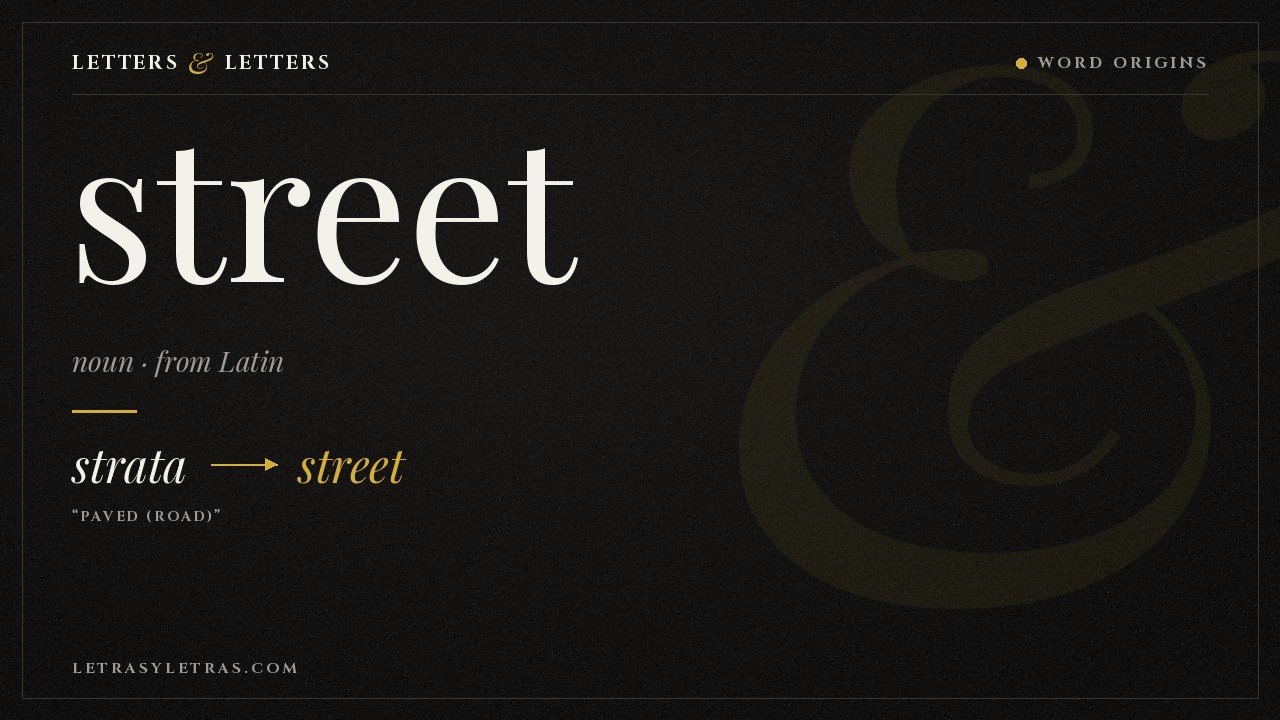
- Street, from Latin strata, short for via strata, a paved road. Old English wrote it stræt.
- Wine, from vinum.
- Cheese, from caseus.
- Kitchen and cook, from coquina and coquus.
- Mile, from milia, “thousands,” because a Roman mile was a thousand paces.
- Candle, from candela.
- Fork, from furca, a pitchfork.
- Wall, camp, pillow, inch, pound and noon belong on the same list.
Notice what these words describe. Paved roads, wine, cheese, stone walls and measured miles were Roman technology. The tribes had no native words for them, so they took the Roman ones.
A second group of everyday Latin words arrived much later, untouched. Nobody bothered to change their shape:
- Agenda: “things to be done.”
- Alibi: “elsewhere.”
- Ego: “I.”
- Veto: “I forbid.”
- Video: “I see.”
- Exit: “he goes out,” once a stage direction in printed plays.
- Bonus: “good.”
- Data: “things given,” the plural of datum.
The verb dico, “I say,” gave English dictionary, dictate and verdict. The adjective alius, “other,” gave us alien. Once you start looking, the Latin underneath English is hard to stop seeing.
How Latin Words Entered English in Four Waves
English is a Germanic language. Its grammar and its most common words (the, and, have, go, water) come from the same ancestor as German and Dutch. Latin came in from the side, in four big waves.
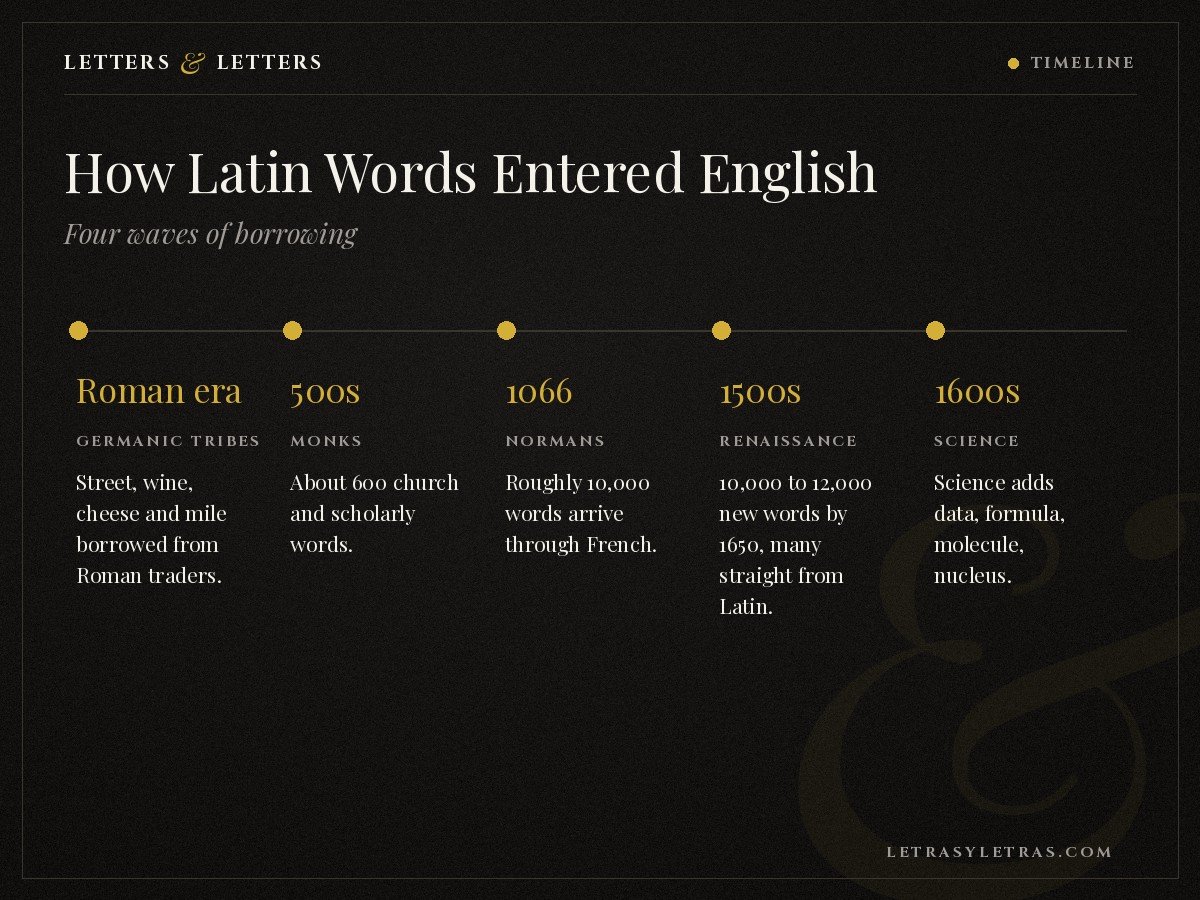
| Period | Who Brought It | Words and Scale |
|---|---|---|
| Before Britain | Germanic tribes trading with Rome | street, wine, cheese, mile, kitchen |
| 500s to 1000s | Christian missionaries and monks | About 600 words, mostly church and scholarly terms |
| 1066 onward | Norman French speakers | Roughly 10,000 words, about three quarters still in use |
| 1500 to 1650 | Renaissance writers and scholars | 10,000 to 12,000 words, such as dexterity, enthusiasm, juvenile |
| 1600s and 1700s | Scientists | data, formula, molecule, nucleus, ratio, vertebra |
The missionaries of the 6th and 7th centuries wrote in Latin. When they wrote in English, they often reused a native word instead of borrowing. Old English gōdspell, “good news,” became our gospel. Most of the roughly 600 Latin words they did borrow were scholarly, and many died out before Middle English.
The Norman wave was different. French had grown out of spoken Latin, so French words were Latin words in a new coat. That is how English ended up with royal, regal and kingly, three words for one idea from three routes.
The Renaissance wave is the one people mocked at the time. Critics sneered at fresh Latin coinages as “inkhorn terms,” words that smelled of the scholar’s ink pot. Many of those words, such as allusion and anachronism, won the argument and stayed.
How large is the Latin share today? The usual estimate is 28 per cent directly from Latin, plus 28 per cent through French. You will see “60 per cent” quoted online. That figure only works if you count French and Latin together.
Beautiful Latin Words and Their Meanings
Many readers come looking for Latin words that sound lovely. These have the bonus of a living English relative, so you can use the family member in daily speech.
- Crepusculum (twilight). It gives English crepuscular, used for animals most active at dawn and dusk, like deer and rabbits. Merriam-Webster lists the English word crepuscular with both the twilight sense and the animal sense.
- Apricus (sunny, full of sunlight). The rare English verb apricate means to bask in the sun.
- Susurrus (a whisper, a murmur). Say it aloud and the word does what it means.
- Mellifluus (flowing with honey). English mellifluous describes a sweet, smooth voice.
- Lux (light). Its family includes lucid and the unit lux.
- Stella (star). Hence stellar and constellation.
- Aurora (dawn). The northern lights are the aurora borealis, the northern dawn.
- Serenitas (calm, clear weather). English serene first described a cloudless sky.
One warning before you print a list like this on a wall. Several popular lists online include querencia, “a place where you feel safe,” as a Latin word. It is Spanish, from the verb querer, “to want” or “to love.” Spanish grew out of Latin, which explains the mix-up. If Spanish is your interest, our guide to Spanish cognates shows how the two languages share roots.
Powerful Latin Words With Deep Meaning
People searching for “powerful” Latin words usually want something for a motto, a tattoo or a team name. These carry weight because Romans used them to describe the qualities they admired most.
- Virtus: courage, excellence. It is built on vir, “man,” and once meant manly valour. English virtue softened it.
- Veritas: truth. It is the motto on Harvard’s crest.
- Dignitas: dignity, standing, a Roman’s public worth.
- Fortitudo: strength, endurance under hardship.
- Vis: force, raw power. Its accusative form survives in English as vim.
- Libertas: freedom. Rome even had a goddess of that name.
- Sapientia: wisdom. It gives Homo sapiens, “wise human.”
- Memento mori: “remember that you will die,” a phrase meant to sharpen life rather than darken it.
Some Latin words sound sincere because they really are. The English word sincere has its own famous Latin myth about wax and marble, which I took apart in the origin of the word sincere.
Latin Words for Love, Light and Darkness
Three themes come up again and again in searches: love, light and the dark side. Latin has a rich word for each.
Love
Amor is love as passion. Caritas is love as care and generosity, the root of charity. Amicitia is friendship. To say “I love you” in Latin, the simple form is te amo.
The poet Virgil gave the world omnia vincit amor, “love conquers all.” People often flip it to amor vincit omnia, and both are good Latin. Ovid offered sharper advice in his love poetry: ut ameris, amabilis esto, “to be loved, be lovable.”
Light
Lux, lumen and sol (sun) cover most of it. From sol come solar and solstice. From luna, the moon, comes lunar, and the old belief that the moon could drive people mad gave us lunatic.
Darkness and Death
Tenebrae means darkness, and it names a gloomy church service held in Holy Week as candles are put out one by one. Umbra means shadow. Italian turned a little shade into ombrella, and English made it umbrella.
Mors, death, gives mortal and mortuary. It also gives a word that sounds harmless: mortgage. The full story of that “death pledge” is in the origin of the word mortgage.
Famous Latin Phrases and Who Really Said Them
Here is where the folklore gets thick. Famous Latin phrases travel fast, and their sources often get lost on the way. I have checked each one below against the ancient writers who recorded it.
Et tu, Brute?
Everybody “knows” these were Julius Caesar’s last words on the Ides of March, 44 BC. There is no evidence he said them. The line is from William Shakespeare’s Julius Caesar (1599), and it may have appeared even earlier in Richard Edes’s lost Latin play Caesar Interfectus of 1582.
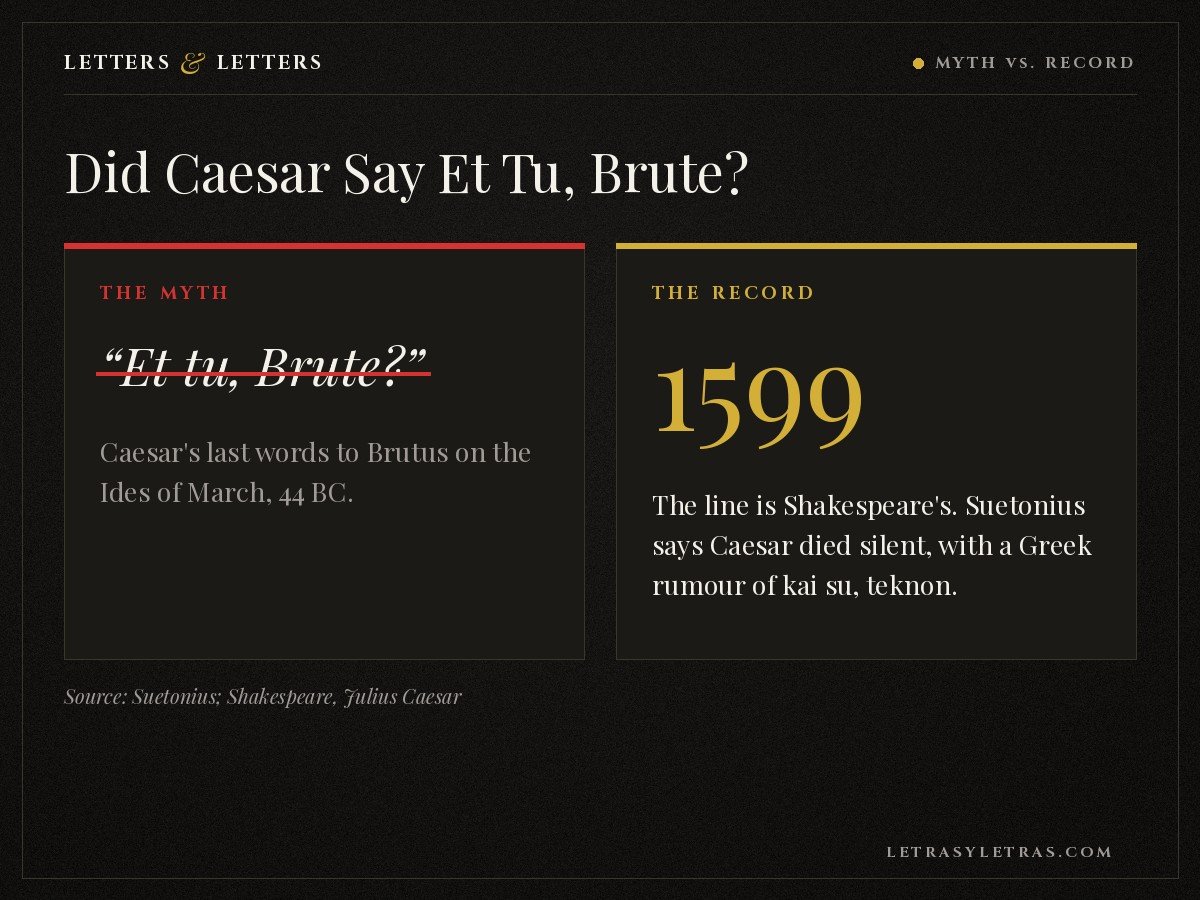
The Roman historian Suetonius, writing about a century and a half after the murder, says Caesar died without a word. He adds that some people claimed Caesar spoke to Brutus in Greek: kai su, teknon, “you too, child.” Even then, Suetonius reports it only as a rumour. You can read his account in an English translation of Suetonius on the Twelve Caesars. Plutarch says Caesar simply pulled his toga over his head.
Carpe diem
This one is genuine. It comes from Horace, Odes book 1, poem 11, published in 23 BC. The full line is carpe diem, quam minimum credula postero: “seize the day, trusting as little as possible in tomorrow.”
The verb carpo means to pick or pluck, as you would ripe fruit. So Horace’s image is closer to “pluck the day while it is ripe.” It is a gardener’s line, not a soldier’s.
Veni, vidi, vici
“I came, I saw, I conquered.” Caesar used it around 47 BC after crushing Pharnaces II of Pontus at the Battle of Zela, in what is now Turkey. Plutarch says Caesar wrote it to a friend in Rome. Suetonius says the three words were displayed on a sign during Caesar’s triumph.
More phrases worth knowing
- Quis custodiet ipsos custodes? “Who will guard the guards themselves?” From the satirist Juvenal.
- Ad hoc: “for this,” made for one particular purpose.
- Bona fide: “in good faith.”
- Status quo: “the state in which,” the way things are.
- Ipso facto: “by the fact itself.”
- Cum laude: “with praise,” as on a diploma.
- Per se: “by itself.”
- Vice versa: “the position turned,” the other way around.
Short Latin sayings like these overlap with the proverb tradition. If you enjoy them, our pieces on define aphorism and proverb definition trace how such lines survive for centuries.
Latin Abbreviations Hiding in Plain Sight
Every time you write e.g. or etc., you are abbreviating a Latin phrase. Most people never learned what the letters stand for, which is why e.g. and i.e. get swapped so often.
- e.g. = exempli gratia, “for the sake of example.” Use it to give examples.
- i.e. = id est, “that is.” Use it to restate or narrow.
- etc. = et cetera, “and the rest.”
- a.m. and p.m. = ante meridiem and post meridiem, before and after midday.
- QED = quod erat demonstrandum, “which was to be demonstrated,” the closing flourish of a maths proof.
- P.S. = post scriptum, “written after.”
- vs. = versus, “turned toward,” hence against.
A memory trick that works: i.e. starts with the same letter as “in essence,” and e.g. starts like “example given.”
One more piece of hidden Latin sits on almost every unfinished website. The dummy text lorem ipsum is a scrambled passage from Cicero’s De finibus bonorum et malorum, written in the 1st century BC. Its first word is a broken half of dolorem ipsum, “pain itself.” Designers have used it since Letraset sold it on transfer sheets in the late 1960s.
Plain English Nouns With Latin Adjectives
Here is a quirk most speakers never notice. English often keeps a short Germanic noun but borrows its adjective from Latin. The noun is everyday speech, the adjective sounds like a textbook.
| Germanic Noun | Latin Adjective | Latin Root |
|---|---|---|
| hand | manual | manus |
| dog | canine | canis |
| bird | avian | avis |
| moon | lunar | luna |
| sun | solar | sol |
| mother | maternal | mater |
| house | domestic | domus |
| sea | marine | mare |
| eye | ocular | oculus |
This split explains why Latin words can feel formal. The short Germanic words are the ones children learn first. The Latin layer came later, through the church, the law courts and the universities. Our guide to Anglo-Saxon words covers the other side of that pairing.
Latin also lends English its building blocks. Endings like -tion, -ity and -ous are Latin, and so are many of the prefixes on our longer words. The suffix meaning guide traces where those endings came from.
Read Latin Words as Fossils, Not Decorations
The best way to learn Latin words is not to memorize a list of 1,000. Take a word you already use, peel it back, and see what Roman object or idea sits underneath. A street was once a paved Roman road. A mortgage was a pledge that ended in death, and a disaster was a bad star. Each one is a small fossil.
If you want to go further, the source texts are free. Project Gutenberg carries the Odes of Horace in English, so you can read carpe diem in its own poem. The line reads better in context than on any coffee mug.
Frequently Asked Questions
What are some cool Latin words?
Crepusculum (twilight), susurrus (a whisper), apricus (sunny) and mellifluus (flowing with honey) are favourites. Each has an English relative: crepuscular, susurration, apricate and mellifluous.
What is “I love you” in Latin?
The simplest form is te amo, from the verb amare, “to love.” Word order is flexible in Latin, so amo te is also correct.
What is a powerful Latin word?
Virtus (courage, excellence), veritas (truth) and fortitudo (strength) are popular choices. Virtus carried the most weight for Romans, since it named the qualities a citizen was judged by.
What are some famous Latin words and phrases?
Carpe diem (Horace, 23 BC), veni, vidi, vici (Caesar, around 47 BC) and quis custodiet ipsos custodes? (Juvenal) are among the best known. Et tu, Brute? is famous too, but it comes from Shakespeare’s 1599 play, not from Caesar.
How much of English comes from Latin?
About 28 per cent of English words come directly from Latin, and roughly another 28 per cent come through French. The often quoted figure of 60 per cent combines both routes.
Is Latin a dead language?
Latin has no native speakers today, which is what “dead” means to linguists. Its descendants, including Spanish, French, Italian, Portuguese and Romanian, are spoken by hundreds of millions of people, and English keeps borrowing from it for science and law.


Alan Sledge is the writer and founder behind Letters & Letters. A lifelong lover of words, Alan has always been drawn to the small mysteries hidden in everyday language, why we say what we say, where our favorite sayings came from and the quotes that manage to put feelings into words better than we ever could ourselves.

Alan Sledge
Alan Sledge is the founder and lead researcher behind Letters & Letters. A lifelong student of linguistic history, he cross-references every word origin, idiom, and quote against primary archival manuscripts, the Oxford English Corpus, and 18th-century print lexicons.