
A university student opens an online portal to check final examination results. Joy erupts across the household after seeing top marks in every difficult subject. Family members and mentors quickly send congratulatory messages praising them for passing with flying colors.
Colleagues repeat the exact same expression when a coworker aces an intense executive job interview. Doctors use the phrase after a patient endures a complicated medical procedure with remarkable resilience. Across modern daily conversation, the phrase represents effortless triumph and distinction.
Yet this vivid expression has nothing to do with visual hues, paint palettes, or graphic design. The phrase originated amid gunpowder smoke, wooden sailing ships, and high seas naval combat. To uncover its true meaning, we must travel back to seventeenth-century maritime warfare.
Warships faced ruthless cannon duels where national survival depended on steadfast discipline. Examining historical naval records reveals how maritime flag protocols became our favorite idiom for triumph.
Quick Answer: Origin of the Phrase Passing With Flying Colors
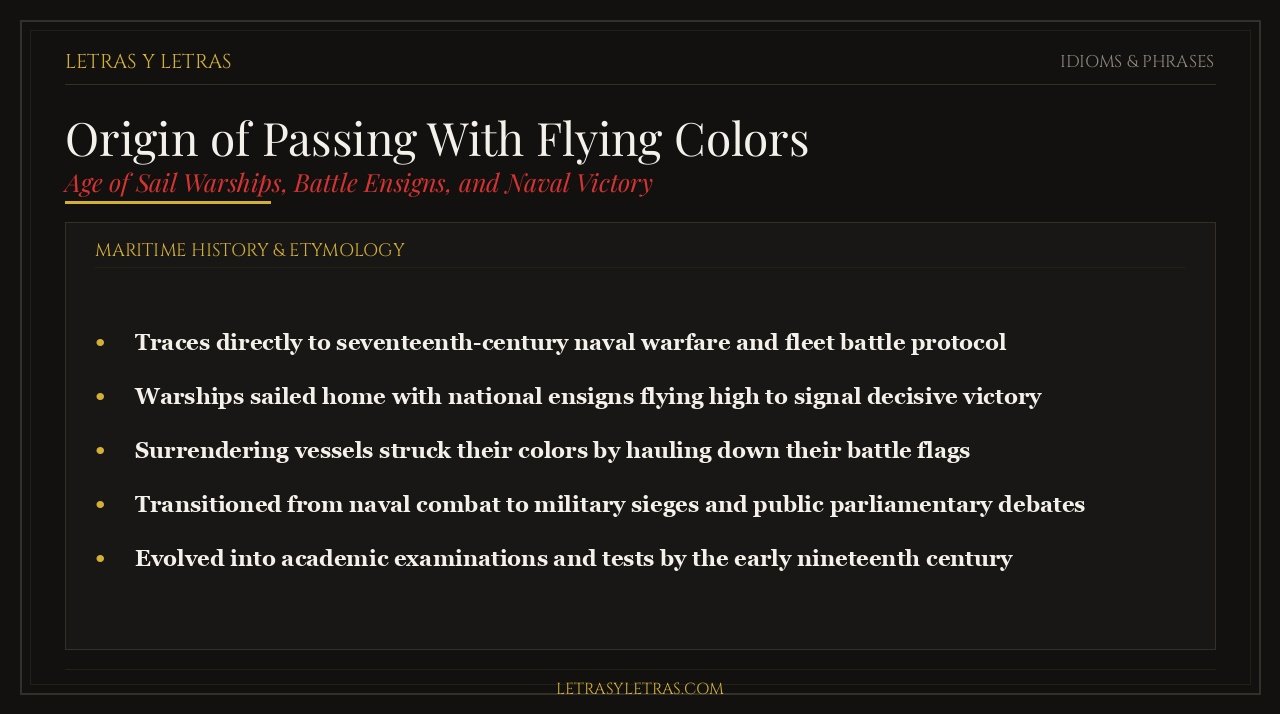
The phrase passing with flying colors originated in seventeenth-century naval warfare during the Age of Sail. In maritime terminology, colors referred to a warship’s official national ensigns, pennants, and battle flags. Victorious vessels sailed into home port with flags flying high and undamaged from their masts. Surrendering vessels were forced to strike their colors by hauling their battle flags down. English writers in the early eighteenth century applied coming off with flying colors to political triumphs. By the early nineteenth century, British universities adopted the phrase for students passing examinations with honors.
Key Takeaways
- Originated in seventeenth-century naval combat where colors referred to national flags.
- Victor ships entered home harbors with battle flags fluttering proudly from tall masts.
- Defeated warships surrendered by striking their colors and lowering their flags.
- Spread to military sieges where honorable garrisons marched out with drums and flying banners.
- Adopted by nineteenth-century British universities to describe earning top examination marks.
The Maritime Definition: What Were Ship Colors?
Modern speakers think of colors as pigments like blue, red, or gold. In historical nautical language, the plural noun colors held a very specific official meaning. The term referred directly to the flags, ensigns, jacks, and pennants flown by naval vessels.
During the Age of Sail, warships depended heavily on visual communication across open waters. Smoke from cannon fire rapidly blanketed ocean battlefields in dense white fog. A ship official colors displayed its sovereign nationality, fleet squadron, and commanding admiral rank.
Etymological documentation in the Online Etymology Dictionary entry on colors confirms these seventeenth-century military roots. Hoisting national colors was a strict legal requirement under international maritime custom. Flying recognized colors separated legitimate state warships from lawless sea pirates.
Naval battle flags were enormous pieces of brightly dyed wool bunting. Sailmakers stitched these massive banners so they could flutter visibly through violent storm winds. Keeping those banners aloft symbolized national pride and unbroken combat resolve.
Sailors treated their ship colors with profound reverence and patriotic devotion. Losing a battle flag brought enduring dishonor to an entire naval crew. Protecting those flying banners was as important as guarding the ship gunpowder magazine.
Surrender and Defeat: The Protocol of Striking Colors
To grasp why flying colors signaled triumph, we must examine the opposite naval outcome. When a warship suffered catastrophic hull damage and heavy casualties, its commander faced an agonizing decision. Further resistance meant unnecessary slaughter for the surviving crew.
Historical records in Royal Museums Greenwich archives on naval flags detail strict battle surrender protocols. A captain signaled formal surrender by ordering sailors to strike the colors. Sailors rapidly unfastened halyards and hauled the battle flag down from the mast.
Lowering the national flag was the universal, unmistakable signal of naval capitulation. The moment the colors dropped, enemy gunners ceased their cannon broadsides immediately. An unpainted wooden vessel without hoisted colors was a captured prize.
Conversely, captains determined to fight to the bitter end took extreme measures. A famous commander would order crewmen to nail the colors directly to the masthead. Nailing colors to the mast meant the flag could never be struck down.
If cannonballs shattered the wooden mast, sailors scrambled into the rigging under sniper fire. They tied fresh ensigns to ropes to prove they had not surrendered. A vessel that maintained flying colors remained unbroken, dangerous, and sovereign.

Returning Home: The Spectacle of Flying Colors
The true drama of flying colors occurred when a fleet returned home after victory. After weeks of brutal naval clashes, battered warships finally appeared on the coastal horizon. Thousands of civilians crowded harbor cliffs and dockside piers in Portsmouth and Plymouth.
Onlookers eagerly scanned the approaching ships through brass spyglasses to assess battle outcomes. Victorious ships sailed past harbor forts with their colorful ensigns flying high from every intact mast. Their proud banners fluttered cleanly in the fresh coastal wind.
Seeing ships enter port with flying colors gave spectators instant confirmation of success. The warship had survived fierce cannon duels without lowering its battle flag. Its crew had defeated the enemy fleet and defended national maritime security.
Defeated enemy prize ships followed behind in humiliating procession. Royal Navy sailors towed captured hulls into harbor with their foreign flags struck down. British ensigns were hoisted directly above the captured flags to signify total dominion.
To return with flying colors meant complete, indisputable victory without compromise. The phrase entered civilian speech as an unforgettable metaphor for public success. It became synonymous with triumphing over immense danger.
Military Sieges and Land Warfare Traditions
While the phrase drew its greatest emotional power from the sea, land armies reinforced the metaphor. Seventeenth-century European warfare revolved around grueling siege warfare against fortified cities. Armies spent months digging trenches and bombarding stone ramparts with heavy artillery.
When a garrison faced inevitable defeat, commanders negotiated formal terms of capitulation. European military codes established distinct levels of surrender depending on the garrison bravery. Cowardly troops who surrendered quickly were stripped of weapons and marched into captivity.
However, an army that defended its ramparts with exceptional valor earned honorable terms. The victorious general granted the defenders the rare honor of marching out with flying colors. Defeated soldiers kept their regimental banners raised, drums beating, and muskets loaded.
Marching away with flying colors allowed soldiers to preserve their martial reputation. The garrison had yielded the physical fortress, but their personal honor remained completely untarnished. Both land and naval customs permanently paired flying flags with dignity and respect.
Historians trace these capitulation articles in seventeenth-century military treaties across Europe. Civilian observers admired officers who secured such honorable concessions from opposing generals. The expression gained deep roots across educated European society.
The Linguistic Shift: From Warships to Political Contests
During the eighteenth century, British writers began borrowing naval expressions for civilian life. Great Britain was an expanding island empire that viewed maritime power as its foundation. Nautical vocabulary naturally migrated from sailor sea chests into fashionable London drawing rooms.
Literary analysis in the Oxford Reference entry on flying colours tracks this evolutionary transition. Early authors preferred the phrasing to come off with flying colors. The expression described individuals who emerged victorious from intense personal or political struggles.
Writers used the phrase to describe contested parliamentary elections. A candidate who defeated corrupt political opponents was said to have come off with flying colors. The metaphor implied that the politician survived ruthless public scrutiny without moral injury.
Debaters and philosophers in Scottish Enlightenment universities applied the term to academic arguments. A scholar who defended a controversial thesis against hostile critics came off with flying colors. The phrase carried an unmistakable aura of intellectual resilience and moral strength.
Readers curious about legal language shaping speech can explore the origin of the phrase caught red handed. Just as ancient Scottish poaching laws birthed enduring idioms, maritime warfare enriched everyday conversation.

Chronological Timeline: The Evolution of the Phrase
Tracing the idiom across three centuries illustrates how military expressions gradually transform into academic vocabulary. The chronological timeline below highlights key historical milestones in the phrase life.
| Year or Era | Historical Source | Context and Linguistic Milestone |
|---|---|---|
| 1600s | Age of Sail Maritime Law | Ship battle ensigns are legally designated as colors under international Law of the Sea. |
| Around 1690 | Royal Navy Battle Accounts | Dispatches describe intact fleets entering harbor with flying colours after naval victories. |
| 1702 | War of the Spanish Succession | European siege capitulation articles allow honorable garrisons to march out with flags flying. |
| 1780 | British Parliamentary Print | Coming off with flying colors is used for politicians triumphing in bitter elections. |
| 1830 | Oxford and Cambridge Slang | English schoolmasters adapt the phrase to students passing rigorous university examinations. |
| Present | Modern Global English | Universal idiom describing outstanding success in tests, job interviews, and challenges. |
The timeline reveals a clear shift from literal military hardware to figurative civilian speech. Between 1690 and 1780, the expression always referenced tangible banners fluttering on ships or fortifications. By the nineteenth century, the physical flag had vanished, leaving only an abstract symbol of victory.
British newspapers during the Victorian era accelerated this popular transition. Journalists praised engineers who completed complex railway viaducts, stating their designs came off with flying colors. The metaphor was becoming a permanent fixture of Victorian public optimism.
Similar etymological shifts occurred with everyday food words. To see how another Georgian lord named world cuisine, read about the origin of the word sandwich. Everyday language constantly reflects eighteenth-century British cultural institutions.
Entering the Classroom: Why We Say Passing With Flying Colors
The specific pairing of passing with flying colors emerged during the nineteenth-century educational boom. Prior to this period, speakers said come off with flying colors or carry off flying colors. The verb pass became attached to the phrase as formal academic testing expanded.
During the nineteenth century, universities like Oxford and Cambridge introduced written competitive honors examinations. The British Civil Service also abolished political patronage, instituting rigorous entrance tests for all applicants. Earning a coveted administrative post required passing demanding exams in classics, mathematics, and law.
Schoolmasters and university tutors began applying the old naval idiom to outstanding students. A student who merely squeezed through received a passing mark. Scholars who conquered the examination with highest distinction passed with flying colors.
The nautical metaphor fit academic testing with uncanny precision. A student was like a solitary vessel sailing through a stormy strait of difficult exam questions. Emerging on the other side with intact dignity mirrored a warship returning with fluttering flags.
By the late nineteenth century, American schools adopted the exact same phrase. Teachers wrote passed with flying colors on report cards across the United States. The phrase lost its salty scent of ocean spray, becoming an academic compliment.
Related Maritime Idioms in Everyday Speech
The English language is an ocean of nautical expressions disguised as common colloquial speech. Because Britain was a seafaring superpower for centuries, sailor jargon permeated civilian vocabulary. Grasping the history of flying colors illuminates several related nautical phrases.
Consider the common phrase showing your true colors. Under eighteenth-century naval law, a warship could legally fly a false foreign flag to deceive enemies. However, international law required the ship to hoist its genuine national flag before firing the first cannon.
A warship that unfurled its actual battle flag was showing its true colors. In modern psychological speech, the phrase describes revealing your genuine character or unvarnished intentions. Both idioms trace directly to identical naval flag traditions.
Similarly, the expression sailing under false colors denotes acting under deception or fraudulent pretenses. When someone pretends to hold qualifications they lack, they sail under false colors. The imagery evokes a pirate ship disguising itself as a peaceful merchant trader.
Other familiar phrases share identical maritime roots. We speak of taking the wind out of someone sails, being taken aback, and clearing the decks. To explore how spiritual and historical customs shaped expressions, read about the origin of the phrase bless you.
You can also explore dozens of colorful expressions in our english idioms and meanings reference library. Maritime history remains the hidden engine driving everyday English figures of speech.
The Enduring Dignity of the Flying Ensign
Wooden sailing ships have long vanished from modern naval battlefields. Modern warships carry radar antennas, electronic sensors, and missile guidance arrays instead of canvas sails. Yet naval vessels still hoist their national ensigns with solemn ceremonial pride.
The human impulse to celebrate hard-won triumph remains as vibrant as ever. When life presents daunting tests, we marshal our inner strength to confront the challenge. Surviving difficult trials without compromising integrity mirrors an ancient warship returning to port.
Passing with flying colors reminds us that genuine victory requires resilience. Real triumph is not merely surviving an ordeal. Genuine success means emerging with your character intact, your dignity unblemished, and your personal banners flying high.
The next time you congratulate someone on an academic or professional milestone, remember the wooden warships. Picture the proud fleet entering Portsmouth harbor beneath fluttering wool ensigns. You are invoking centuries of maritime valor with four simple words.
Frequently Asked Questions
What does the phrase passing with flying colors mean?
The idiom passing with flying colors means achieving outstanding success or victory with highest distinction. It is commonly used when someone excels on an academic examination, a job interview, or a difficult challenge.
Why were flags called colors in naval history?
In seventeenth-century military and naval terminology, colors referred to regimental banners and national ensigns. The brightly dyed fabric stood out against wooden hulls and gunpowder smoke, serving as vital visual signals during battle.
What did striking the colors mean during sea battles?
Striking the colors meant lowering the national battle flag from the warship mast. This action served as the universal and binding signal of military surrender during naval combat in the Age of Sail.
Did the phrase originate from art or horse racing?
Common folklore claiming the phrase originated from painters mixing colors or jockeys wearing colorful silks is incorrect. Historical documents prove the expression came entirely from seventeenth-century naval combat and military siege protocols.
When did the phrase become associated with school tests?
The phrase became linked to academic examinations during the early nineteenth century in England. Tutors at Oxford and Cambridge universities adapted the naval idiom to describe students passing rigorous competitive honors exams with distinction.
Alan Sledge is the founder and lead writer at letrasyletras.com, dedicated to uncovering the true etymological histories behind our favorite words and phrases.


Alan Sledge is the writer and founder behind Letters & Letters. A lifelong lover of words, Alan has always been drawn to the small mysteries hidden in everyday language, why we say what we say, where our favorite sayings came from and the quotes that manage to put feelings into words better than we ever could ourselves.

Alan Sledge
Alan Sledge is the founder and lead researcher behind Letters & Letters. A lifelong student of linguistic history, he cross-references every word origin, idiom, and quote against primary archival manuscripts, the Oxford English Corpus, and 18th-century print lexicons.