
Few slang words in the global lexicon carry as much cultural weight as the term gringo. Travelers hear it in bustling markets from Tijuana to Buenos Aires. Yet despite its everyday familiarity, the real historical background of the word remains widely misunderstood.
Where did this famous term actually originate, and what was its original historical definition? Most popular explanations repeat dramatic military legends about American soldiers and green uniforms.
Historical linguistic records tell a completely different story. The true origin traces back to eighteenth-century Spain, long before the Mexican-American War ever began.
Quick Answer: What Is the Origin of the Word Gringo?
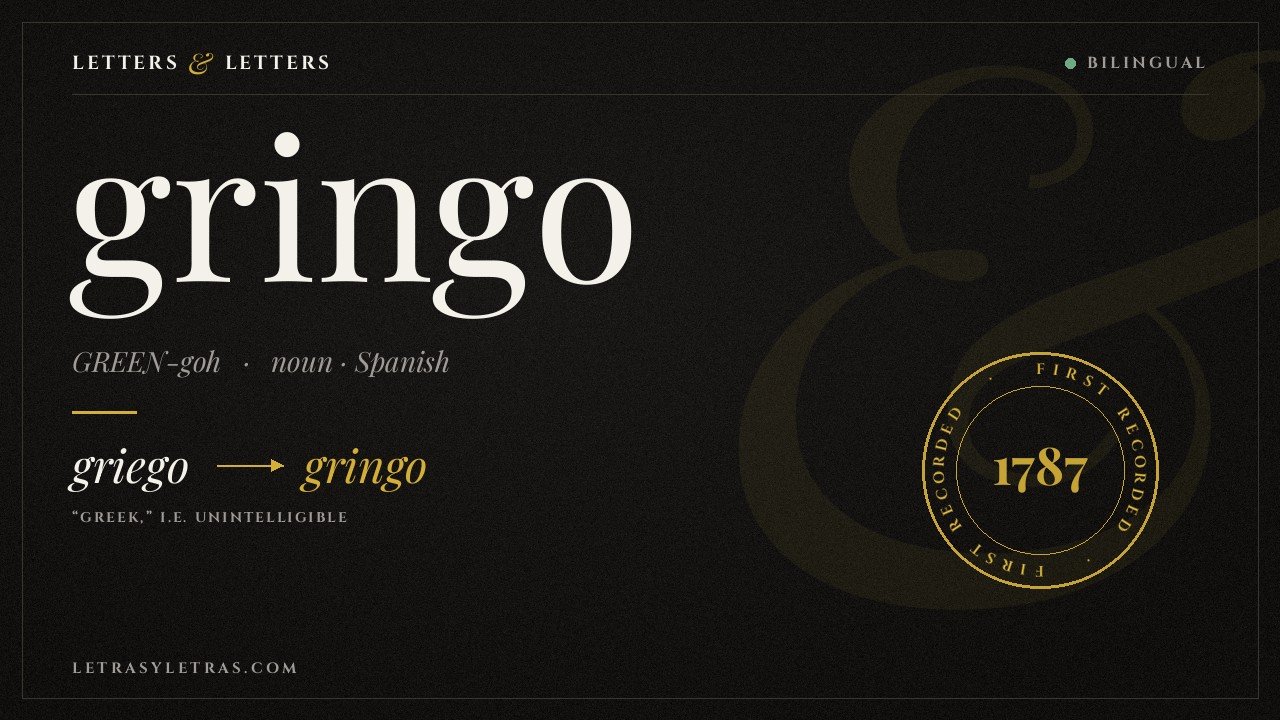
The word gringo originates from eighteenth-century Spain as a phonetic alteration of griego, meaning Greek. First recorded in Father Esteban de Terreros y Pando’s 1787 dictionary, it described foreigners who spoke Spanish with an unintelligible accent. The phrase mirrored the classical expression hablar en griego, similar to the English idiom it is all Greek to me. Popular folklore claiming the word came from Mexican soldiers shouting Green, go home at American troops in 1846 is historically false, as the term appeared in print sixty years earlier.
Key Takeaways
- Gringo derives phonetically from Spanish griego, meaning Greek or unintelligible speech.
- First recorded in print in 1787 in Father Terreros y Pando’s Spanish dictionary.
- Originally applied in Madrid and Málaga to Irish immigrants with thick foreign accents.
- The 1846 Mexican-American War green uniform theory is completely debunked by historical records.
- In nineteenth-century Argentina, gringo referred specifically to Italian agricultural colonists.
The 1787 Dictionary Proof: Father Terreros y Pando
The earliest documented appearance of gringo in print dates back to the late eighteenth century. It appeared in the landmark Spanish lexicon compiled by Father Esteban de Terreros y Pando.
His major work was titled the Diccionario castellano con las voces de ciencias y artes. Although Father Terreros completed his manuscript earlier, Volume Two was officially published in Madrid in 1787. Archival records are maintained in the Biblioteca Virtual Miguel de Cervantes archives.
In that historic volume, the Jesuit lexicographer provided a clear and revealing definition. He noted that in Málaga and Madrid, residents called foreigners gringos because of their heavy accents.
Terreros specifically observed that their pronunciation prevented them from speaking Castilian naturally. He also recorded that in Madrid, residents applied the name in particular to Irish residents.
During the eighteenth century, thousands of Catholic Irish soldiers served in the Spanish military. Irish merchants and scholars lived throughout Madrid, Cadiz, and the port city of Málaga.
These Irish arrivals spoke Spanish with a thick, unmistakable accent. Spanish locals humorously labeled their speech as gringo, meaning strange or unintelligible.
This early dictionary entry provides decisive chronological proof for modern etymologists. The word flourished in Spanish everyday speech decades before United States troops marched into Mexico.
Linguistic documentation in the Online Etymology Dictionary confirms that the term began as a phonetic descriptor for foreign speech. It was not born as a political battlefield insult.
Debunking the Green Go Home Military Legend
Ask a casual traveler about the word gringo, and you will almost always hear the military uniform legend. This pervasive myth claims that Mexican locals invented the phrase during the Mexican-American War of 1846.
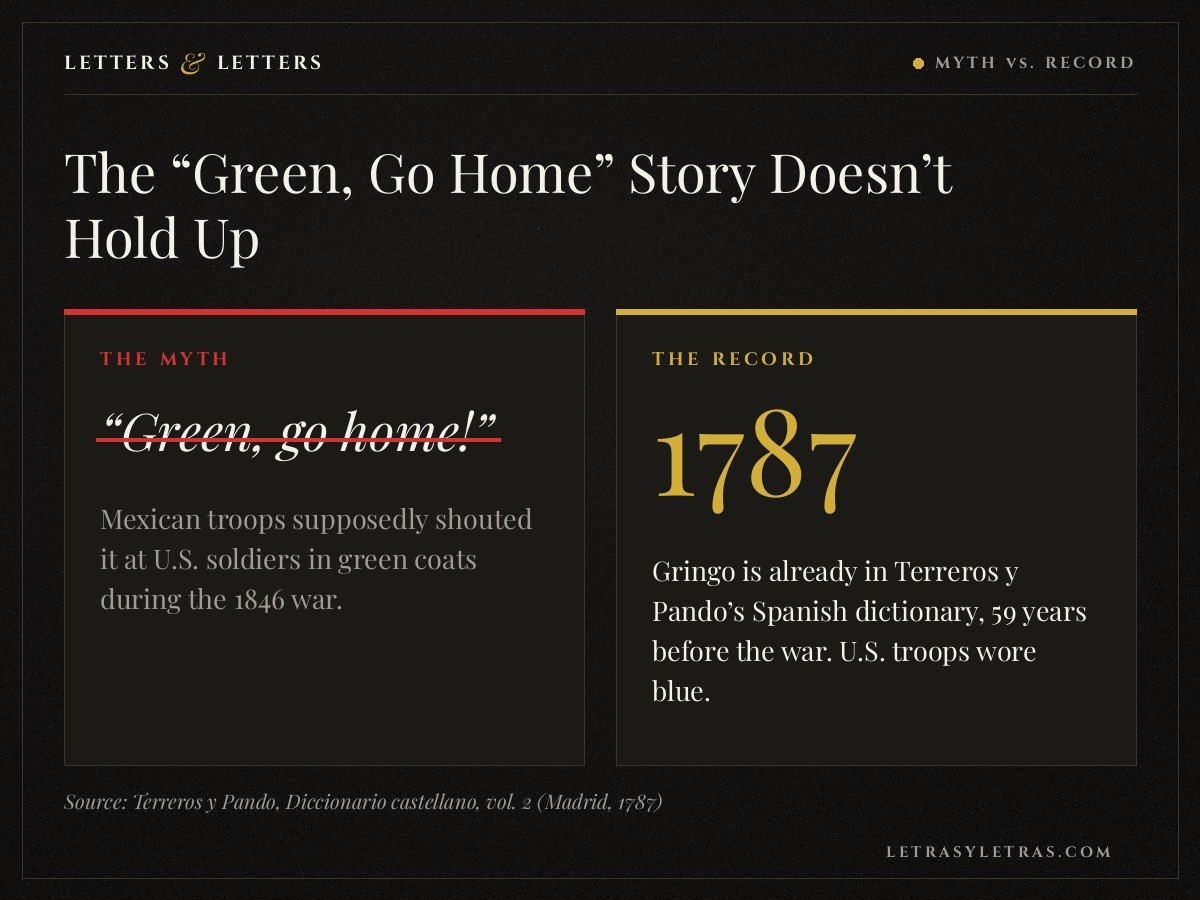
According to this popular story, American soldiers marched into Mexico wearing distinct green coats. Angry Mexican citizens and soldiers allegedly yelled Green, go home or Green, go to demand their departure.
Generations of storytellers have repeated this tale in classrooms, tour buses, and casual conversations. However, serious historical inspection completely destroys this convenient folk etymology.
First, standard United States Army infantry regulations required soldiers to wear dark blue woolen coats. Regular troops marched south wearing blue jackets and sky blue trousers, not green uniforms.
While some volunteer units wore varying attire, green was never the identifying standard uniform of the American military. The color argument fails basic historical military inspection.
Second, the chronological record makes the Mexican-American War theory impossible. Father Terreros documented the term in Spain sixty years before General Zachary Taylor crossed the Rio Grande.
A word already defined in Madrid in 1787 could not have been invented in Mexico in 1846. Folk etymologies often invent dramatic stories after the fact to explain unfamiliar words.
Similar popular myths surround other historical expressions, as detailed in our guide to the origin of the phrase bless you. True linguistic evolution follows slow, organic phonetic shifts rather than sudden patriotic slogans.
The Green Grow the Lilacs Musical Myth
Another colorful variant of the military legend involves traditional Scottish and American folk songs. This version claims American soldiers sang Robert Burns lyrics around nightly campfires during the invasion.
The favorite candidate was the famous tune Green Grow the Rashes, O. Other storytellers claim the troops sang the Irish-American ballad Green Grow the Lilacs.
According to this legend, Mexican listeners overheard the opening lyric green grow and phoneticized it into gringo. The story paints a romantic picture of singing soldiers under desert stars.
Yet like the green uniform theory, this musical explanation lacks any historical foundation. Linguistic historians have searched military diaries and Mexican wartime broadsides without finding evidence.
No contemporary Mexican accounts from the 1840s describe American soldiers as green grow singers. The romantic song theory was invented decades later by English-speaking travelers seeking a poetic explanation.
Linguistic drift rarely operates through mistaken song lyrics overheard at a distance. Instead, words travel with living speakers and adapt existing vocabulary to describe unfamiliar newcomers.
The Greek Connection: It Is All Greek to Me
If green uniforms and Scottish ballads are fictions, where did the word gringo actually come from? Philologists, including the renowned Catalan linguist Joan Corominas, trace the root directly to the Spanish word griego.
Griego is simply the Spanish noun and adjective for Greek. For thousands of years, European cultures used the Greek language as a universal symbol for unintelligible speech.
In classical Latin, medieval scholars often scribbled a famous note in the margins of complex manuscripts. The Latin phrase ran Graecum est, non potest legi, meaning it is Greek, it cannot be read.
When a medieval monk encountered Greek phrases he could not translate, he dismissed them as incomprehensible. This practical reality gave birth to an enduring international idiom.
The English language adopted the identical cultural metaphor. In Shakespeare’s play Julius Caesar, the character Casca hears Cicero speak Greek. He famously remarks that for his own part, it was Greek to him.
Spanish speakers developed the exact same idiomatic expression. The traditional Spanish idiom hablar en griego meant speaking in Greek, or talking completely incomprehensible gibberish.
To explore how ancient crafts created similar expressions, consult our curated archive of english idioms and meanings. Language communities worldwide naturally turn unfamiliar speech into vivid social metaphors.
Over centuries of everyday spoken Spanish, phonetic changes softened the pronunciation of griego. In the bustling southern port of Málaga, sailors and market vendors slurred the word.
The pronunciation shifted from griego to grigo, and gradually developed an intrusive nasal consonant sound. This phonetic drift transformed the word into gringo, perfectly mirroring the older meaning of foreign gibberish.
To say someone spoke gringo meant they spoke like a foreigner with incomprehensible pronunciation. Over time, the descriptive label transferred from the strange speech to the foreign speaker himself.
Evolution Across the Americas and Regional Nuances
As Spanish settlers and maritime traders traveled to the New World, they carried their regional vocabulary across the Atlantic. In the Americas, the word gringo adapted to local demographic shifts.
In the southern cone of South America, the word took on a distinct meaning. During the nineteenth century across Argentina and Uruguay, large waves of European immigrants arrived to farm the fertile pampas.
Most of these agricultural settlers came from northern Italy. Native Argentine gauchos and townspeople began calling these Italian immigrants gringos because they struggled with Spanish phonetics.
Classic nineteenth-century Argentine literature, including the celebrated epic poem Martín Fierro, frequently mentions gringos in this specific agricultural context. The term carried no connection to North Americans or the English language.
Meanwhile, in Brazil, the Portuguese language absorbed the term with an even broader meaning. To modern Brazilians, a gringo is simply any foreigner, regardless of their nationality or native language.
An Argentine, a German, a Japanese tourist, and an American traveler are all equally labeled gringos in Rio de Janeiro. The Brazilian usage remains strictly focused on foreign birth rather than ethnicity.
In Mexico and Central America, geographic proximity to the United States shaped a narrower definition. Following the conflicts of the nineteenth century, Mexicans primarily interacted with English-speaking travelers and business owners.
As a result, gringo became specifically associated with citizens of the United States. Today, the word is universally recognized across North America as an informal label for Americans.
The tone of the word depends entirely on context, relationship, and vocal inflection. It can be used as an affectionate family nickname, a neutral descriptor, or an abrasive social insult.
Just as ancient social boundaries influenced the origin of the word curfew, regional migrations continue to reshape everyday vocabulary. A word that began in Spanish taverns now echoes across an entire continent.
Chronological Timeline: The Evolution of Gringo
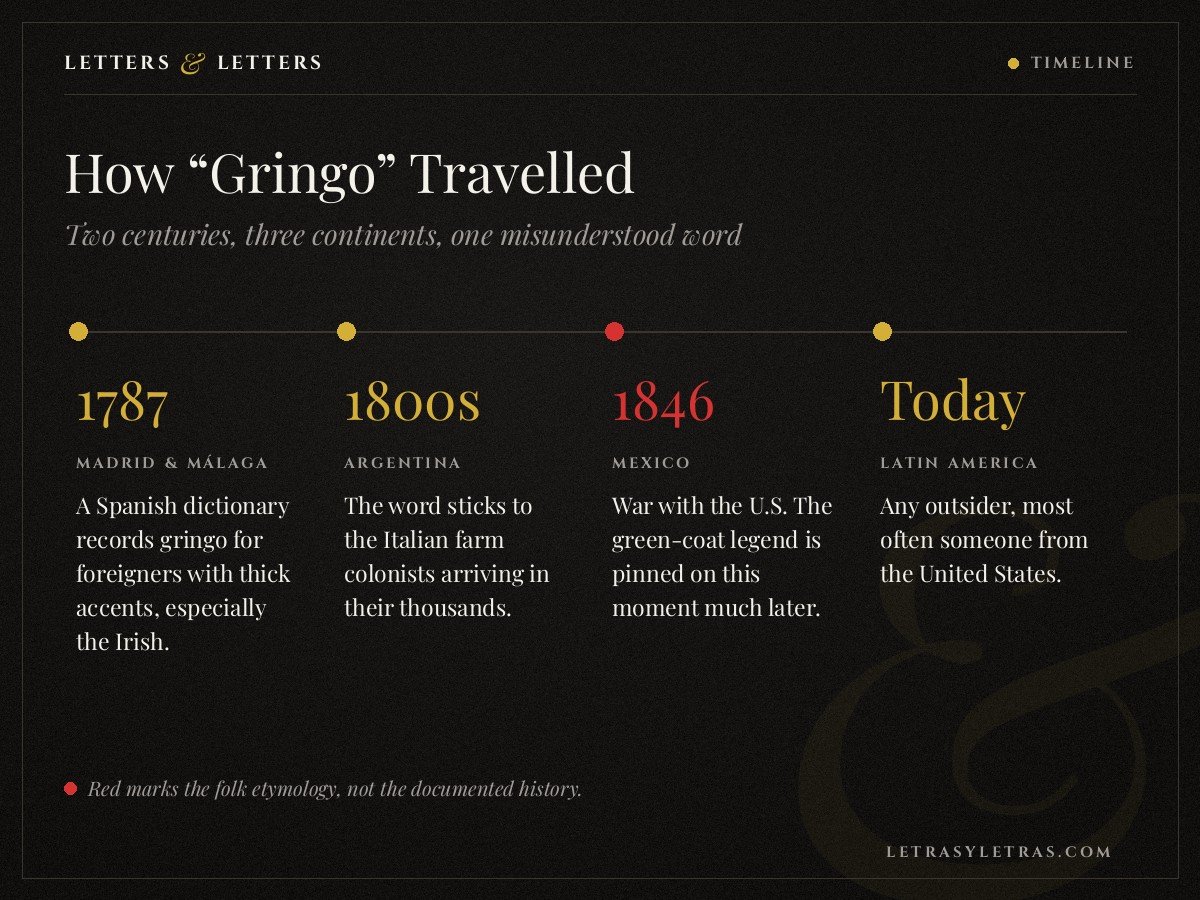
Tracking historical citations demonstrates how regional slang gradually transformed into an international cultural label. This chronological timeline summarizes major lexicographical milestones from European archives to the modern Americas.
| Year | Historical Source | Linguistic Milestone |
|---|---|---|
| 1600s | Spanish Literature | Hablar en griego becomes established as common idiom for incomprehensible foreign speech. |
| 1787 | Father Terreros y Pando | First printed definition of gringos in Madrid and Málaga dictionary, applied to Irish immigrants. |
| 1817 | Mexican Documents | Term appears in colonial Mexico describing foreigners prior to independence from Spain. |
| 1846 | Mexican-American War | Term popularized along border, spawning the false green uniform and folk song legends. |
| 1872 | José Hernández (Martín Fierro) | Argentine epic poem documents gringos as Italian agricultural colonists on the pampas. |
| 1899 | Real Academia Española | Official RAE dictionary formally admits gringo, defining it through phonetic links to griego. |
Other Cross-Linguistic Slang Terms
The fascinating history of gringo is not an isolated linguistic phenomenon. Many cultures have coined colorful slang terms to categorize foreign visitors and neighboring communities.
Consider the parallel history of the word Yankee in American English. Linguistic scholars trace Yankee to early Dutch colonists living in seventeenth-century New Amsterdam.
Dutch settlers humorously referred to English neighbors as Jan Kees, combining the common Dutch names Jan and Kees. Over decades of contact, the Dutch nickname morphed into the proud moniker Yankee.
In Spain, locals frequently use the colloquial word guiri to describe foreign tourists. Etymologists trace guiri to nineteenth-century civil conflicts known as the Carlist Wars.
Basque rebels nicknamed central government soldiers guiristinos, after Queen Maria Cristina. Today, Spaniards use guiri casually for fair-skinned foreign visitors exploring sunny coastal beaches.
Similarly, the term paisano demonstrates how language unites communities across borders. Derived from Romance roots for country and land, it originally identified someone from the same home village.
These cross-cultural terms show that human communities consistently invent words to navigate cultural encounters. Rather than viewing them as static labels, we can appreciate the rich historical migrations behind them.
To learn how medieval terms shifted into speech, read our guide on where does the word christmas come from. Words travel across borders and outlive the empires that first coined them.
Frequently Asked Questions
What is the true origin of the word gringo?
The word gringo derives from the Spanish word griego, meaning Greek. It was recorded in 1787 in Madrid as a term for foreigners whose heavy accents made their speech unintelligible.
Did gringo come from green go home?
No, the story claiming the word came from Mexican soldiers yelling Green, go home in 1846 is a myth. The term was already published in Spanish dictionaries sixty years earlier.
Is the word gringo considered an offensive slur?
The word gringo is not inherently an offensive slur. Its meaning depends entirely on speaker intent, tone of voice, and social context, often functioning as a neutral cultural label.
Why were Irish people originally called gringos?
In eighteenth-century Spain, thousands of Irish soldiers and merchants lived in Madrid and Málaga. Spanish locals called them gringos because their Gaelic and English accents made spoken Spanish sound strange.
How does the meaning of gringo differ in South America?
In Argentina and Uruguay, gringo historically referred to Italian agricultural immigrants rather than Americans. Across Brazil, the word is used broadly for any foreign visitor regardless of nationality.
The Living Heritage of Our Words
Language acts as an extraordinary historical mirror, recording how human societies meet, trade, and misunderstand one another. When we speak words like gringo, we echo centuries of intercultural dialogue and linguistic evolution.
The word does not belong to a nineteenth-century battlefield or a fictional campfire song. It belongs to the enduring human tendency to find humor in foreign speech and unfamiliar accents.
Tracing these linguistic pathways frees us from persistent folk legends and reveals historical truth. It reminds us that behind every everyday slang word lies a rich history of human movement and cultural adaptation. For reflections on seeking truth, explore our collection of quotes about perfection.
Alan Sledge is the lead writer at letrasyletras.com. He uncovers the true historical etymologies behind our favorite words and phrases.


Alan Sledge is the writer and founder behind Letters & Letters. A lifelong lover of words, Alan has always been drawn to the small mysteries hidden in everyday language, why we say what we say, where our favorite sayings came from and the quotes that manage to put feelings into words better than we ever could ourselves.

Alan Sledge
Alan Sledge is the founder and lead researcher behind Letters & Letters. A lifelong student of linguistic history, he cross-references every word origin, idiom, and quote against primary archival manuscripts, the Oxford English Corpus, and 18th-century print lexicons.