
Spanish speakers reject suitors with pumpkins, swear by grapes at midnight and earn their living in chickpeas. Some of the oddest images in the language come straight from the kitchen. This guide traces ten Spanish idioms with food origins back to their dictionaries, fables and newspapers.
Several popular explanations collapse under a little scrutiny. One famous “origin” is really a marketing story. Another leans on a Greek belief nobody can quite source, so we will follow the paper trail instead.
Quick Answer: Spanish Idioms With Food Origins
Many Spanish idioms with food origins have traceable sources, starting with “dar calabazas”, to reject a suitor. Around 1627, Gonzalo Correas tied it to the dried gourds swimmers used as floats. The 1780 Academy dictionary then recorded its romantic sense.
“Media naranja” borrows the split humans of Plato’s Symposium. “Sacar las castañas del fuego” echoes La Fontaine’s 1679 fable of a monkey, a cat and roasting chestnuts.
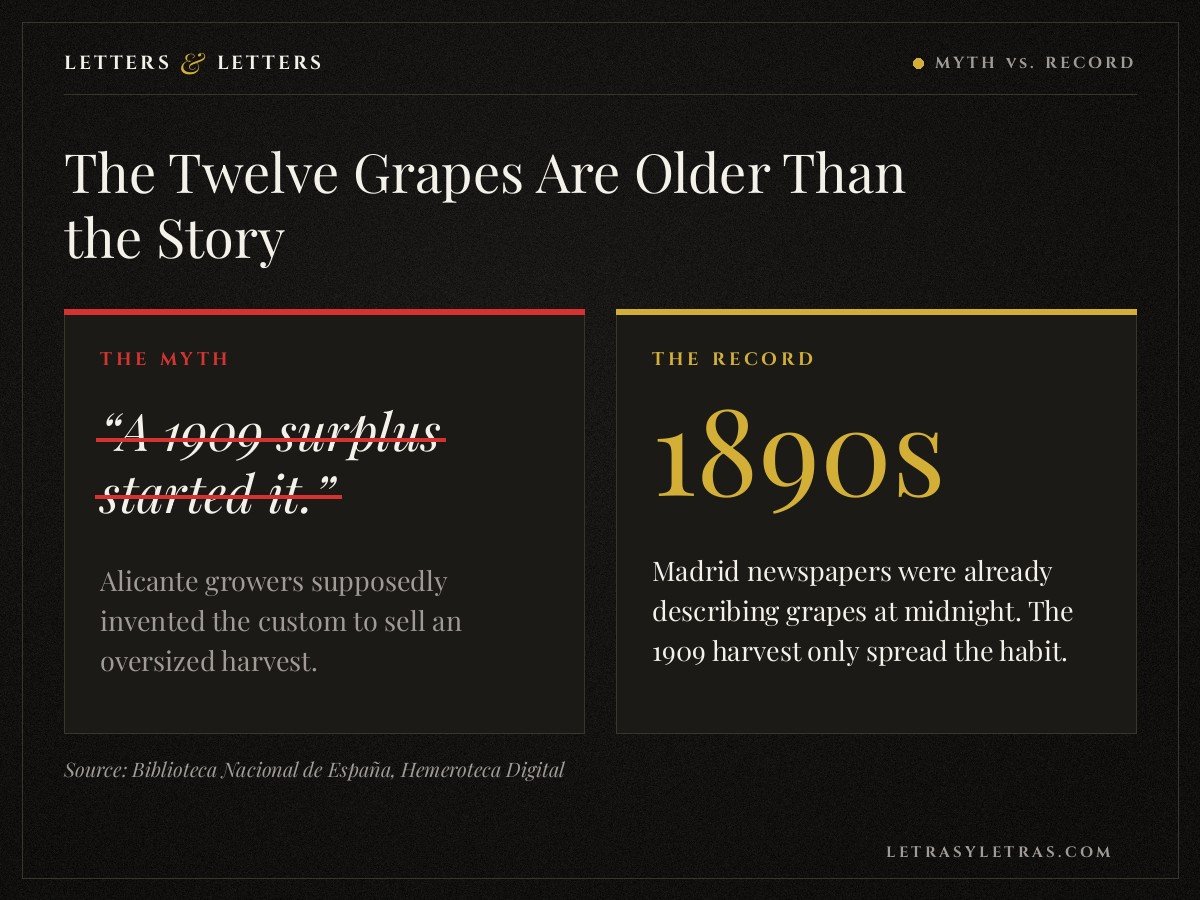
“Nos van a dar las uvas” refers to the twelve New Year grapes. Madrid newspapers described that custom in the 1890s, long before the 1909 surplus that supposedly invented it. Others, like “importar un comino” and “ganarse los garbanzos”, grew from humble kitchen staples such as cumin seeds and chickpeas.
Key Takeaways
- Correas linked dar calabazas to swimming gourds around 1627, not to a documented Greek belief.
- The Spanish Academy’s dictionary first recorded its romantic meaning in 1780.
- Media naranja applies Plato’s myth of split humans to a fruit named through Arabic and Persian.
- Madrid papers mentioned the New Year grapes in the 1890s, so the 1909 surplus did not invent them.
- Sacar las castañas del fuego retells La Fontaine’s 1679 fable of Bertrand the monkey and Raton the cat.
Why the Spanish Table Shaped Spanish Speech
Food idioms survive because everyone recognises the ingredients. A chickpea or a cumin seed needs no footnote. The metaphor passes from grandparent to grandchild intact.
Spanish adds another layer, since centuries of Arabic influence brought new crops and new words to the same kitchens. For that wider story, see our guide to spanish words of arabic origin. Here we stay with the idioms, one dish at a time.
1. Dar Calabazas: The Pumpkin Rejection
Meaning: to turn down a romantic proposal, or to fail a student in an exam. “Le pidió salir y le dio calabazas” means she said no.
The most repeated explanation claims ancient Greeks treated pumpkin as an anaphrodisiac, a food that cools desire. Countless articles repeat it, yet none quote a Greek author who says so.
There is a botanical snag as well. Pumpkins are American plants, unknown in Europe until the sixteenth century. Any Greek “pumpkin” would have been a different gourd altogether.
The documented trail runs through water instead. Around 1627, the Salamanca professor Gonzalo Correas compiled his Vocabulario de refranes y frases proverbiales. In it he described learners who swam with dried gourds and threw them aside once they could manage alone.
Modern Spanish keeps that image in “nadar sin calabazas”, to get by without help. By 1780, the Academy dictionary defined dar calabazas as a woman rejecting a suitor. Today the Real Academia entry for calabaza lists both the refused proposal and the failed exam.
2. Media Naranja: Plato’s Orange
Meaning: your other half, the partner who completes you. “Por fin encontró a su media naranja” means he finally found the one.
The idea is Greek, and very old. Plato wrote the Symposium around 385 BC. In it, the comic poet Aristophanes describes the first humans as round beings with four arms and two faces.
Zeus split them in half as punishment, and each half has searched for its partner ever since. You can read the speech in the Project Gutenberg edition of the Symposium.
Spanish turned that sphere into fruit. The Academy defines media naranja as someone so suited to another that they seem half of oneself. Architects borrowed the phrase too, and a media naranja is also a hemispherical dome.
Even the word naranja travelled far. It reached Spanish through Andalusi Arabic, which took it from Arabic nāranj. Behind that sit Persian nārang and, earlier still, Sanskrit.
3. Nos Van a Dar las Uvas: Twelve Grapes at Midnight
Meaning: “we’ll be here until New Year”. People say it when a queue, a meeting or a task drags on forever.
The grapes are the twelve Spaniards eat at midnight on 31 December. Each one matches a chime of the clock. According to the familiar story, Alicante growers had a huge surplus in 1909 and invented the custom to sell it.
That tale is tidy and memorable. Unfortunately, it is not where the custom began.
Madrid newspapers were describing grapes at midnight years earlier. Reports from the 1890s present it as a Madrid habit borrowed from French-style celebrations. Wealthy families toasted the new year with champagne and grapes.
A popular theory adds a twist from December 1882. That month, Mayor José Abascal charged a fee for street celebrations on the Night of the Kings. Madrileños reportedly answered by mocking the elite with grapes in the Puerta del Sol.
The 1909 harvest still mattered, because it carried a Madrid habit across the country. You can check the earlier reports in the Biblioteca Nacional Hemeroteca Digital.
4. Sacar las Castañas del Fuego: The Cat’s Burnt Paws
Meaning: to do someone else’s dirty or risky work for them. English says “to be a cat’s paw”.
Both languages took the image from the same French fable. Jean de La Fontaine published “Le Singe et le Chat” in 1679, in his second collection of fables. In it, Bertrand the monkey and Raton the cat watch chestnuts roasting in a fire.
The monkey flatters the cat into fishing them out, then eats every one while Raton burns his paws. When the cook walks in, both thieves flee, and only one of them has eaten.
Spanish kept the chestnuts and the fire. To “sacarle a alguien las castañas del fuego” still means taking the burns while another person takes the reward.
5. Dar Gato por Liebre: The Inn Swindle
Meaning: to pass off something inferior as the real thing. A seller who gives you a fake watch “te dio gato por liebre”.
The traditional explanation points to old Spanish inns. Travellers ordered hare and suspected, sometimes rightly, that the innkeeper had served cat. Spanish picaresque literature is full of inns with dreadful reputations, and the phrase fits that world neatly.
Be careful with the colourful extras, though. Some articles describe charms that made a disguised cat leap from the plate, yet rarely cite a source. Stick to the safe version: the idiom records a real fear of being cheated at the table.
6. Importar un Comino: Worth Less Than a Seed
Meaning: to not matter at all. “Me importa un comino” is roughly “I couldn’t care less”.
A cumin seed is tiny, cheap and plentiful, which makes it a handy unit of worthlessness. Its name reached Spanish from Latin cuminum, which came from Greek kýminon. Sister phrases with the same meaning include “no valer un comino” and “no montar un comino”.
Speakers swap in other cheap produce for variety. You will hear “me importa un pimiento”, “un pepino” and “un rábano”. Each one shrinks the problem to the size of a salad ingredient.
7. Estar Hecho una Sopa: Soaked Like Bread
Meaning: to be drenched to the skin. Caught in a storm without an umbrella, you arrive “hecho una sopa”.
The idiom makes sense once you know what sopa first meant. According to the Academy, the word comes from a Germanic root, sŭppa. One of its senses is still a slice of bread soaked in liquid.
Old soups were often bread dunked in broth, milk or wine. A person dripping with rain looks just like that sodden slice.
The same bread gave Spanish “sopa boba”, the bread and broth convents handed to the poor. Today it means living comfortably at someone else’s expense. Neither idiom involves the vegetable soup you might picture.
8. Ganarse los Garbanzos: Earning Your Chickpeas
Meaning: to earn a living. “Trabaja de noche para ganarse los garbanzos” means he works nights to pay the bills.
Chickpeas were the backbone of the cocido, the stew eaten in poor and middling homes alike. Earning your chickpeas meant earning the basic meal, much like bringing home the bacon. The Academy records the same idea as “buscarse los garbanzos”.
The legume also produced a sharper idiom. A “garbanzo negro”, a black chickpea, is the person who stands out in a group for bad character. English has its black sheep, and Spanish has a dark seed in the pot.
9. Al Pan, Pan, y al Vino, Vino: Call Bread “Bread”
Meaning: to speak plainly and call things by their proper names. It is the Spanish cousin of “call a spade a spade”.
Bread and wine were the two staples of the Mediterranean table, so naming them correctly stood for honesty itself. The proverb belongs to the old Spanish refranero, the body of traditional sayings. It still rebukes anyone who softens a hard truth.
Bread runs through many other sayings as well. “Contigo, pan y cebolla” promises love even on a diet of bread and onions. “Ser pan comido”, to be eaten bread, means something is easy, like “a piece of cake”.
10. Pedir Peras al Olmo: Pears From an Elm
Meaning: to expect the impossible from someone. An elm tree will never grow pears, however long you wait beneath it.
This one has a full write-up in our guide to idioms in spanish. It earns a place here because it shows how often Spanish uses the orchard to judge character. You do not blame the elm for being an elm.
Timeline of Spanish Idioms With Food Origins
| Year | Author / Source | Context and Milestone |
|---|---|---|
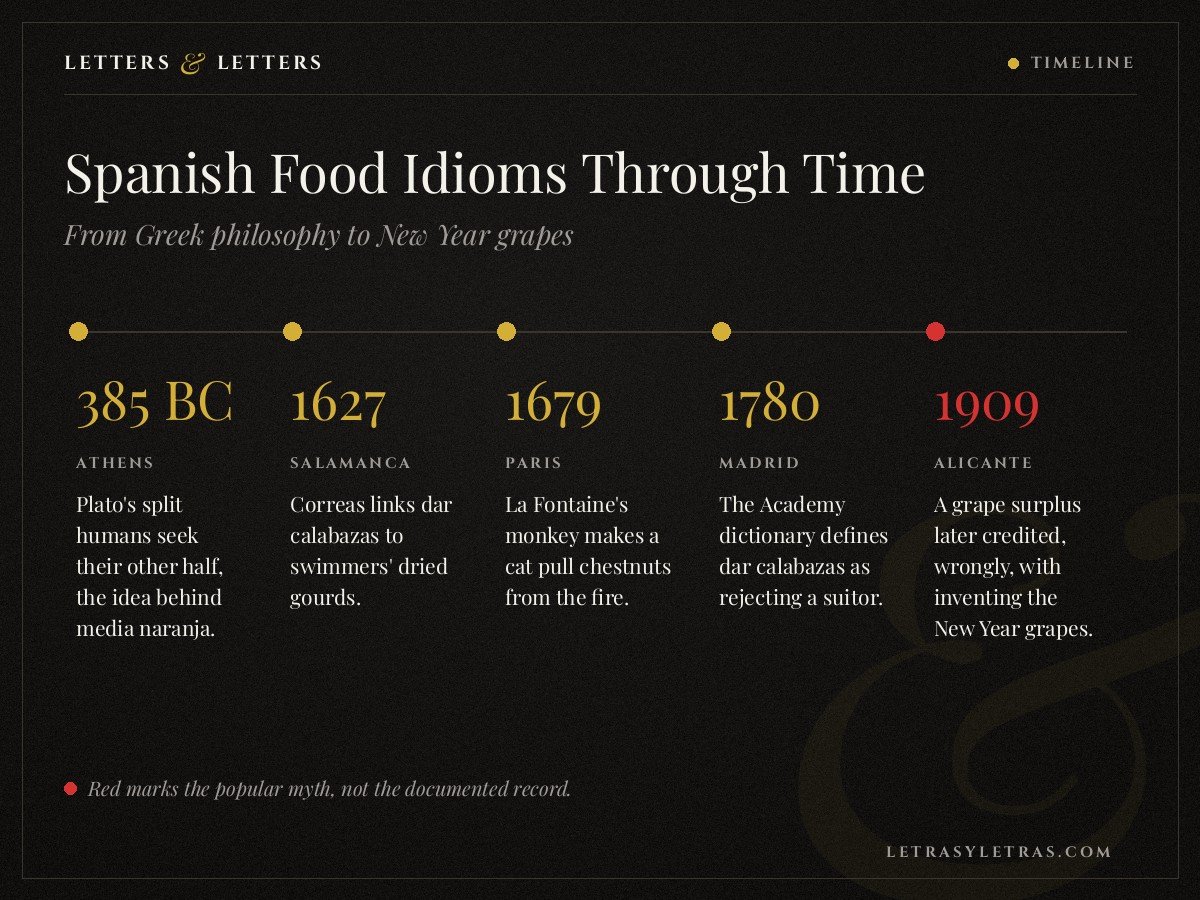
| c. 385 BC | Plato, Symposium | Aristophanes tells of split humans seeking their other half, the idea behind media naranja. |
| c. 1627 | Gonzalo Correas, Vocabulario de refranes | Links dar calabazas to the dried gourds used as swimming floats. |
| 1679 | Jean de La Fontaine, “Le Singe et le Chat” | The monkey and cat fable behind sacar las castañas del fuego. |
| 1780 | Royal Spanish Academy dictionary | Defines dar calabazas as rejecting a suitor’s proposal. |
| 1882 | Madrid city decree | Mayor José Abascal charges a fee for street celebrations on the Night of the Kings. |
| 1890s | Madrid newspapers | Describe eating grapes at midnight on New Year’s Eve as a Madrid custom. |
| 1909 | Alicante grape growers | A large harvest spreads the grape custom nationwide, later mistaken for its origin. |
How to Use These Idioms Without Sounding Like a Textbook
Native speakers use most of these casually, so tone matters more than grammar. “Me importa un pepino” is playful, while “me importa un comino” sounds a touch drier. Save “dar calabazas” for stories about romance or exams.
Regional taste counts too. The New Year grapes are deeply Spanish, and some Latin American listeners may not know the uvas idiom. For more phrases that cross between languages, try our english idioms and meanings guide.
Frequently Asked Questions
What are some common Spanish idioms with food?
Popular examples include dar calabazas, media naranja, importar un comino, ser pan comido and estar hecho una sopa. They mean to reject someone, a soulmate, to not matter, to be easy and to be soaked. Each one turns an everyday ingredient into a bigger idea.
Why do Spanish people say “dar calabazas”?
Gonzalo Correas, writing around 1627, linked it to the gourds swimmers used as floats and later threw aside. The Royal Spanish Academy recorded its sense of rejecting a suitor in 1780. A popular claim about a Greek anti-love food has no clear ancient source.
Where does “media naranja” come from?
The idea comes from Plato’s Symposium. There, Aristophanes says humans were split in half and spend their lives searching for the missing part. Spanish pictured that missing half as half an orange.
Did a grape surplus in 1909 start the New Year grapes?
No. Madrid newspapers were describing midnight grapes in the 1890s. The large 1909 harvest helped spread the custom across Spain, which is why it often gets the credit.
What does “pan comido” mean in Spanish?
“Ser pan comido” means something is very easy, like the English “a piece of cake”. The image is bread that has already been eaten, a job finished before you notice.
A Language You Can Taste
Every idiom here began with something people could hold, smell or swallow. A gourd kept swimmers afloat, a chestnut burned a cat, and a cheap seed became the measure of indifference. Learn the stories and the phrases stop being vocabulary and become history.
When a slow queue prompts “nos van a dar las uvas”, mention that the grapes are older than the legend. Small corrections like that are what Alan Sledge collects for this site. Spanish has plenty more where these came from.


Alan Sledge is the writer and founder behind Letters & Letters. A lifelong lover of words, Alan has always been drawn to the small mysteries hidden in everyday language, why we say what we say, where our favorite sayings came from and the quotes that manage to put feelings into words better than we ever could ourselves.

Alan Sledge
Alan Sledge is the founder and lead researcher behind Letters & Letters. A lifelong student of linguistic history, he cross-references every word origin, idiom, and quote against primary archival manuscripts, the Oxford English Corpus, and 18th-century print lexicons.