
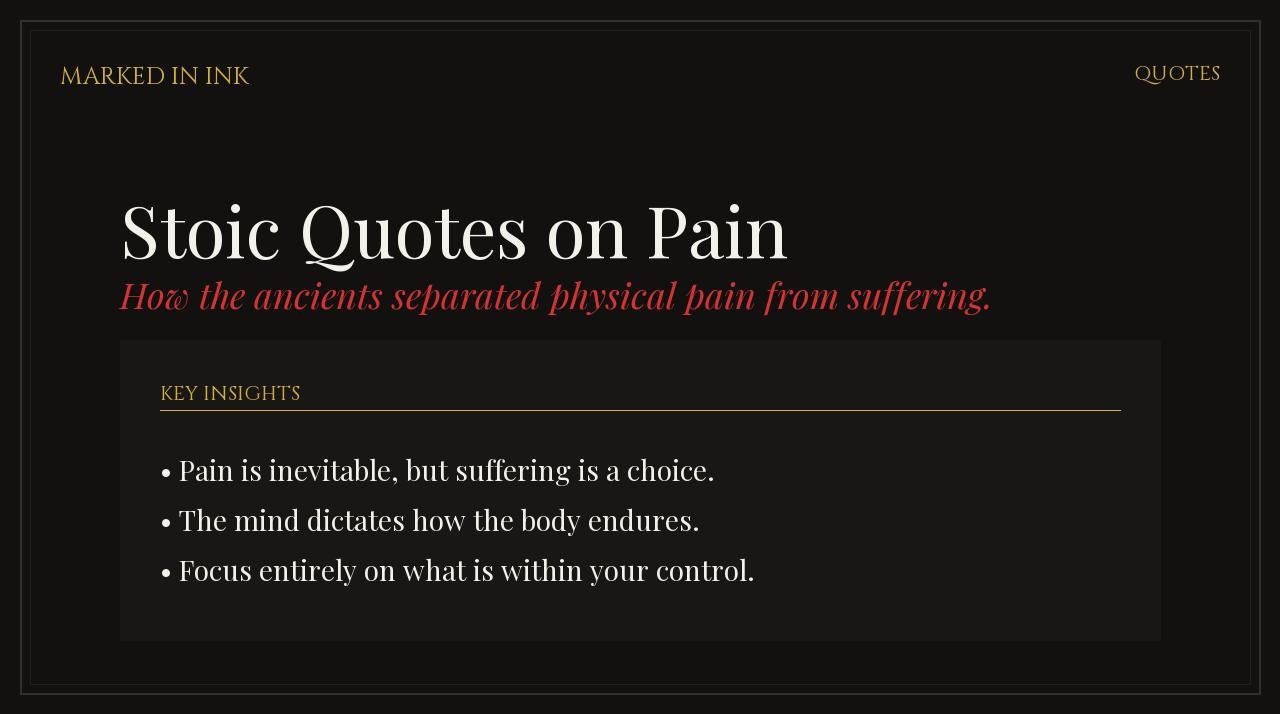
Pain is an inevitable part of the human experience. We all face physical or emotional hardship eventually. The ancient Stoics approached this reality in a profound way, believing that we can always control our minds.
Quick Answer: Stoic Quotes on Pain
The core Stoic belief regarding pain is that physical discomfort is an external event entirely out of our control, while the suffering we experience is an internal choice. Ancient philosophers such as Marcus Aurelius, Epictetus, and Seneca taught that we add a secondary layer of suffering to our pain whenever we complain, fear, or focus negatively on the sensation. By consciously separating the physical feeling from the internal narrative we construct about it, we can effectively eliminate psychological suffering. The Stoics argued that pain is either bearable, meaning it can be endured with a calm mind, or unbearable, meaning it will eventually bring an end to itself. The ultimate goal is to focus exclusively on our rational mind, maintaining tranquility regardless of the physical body’s state.
Key Takeaways
- The Stoics separated physical pain from psychological suffering.
- Marcus Aurelius believed that altering your perception removes the feeling of harm.
- Epictetus taught that the fear of pain is worse than the pain itself.
- Seneca emphasized that anticipating hardship creates unnecessary suffering.
- Many popular quotes attributed to the Stoics are modern misattributions.
To grasp this concept, you can explore other famous quotes and quotations. The Stoics taught that true strength comes from endurance. By removing our judgment of the pain, the suffering vanishes.
Here we will explore 25 verified stoic quotes on pain. These passages come directly from ancient texts. Let us look at what the Stoics actually taught.
Marcus Aurelius on Pain
Marcus Aurelius was an emperor and a philosopher. He ruled Rome during plagues and wars, facing immense physical and emotional strain. His journal, Meditations, is filled with reminders to himself.
1. “If you are distressed by anything external, the pain is not due to the thing itself, but to your estimate of it; and this you have the power to revoke at any moment.” (Marcus Aurelius, Meditations VIII.47)
This quote highlights the power of perception. The physical sensation is neutral until our mind judges it.
2. “When pain is unbearable it destroys us; when it does not it is bearable.” (Marcus Aurelius, Meditations VII.33)
He reminds himself that pain has a natural limit. If you are alive, you are capable of enduring it.
3. “Do not let us build a second story to our sorrow by being sorry for our sorrow.” (Marcus Aurelius, Meditations)
We often compound our pain by complaining. Stop the mental narrative to shrink the pain.
4. “Let the part of thy soul which leads and governs be undisturbed by the movements in the flesh.” (Marcus Aurelius, Meditations V.26)
Keep your rational mind separate from your bodily sensations.
5. “Pain is either an evil to the body, then let the body say what it thinks of it, or to the soul.” (Marcus Aurelius, Meditations VIII.28)
The mind can choose to remain calm regardless of the body’s state.
6. “Take away thy opinion, and then there is taken away the complaint.” (Marcus Aurelius, Meditations IV.7)
Our complaints create the feeling of being harmed.
7. “Everything that happens is either endurable or not. If it is endurable, then endure it.” (Marcus Aurelius, Meditations X.3)
This simple directive cuts through self-pity.
8. “Reject your sense of injury and the injury itself disappears.” (Marcus Aurelius, Meditations IV.7)
Mental resilience starts with refusing to feel injured. Check the origin of the phrase bite the bullet for more.
Epictetus on Enduring Hardship
Epictetus was born a slave and suffered a physically disabling injury. His teachings focus heavily on the dichotomy of control. He knew that physical pain was out of his hands.
9. “For it is not death or pain that is to be feared, but the fear of pain or death.” (Epictetus, Discourses II.1)
The fear of an event is worse than the event itself.
10. “I must suffer exile. But must I die groaning? Must I whine as well?” (Epictetus, Discourses I.1)
We can choose our attitude in any situation.
11. “Disease is an impediment to the body, but not to the will, unless the will itself chooses.” (Epictetus, Enchiridion 9)
Physical illness cannot stop your moral choices.
12. “Faced with pain, you will discover the power of endurance.” (Epictetus, Enchiridion 10)
Hardship reveals our hidden strengths.
13. “We cannot choose our external circumstances, but we can always choose how we respond to them.” (Epictetus, Discourses)
This is the foundational principle of his philosophy.
14. “He is a wise man who does not grieve for the things which he has not, but rejoices for those which he has.” (Epictetus, Fragments)
Focusing on what you lack brings unnecessary pain.
15. “Make the best use of what is in your power, and take the rest as it happens.” (Epictetus, Discourses I.1)
Acceptance is the antidote to suffering.
16. “There is only one way to happiness and that is to cease worrying.” (Epictetus, Discourses II.16)
Worry is a form of self-inflicted pain. To explore facing fears, see the origin of the phrase break a leg.
Seneca on the Mind and Body
Seneca served as an advisor to Nero and faced exile, illness, and ultimately a forced death. He wrote extensively about managing the mind during times of intense distress.
17. “We suffer more in imagination than in reality.” (Seneca, Letters from a Stoic XIII)
Our minds exaggerate potential threats, causing premature pain.
18. “He suffers more than necessary, who suffers before it is necessary.” (Seneca, Letters from a Stoic XCVIII)
Anticipating pain creates a longer period of suffering.
19. “It does not matter what you bear, but how you bear it.” (Seneca, On Providence II)
The true test of character is your reaction to adversity.
20. “Death is a release from and an end of all pains.” (Seneca, Letters from a Stoic XXIV)
Seneca viewed death as a natural boundary to human suffering.
21. “Sometimes even to live is an act of courage.” (Seneca, Letters from a Stoic LXXVIII)
Enduring life’s difficulties requires immense bravery.
22. “A gem cannot be polished without friction, nor a man perfected without trials.” (Seneca, On Providence IV)
Pain is a tool for personal growth. This mindset is like the drive found in the origin of the word berserk.
23. “Fire tests gold, suffering tests brave men.” (Seneca, On Providence V)
Hardship reveals our true nature.
24. “To bear trials with a calm mind robs misfortune of its strength and burden.” (Seneca, Letters from a Stoic)
Tranquility is your best defense against adversity.
25. “I judge you unfortunate because you have never lived through misfortune. You have passed through life without an opponent.” (Seneca, On Providence IV)
A life without pain is a life untested. Read definitions on the Merriam-Webster dictionary.
Debunking Fake Stoic Quotes on Pain
The internet is filled with modern paraphrases disguised as ancient wisdom. Many quotes attributed to the Stoics are completely fabricated. Here are two popular examples that you should stop sharing.
“Everything we hear is an opinion, not a fact. Everything we see is a perspective, not the truth.”
This quote is widely attributed to Marcus Aurelius. It sounds deep, but it is not from Meditations. The Stoics believed in objective truth and virtue. This quote suggests a relativism that contradicts core Stoic teachings.
“You have power over your mind, not outside events. Realize this, and you will find strength.”
While this summarizes the dichotomy of control, Marcus Aurelius never wrote these exact words. It is a modern summary of his ideas. You can search the Online Etymology Dictionary for historical context. Always look for citations when reading quotes online.
Frequently Asked Questions
Did the Stoics believe in ignoring pain?
No, the Stoics did not ignore pain. They acknowledged physical pain as a real sensation. However, they believed we should not add mental suffering to it through complaints or fear.
What did Marcus Aurelius say about physical pain?
Marcus Aurelius said that pain is either bearable or unbearable. If it is bearable, endure it. If it is unbearable, it will destroy you and the pain will end.
How did Epictetus deal with pain?
Epictetus dealt with pain by focusing strictly on his will. He believed that a physical ailment could affect his body. It could not affect his moral choices unless he allowed it to.
Why are there so many fake Stoic quotes?
Many fake quotes exist because people summarize Stoic ideas into modern phrases. Over time, these summaries get shared on social media. They are then falsely attributed to the original philosophers.
Can Stoicism help with chronic pain?
Yes, Stoicism can help manage chronic pain by teaching acceptance. By focusing on what you can control, the psychological burden of chronic pain often decreases.
Finding peace in the face of pain requires practice. By studying stoic quotes on pain, you can train your mind to handle discomfort. With time, you will build the mental resilience to endure whatever comes your way.


Alan Sledge is the writer and founder behind Letters & Letters. A lifelong lover of words, Alan has always been drawn to the small mysteries hidden in everyday language, why we say what we say, where our favorite sayings came from and the quotes that manage to put feelings into words better than we ever could ourselves.

Alan Sledge
Alan Sledge is the founder and lead researcher behind Letters & Letters. A lifelong student of linguistic history, he cross-references every word origin, idiom, and quote against primary archival manuscripts, the Oxford English Corpus, and 18th-century print lexicons.