
Smokers toss unfinished cigarette packs into wastebaskets to break nicotine dependence overnight. Smartphone users delete social media applications to escape ceaseless digital notifications. Coffee drinkers abruptly abandon morning caffeine rituals despite bracing for intense throbbing headaches.
In contemporary English, quitting cold turkey denotes the complete and immediate cessation of an addictive substance or ingrained habit. The method eschews gradual tapering, nicotine patches, and clinical weaning. Speakers use the vivid culinary metaphor daily without pausing to consider why poultry represents abrupt withdrawal.
The true origin of the phrase cold turkey connects American colloquialisms with early twentieth-century addiction medicine. Behind the colorful food metaphor lies a visceral physical reality. Severe physiological withdrawal chills once transformed patients skin into the bumpy flesh of raw poultry.
Quick Answer: Origin of the Phrase Cold Turkey
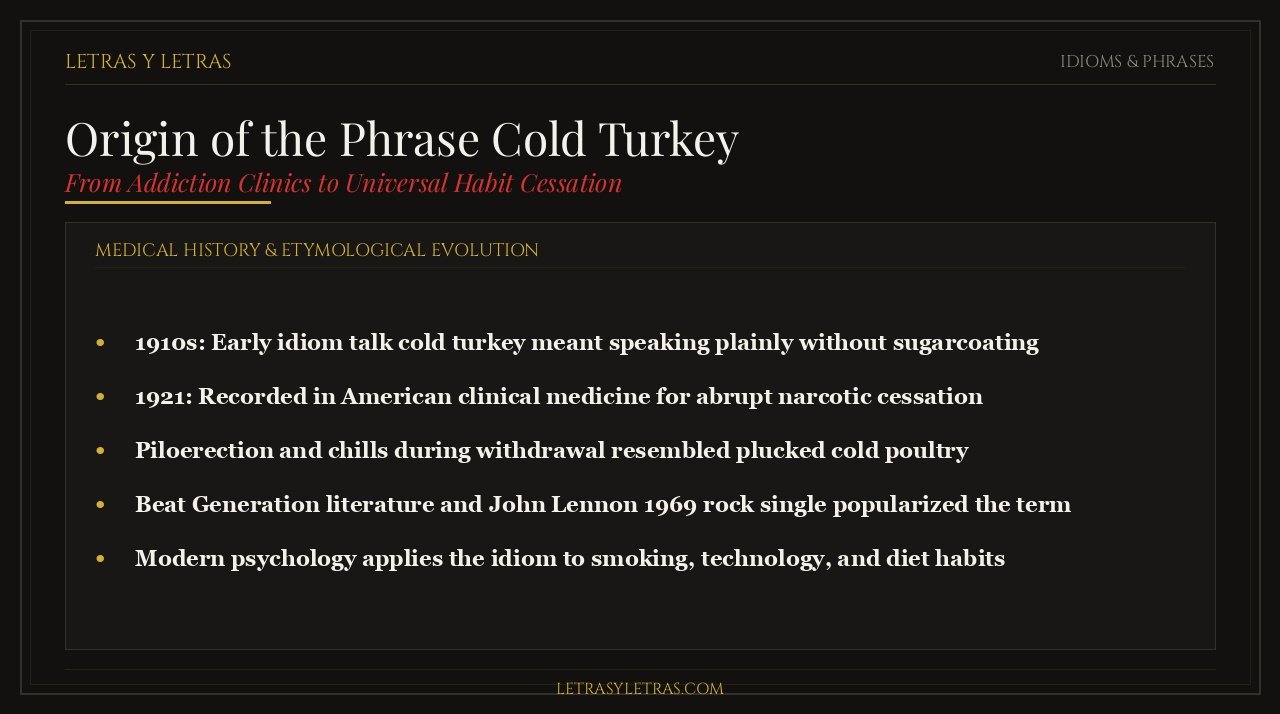
The phrase cold turkey originated in early twentieth-century North American slang before entering addiction medicine in the 1920s. The term initially meant plain, unvarnished speaking, derived from serving cold leftover poultry without warm gravy. By 1921, American medical facilities used cold turkey treatment to describe abruptly stopping narcotics without tapering. During acute withdrawal, patients suffer severe chills, hypothermia, and piloerection. Their pale, bumpy gooseflesh physically resembles a plucked, uncooked turkey carcass hanging in a butcher shop. Beat Generation writers and John Lennon 1969 rock single popularized the idiom worldwide for quitting any stubborn habit.
Key Takeaways
- Cold turkey describes abruptly terminating an addictive habit without gradual tapering.
- Early American slang used talk cold turkey to signify blunt, honest speaking.
- Addiction clinics adopted the phrase in 1921 for abrupt narcotic detoxification.
- Severe withdrawal chills cause piloerection resembling bumpy, plucked poultry skin.
- Today the idiom applies widely to smoking, diet, caffeine, and digital screen habits.
The Modern Idiom: Defining Abrupt and Total Cessation
Overcoming habitual dependence represents one of the most demanding psychological trials a human being can face. Modern behavioral science offers dozens of structured weaning strategies, including nicotine replacement, step-down dosage programs, and cognitive counseling. Yet many individuals choose the most drastic approach available.
Going cold turkey means severing contact with a habit instantaneously. The individual relies solely on raw willpower and physical endurance to weather acute cravings. This approach accepts immediate physical suffering in exchange for faster chemical liberation.
Records in the Merriam-Webster dictionary define the term as abrupt, complete cessation. The phrase carries a gritty, uncompromising emotional resonance. It evokes fortitude, stubborn determination, and unvarnished personal discipline.
The expression has expanded far beyond its original clinical narcotic boundaries. People routinely speak of quitting junk food, video games, online shopping, or toxic relationships cold turkey. It serves as our universal cultural shorthand for immediate behavioral transformation.
Why did English speakers settle upon refrigerated domestic fowl to describe radical personal resolve? The answer requires tracing two separate historical linguistic streams that merged in the American Midwest. Our investigation begins with cold leftovers and unadorned speech.
Culinary and Colloquial Roots: Leftovers and Plain Speaking
The earliest colloquial usage of cold turkey had nothing to do with medical withdrawal or narcotics. In nineteenth-century American households, roasted turkey was a celebratory feast prepared for Thanksgiving and festive gatherings. The following day, families consumed leftover meat straight from the icebox.
Cold roast poultry required zero additional culinary preparation, rich sauces, or warm buttered gravy. It was plain, simple, and unadorned food served without polite pretense. Eating cold turkey was a direct, straightforward dining experience.
By the early twentieth century, American vernacular speech began using cold turkey as a metaphor for blunt truth. To talk cold turkey meant to speak plainly, directly, and honestly without diplomatic sugarcoating. The phrase functioned as an intensified variation of the older American idiom to talk turkey.
Scholars at the Online Etymology Dictionary cite early records near 1914. A Canadian newspaper, The Daily Colonist in British Columbia, published a dialogue featuring the phrase. One speaker announces that he plans to talk cold turkey to settle a business dispute.
In this initial phase, the idiom signified dealing with unvarnished reality. Cold turkey was the conversational equivalent of a cold meal, stripped of flattering ornamentation. This cultural association with blunt, sudden truth established the foundation for its next linguistic leap.
The Clinical Crucible: 1920s Addiction Medicine
Following World War I, American cities faced a severe public health crisis involving morphine, heroin, and cocaine dependency. The passage of the Harrison Narcotics Tax Act in 1914 had criminalized unauthorized opiate possession. Thousands of dependent individuals found themselves arrested and incarcerated in municipal jails.
Prison doctors and city clinic physicians struggled to manage acute withdrawal symptoms among incoming inmates. Some facilities experimented with gradual dosage reductions using synthetic sedatives. Many overwhelmed institutions, however, simply cut off all narcotics immediately upon admission.
Medical staff and inmates began referring to this unassisted detox protocol as the cold turkey treatment. The earliest known print appearance connecting the phrase to medicine appeared in 1921. The Des Moines Daily News published an article describing narcotic treatment methods in municipal facilities.
Iowa reporters explained that patients received what clinicians termed the cold turkey treatment. This historical article noted that clinicians stopped all drugs immediately upon arrival. Such terminology captured the blunt, unceremonious nature of the medical intervention.
Within a few years, the term spread across American correctional facilities and public health reports. In 1927, medical journals and criminological studies regularly referenced cold turkey detoxification. The phrase had found its permanent medical home.
The Physical Reality: Piloerection, Chills, and Plucked Skin
While the plain speaking idiom contributed to the name, a dramatic physical symptom cemented the metaphor in clinical minds. Anyone who has observed acute opiate withdrawal understands how intensely the human body reacts to sudden chemical deprivation. The central nervous system rebounds into hyperactive autonomic storm.
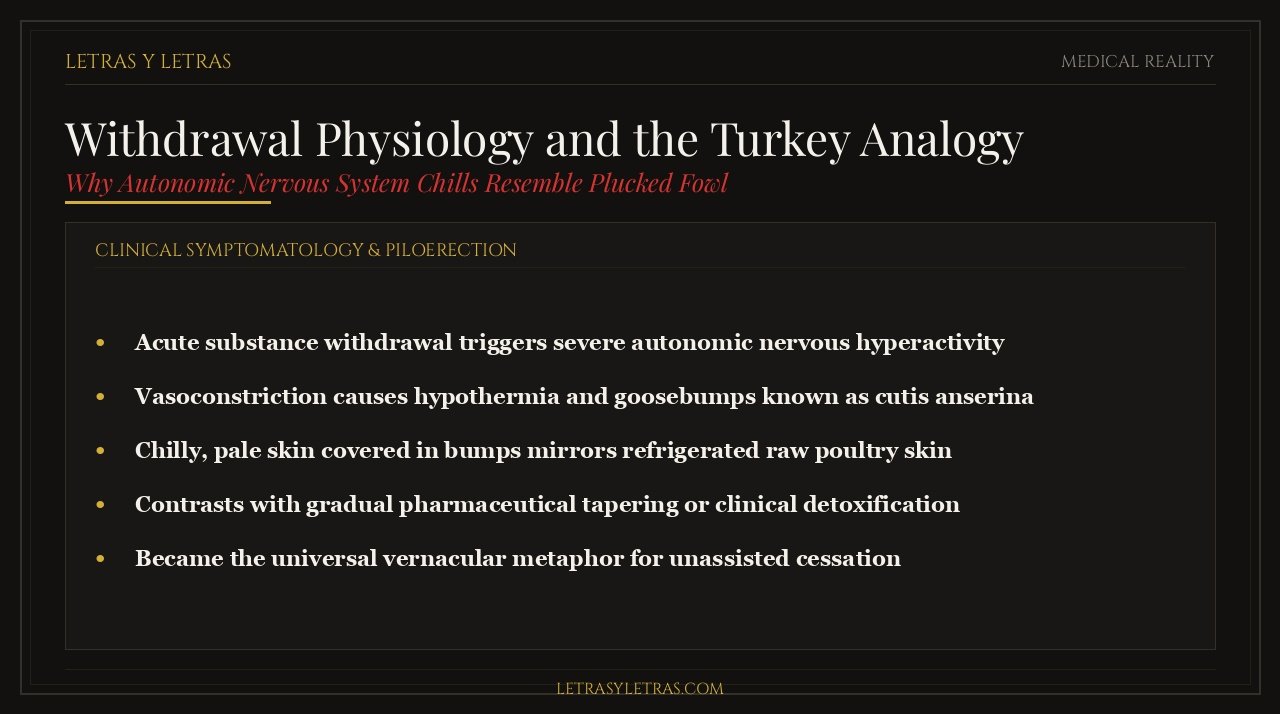
Data from the National Library of Medicine details this exact physiological sequence. As natural endorphin receptors go unfulfilled, sympathetic nerve pathways fire uncontrollably. Peripheral blood vessels constrict dramatically, plunging peripheral skin temperatures downward.
Patients experience violent shivering, muscle tremors, and profound internal chills. Simultaneously, microscopic muscles called arrector pili contract violently around hair follicles across the arms, legs, and torso. This involuntary reaction produces pronounced goosebumps, medically designated as cutis anserina.
The patient skin becomes pale, clammy, and covered in thousands of raised, rigid bumps. To attending nurses and prison guards, the physical appearance was unmistakable. The shivering patient bumpy flesh bore a striking visual resemblance to an uncooked, freshly plucked turkey carcass.
Butchers displayed plucked poultry on crushed ice in market display windows. The cold, bumpy, pale skin of the bird matched the afflicted patient body with haunting accuracy. This visual analogy proved so potent that it permanently fused with the plain speaking idiom.
This dual etymology gave cold turkey exceptional staying power. The phrase described both the unvarnished abruptness of the treatment and the physical appearance of the suffering patient. Medical vernacular rarely invents metaphors with such vivid biological resonance.
The Beat Generation and Rock Counterculture: Burroughs to Lennon
For several decades, cold turkey remained confined to underworld slang, prison wards, and clinical medical journals. Respectable middle-class households rarely uttered the phrase in polite social settings. That linguistic isolation shattered during the post-war cultural explosion of the 1950s and 1960s.
In 1953, underground American author William S Burroughs published his semi-autobiographical novel Junkie. Burroughs wrote candidly about his struggles with substance dependence across American cities. His narrative detailed the agony of cold turkey withdrawal, explaining the visceral reality of street slang to literary readers.
Six years later, Burroughs published Naked Lunch, which became a sensation and a landmark free speech court case. Intellectuals and college students devoured Beat literature, adopting underground argot into counterculture vocabulary. The phrase cold turkey began appearing in college magazines, coffee houses, and poetry circles.
The definitive global breakthrough occurred in October 1969. Former Beatles songwriter John Lennon released a raw, searing rock single titled Cold Turkey with the Plastic Ono Band. Lennon had recently ended his personal heroin dependency without medical tapering.
Lennon lyrics described the torment of withdrawal with visceral honesty, singing of rising fevers, heavy bones, and desperate chills. The song climbed international music charts in the United States and the United Kingdom. Radio disc jockeys repeated the title across airwaves worldwide, broadcasting the phrase into millions of teenage bedrooms.
The rock anthem permanently lifted cold turkey out of specialized clinical jargon. Overnight, the expression became a globally recognized household idiom. It was ready to be applied to ordinary human habits.
Linguistic Expansion: From Chemical Dependency to Everyday Habits
During the 1970s and 1980s, public health campaigns in the United States and Europe launched aggressive anti-smoking initiatives. The Surgeon General warned citizens about the lethal dangers of tobacco, prompting millions of smokers to attempt cessation. Smoking cessation clinics and self-help literature popularized cold turkey as a legitimate lifestyle choice.
Health guides debated the comparative merits of gradual nicotine reduction versus quitting cold turkey. Many behavioral psychologists argued that sudden, absolute cessation produced superior long-term success rates compared to prolonged tapering. The phrase lost its criminal associations and gained moral authority.
By the turn of the millennium, the metaphor had migrated into the digital arena. Mental health researchers began studying technological addiction, compulsive smartphone usage, and social media fixation. Psychologists routinely advise burned-out individuals to undergo cold turkey digital detoxes.
Today, people speak of quitting caffeine, sugar, online gambling, or television binge-watching cold turkey. The expression has transcended its physical origins to represent decisive psychological boundaries. It stands as our premier metaphor for drawing a line in the sand.
Chronological Milestones in the History of Cold Turkey
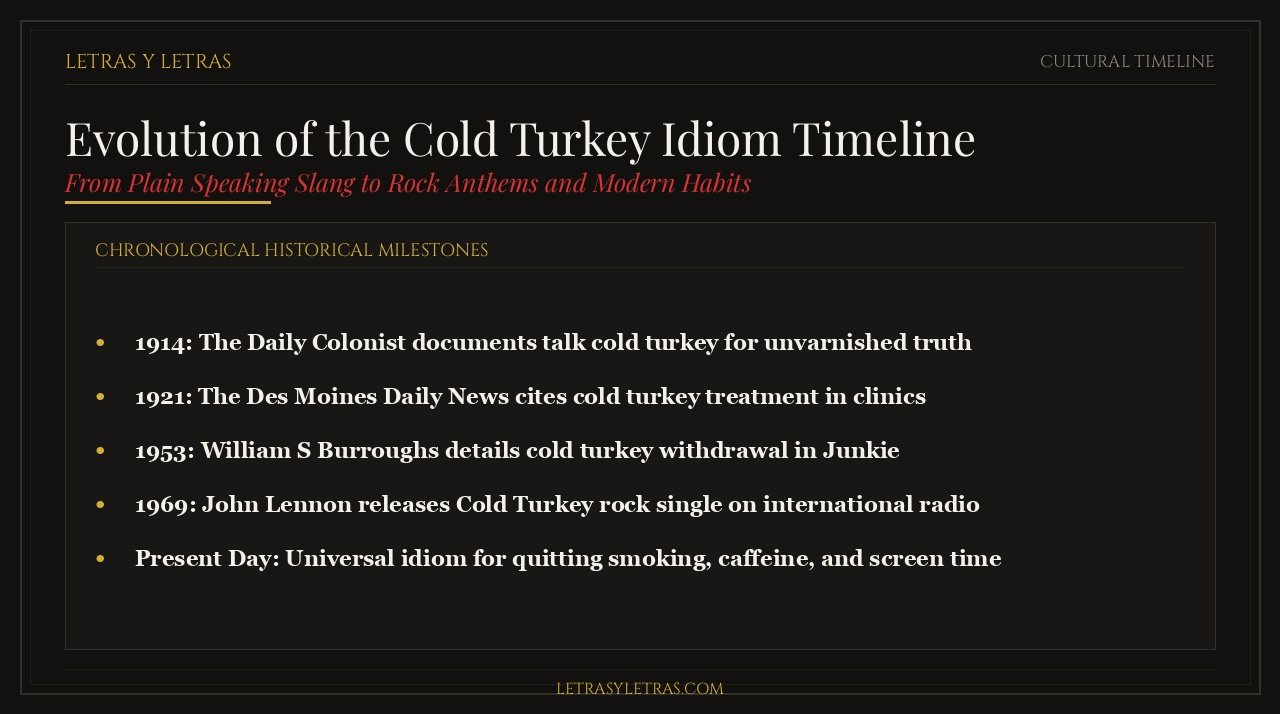
The historical timeline below summarizes the major linguistic, medical, and cultural milestones of the phrase cold turkey:
| Time Period | Cultural Arena | Key Milestone | Linguistic Impact |
|---|---|---|---|
| 1880 to 1910 | American Colloquial Speech | Leftover cold turkey served plain; to talk turkey means honesty. | Associates cold poultry with unadorned, direct, plain reality. |
| 1914 | Canadian Newspaper Print | The Daily Colonist prints talk cold turkey for blunt speech. | Earliest documented appearance of the phrase in published prose. |
| 1921 | The Des Moines Daily News | Cites cold turkey treatment for abrupt narcotic detoxification. | First recorded connection between the idiom and chemical withdrawal. |
| 1927 to 1935 | Clinical Medical Journals | Physicians document gooseflesh resembling plucked turkey skin. | Fuses physical withdrawal piloerection with the plain speaking idiom. |
| 1953 | William S Burroughs (Junkie) | Beat Generation novel brings street addiction slang to intellectuals. | Introduces cold turkey into post-war American literature. |
| 1969 | John Lennon (Plastic Ono Band) | Releases Cold Turkey rock single on international radio stations. | Transforms the expression into a global household idiom. |
| 1980 to Present | Global Behavioral Psychology | Applied to smoking cessation, caffeine, sugar, and screen habits. | Universal metaphor for immediate, unassisted behavioral quitting. |
Debunking Common Myths About the Origin of Cold Turkey
Because cold turkey possesses a curious culinary name, popular folklore has generated several colorful theories. Consulting historical documents and medical archives dispels three prominent myths:
The primary myth claims the phrase originated from Thanksgiving dinner leftovers that went bad. Storytellers claim eating spoiled cold poultry produced violent shivering and stomach cramps resembling withdrawal. Culinary history provides zero evidence connecting spoiled poultry to the idiom.
The true connection was the visual appearance of bumpy plucked skin during chills, combined with plain speaking slang. Confusing digestive illness with piloerection overlooks documented medical archives. The timeline clearly points to 1920s clinical facilities.
A second myth asserts that John Lennon invented the phrase while composing his 1969 song. While Lennon music made the term famous across pop culture, the idiom existed fifty years prior. Medical textbooks had analyzed cold turkey protocols decades before Lennon was born.
A third myth claims the expression originated in the British Royal Navy as a punishment for drunken sailors. Naval historians confirm that British vessels never recorded such terminology. The phrase is an authentic twentieth-century North American creation.
We saw similar folk myths debunked in our origin of the phrase crocodile tears guide. Popular imagination frequently invents dramatic fables to explain peculiar idioms.
The Psychology of Sudden Quitting: Why Cold Turkey Endures
Why does the cold turkey approach retain such immense cultural prestige despite the availability of gradual tapering? The answer lies in human psychology and cognitive resolve. Gradual reduction requires constant negotiation with temptation, which often exhausts mental willpower.
When someone attempts to taper a habit, every cigarette or spoonful of sugar demands an agonizing internal calculation. Going cold turkey eliminates decision fatigue through absolute clarity. An absolute prohibition is often easier to maintain than moderate indulgence.
The strategy requires intense commitment and deep personal discipline. We explored timeless reflections on mental focus in our curated quotes on discipline collection. Governing immediate impulses is the foundation of lasting personal freedom.
Language often reflects profound social and psychological struggles. Consider how collective resolve forged an international verb in our origin of the word boycott history. United, decisive action transforms reality.
Uncompromising honesty with oneself is essential when overcoming destructive habits. Discover ancient standards of truth in our origin of the word sincere investigation. True renewal demands unadulterated integrity.
Human beings often carry hidden points of critical vulnerability. Explore mortal fragility in our analysis of the origin of the phrase Achilles heel. Identifying vulnerabilities prevents tragic downfall.
Leadership also crumbles when stubborn pride refuses to acknowledge reality. Review high-stakes Bronze Age governance in our meaning of the name Agamemnon study. Stubborn obstinacy inevitably breeds disaster.
Linguistic history also reminds us of playful counterculture slang. Discover cheerful approval in our origin of the phrase cool beans guide. Playful phrases enrich everyday conversation.
Superstition and spatial language also reveal cultural shifts over time. Examine Roman left-hand omens in our origin of the word sinister study. Words evolve unexpected meanings across centuries.
Recreational gambling often evolved into universal warnings of peril. Trace medieval dice games in our origin of the word hazard investigation. Reckless pursuits carry lasting consequences.
Tranquil retreats provide the ultimate contrast to turbulent withdrawal. Explore ancient Persian walled gardens in our origin of the word paradise reflection. The human spirit constantly strives toward peace and renewal.
Frequently Asked Questions
What is the literal meaning of going cold turkey?
Going cold turkey means immediately quitting an addictive substance or habit without gradual tapering, weaning, or transitional substitutes.
Why is it called cold turkey?
The phrase comes from the physical symptoms of acute withdrawal. Shivering chills and goosebumps make a patient pale skin resemble the bumpy flesh of a cold, plucked turkey carcass.
When was the phrase cold turkey first used?
The idiom talk cold turkey appeared in 1914 for plain speaking. By 1921, American addiction clinics and newspapers used cold turkey treatment to describe abrupt detoxification.
Did John Lennon invent the phrase cold turkey?
No, John Lennon did not invent the phrase. Lennon released his famous rock single Cold Turkey in 1969, popularizing an existing medical idiom that dated to the 1920s.
Is quitting cold turkey safe for all substances?
Quitting cold turkey is generally safe for nicotine, caffeine, and behavioral habits. Abrupt cessation of heavy alcohol or benzodiazepines, however, can cause severe medical complications requiring professional supervision.
What habits do people quit cold turkey today?
Today, people apply the phrase to quitting cigarettes, alcohol, excessive caffeine, sugar, video games, smartphones, and social media habits.
Alan Sledge is the lead writer at letrasyletras.com, uncovering historical wisdom and word origins.


Alan Sledge is the writer and founder behind Letters & Letters. A lifelong lover of words, Alan has always been drawn to the small mysteries hidden in everyday language, why we say what we say, where our favorite sayings came from and the quotes that manage to put feelings into words better than we ever could ourselves.

Alan Sledge
Alan Sledge is the founder and lead researcher behind Letters & Letters. A lifelong student of linguistic history, he cross-references every word origin, idiom, and quote against primary archival manuscripts, the Oxford English Corpus, and 18th-century print lexicons.