
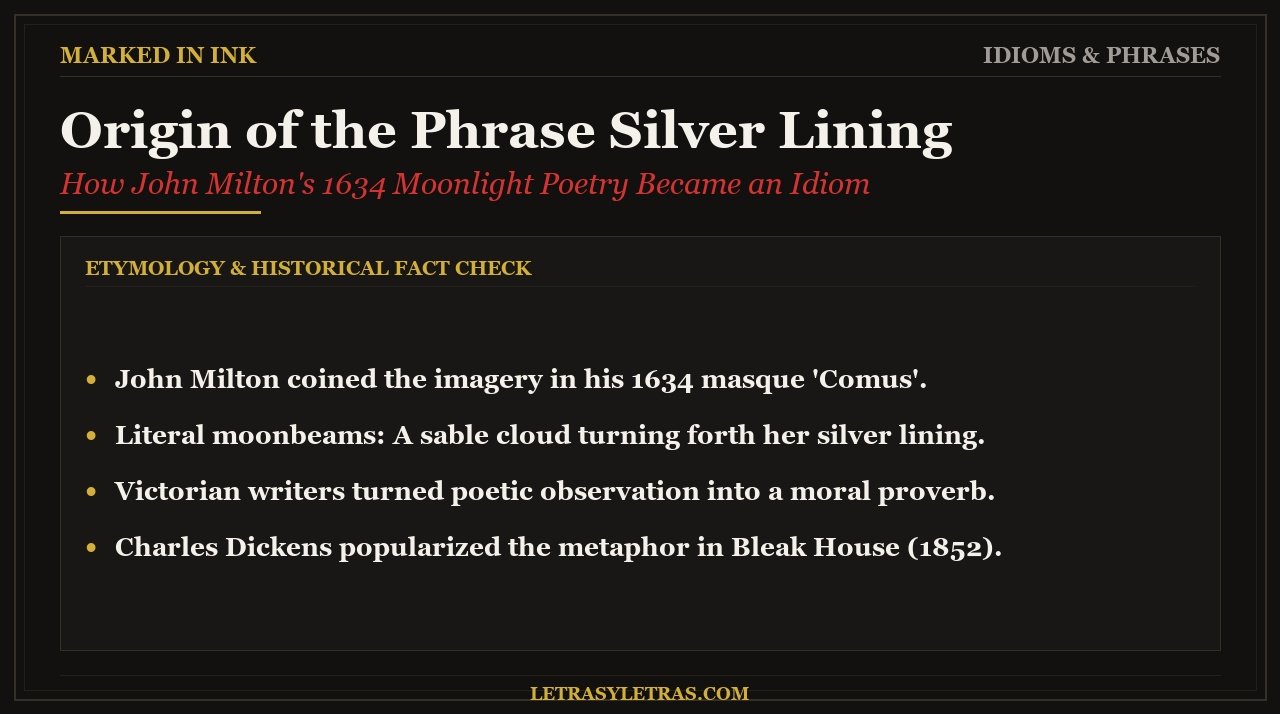
Long before becoming a motivational slogan, a silver lining was a literal description of moonlight. You might assume this comforting idiom originated in Victorian self-help manuals. The real history belongs to a dramatic theatrical performance staged in a Welsh border castle during 1634.
Quick Answer: Origin of the Phrase Silver Lining
The phrase “silver lining” originated in 1634 with English poet John Milton in his masque Comus. Milton described moonlight shining behind a dark cloud. In the nineteenth century, Victorian writers turned this poetic observation into the proverb “every cloud has a silver lining,” meaning difficult times hold hidden hope.
Key Takeaways
- John Milton coined the phrase in his 1634 dramatic masque Comus.
- The original line was a literal observation of moonlight behind dark storm clouds.
- Victorian writers in the 1840s adapted the poetic line into a moral proverb.
- Charles Dickens helped cement the metaphor in his 1852 novel Bleak House.
- The phrase transitioned from seventeenth-century poetry to a universal symbol of hope.
The Night at Ludlow Castle in 1634
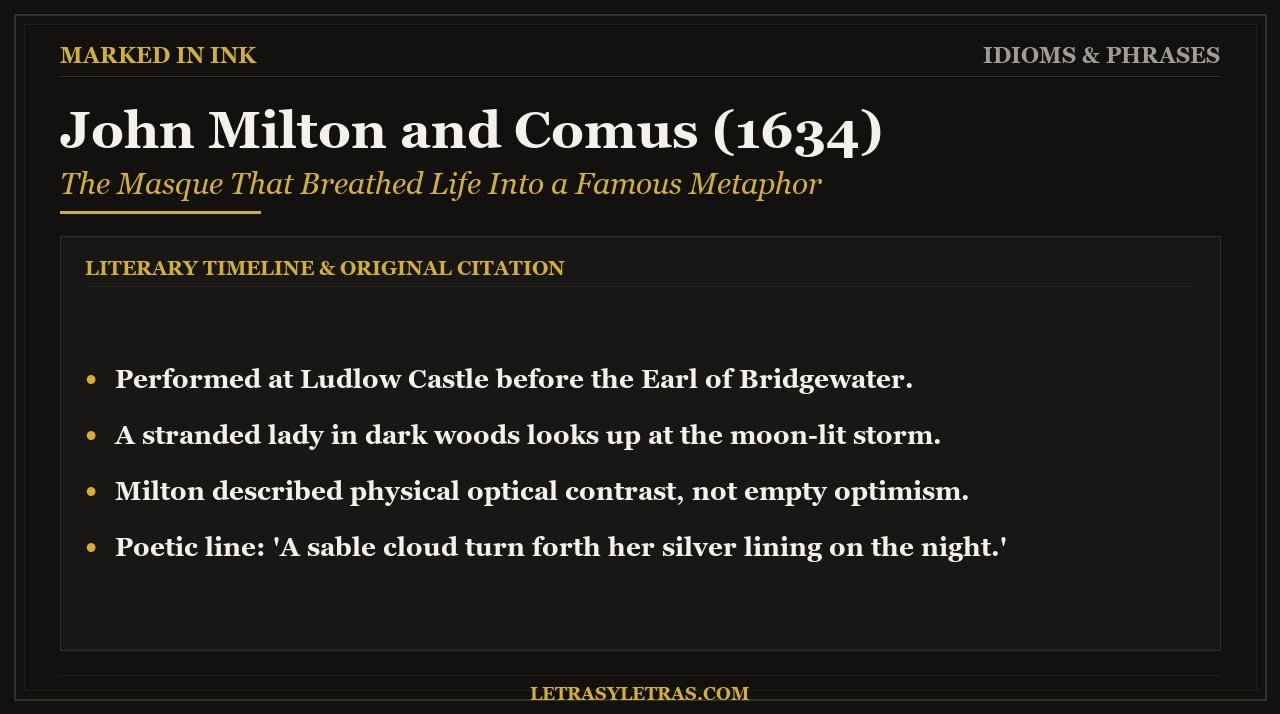
The story begins in September 1634 at Ludlow Castle in Shropshire. An aristocratic family commissioned a musical entertainment known as a masque.
Young scholar John Milton wrote the dramatic text. His production was titled Comus, A Masque Presented at Ludlow Castle. The plot centers on a young noblewoman lost in an enchanted forest at night.
Darkness settles around her in the woods. Dense tree canopy blocks all starlight. Thick storm clouds obscure the night sky, deepening her fear.
She looks up toward the heavens in despair. A brief gap opens among overcast clouds. She sees the bright moon illuminating the edge of a dark cloud.
Milton gave his heroine a memorable line about a sable cloud turning forth its silver lining. She took comfort from an optical fact. Even dark clouds cannot extinguish the light shining behind them.
Literal Moonlight Before Moral Metaphor
For more than a century after Milton wrote Comus, English speakers treated his words literally. Naturalists and poets referenced silver linings exclusively when describing atmospheric phenomena. The line captured an optical effect known today as cloud iridescence.
When strong moonlight strikes high clouds, light diffracts around water droplets. This diffraction creates a glowing border around the dark cloud body. Milton possessed a keen eye for natural illumination.
Writers throughout the eighteenth century quoted Milton with reverence. They treated his phrase as high poetry rather than casual street vernacular. Explore more language history in our guide to english idioms and meanings.
Literary figures admired the contrast between sable and silver. Sable referred to deep black heraldic fur. Silver provided the radiant counterpoint that signaled safety.
Nobody in the eighteenth century told friends to find a silver lining during personal misfortune. The expression remained firmly anchored to the night sky.
How the Victorians Created the Modern Proverb
The shift from literal moonlight to emotional resilience happened during the early Victorian period. British society experienced rapid industrial expansion and urban poverty. Victorians placed immense cultural value on endurance and spiritual strength.
Writers and religious essayists began extracting Milton poetic imagery for moral lessons. They argued that difficult human trials contained hidden blessings.
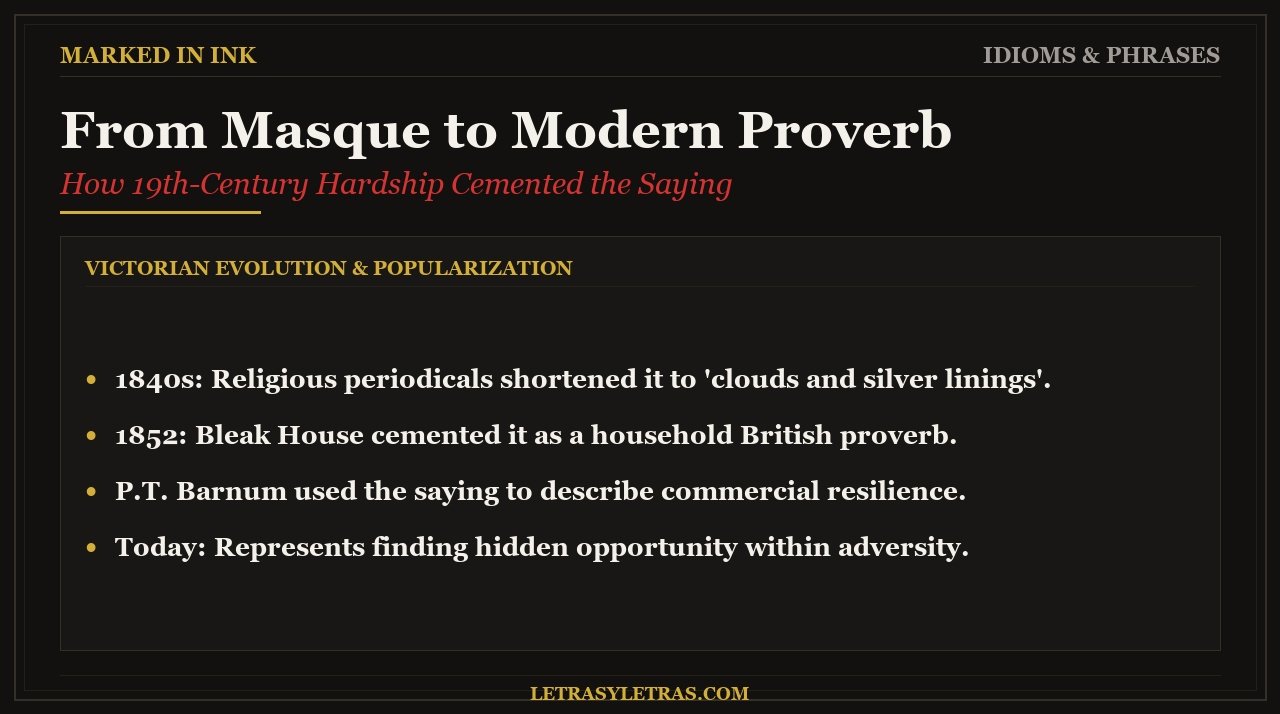
In 1840, the phrase began appearing in popular British periodicals as an emerging proverb. Irish novelist Samuel Lover included an early variation in his 1842 book Treasure Trove. He noted that every cloud had a silver lining under heaven.
By the late 1840s, magazines across Britain standardized the expression. The phrase evolved into a command for emotional resilience.
Linguistic history often mirrors cultural shifts. As seen in the origin of the phrase bless you, physical observations became everyday proverbs.
Charles Dickens and Popular Print
The mid-nineteenth century saw mass-market printing explode across Britain. Popular novelists played a decisive role in embedding idioms into the everyday lexicon. No author held more influence over Victorian readers than Charles Dickens.
In his celebrated 1852 novel Bleak House, Dickens invoked the silver lining imagery. He used it to describe characters finding peace amid heavy emotional burdens. Readers adopted the phrase immediately.
Across the Atlantic, showman P.T. Barnum adopted the phrase in public lectures. He used it to describe business resilience after commercial setbacks.
Lexicographers at the Online Etymology Dictionary track this transatlantic surge during the 1850s. Within two decades, the proverb migrated into newspapers, political speeches, and working-class parlance.
The phrase achieved global permanence during World War I. Jerome Kern composed the hit song “Look for the Silver Lining” in 1919. The tune offered comfort to families facing wartime loss.
Popular Myths About the Silver Lining
Several popular misconceptions surround the origin of this famous saying. Examining these stories separates fact from folklore.
Myth 1: The Phrase Comes From Tailoring
One persistent myth claims the phrase originated with luxury garment makers. According to this story, wealthy aristocrats lined dark wool coats with silver silk. While silver linings existed in fashion, historical records show no connection to the idiom.
Milton explicitly described a sable cloud in the night sky. His metaphor was meteorological from its very first utterance. This tailoring claim is an inventive story created centuries later.
Myth 2: Ancient Roman Proverb
Another claim suggests that the silver lining is a translation of an ancient Roman proverb. Classical Roman writers wrote about finding virtue during adversity, but never used this cloud metaphor. Latin literature contains references to calm seas, yet clouds with silver linings belong to English poetry.
You can verify historical definitions through the Merriam-Webster dictionary. The earliest documented English appearances lead directly back to Milton text in 1634.
Myth 3: Shakespeare Coined the Term
Readers frequently assume William Shakespeare coined the silver lining line. Shakespeare wrote about storms and moonlight in plays like The Tempest. However, the specific pairing of clouds and silver linings appears nowhere in his collected works.
Milton admired Shakespeare deeply, but this particular poetic imagery belongs solely to Milton. Dramatic lore in our guide on the origin of the phrase break a leg shares a similar background.
The Linguistic Evolution: A Timeline
Examining chronological milestones shows how a poetic line became a universal proverb.
- 1634: John Milton (Comus) writes the first recorded line of a sable cloud with a silver lining.
- 1790s: Romantic poets quote Milton line to describe literal moonlight and storm clouds.
- 1842: Samuel Lover (Treasure Trove) writes an early transition toward the proverb format.
- 1852: Charles Dickens (Bleak House) popularizes the metaphorical meaning for Victorian readers.
- 1869: P.T. Barnum employs the phrase in American commercial print to symbolize financial resilience.
- 1919: Jerome Kern musical theatre song “Look for the Silver Lining” cements global recognition.
The evolution demonstrates the remarkable elasticity of English idioms. A single descriptive sentence penned for a private performance evolved across centuries into a global idiom.
Why the Metaphor Continues to Resonate
Language survives when it addresses a fundamental aspect of human psychology. The concept of the silver lining has outlasted other expressions because it visualizes hope with precision.
Humans are visual creatures. Telling someone that bad times will pass is abstract. Giving someone a clear picture of a glowing silver rim around a dark cloud provides an immediate mental anchor.
Cognitive psychologists refer to this mental habit as positive cognitive reappraisal. It involves reframing a stressful event to identify constructive aspects. Long before psychologists named this coping mechanism, John Milton provided humanity with a fitting poetic emblem.
The phrase continues to inspire creative writing, personal philosophy, and daily conversation. For philosophical reflections on human resilience, explore our collection of famous quotes and quotations.
Frequently Asked Questions
Who first coined the phrase silver lining?
English poet John Milton coined the phrase in his 1634 dramatic masque titled Comus. He used it to describe moonlight shining behind a dark cloud.
What does every cloud has a silver lining mean?
The proverb means that every difficult or unpleasant situation contains some positive aspect, hidden benefit, or reason for hope.
When did the phrase become a common proverb?
The phrase transitioned from a poetic line into a widespread popular proverb during the 1840s and 1850s in Victorian Britain.
Did Charles Dickens invent the silver lining expression?
No. Charles Dickens used the metaphor in his 1852 novel Bleak House, which helped popularize it widely, but the original imagery came from John Milton in 1634.
What was the original line written by John Milton?
In Comus (1634), Milton wrote: “Was I deceived, or did a sable cloud turn forth her silver lining on the night?”
Language preserves artistic triumphs of the past in surprising ways. When you encourage a friend to find a silver lining, you recite seventeenth-century verse. As storm clouds gather, remember that the light behind them is older than the temporary darkness in front.
Alan Sledge is the founder and lead writer at letrasyletras.com, dedicated to uncovering the true etymological histories behind our favorite words and phrases.