
When you look at a crisp shadow profile cut from black paper, you probably think of delicate eighteenth-century craftsmanship. You might picture romantic Victorian keepsakes or classic theater backdrops. What you probably do not picture is a furious national tax revolt.
Yet behind this elegant artistic noun lies one of the sharpest political insults in European history. The word did not begin in a Parisian painter’s studio. It was born in the marble hallways of Versailles during a catastrophic financial collapse.
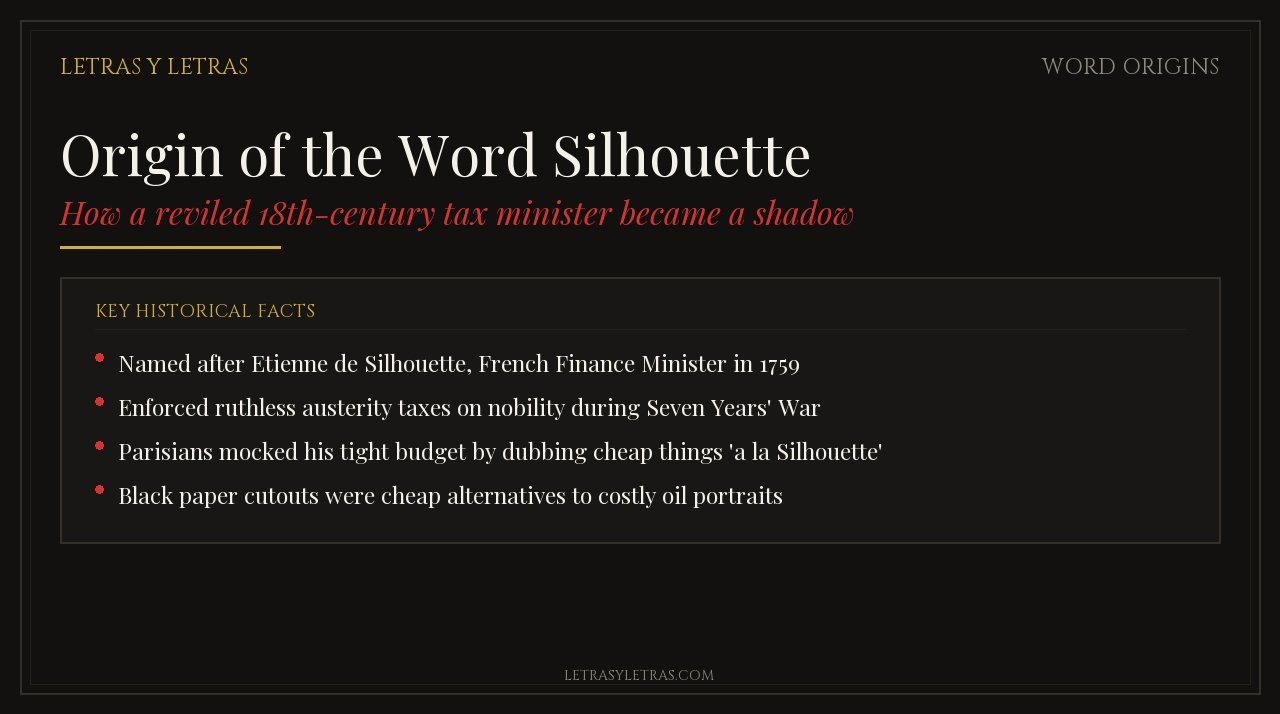
The true origin of the word silhouette traces back to a real French politician named Étienne de Silhouette. In 1759, his aggressive budget cuts and relentless penny-pinching enraged the French nobility. The aristocracy fought back with biting satire, permanently affixing his surname to anything done cheaply.
Quick Answer: Origin of the Word Silhouette
The word silhouette derives from Étienne de Silhouette (1709 to 1767), who served as Controller-General of Finances under King Louis XV of France in 1759. Faced with crushing national debt during the Seven Years’ War, Silhouette imposed severe austerity measures and luxury taxes on the French nobility. Furious aristocrats mocked his extreme frugality by labeling anything skimpy, cheap, or unfinished as done ‘à la Silhouette.’ Black paper cutout profile portraits, which cost only pennies compared to expensive commissioned oil paintings, were derisively named portraits à la Silhouette. Over the next century, the satirical political association faded, leaving silhouette as the universal term for a dark outline or shadow profile.
Key Takeaways
- Étienne de Silhouette served as French Finance Minister for only eight months in 1759.
- His harsh taxes targeted carriage horses, jewelry, servants, and aristocratic silverware.
- The French public began using his name as slang for doing things on the cheap.
- Paper shadow portraits were mocked as poor man’s art before becoming respectable.
- English adopted the term in 1798, shedding the original political mockery.
France on the Brink: The Crisis of 1759
To understand how this surname became an artistic noun, we must examine France in the spring of 1759. The kingdom was locked in the Seven Years’ War against Great Britain and Prussia. Military campaigns across North America, Europe, and India had emptied the royal treasury.
France was drowning in national debt. Bankers in Amsterdam and Geneva refused further loans to the French Crown. Interest payments consumed half of state revenues, and military suppliers refused shipments without cash advances.
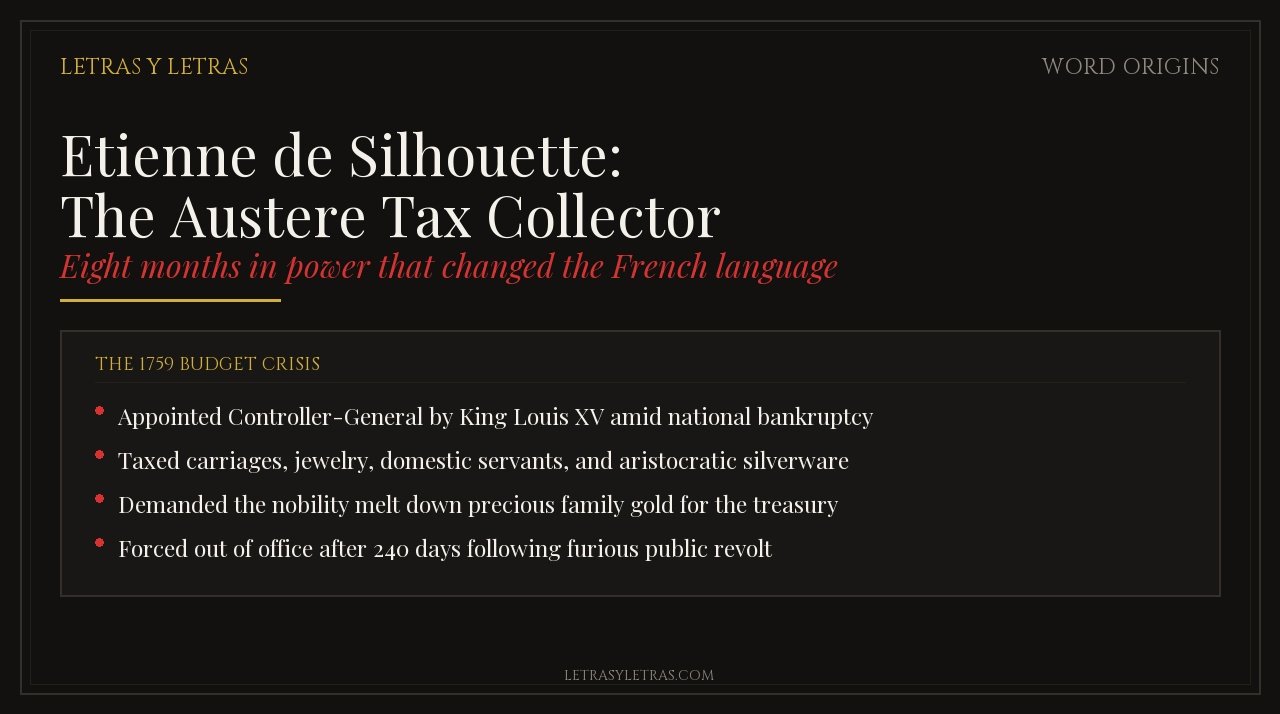
King Louis XV needed a financial miracle. On March 4, 1759, the king appointed Étienne de Silhouette as Controller-General of Finances. Silhouette was an intellectual who had translated English philosophical essays and studied British banking systems.
Louis XV hoped Silhouette could replicate British fiscal efficiency without provoking a civil rebellion. The court expected mild reforms and gentle borrowing. Instead, the newly appointed minister arrived with an economic guillotine.
The Austerity Campaign of Étienne de Silhouette
Étienne de Silhouette realized that France’s financial crisis could not be solved by cosmetic measures. The tax burden already crushed the peasantry and merchant class. The only untapped pools of wealth belonged to the exempt nobility and high clergy.
Within weeks of taking office, Silhouette introduced sweeping fiscal legislation. He imposed direct taxes on luxury estates, carriage horses, domestic servants, and gold plate. He placed duties on luxury hunting dogs, expensive wines, and silk garments.
Most shocking of all, Silhouette demanded that wealthy aristocrats surrender their antique silverware and gold decorations. He proposed that noble families send family plate to the royal mint to be melted into coinage.
Silhouette even ordered members of the royal court to curtail lavish feasts and pension payouts. He declared that while French soldiers froze in military bivouacs, Parisian elites had no right to excessive luxury. His blunt honesty shocked Versailles.
The Satirical Retaliation: À la Silhouette
The French aristocracy had no intention of melting down their family heirlooms. Because the nobility controlled regional parlements and published Paris gazettes, they launched a relentless propaganda campaign against the minister.
Unable to remove him through formal debate, the court turned to mockery. French satirists began using his name as an adjective describing anything cheap, stingy, or pitifully unfinished. If an item was reduced to its bare minimum, people said it was made à la Silhouette.
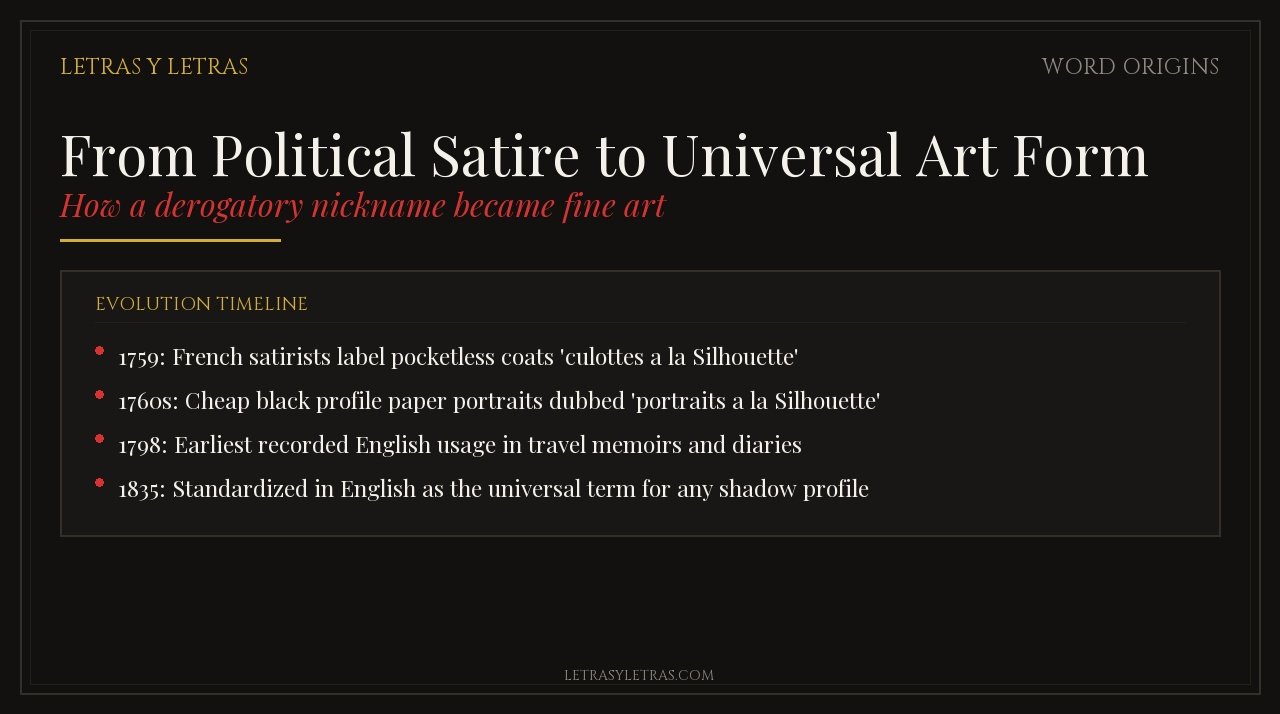
Fashion-conscious Parisian men began wearing plain, dark woolen coats stripped of gold braiding. They mockingly removed sleeve cuffs and deep pockets, claiming that Silhouette had left them no money to carry. These skimpy garments were widely nicknamed culottes à la Silhouette.
Wooden snuffboxes replaced gold cases, and cheap pewter tableware took the place of sterling silver. For months in 1759, Paris society treated the surname as the ultimate punchline for penny-pinching frugality. Like the origin of the word boycott, social ostracism rapidly turned a personal name into slang.
The Rise of Paper Shadow Profiles
The arena where this satirical insult achieved immortality was portraiture. In the mid-eighteenth century, having a portrait made was a slow, exorbitantly expensive luxury. An aristocratic oil painting by a royal academician took months of sittings and cost hundreds of gold livres.
Ordinary citizens, minor shopkeepers, and impoverished students could never afford commissioned canvas portraits. Instead, they visited street limners who used candles to cast a client’s facial shadow onto white paper. The artist traced the outline with graphite and cut the profile from black cardboard or paper with shears.
These paper shadow portraits took less than three minutes to produce. They required no expensive pigments, no canvas, and no master craftsmanship. They cost mere sous instead of gold coins.
When the austerity craze gripped Paris in 1759, aristocrats noticed these cheap paper cutouts. Wealthy elites snidely declared that shadow profiles were the only kind of art fit for Silhouette’s France. They labeled the cutouts portraits à la Silhouette.
The label was meant as an insult. It suggested that a shadow profile was not real art, but merely a skimpy, cheap substitute for a painted masterpiece. Yet the public embraced the name with delight.
Silhouette’s Fall and Final Exile
Étienne de Silhouette’s tenure at Versailles was as brief as it was chaotic. His radical austerity proposals united every powerful faction in France against him. The nobility, the high financiers, the regional parlements, and even the king’s mistress, Madame de Pompadour, demanded his removal.
Recognizing that his minister was politically toxic, Louis XV dismissed Silhouette on November 21, 1759. Silhouette had held office for exactly eight months, or roughly 240 days. Disgraced and ridiculed, he retired to his country estate at Bry-sur-Marne.
In an ironic historical twist, Silhouette spent his retirement cultivating books and practicing the very hobby that carried his name. Visitors to his estate noted that the walls of his study were decorated with framed paper cutouts and shadow profiles.
Silhouette died quietly in 1767. Successors quickly abandoned his reforms, worsening debts that fed the French Revolution thirty years later. Yet while his economic policies vanished, his surname conquered the world.
The Cross-Channel Migration into English
Throughout the late eighteenth century, shadow portraits flourished across Europe under various names. In England and Scotland, artists referred to them as ‘shades’, ‘profiles in miniature’, or ‘black profiles’. Specialized artists traveled between London and Edinburgh cutting likenesses for prominent families.
English travelers visiting post-1789 France brought the French term home. Both the Oxford English Dictionary archives and the Online Etymology Dictionary records date the earliest English print citation to 1798.
Early English travelers used the word with conscious foreign flair, referring specifically to French paper profiles. By the 1830s, the term lost its foreign italics. English writers began applying silhouette broadly to any dark form visible against a brighter background.
The satirical sting of the 1759 French tax revolt disappeared from collective memory. What remained was a graceful, evocative word denoting outlines, horizons, and contrasting light. Readers exploring the origin of the word candidate will notice a similar pattern: political theater often creates lasting everyday vocabulary.
| Year | Historical Actor / Source | Evolutionary Milestone |
|---|---|---|
| 1709 | Étienne de Silhouette Born | Born in Limoges, France; later studies European economics and British law. |
| March 1759 | King Louis XV Appointment | Silhouette named Controller-General of Finances amid severe war debt. |
| Summer 1759 | Parisian Satirists | The phrase ‘à la Silhouette’ coined for cheap, stripped-down goods and shadow art. |
| Nov 1759 | Royal Dismissal | Silhouette dismissed after eight months of aristocratic pushback and public unrest. |
| 1798 | English Print Records | First recorded appearance of silhouette in English travel diaries and essays. |
| 1835 | Universal Standardization | English lexicons define silhouette as any dark outline viewed against light. |
The Psychology of Eponyms
Linguists classify words derived from proper names as eponyms. Silhouette is among the most famous eponyms in speech, standing alongside terms like boycott, sandwich, and chauvinism.
Eponyms reveal how emotional societies become during political crises. When people feel powerless against state authorities, language becomes their sharpest weapon. Satirists attach an official’s name to foolish or cheap items, ensuring that the target suffers public ridicule.
In most cases, political slang dies out once the controversy subsides. Thousands of eighteenth-century political insults vanished without a trace. Silhouette survived because it filled an urgent artistic void.
Before the word silhouette took root, artists struggled with awkward phrases like ‘sciagraphy’ or ‘shadow profilature’. Silhouette sounded exotic, crisp, and French. It provided a single, elegant label for an art form that swept nineteenth-century drawing rooms.
From Paper Cutouts to Modern Visual Culture
During the nineteenth century, silhouette cutting reached its golden age. Master practitioners like Auguste Edouart cut thousands of likenesses across Britain and America, capturing presidents and authors. Many of these delicate paper portraits are preserved in the Metropolitan Museum of Art collection.
When photography emerged in the 1840s with the daguerreotype, critics predicted the death of shadow art. Yet silhouette aesthetics refused to disappear. Instead, visual artists realized that black profile outlines carried unique psychological power.
In cinema, directors used stark silhouettes to convey mystery, danger, and romance. Early twentieth-century animators created entire fairy tales using cut paper silhouettes. Today, graphic designers use vector silhouettes for modern app icons, brand logos, and sports emblems.
When you admire a skyline at sunset, you invoke an eighteenth-century minister who taxed noblemen’s pocketbooks. For additional linguistic explorations, review our detailed guide on english idioms and meanings.
Frequently Asked Questions
What is the origin of the word silhouette?
The word silhouette comes from Étienne de Silhouette, an eighteenth-century French Minister of Finance under King Louis XV. In 1759, his severe austerity policies and luxury taxes angered Parisian aristocrats. They began mocking his frugality by labeling cheap black paper shadow portraits as portraits à la Silhouette.
Who was Étienne de Silhouette?
Étienne de Silhouette was a French author, translator, and royal administrator. In March 1759, he was appointed Controller-General of Finances to resolve national war debt. His aggressive taxation of the wealthy led to fierce public opposition, causing his dismissal after only eight months.
Why were shadow portraits called silhouettes?
In eighteenth-century France, oil paintings were extremely costly and slow to produce. Paper shadow cutouts cost only pennies and took minutes to make. Aristocrats derided these cutouts as cheap art fit only for Silhouette’s austere budget, labeling them with his surname.
When did the word silhouette enter the English language?
The earliest documented appearance of silhouette in English print occurred in 1798 in travel literature. By the 1830s, English writers used it to describe any dark outline or shadow cast against light.
Did Étienne de Silhouette actually cut shadow profiles?
Historical accounts confirm that Étienne de Silhouette practiced paper cutting and collected shadow portraits at his estate in Bry-sur-Marne. However, the term became public slang because of his austere financial reputation rather than his personal artistic talent.
Alan Sledge is the founder and lead writer at letrasyletras.com, dedicated to uncovering the true etymological histories behind our favorite words and phrases.