
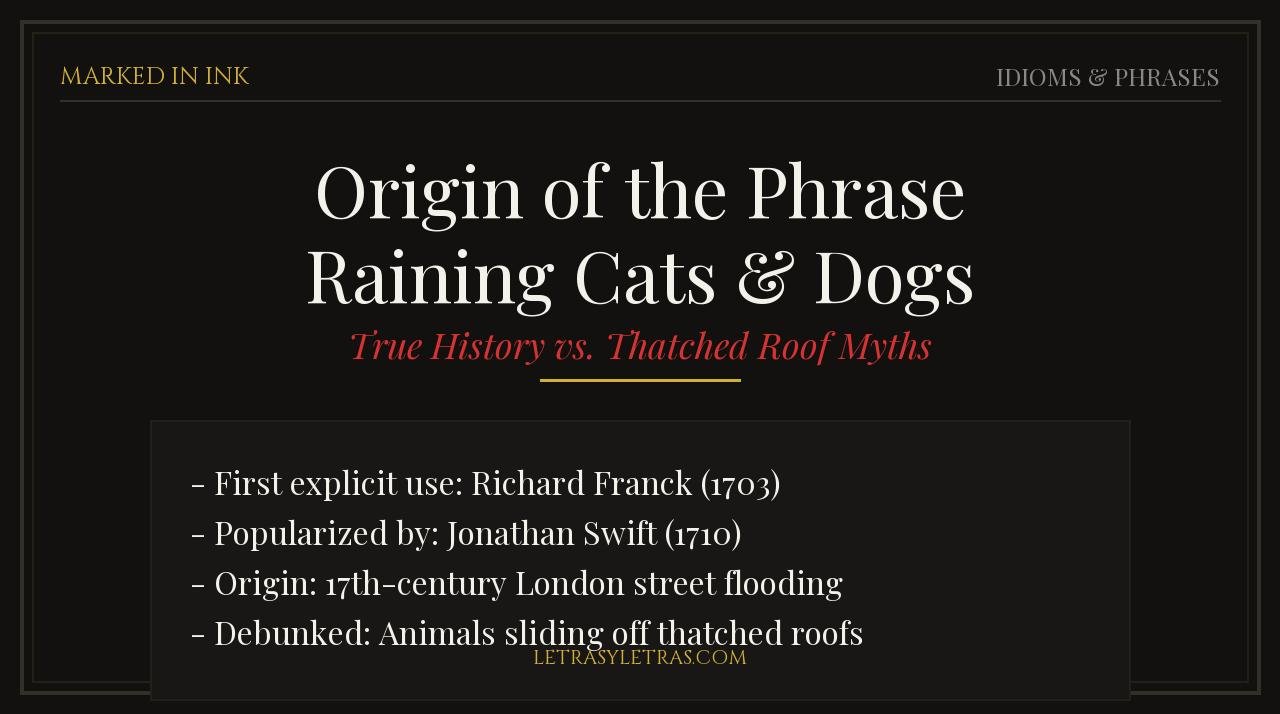
A common myth claims pets in the 1500s fell through thatched roofs during storms. In truth, the origin of the phrase raining cats and dogs is rooted in urban history.
Quick Answer: Origin of the Phrase Raining Cats and Dogs
“Raining cats and dogs” means raining very heavily. The most widely cited early use comes from Jonathan Swift’s 1710 poem A Description of a City Shower. However, an earlier reference appears in Richard Brome’s 1651 play The City Wit, where the phrase “dogs and polecats” appears in a similar context. Popular myths linking the phrase to Norse mythology, the Greek phrase cata doxa, or animals falling from thatched roofs have all been debunked by etymologists and have no documented historical support.
Key Takeaways
- Jonathan Swift’s 1710 poem A Description of a City Shower is the best-known early use.
- Richard Brome used a similar phrase with “dogs and polecats” as early as 1651.
- The Norse mythology theory (Odin’s cats and dogs) has no documented linguistic evidence.
- The Greek cata doxa origin theory is rejected by most etymology scholars.
- The phrase had entered common use in English by the mid-18th century.
Playwright Richard Brome wrote a similar version in 1651. Poet Jonathan Swift popularized the imagery in his 1710 poem A Description of a City Shower. Pets never fell off roofs.
This early citation proves authors associated fierce weather with falling animals. You can trace its usage back centuries. Historical urban life spawned many enduring phrases.
By Alan Sledge | About the Author
The Earliest Recorded Uses in English Literature
Historians look for the earliest printed references to trace English idioms. The exact wording we use today took time to form. Authors tried various animal combinations to describe torrential rain.
The first literary variation comes from English playwright Richard Brome. Brome wrote this in a 1651 comedy titled The City Wit. He predicted it would rain dogs and polecats, which are wild members of the weasel family.
A slightly closer version appeared fifty years later. In 1703, Richard Franck published a work called Northern Memoirs. He mentioned a storm where “it rains cats and dogs.”
However, satirist Jonathan Swift cemented the phrase in public consciousness. Swift published a poem in 1710 called A Description of a City Shower. He vividly described a devastating flood sweeping through London.
Later, in a 1738 publication, Swift wrote the exact idiom. He noted a character would go out into bad weather, sure it would rain cats and dogs. Through Swift’s popularity, the idiom became a permanent fixture.
You can explore more histories in our guide on english idioms and meanings.

The Dirty Streets of 17th-Century London
To grasp the origin of the phrase raining cats and dogs, picture 1600s London. The city lacked a modern sewage system. Open gutters ran down narrow, unpaved streets.
During heavy rainfall, these crude drainage channels quickly overflowed. Flash floods created torrents of filthy water. The city had many stray animals, which often succumbed to disease or starvation.
When a severe storm hit, rushing waters carried their carcasses through the streets. To a pedestrian, it literally looked like it rained dead cats and dogs. This macabre sight left a lasting impression on London residents.
Jonathan Swift drew upon this grim reality for his writing. His poem detailed the trash and animal remains washing through the city. The literal washing away of animals became a figurative expression for heavy rain.
If you find this historical context fascinating, check out another article. You might enjoy reading about the origin of the phrase caught red handed. Historical urban life often spawned our most enduring phrases.

Debunking the Thatched Roof Myth
Perhaps the most widespread myth involves thatched roofs. This theory circulates endlessly on social media and chain emails. It claims that pets slept on roofs of peasant cottages to stay warm.
The story goes that when it rained heavily, the thatch became slippery. Animals would lose their footing and slide off the roof. Thus, it appeared to be raining cats and dogs.
Historians and etymologists have thoroughly discredited this narrative. First, thatched roofs were tightly woven and highly waterproof. Dogs do not typically climb onto roofs anyway.
While a cat might climb a roof, the idea of multiple pets congregating there defies animal logic. The physics behind this myth simply do not hold up to scrutiny.
The Norse Mythology Connection
Another popular theory links the origin to Norse mythology. This explanation leans on the symbolic associations of ancient gods. Odin, the god of storms, was often depicted with wolves or dogs.
In maritime folklore, dogs were allegedly associated with the wind. Witches, who supposedly rode storms, were pictured as black felines. Therefore, a severe storm combining high winds and rain represented a clash between animals.
While this sounds poetic, linguists have found zero evidence to support it. The transition from ancient Norse beliefs to 17th-century English slang lacks any stepping stones.
This theory tries to inject ancient mystique into a phrase born from urban squalor. The truth is often grittier than mythology. You can see similar mythological fabrications in the origin of the phrase break a leg.
The Greek Kata Doxa Theory
Linguists love to hunt for foreign root words. Some scholars suggested the phrase might be a corruption. They pointed to the Greek expression “cata doxa.” This translates to “contrary to experience” or “unbelievable.”
The hypothesis argues that scholars borrowed “cata doxa” for unbelievable rainstorms. Over time, the uneducated public mispronounced “cata doxa” as “cats and dogs.” This linguistic corruption is known as an eggcorn.
Etymologists quickly shot this theory down. The leap from an obscure academic Greek term to street vernacular is highly improbable. This phrase first appeared in comedies aimed at the general public.
Richard Brome’s use of “dogs and polecats” completely invalidates the “cata doxa” theory. If the phrase started as a Greek mispronunciation, including “polecats” makes no phonetic sense. The Greek theory is a classic example of over-analyzing a simple idiom.
Historical Weather Patterns in Great Britain
To understand why the British needed vivid metaphors for rain, look at their climate. The British Isles are famous for unpredictable and damp weather. Our language features dozens of phrases dedicated to rain.
When a true deluge occurs, it requires a phrase with impact. The imagery of falling animals provided the necessary dramatic effect. This century also coincided with the Little Ice Age.
Weather patterns across Europe became increasingly erratic and severe. Extremely harsh winters were followed by torrential spring rains. These severe weather events made a deep impression on writers.
The need to articulate sheer volume of water led to colorful exaggerations. You will find similar linguistic creativity in our collection of famous quotes and quotations.
Similar Phrasing in Other Languages
English is not the only language using bizarre imagery to describe heavy rain. Exploring how other cultures express this concept highlights human creativity. Exaggerated weather metaphors are a universal phenomenon.
In Welsh, people say something odd. They mention raining old ladies and sticks. This imagery is arguably stranger than falling pets.
In French, people mention ropes. They say it is raining ropes, as heavy, continuous rain can look like thick cords. The French also say “il pleut comme une vache qui pisse.”
The Dutch use words for raining pipe stems. In Spanish, they talk about raining toads and snakes. This desire to compare heavy rain to falling objects crosses all boundaries.
Why the Idiom Endures Today
Language is constantly shifting, yet some idioms remain stubbornly fixed. The origin of the phrase raining cats and dogs is rooted in a bygone era. Why do we still use it?
The primary reason is its striking visual absurdity. Visualizing household pets tumbling from storm clouds is inherently amusing. It provides a touch of humor to otherwise miserable weather.
Additionally, the rhythm of the phrase is satisfying to speak. The crisp consonants in “cats” and “dogs” create a sharp sound. It rolls off the tongue easier than “a torrential downpour.”
Idioms are learned through cultural osmosis. Parents pass them down to children, generation after generation. For more examples, check out the origin of the phrase peanut gallery.
How to Use Raining Cats and Dogs in Writing
While the phrase is universally understood, it is considered informal. It belongs in conversational English, creative writing, or lighthearted journalism. You would not use it in a formal scientific report.
For example, a novelist might write about canceled plans. They would blame it on raining cats and dogs. A blogger could type about getting caught in a storm.
Because it is considered a cliché, writers should use it sparingly. Relying too heavily on established idioms can make prose feel unoriginal. Sometimes describing the actual physical sensation of the rain is more effective.
If you are curious about other informal expressions, read about the origin of the phrase bless you. You might also enjoy the origin of the word sandwich. They all share similar journeys from historical moments to everyday speech.
Frequently Asked Questions
Why do we say it is raining cats and dogs?
We use the phrase to describe exceptionally heavy rainfall. The expression originated in 17th-century London. Severe rainstorms washed dead stray animals through the city’s open drainage gutters.
Who first said raining cats and dogs?
The earliest recorded version was written by playwright Richard Brome in 1651. He wrote it as “raining dogs and polecats.” The modern phrasing appeared in Richard Franck’s 1658 work titled Northern Memoirs.
Did cats and dogs fall from thatched roofs?
No, this is a very common myth. Thatched roofs were tightly woven and waterproof. Dogs do not climb onto roofs, and animals would not congregate there during a storm.
Is raining cats and dogs a metaphor or idiom?
It is primarily classified as an idiom. An idiom is a phrase whose meaning cannot be understood from literal definitions. It functions as a figurative expression for a heavy downpour.
Did Jonathan Swift invent the phrase raining cats and dogs?
No, Jonathan Swift did not invent the phrase, but he popularized it. He used the imagery in his 1710 poem A Description of a City Shower. He explicitly wrote the phrase in a 1738 publication.
Keep Exploring Linguistic History
The origin of the phrase raining cats and dogs reminds us that language is rarely neat. It grows out of the messy experiences of everyday people. The grim reality of 17th-century urban flooding is the true source of this linguistic quirk.
The next time you find yourself caught in a sudden downpour, appreciate the history behind the words you use. Our vocabulary is a living museum, preserving the sights and struggles of our ancestors.
If you enjoyed learning about the origin of the phrase raining cats and dogs, share this article with your friends. Stay curious, keep reading, and always ask questions about the words you speak every day!
Sources: Online Etymology Dictionary | Merriam-Webster dictionary


Alan Sledge is the writer and founder behind Letters & Letters. A lifelong lover of words, Alan has always been drawn to the small mysteries hidden in everyday language, why we say what we say, where our favorite sayings came from and the quotes that manage to put feelings into words better than we ever could ourselves.

Alan Sledge
Alan Sledge is the founder and lead researcher behind Letters & Letters. A lifelong student of linguistic history, he cross-references every word origin, idiom, and quote against primary archival manuscripts, the Oxford English Corpus, and 18th-century print lexicons.