
Ancient stargazers scanned the night sky for signs of celestial wrath. A streak of crimson light across the dark firmament signaled impending doom. Planetary alignments decided the fate of empires, harvests, and newborn princes.
Today, our modern vocabularies use disaster to name cataclysmic earthquakes, shipwrecks, financial crashes, and structural collapse. We view these crises through geology, engineering failures, or economic volatility. Few people realize that every utterance of this grim noun evokes medieval astrology.
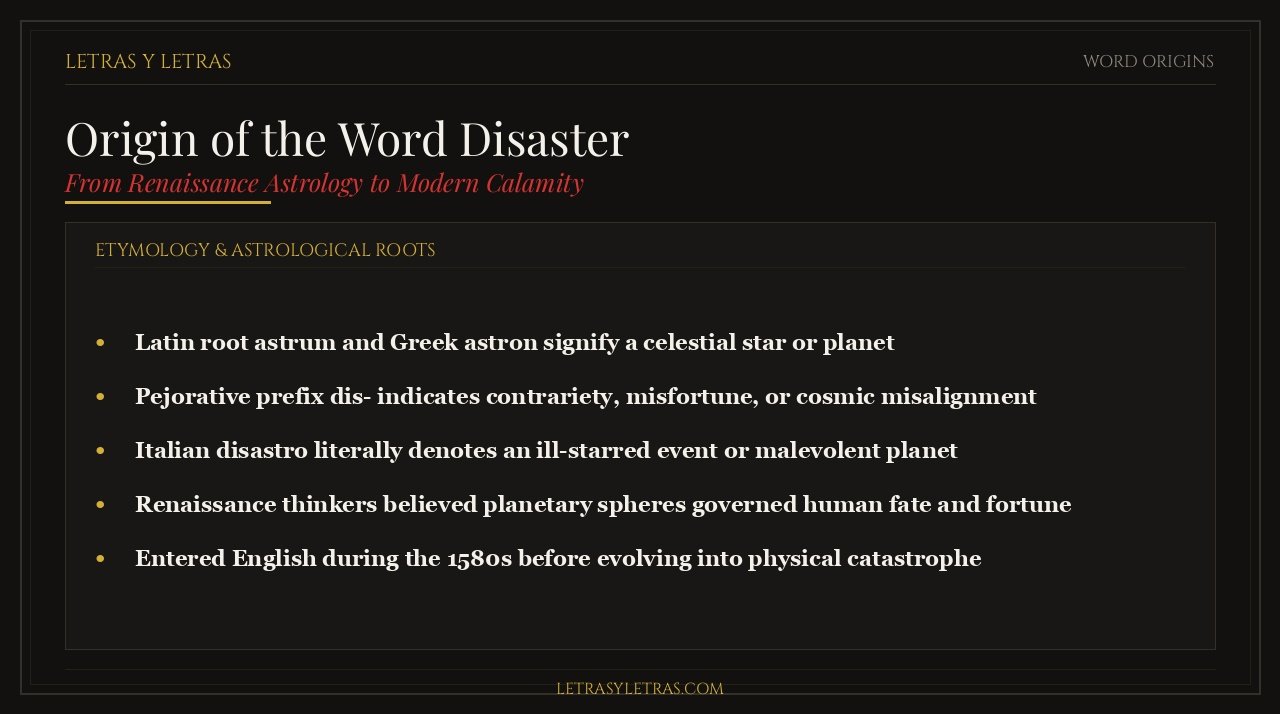
Etymologically, disaster literally translates to an unfavorable star. It unites a pejorative Latin prefix with an ancient Greek root for celestial bodies. The word preserves a forgotten era when human suffering was blamed upon planetary malice.
Quick Answer: Origin of the Word Disaster
The word disaster originated in sixteenth-century European astrology, entering English from Middle French desastre and Old Italian disastro. The term derives from the pejorative prefix dis-, signifying contrariety or malice, combined with the Latin noun astrum, borrowed from Greek astron meaning star. Etymologically, disaster literally signifies an ill-starred event or a calamity caused by an unfavorable planetary alignment. Renaissance physicians and astrologers believed the macrocosm of orbiting planets directly governed human health and political fortunes. When sudden catastrophes, plague epidemics, or military defeats struck, people attributed the ruin to malevolent stellar configurations. William Shakespeare popularized the concept in Elizabethan theater before the Scientific Revolution secularized the word into our universal term for physical destruction.
Key Takeaways
- Disaster derives from pejorative prefix dis- and Greek root astron, literally meaning ill star.
- Italian Renaissance writers coined disastro to explain sudden misfortune via planetary influence.
- Elizabethan playwrights adopted the term during the late 1580s for dramatic tragedies.
- The Scientific Revolution decoupled the word from astrology, turning it into physical destruction.
- Modern speech uses disaster universally for natural hazards, structural ruin, and personal failure.
The Modern Catastrophe: How Ancient Skies Shape Modern Speech
Modern society defines catastrophes through physical laws and empirical observations. Seismologists track fault lines to measure tectonic shockwaves. Meteorologists deploy radar satellites to monitor rotating tropical hurricanes.
Our ancestors possessed no sensitive seismographs or atmospheric satellites. When sudden destruction shattered their villages, they looked upward for explanations. They sought causes within the cold, silent mechanics of the revolving night sky.
Linguistic records in the Merriam-Webster dictionary define disaster as a sudden calamitous event bringing great damage. The lexicographical history traces the noun directly to astrological ill stars. Language preserves ancient cosmological instincts long after religious and scientific frameworks evolve.
Every time we utter the word disaster, we invoke medieval celestial fatalism. We echo the anxieties of Renaissance merchants whose fortunes rose and fell beneath unpredictable skies. The vocabulary of human tragedy remains bound to distant celestial bodies.
Classical Roots: Greek Astron and Latin Astrum
To uncover the etymological machinery of disaster, one must examine classical antiquity. The Greek noun astron signified any bright star, shining constellation, or celestial body. Ancient Greek astronomers used the term to map the fixed patterns of the northern hemisphere.
From this foundational root, Hellenic scholars built an extensive scientific vocabulary. Words like astronomy, astrophysics, astronaut, and asteroid all trace their lineages back to astron. The Greeks viewed stars as eternal, mathematical markers of cosmic order.
Roman scholars adopted the Greek concept, translating it into the Latin noun astrum. Latin poets used astrum to describe glorious heavenly heights. Classical writers frequently spoke of rising to the stars to achieve immortal fame.
Scholars at the Online Etymology Dictionary trace the noun to Latin astrum. In classical Rome, the star represented divine grandeur and mathematical perfection. To fall from stellar favor was to invite total personal ruin.
The Pejorative Prefix: How Dis- Distorts the Heavens
The root word for star required a powerful partner to produce catastrophe. That partner was the classical prefix dis-. In Latin grammar, dis- functioned as an indicator of separation, reversal, privation, or contrariety.
Prefixing dis- to an existing noun or verb corrupted its positive qualities. Order became disorder through chaotic fragmentation. Harmony disintegrated into discord when voices clashed in bitter dispute.
When Renaissance scholars attached dis- to astrum, they created a compound noun. The literal construction signified an ill star, a contrary star, or a malevolent celestial omen. It denoted an event that unfolded contrary to favorable astrological alignments.
The prefix transformed a glorious celestial body into an active agent of misfortune. A person suffering a calamity was not merely unlucky in earthbound affairs. That unfortunate individual was experiencing the direct, hostile opposition of cosmic forces.
Renaissance Astrological Determinism: Macrocosm Meets Microcosm
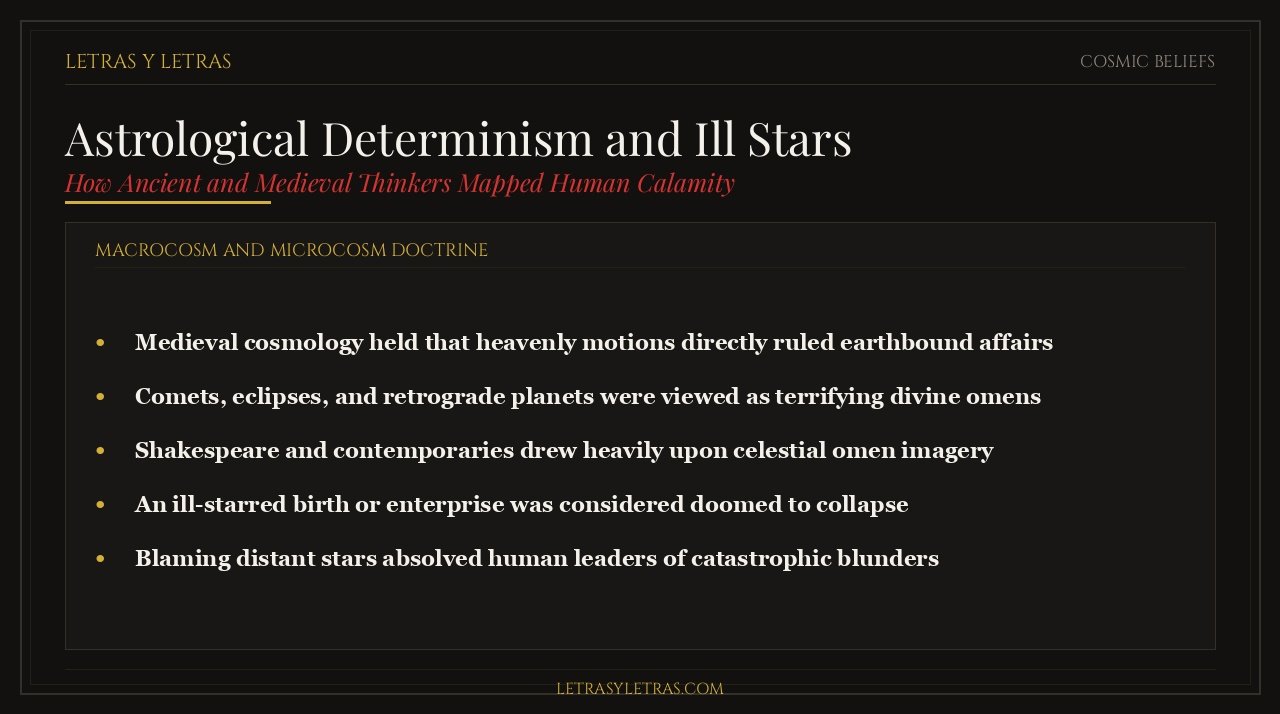
To understand why this linguistic pairing gained universal popularity, one must examine Renaissance intellectual culture. During the fourteenth and fifteenth centuries, European thinkers embraced the doctrine of correspondence. This philosophy held that the macrocosm of the heavens directly mirrored the microcosm of human existence.
Kings, popes, and military commanders routinely employed court astrologers before launching campaigns. Royal physicians checked planetary tables before bleeding patients or administering herbal medicines. Medical doctrine held that bodily humors fluctuated according to lunar phases and planetary conjunctions.
Historical analysis from the British Library Shakespeare collection illustrates how pervasive astrology was in daily life. Elizabethans regarded comets, eclipses, and retrograde planetary cycles as terrifying heavenly portents. The heavens did not simply observe human affairs, but actively dictated their outcomes.
When sudden catastrophe struck an Italian city, citizens rarely sought naturalistic causes. A sudden outbreak of bubonic plague was attributed to poisonous vapor stirred by Saturn. Military routs were blamed on Mars entering an unfavorable planetary house.
Blaming the heavens served an important psychological and political function for ruling elites. Monarchs could explain away catastrophic military miscalculations by citing unbeatable cosmic forces. The stars absorbed human accountability, providing a grand cosmic excuse for devastating failure.
The Italian Coining: Disastro and Court Astrologers
The precise lexical form that birthed our modern word emerged in northern Italy. Italian scholars and court poets coined the noun disastro during the fourteenth century. The vibrant intellectual centers of Florence, Venice, and Milan embraced astrological study with passionate devotion.
Italian astrologers developed elaborate natal charts for noble patrons. An unfavorable configuration of Saturn and Mars was classified as a malevolent omen. When a prince suffered sudden illness or bankruptcy, astrologers recorded the misfortune as a literal disastro.
From the Italian peninsula, the sophisticated cultural term radiated across western Europe. French humanists adopted the word during the sixteenth century, Gallicizing it into désastre. Their literary treatises used the term to describe ruinous political collapses and tragic royal downfalls.
By the late sixteenth century, the word had crossed the English Channel. English translators, eager to enrich their native vernacular with Continental terminology, embraced the evocative loanword. It arrived in London during a period of unprecedented literary experimentation.
Shakespeare and the Ill-Starred Elizabethan Stage
No writer did more to weave astrological vocabulary into the English language than William Shakespeare. The Elizabethan playwright was deeply attuned to the astrological superstitions of London audiences. He filled his greatest tragedies with celestial metaphors, doomed stars, and planetary portents.
In the opening prologue of Romeo and Juliet, Shakespeare famously dubs the young lovers star-crossed. Their tragic demise is not merely a social conflict between rival families. This tragic fate is written across the unforgiving celestial firmament before the first scene begins.
In King Lear, the villain Edmund mocks his society obsession with stellar scapegoating. Edmund derides men who blame planetary compulsion for their own wicked choices and foolish errors. Shakespeare dialogue demonstrates that intellectuals were already questioning blind astrological determinism.
Shakespeare explicitly deployed the noun disaster in Hamlet to describe ominous cosmic portents. Horatio recalls strange omens that preceded the fall of Julius Caesar in ancient Rome. He speaks of dews of blood, fiery comets, and disasters in the sun.
Through London public theaters, the term penetrated everyday English conversation. Audiences who heard the word on stage adopted it into their own speech. Disaster became the definitive dramatic descriptor for overwhelming human catastrophe.
The Scientific Revolution and the Secularization of Calamity
During the seventeenth and eighteenth centuries, the intellectual landscape of Europe experienced a profound change. The Scientific Revolution fundamentally severed astronomy from its astrological origins. Nicolaus Copernicus demonstrated that the earth orbited the sun, dismantling geocentric cosmology.
Johannes Kepler formulated mathematical laws of planetary motion, replacing mystical influences with geometric precision. Galileo Galilei trained his optical telescope on Jupiter, discovering orbiting moons that shattered traditional celestial spheres. Isaac Newton published his universal law of gravitation, establishing that physical matter follows mechanical laws.
As empirical science advanced, educated society abandoned literal belief in astrological malice. Educated observers no longer believed that Saturn cast evil rays upon newborn infants. Planetary conjunctions were recognized as predictable mechanical cycles rather than divine harbingers of doom.
Yet while astrology faded into popular superstition, the word disaster remained firmly entrenched. Languages rarely discard powerful, evocative words simply because underlying scientific theories change. Instead, words undergo semantic secularization, retaining emotional force while acquiring physical meanings.
By the nineteenth century, disaster referred strictly to material events rather than stellar curses. Shipwrecks, volcanic eruptions, coal mine explosions, and railway collisions were labeled disasters. The ill star became a dead metaphor, hidden inside an everyday noun.
Chronological Milestones in the History of Disaster
The historical timeline below summarizes the major linguistic, philosophical, and scientific milestones in the evolution of the word disaster:
| Historical Era | Linguistic Source | Literal Meaning | Cultural Significance |
|---|---|---|---|
| Classical Greece | Greek noun astron | Star, constellation, heavenly body | Establishes the foundational astronomical root across Mediterranean languages. |
| Roman Empire | Latin noun astrum | Star, celestial sphere, glory | Connects celestial bodies with divine honor and lofty heavenly heights. |
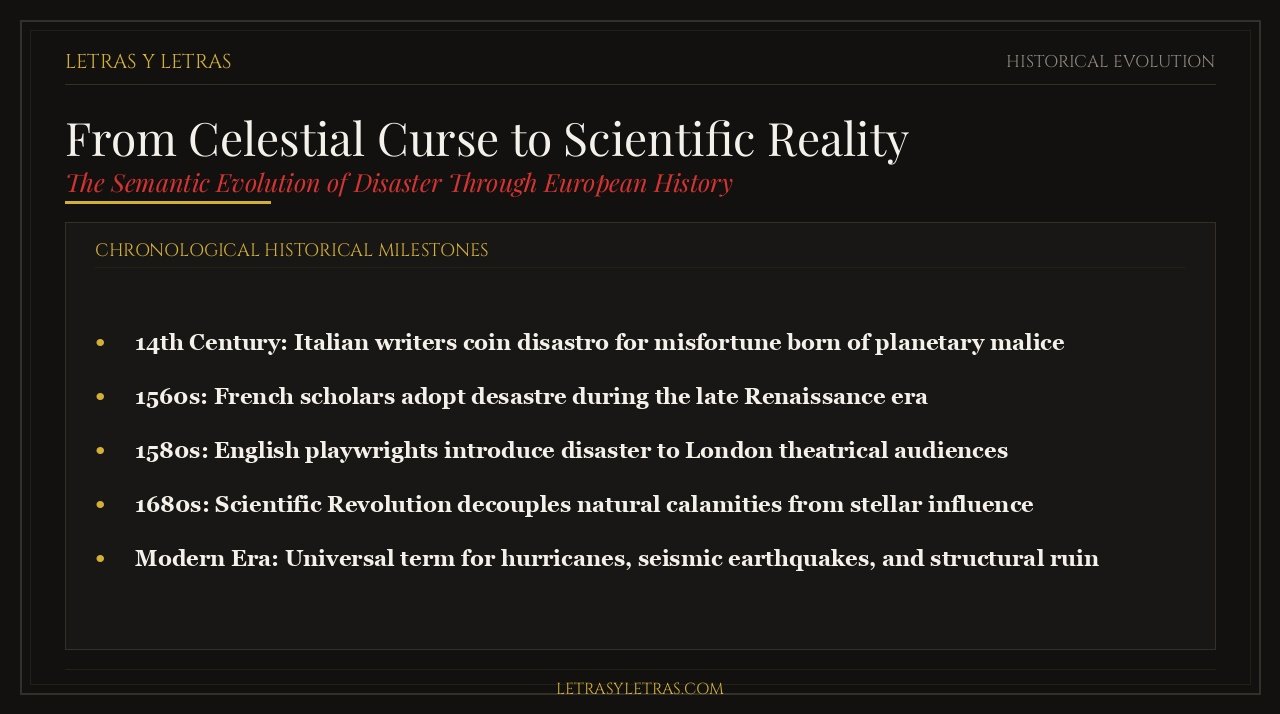
| 14th Century | Old Italian disastro | Ill star, malevolent planetary alignment | Coined by Renaissance astrologers to explain sudden aristocratic ruin. |
| 1560s | Middle French désastre | Ruinous misfortune, adverse star | Spreads through Continental political discourse and Renaissance poetry. |
| 1580s to 1600s | Elizabethan English disaster | Star-crossed calamity, cosmic portent | Popularized by Shakespearean theater and London dramatic poetry. |
| 1700s to 1800s | Scientific Enlightenment | Physical catastrophe, natural ruin | Decouples from astrology to describe earthquakes, fires, and industrial accidents. |
| 20th Century to Present | Modern Global English | Total failure, systemic collapse | Universal term applied to natural hazards, financial panics, and personal blunders. |
Debunking Common Myths About the Origin of Disaster
Because disaster is such a familiar word, folklore has generated several erroneous explanations regarding its birth. Examining historical linguistics dispels three persistent myths:
The primary myth claims the word originated from naval shipwrecks caused by sailors misreading navigational stars. Proponents claim that losing sight of guiding stars was called a dis-aster. While poetic, maritime archives confirm the term existed in Italian astrology centuries before naval navigational manuals appeared.
A second myth asserts that disaster was invented by medieval physicians to describe eye cataracts that resembled cloudy stars. While Latin medical texts used stellar metaphors, they never used disastro for ocular pathology. The word was exclusively astrological in origin.
A third myth claims the word entered English during the Great Fire of London in 1666. Official city documents prove the word had already circulated in print for nearly a century. William Shakespeare used the noun decades before the Great Fire consumed London timbered streets.
We saw similar folk myths debunked in our origin of the phrase crocodile tears guide. Popular imagination frequently invents dramatic nautical or medical tales to explain peculiar words.
The Psychological Comfort of Blaming the Stars
Why did humanity cling to astrological fatalism for so many centuries? The answer lies in human cognitive psychology and our deep aversion to randomness. Unpredictable suffering is difficult for the human mind to endure without assigned meaning.
When drought destroys crops or a plague strikes a household, people crave a grand narrative. Believing that distant, majestic celestial spheres caused the ruin provides cold psychological solace. Cosmic malice feels less terrifying than meaningless, chaotic coincidence.
Disaster provided our ancestors with an external scapegoat for agonizing pain. It allowed suffering communities to endure catastrophic loss without succumbing to existential despair. If the stars ordained the tragedy, human beings could only bow their heads and endure.
We explored enduring reflections on fortitude and inner resolve in our curated quotes on discipline collection. Governing immediate reactions in the face of sudden adversity is the true mark of character.
Uncompromising honesty with oneself is essential when overcoming sudden misfortune. Discover ancient standards of truth in our origin of the word sincere investigation. True renewal demands unadulterated integrity.
Human beings often carry hidden points of critical vulnerability that invite catastrophic collapse. Explore mortal fragility in our analysis of the origin of the phrase Achilles heel. Identifying vulnerabilities prevents tragic downfall.
Leadership also crumbles when stubborn pride refuses to acknowledge reality. Review high-stakes Bronze Age governance in our meaning of the name Agamemnon study. Stubborn obstinacy inevitably breeds disaster.
Recreational gambling often evolved into universal warnings of peril. Trace medieval dice games in our origin of the word hazard investigation. Reckless pursuits carry lasting consequences.
Superstition and spatial language also reveal cultural shifts over time. Examine Roman left-hand omens in our origin of the word sinister study. Words evolve unexpected meanings across centuries.
Decisive collective action can also overturn oppressive circumstances. Consider how collective resolve forged an international verb in our origin of the word boycott history. United resistance transforms reality.
Facing adversity directly requires raw willpower and sudden behavioral commitment. Learn how withdrawal medicine forged a universal idiom in our origin of the phrase cold turkey guide. Enduring pain often opens the path to renewal.
Tranquil retreats provide the ultimate contrast to turbulent worldly ruin. Explore ancient Persian walled gardens in our origin of the word paradise reflection. The human spirit constantly strives toward peace and renewal.
Frequently Asked Questions
What is the literal meaning of the word disaster?
The word disaster literally means an ill star, combining pejorative prefix dis- with Greek root astron.
Where did the word disaster originate?
The word originated in fourteenth-century Italy as disastro, used by Renaissance astrologers to explain sudden aristocratic ruin through planetary conjunctions.
When did disaster enter the English language?
Disaster entered English during the 1580s, borrowed from Middle French désastre and Old Italian disastro.
How did William Shakespeare use the word disaster?
Shakespeare used disaster in Hamlet to describe ominous cosmic portents and drew upon star-crossed celestial imagery in Romeo and Juliet.
When did disaster lose its astrological meaning?
Disaster lost its astrological meaning during the Scientific Revolution, evolving into our modern term for physical destruction.
What other English words share roots with disaster?
Related words include astronomy, asteroid, astronaut, asterisk, and astrophysics, all deriving from Greek root astron meaning star.
Alan Sledge is the lead writer at letrasyletras.com, uncovering historical wisdom and word origins.


Alan Sledge is the writer and founder behind Letters & Letters. A lifelong lover of words, Alan has always been drawn to the small mysteries hidden in everyday language, why we say what we say, where our favorite sayings came from and the quotes that manage to put feelings into words better than we ever could ourselves.

Alan Sledge
Alan Sledge is the founder and lead researcher behind Letters & Letters. A lifelong student of linguistic history, he cross-references every word origin, idiom, and quote against primary archival manuscripts, the Oxford English Corpus, and 18th-century print lexicons.