
The origin of the word berserk brings to mind fierce Viking warriors. However, the origin of the word assassin reveals a different history. This term began as a religious slur against a medieval Persian sect.
Quick Answer: Origin of the Word Assassin
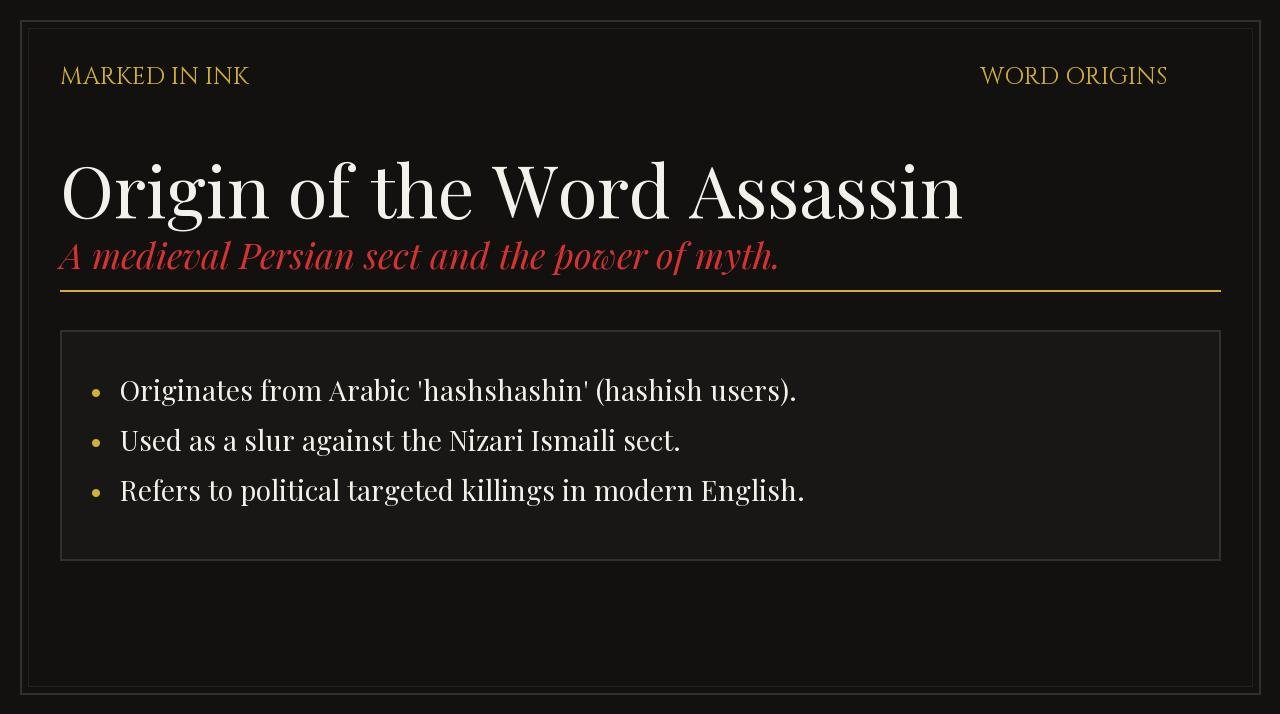
The word assassin originates from the Arabic term hashshashin, which means hashish users. It was initially used as a derogatory slur by the enemies of the Nizari Ismaili sect, a medieval Muslim group based in Persia and Syria. Although opponents claimed the sect’s fighters were drugged before carrying out targeted killings, modern historians widely dismiss this as fabricated propaganda. Marco Polo popularized this myth in Europe, and the word gradually evolved from a specific insult into a general term for anyone who commits a politically motivated murder.
Key Takeaways
- The word assassin comes from the Arabic ‘hashshashin’, meaning hashish users.
- It was used as propaganda against the Nizari Ismaili sect.
- The sect used targeted elimination as a defense against larger armies.
- Marco Polo helped spread the myth of the drug-fueled fighters in Europe.
- The word entered English in the 16th century to mean a political murderer.
Many people believe the word connects to hashish use. This theory is highly debated among modern historians. The truth involves the Nizari Ismaili sect, led by Hasan-i Sabbah.
They were a small but formidable group facing much larger enemies. To survive, they used targeted elimination rather than open warfare. Their enemies spread rumors about them.
European Crusaders carried those stories back home. The origin of the word assassin is a classic example of propaganda. It shows how enemies can shape language.
The Foundation of the Nizari Ismaili State
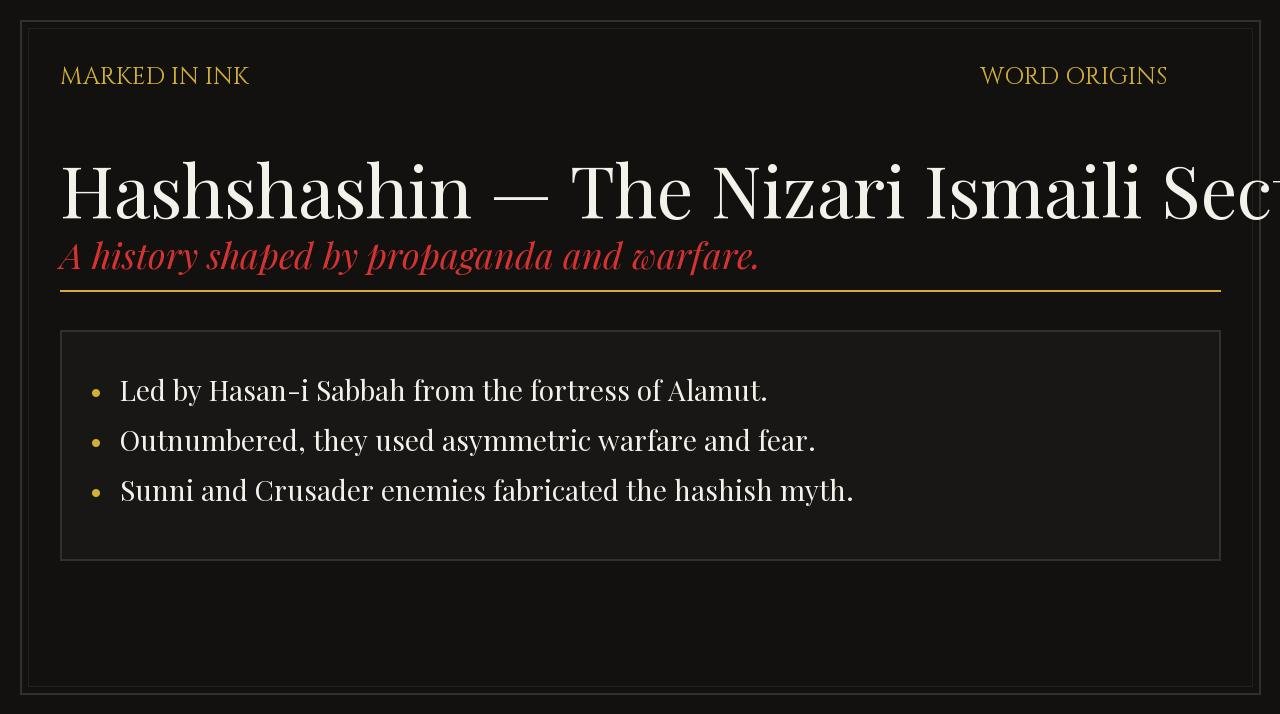
Hasan-i Sabbah was a brilliant strategist and religious leader. In 1090, he captured the fortress of Alamut without shedding blood. This mountain stronghold became the center of an independent state.
Surrounded by hostile Seljuk Turks, Hasan knew his small group was vulnerable. They could not survive a traditional war. He trained a specialized corps of fighters called fida’is.
These men were willing to sacrifice their lives. They fought for their faith and their leader. The fida’is were exceptionally patient and disciplined.
They would spend months infiltrating their targets. When the time was right, they would strike publicly. This sent a clear message to their enemies.
They rarely attempted to escape. Most fighters believed their death was a martyrdom. This level of dedication terrified the Seljuks and later the Crusaders.
The fear they inspired was their primary weapon. It kept much larger armies at bay for nearly two centuries. You can find more fascinating word histories on our site.
For instance, the origin of the word salary connects to ancient military practices. The story of Alamut is unique. This fortress was a center of learning with a massive library.
Nizari leaders were highly educated. They patronized scholars and scientists. This intellectual vibrancy contradicts the image of mindless killers.
Marco Polo and the Myth
Enemies of the Nizari Ismailis used the term hashshashin. This Arabic word means hashish users. They claimed the fighters consumed hashish before their missions.
Historical evidence suggests this was entirely fabricated. The sect’s enemies wanted to delegitimize their religious devotion. By labeling them drug addicts, opponents stripped away their political validity.
When Marco Polo passed through the region later, he recorded these tales. His writings popularized the hashish story in Europe. Marco Polo is largely responsible for cementing this myth.
In his famous book, Polo described an ancient mountain leader. This leader supposedly used a secret garden to brainwash young men. Polo claimed the leader would drug the youths.
He transported them to a beautiful garden filled with wine. When they awoke, they believed they were in Paradise. The leader would then drug them again.
He told them the only way to return was to die. This dramatic story is almost entirely fiction. Modern historians point out that Marco Polo visited much later.
He was likely repeating local legends. The Nizari Ismailis were strict Muslims who forbade intoxicants. Today, the Merriam-Webster dictionary notes the Arabic root.
From Slur to Standard Vocabulary
The myth was too good to let go. It captured the imagination of medieval Europe. The mystery of these fighters became a popular trope.
Dante mentions them in the Inferno. The word slowly lost its specific connection to the sect. It became a general noun over time.
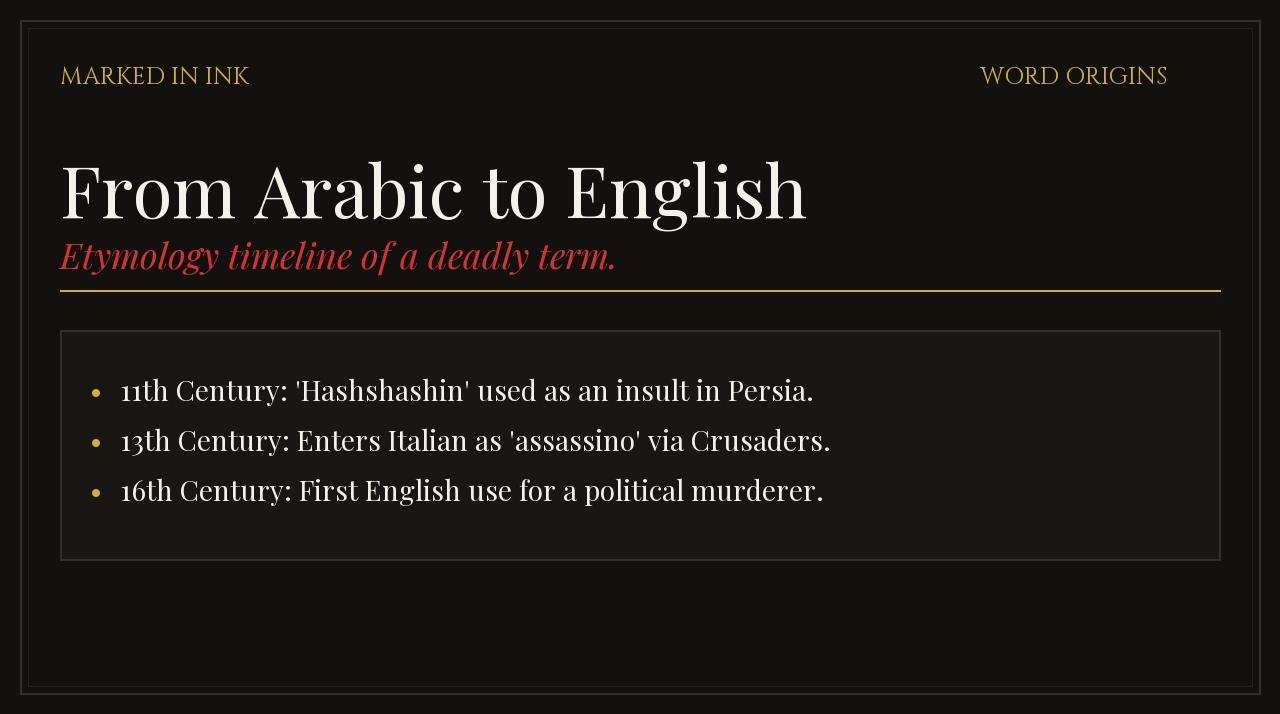
The history of this transition reveals much about European fears. It first appeared in European languages in the 13th century. Early French and Italian texts used it to describe the sect.
The Crusaders had direct contact with the Syrian Nizaris. Rashid al-Din Sinan led this group. He skillfully played the Crusaders and Muslim forces against each other.
By the time the word entered English, its meaning broadened. An English writer in the 1520s used it for a murderer. The focus shifted from the killer’s identity to the crime.
This shift is common in language. We see similar patterns when exploring english idioms and meanings. Specific historical events often leave behind generalized vocabulary.
The Erasure of History
The transition from a proper noun took several centuries. It reflects the gradual forgetting of the real people. Today, we use the term freely to describe targeted murder.
We rarely think about the complex religious disputes. The Nizari Ismaili state finally fell in 1256. Mongol leaders viewed the mountain fortresses as a threat.
Hulagu Khan led a massive army against them. The Nizaris could not withstand the Mongol siege engines. Their leader surrendered Alamut in hopes of sparing his people.
The Mongols systematically dismantled the fortresses. Most tragically, they burned the great library of Alamut. Countless texts on theology and science were destroyed.
This act ensured the Nizari perspective was lost. They were forced into hiding for centuries. We are left only with accounts written by enemies.
This one-sided history is why the myth survived. When reading accounts, we must ask who wrote them. Sunni scholars wanted to paint them as dangerous heretics.
Crusaders wanted to depict them as exotic villains. Neither group had any interest in recording the truth. If you look at the origin of the phrase caught red handed, you see similar trends.
Modern Usage and Cultural Impact
In recent decades, modern historians have re-evaluated this history. By examining texts, they are piecing together a better picture. They have shown the Nizaris were not a cult.
They were a resilient community struggling to survive. Their use of targeted elimination was a calculated military strategy. Scholars emphasize the sect’s intellectual contributions today.
The Nizari Ismailis still exist as a peaceful Muslim community. Their modern identity stands in stark contrast to dark legends. This historical correction is vital for true knowledge.
The way we use language matters deeply. Words carry the weight of their history. When we use this term, we repeat old propaganda.
It is a reminder that language is often a battlefield. To further explore how language shapes reality, check out famous quotes and quotations. Today, the word is ubiquitous in news and media.
It appears in movies and video games frequently. These stories have spawned massive pop culture franchises. This popularity speaks to our fascination with secrecy and danger.
However, the legal definition of the word remains serious. A targeted killing implies a political motive. This distinction traces back to the original fida’is.
They only targeted powerful leaders. Modern political killers are universally condemned. The evolution of the word highlights the fluid nature of language.
FAQ
Did the original assassins really use hashish?
Most historians agree that the hashish story is a myth. The term hashshashin was used as a derogatory insult. There is no reliable evidence they consumed drugs.
Who was the Old Man of the Mountain?
This was a title used by the Crusaders. They used it to describe the leader of the Syrian branch. He was a brilliant strategist who maintained independence.
When was the word assassin first used in English?
The word first appeared in English texts in the 1520s. It was originally used to describe the specific Middle Eastern sect. It quickly broadened to mean any murderer.
Does the Nizari Ismaili sect still exist?
Yes, they are a vibrant Muslim community today. They are known for their philanthropic work around the world. They have completely moved past their turbulent history.
If you enjoyed learning about this historical mystery, please share this guide! We hope you loved reading it. Happy reading!


Alan Sledge is the writer and founder behind Letters & Letters. A lifelong lover of words, Alan has always been drawn to the small mysteries hidden in everyday language, why we say what we say, where our favorite sayings came from and the quotes that manage to put feelings into words better than we ever could ourselves.

Alan Sledge
Alan Sledge is the founder and lead researcher behind Letters & Letters. A lifelong student of linguistic history, he cross-references every word origin, idiom, and quote against primary archival manuscripts, the Oxford English Corpus, and 18th-century print lexicons.