
An employee storms out of an executive boardroom after delivering a furious verbal rebuke to company leadership. Colleagues whisper anxiously by office water coolers, predicting immediate career ruin for the departing worker. Friends warn that the angry worker just committed professional suicide by burning bridges.
In modern conversation, burning bridges serves as a grim warning against self-destructive anger. Career advisors tell professionals to preserve networking contacts during voluntary job transitions. Marriage counselors urge divorcing spouses to avoid vindictive behavior that prevents peaceful cooperation.
Yet the true origin of the phrase burning bridges was not an act of foolish emotional recklessness. In classical military strategy, setting fire to a bridge was a deliberate calculation of total commitment. Ancient commanders burned river crossings to destroy all hope of retreat and compel victory.
Quick Answer: Origin of the Phrase Burning Bridges
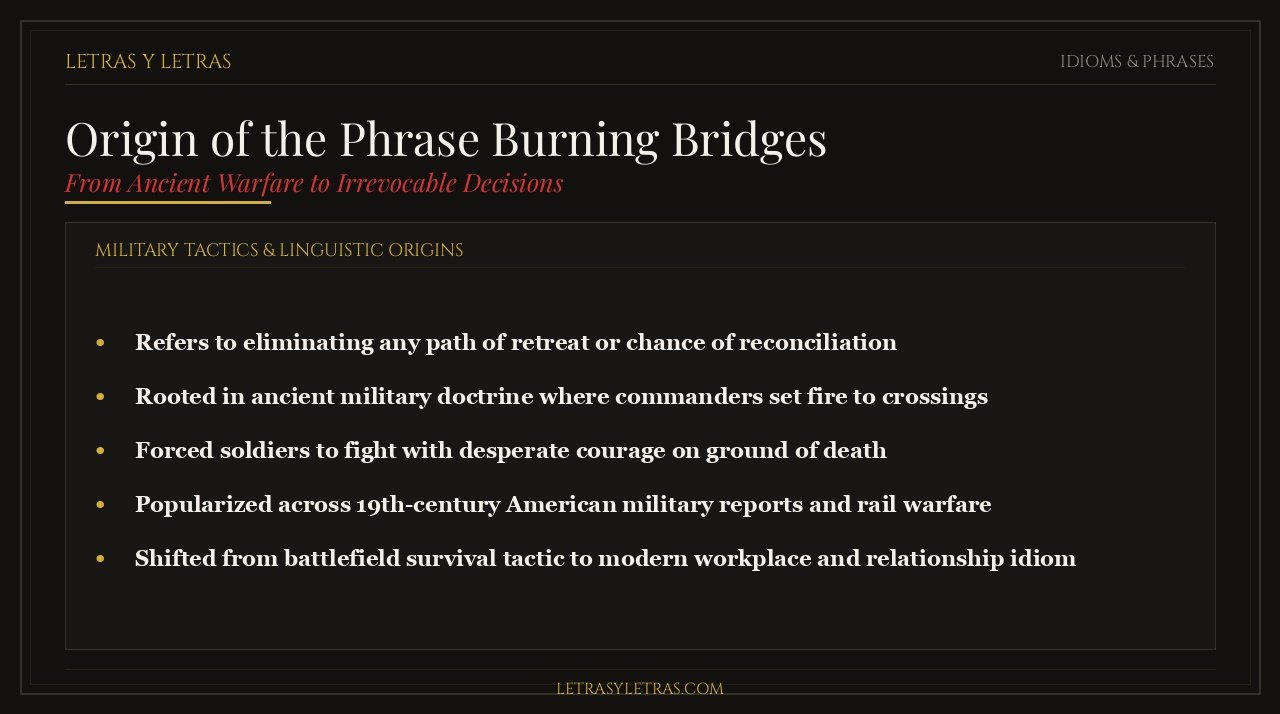
The phrase burning bridges means making an irreversible decision that eliminates any possibility of retreat or reconciliation. Historical warfare records reveal that advancing armies crossed river barriers and burned wooden bridges behind them. This maneuver prevented enemy counterattacks while eliminating escape routes for attacking soldiers. Deprived of retreat, troops had to conquer or perish in battle. Ancient strategist Sun Tzu described this tactic as placing soldiers on the ground of death. During the nineteenth century, American military reports popularized the phrase before Victorian writers adopted it as an idiom.
Key Takeaways
- Burning bridges describes taking actions that permanently cut off retreat or return.
- Rooted in ancient military doctrine of forcing armies to fight without retreat options.
- Reflected in Sun Tzu ancient military philosophy regarding the ground of death.
- Parallels classical military traditions of burning boats, practiced by Xiang Yu and Roman generals.
- Shifted during the late nineteenth century from military logistics to personal career idioms.
The Modern Idiom: Irrevocable Exits and Relationship Sabotage
Modern society treats burning bridges as an unforced strategic blunder. When workers resign from jobs with angry letters, mentors caution that the business community is small. Hostile actions destroy valuable professional references and poison future employment prospects.
In personal relationships, burning bridges describes delivering insults that make reconciliation impossible. Angry partners sometimes utter grievances designed to wound rather than resolve conflict. Once spoken, bitter words demolish emotional trust forever.
Our contemporary view sees the bridge burner as impulsive, unstable, and shortsighted. We value diplomacy, flexibility, and the ability to maintain pleasant social contacts. Keeping bridges open is viewed as the hallmark of emotional maturity.
Lexical documentation in the Merriam-Webster dictionary defines the phrase as destroying retreat paths. The authority notes that the idiom implies committing oneself irrevocably to a single course. Modern dictionaries reflect centuries of strategic military metaphor.
To early military commanders, however, cutting off retreat was not foolish impulsiveness. It was the ultimate psychological weapon deployed against cowardice. Grasping this origin requires examining ancient battlefields where armies faced certain destruction.
Ancient Military Tactics: The Ground of Death
Ancient warfare was decided by morale rather than technological superiority. When bronze swords clashed and spears shattered, human panic was the deadliest adversary. Soldiers who believed they could flee toward home frequently broke formation during combat.
A fleeing army suffered catastrophic casualties compared to a disciplined force. Victorious cavalry cut down running infantrymen with brutal efficiency. Experienced generals recognized that preservation of fighting spirit was paramount.
Strategic analysis in the Encyclopedia Britannica Sun Tzu overview highlights this psychological principle. Sun Tzu wrote in The Art of War about distinct combat terrains. He identified the ground of death as land where survival required immediate, fearless aggression.
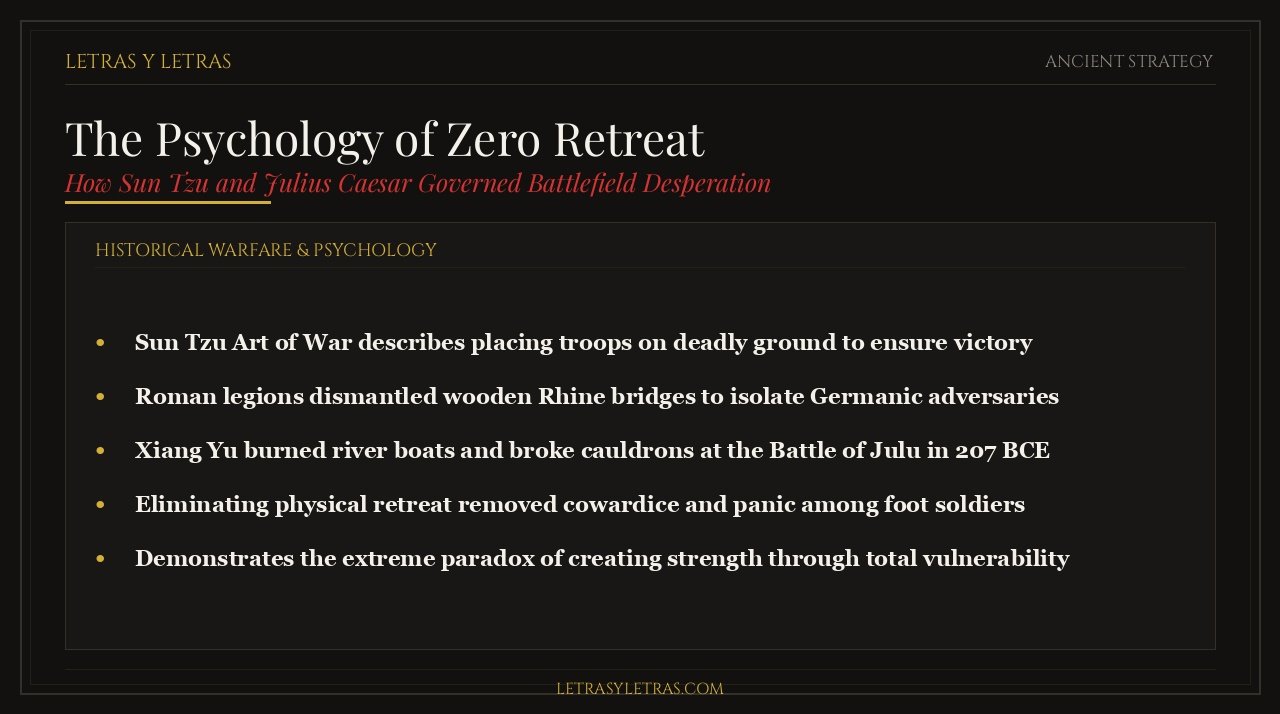
Sun Tzu instructed commanders to place troops in positions where escape was physically impossible. When soldiers know that surrender or flight is hopeless, fear transforms into desperate valor. Men fight with ferocious strength when survival offers no alternative.
Burning river bridges created this lethal psychological terrain instantly. With black smoke rising behind them and water blocking their retreat, soldiers faced forward. Victory was their only bridge home.
Xiang Yu at the Battle of Julu: Breaking Cauldrons and Sinking Boats
One of the most famous historical demonstrations of this tactic occurred in ancient China. In 207 BCE, rebel warlord Xiang Yu led insurgent forces against the imperial Qin dynasty. His army crossed the Yellow River to confront a vastly superior imperial host.
Upon reaching the hostile riverbank, Xiang Yu issued astonishing tactical orders. He commanded his soldiers to sink every transport vessel that brought them across the deep water. Next, he ordered every cooking cauldron smashed and every camp tent burned.
Xiang Yu distributed rations sufficient for exactly three days of marching. He declared to his startled troops that there was no food and no return route. The only food they would eat was captured Qin grain after total victory.
Deprived of boats and cauldrons, the rebel army attacked with savage intensity. They routed the Qin forces at the Battle of Julu, toppling an imperial dynasty. Chinese literature preserved this legendary maneuver as the four-character idiom of breaking cauldrons and sinking boats.
Xiang Yu victory proved that removing escape routes unlocks astonishing human resilience. Western military leaders observed the identical phenomenon across European river campaigns. The psychological principle was universal across human warfare.
Roman Engineering: Julius Caesar and Tactical River Crossings
The Roman military perfected the art of strategic bridge destruction across continental Europe. Roman legions were renowned for rapid bridge construction using timber piles and iron fittings. Julius Caesar demonstrated this tactical mastery during his Gallic campaigns in 55 BCE.
Caesar ordered his military engineers to span the wide Rhine River in ten days. His legions marched into Germanic territory, demonstrating Roman engineering dominance to terrified tribes. After ravaging hostile villages for eighteen days, Caesar withdrew his troops across the river.
As soon as the last Roman legionnaire stepped onto friendly soil, Caesar dismantled the wooden crossing. He broke down the river bridge to prevent Germanic warriors from pursuing his forces. The river returned to an impassable defensive boundary.
Centuries later, Roman emperor Julian faced Persian armies along the Tigris River in 363 CE. After ferrying his legions across the waterway, Julian ordered his fleet of transport ships burned. Julian sought to deny Persian captures while forcing his legions to march boldly inland.
Historical documentation in the Online Etymology Dictionary records the ancient Germanic heritage of bridge structures. Crossing water represented a perilous threshold between safety and peril. Destroying that threshold transformed defensive caution into offensive audacity.
The American Civil War and the Logistics of Destruction
While ancient generals destroyed wooden footbridges, modern phraseology solidified during industrial rail warfare. The American Civil War between 1861 and 1865 transformed bridge destruction into a high-stakes tactical science. Armies depended entirely on wooden trestle railroad bridges for food, munitions, and reinforcements.
Union and Confederate cavalry raiders made railroad bridges their primary targets. Setting fire to a vital railway crossing paralyzed enemy troop movements for weeks. Both sides maintained specialized engineering corps dedicated to burning and rebuilding bridges.
General William Tecumseh Sherman utilized systematic bridge destruction during his Atlanta campaign. As Sherman army marched toward the sea, engineers tore up rail lines and torched river bridges. Sherman deliberately cut his own telegraph wires and supply links, moving without supply lines.
Northern newspapers covered these military maneuvers with dramatic prose. Dispatches described commanders burning bridges behind them as they plunged into hostile territory. The phrase began permeating American vernacular speech through vivid wartime journalism.
Veterans returned home from the battlefields carrying military jargon into civilian life. Expressions forged in smoke and gunpowder entered boardrooms, law offices, and political debates. Burning bridges began its transition from literal logistics to figurative language.
Burning Bridges Versus Burning Boats: Comparing Classical Tropes
Language lovers frequently compare burning bridges with its sister phrase, burning one boats. Both idioms express irrevocable commitment to a chosen course of action. However, the two expressions possess distinct historical lineages and subtle connotations.
Burning boats evokes amphibious landings on distant, foreign shores. In 1519, Spanish conquistador Hernan Cortes scuttled eleven ships at Veracruz after landing in Mexico. Cortes sought to prevent mutinous sailors from abandoning the expedition and sailing back to Cuba.
Classical Roman historians recorded similar naval actions by Agathocles of Syracuse in ancient North Africa. Burning ships implies bold exploration, foreign colonization, and adventurous daring. It carries an aura of epic questing across mysterious oceans.
Burning bridges, by contrast, implies an infrastructure of mutual connection that was deliberately destroyed. A bridge connects two familiar shores, allowing trade, friendship, and civil communication. When you burn a bridge, you sever ties with people you once knew intimately.
This distinction explains why burning bridges carries a darker, more tragic social connotation today. Sinking an expedition boat feels heroic and ambitious. Burning a bridge feels defensive, bitter, and hostile to community ties.
From Battlefield Necessity to Professional Blunder
During the late nineteenth century, industrial expansion created a competitive corporate landscape. Railroad barons, mining tycoons, and factory managers competed for commercial dominance across North America. Business journals began adopting military vocabulary to describe commercial rivalries.
By the 1890s, trade publications used burning bridges to describe reckless commercial departures. A merchant who defaulted on debts or publicly insulted suppliers was said to have burned his bridges. The phrase ceased to mean bold military bravery.
Instead, the idiom absorbed a strong negative moral caution. In a networked capitalist economy, mutual dependency is vital for survival. A businessman who destroys goodwill cuts off future financial credit and trade partnerships.
During the twentieth century, human resources departments and career counselors embraced the metaphor universally. Today, burning bridges almost exclusively describes unprofessional behavior during resignation or divorce. The fiery heroism of ancient warriors gave way to mundane workplace advice.
Despite this semantic inversion, the underlying truth remains identical across millennia. Once a crossing is consumed by flames, you cannot walk back across the river. Some decisions alter reality permanently.
Chronological Milestones in the History of Burning Bridges
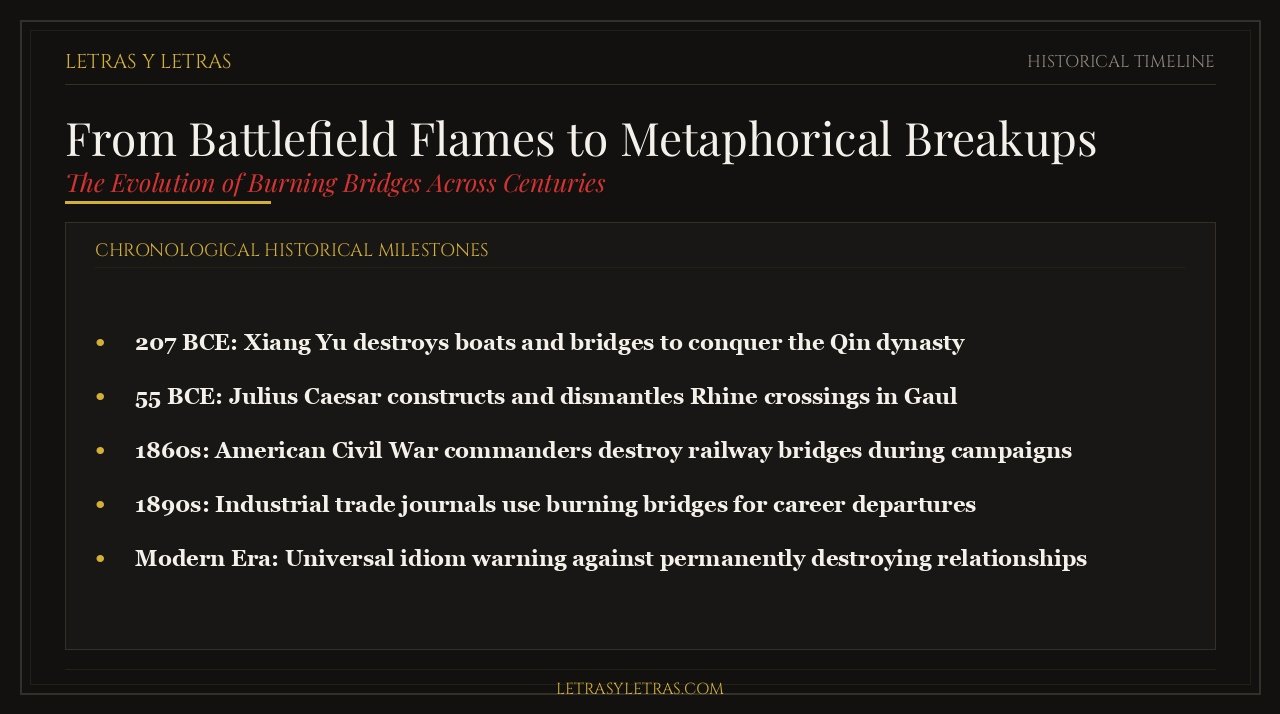
The historical table below traces key milestones in the development of the idiom from ancient warfare to contemporary language:
| Historical Era | Strategic Event | Military Doctrine | Evolutionary Meaning |
|---|---|---|---|
| 5th Century BCE | Sun Tzu Art of War | Ground of death doctrine | Removes retreat routes to force fighting soldiers into heroic desperate courage. |
| 207 BCE | Battle of Julu | Xiang Yu sinks boats and breaks pots | Chinese armies demonstrate the decisive power of destroying retreat mechanisms. |
| 55 BCE | Caesar Gallic Wars | Rhine bridge dismantling | Roman engineers demolish timber crossings to secure defensive border lines. |
| 1861 to 1865 | American Civil War | Railroad bridge arson | Widespread newspaper reporting cements literal bridge burning in popular culture. |
| 1890s | Industrial Expansion | Corporate trade idioms | Commercial publications adopt the phrase for reckless business severances. |
| 20th Century to Present | Modern Vernacular | Career and social psychology | Universal cautionary idiom warning against bitter, irrecoverable relationship exits. |
Debunking Common Myths About Burning Bridges
Because bridge destruction captures popular imagination, several persistent myths surround the idiom. Examining historical records dispels three widespread errors:
The primary myth claims the phrase originated exclusively with Julius Caesar crossing the Rubicon in 49 BCE. While Caesar crossed the Rubicon River, he did not burn a bridge there. He famously declared the die is cast, making a distinct political metaphor.
A second myth asserts that ancient armies always burned bridges behind them during every major river crossing. In reality, building bridges required massive labor, valuable lumber, and specialized engineering corps. Commanders preserved bridges whenever possible, burning them only during extreme tactical crises.
A third myth claims Napoleon Bonaparte coined the phrase during his disastrous Russian campaign of 1812. While French engineers torched pontoon bridges over the Berezina River, they did so to stop Russian pursuit. Napoleon did not invent the figurative idiom, which matured in late nineteenth-century print.
We saw similar historical myths corrected in our origin of the phrase baker dozen investigation. Folklore often attributes military sayings to single famous generals rather than broader administrative traditions.
The Psychological Trap of Permanent Severance
Why does the metaphor of burning bridges resonate so powerfully across human psychology? The answer lies in the human desire for emotional closure during stressful conflicts. When injured by an employer or romantic partner, attacking feels like decisive strength.
In moments of high adrenaline, people believe they will never need the other party again. The flames of righteous indignation produce temporary emotional relief. Yet life is long, unpredictable, and surprisingly interconnected across modern communities.
True strength requires self-control rather than theatrical demolition. Cultivating emotional fortitude and calm endurance is explored in our curated quotes on discipline collection. Governing personal anger prevents tragic self-sabotage.
Uncompromising honesty must guide all human partnerships and business agreements. Discover classical standards of truth in our origin of the word sincere investigation. Genuine integrity never requires toxic drama.
Human beings frequently possess hidden weaknesses beneath displays of aggression. Examine anatomical vulnerability in our analysis of the origin of the phrase Achilles heel. Arrogance frequently precedes devastating downfall.
Historical communities established structural limits to prevent social disorder and dangerous fire. Discover medieval safety decrees and evening bells in our origin of the word curfew history. Societal regulations protect vulnerable citizens.
Recreational habits and marketplace revelry also produced vibrant social idioms over time. Trace equestrian horse racing and tavern culture in our origin of the word cocktail history. Human rituals reflect complex communal desires.
Bodily vigor and physical power have inspired cultural metaphors across ancient civilizations. Explore classical Roman anatomy and rodent metaphors in our origin of the word muscle analysis. Physical capacity requires humble stewardship.
Sudden illness and biological vulnerability also remind us of mortal limitations. Examine maritime naval history in our origin of the phrase under the weather reflection. Weathering hardship requires patient endurance.
Catastrophic crises have tested human institutions across millennia of written history. Examine Renaissance celestial omens in our origin of the word disaster reflection. Facing crisis demands clear vision.
Overcoming toxic dependencies often demands sudden willpower without hesitation. Learn how withdrawal medicine forged a universal idiom in our origin of the phrase cold turkey guide. Confronting adversity directly fosters lasting renewal.
Historical prejudice and augury omens shaped linguistic perceptions of human action. Examine Roman left-hand symbolism in our origin of the word sinister review. Words evolve unexpected meanings across centuries.
Gambling and reckless bets carried lasting consequences across medieval Europe. Trace medieval dice games and Crusader history in our origin of the word hazard investigation. Thoughtful restraint shields people from catastrophe.
Serene sanctuaries offer the ultimate antidote to the turmoil of burned relationships. Explore ancient Persian walled gardens in our origin of the word paradise reflection. The human spirit continually seeks reconciliation and peace.
Frequently Asked Questions
What is the literal meaning of burning bridges?
Burning bridges means eliminating any route of retreat or reconciliation by taking an irreversible, decisive action.
Did ancient armies actually burn bridges?
Yes, ancient military commanders destroyed bridges behind their troops to prevent retreat and force total commitment.
How does Sun Tzu relate to burning bridges?
Sun Tzu advocated placing troops on the ground of death without escape options to compel fierce valor.
Who burned boats at the Battle of Julu?
Chinese warlord Xiang Yu sank his transport boats and broke cauldrons in 207 BCE to defeat Qin forces.
What is the difference between burning bridges and burning boats?
Burning boats implies adventurous overseas conquest, while burning bridges implies destroying mutual connections with familiar partners.
When did burning bridges become a career idiom?
The phrase transitioned into commercial and workplace idioms during the late nineteenth century in American industrial publications.
Alan Sledge is the lead writer at letrasyletras.com, uncovering historical wisdom and word origins.


Alan Sledge is the writer and founder behind Letters & Letters. A lifelong lover of words, Alan has always been drawn to the small mysteries hidden in everyday language, why we say what we say, where our favorite sayings came from and the quotes that manage to put feelings into words better than we ever could ourselves.

Alan Sledge
Alan Sledge is the founder and lead researcher behind Letters & Letters. A lifelong student of linguistic history, he cross-references every word origin, idiom, and quote against primary archival manuscripts, the Oxford English Corpus, and 18th-century print lexicons.