
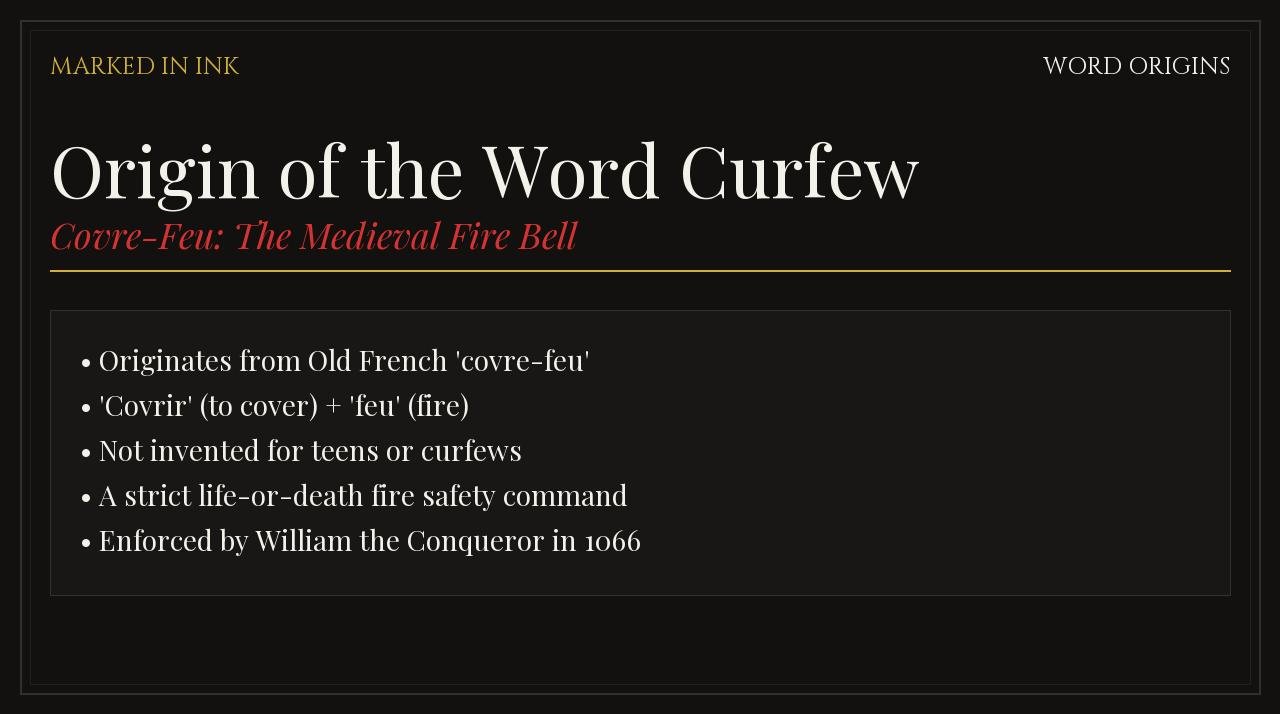
You might associate the word curfew with strict parents, teenage rules, or citywide emergency lockdowns. But this term was never invented to control people. For centuries, it served as a life-or-death fire-safety command in medieval wooden towns. The origin of the word curfew reveals a fascinating history of survival rather than restriction. The primary keyword in this first section is origin of the word curfew, which sets the stage for a fiery tale.
Quick Answer: Origin of the Word Curfew
The word curfew comes from the Old French phrase “covre-feu,” meaning “cover fire.” In medieval European towns, homes were built from highly flammable wood and thatch. To prevent disastrous fires while families slept, town bells would ring at dusk. This signaled citizens to cover their open hearth fires with a heavy metal lid. Over centuries, as architecture improved and open fires vanished, the term evolved from a literal fire safety command into a general regulation requiring people to stay off the streets at night.
Key Takeaways
- The word curfew derives from the Old French “covre-feu” (cover fire).
- It began as a strict medieval fire safety measure, not a public order law.
- Citizens used metal domes to cover smoldering hearths safely overnight.
- William the Conqueror famously enforced the curfew bell in England after 1066.
- By the 19th century, the word transitioned into a deadline for staying indoors.
Before stone became common, early European cities were built almost entirely of wood, thatch, and straw. These highly flammable materials meant a single stray spark could wipe out an entire community. Residents needed a strict system to prevent disaster while they slept. To solve this, medieval authorities instituted a nightly routine that would eventually give us the word we use today.
What Does Curfew Actually Mean?
If you consult Merriam-Webster, you will see curfew defined as a regulation requiring people to remain indoors between specified hours. However, the linguistic roots tell a different story. The term comes from the Old French phrase covre-feu (or couvre-feu). This phrase breaks down into covrir, meaning “to cover”, and feu, meaning “fire”.
In the Middle Ages, families kept open hearth fires in the center of their living spaces for warmth and cooking. When the local town bell rang at dusk (usually around 8 PM), it was the signal to perform a crucial task. Citizens had to cover their open hearth fires with a metal lid known as a couvre-feu. This heavy metal dome kept the ashes smoldering safely overnight without throwing dangerous sparks onto wooden floors.

William the Conqueror and the English Curfew
The practice arrived in England shortly after 1066. William the Conqueror is often credited with enforcing the curfew bell across his new kingdom. He used it as a strict regulation to prevent rebellious gatherings at night, though its practical fire-safety benefit remained. By the time it appeared in English records, the phrase had morphed.
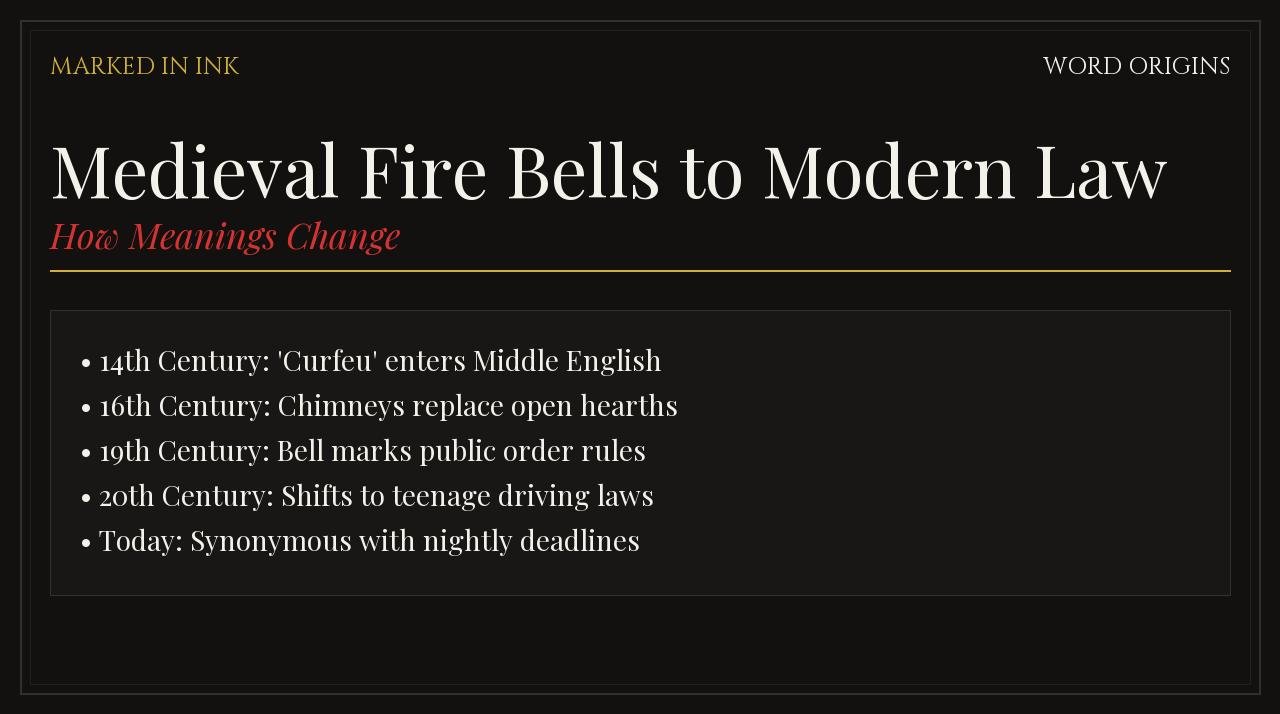
The Online Etymology Dictionary notes that the spelling shifted through Anglo-French. It entered Middle English as curfeu. Over time, the literal practice of covering fires with a metal shield faded as home construction improved with brick and stone chimneys. Just as the origin of the word salary evolved from salt rations, curfew evolved far beyond its fiery beginnings.
From Medieval Fire Bells to Modern Law
By the 19th century, the meaning of curfew had shifted entirely. Since the bell ringing marked the end of the day, the word became associated with the time people were expected to be off the streets. It transitioned from a fire prevention tool into a public order regulation. Similar linguistic shifts happen often, as seen in the origin of the word berserk.
Today, the term is applied to everything from teen driving laws to martial law situations. The metal fire covers are now museum artifacts, but the nightly deadline lives on in our vocabulary. The origin of the word curfew is a perfect example of how language adapts to human needs, turning a medieval survival tactic into a modern civic rule.
Common Questions About the Word Curfew
When was the word curfew first used?
The term entered Middle English in the early 14th century. It derived from the earlier Anglo-French coverfeu, which was used shortly after the Norman Conquest of 1066.
Did William the Conqueror invent the curfew?
No, William the Conqueror did not invent the concept. The practice of covering fires existed in mainland Europe before 1066, but he strictly enforced it in England.
What was a couvre-feu made of?
A traditional couvre-feu was a large, bell-shaped cover made of copper or iron. It featured small holes to let just enough oxygen in to keep the fire smoldering without flaming.
Is curfew related to the word fire?
Yes. The second half of the original French phrase is feu, which directly translates to fire.
We hope this look at the origin of the word curfew sheds light on its fiery past. The next time you hear about a nightly deadline, you can remember the medieval wooden towns and the ringing bells that started it all. Share this piece of history with your fellow word nerds!