
Customers walk into modern pastry shops and order twelve freshly glazed cinnamon rolls. The smiling clerk places twelve pastries inside a paper box, then adds a thirteenth treat without extra charge. Staff members refer to this bonus treat as a baker dozen.
Modern shoppers view this thirteenth pastry as a charming gesture of commercial goodwill. It feels like an act of neighborly generosity designed to delight returning patrons. Sweet shop counters make the baker dozen seem like a warm marketing invention.
Yet the true origin of the phrase baker dozen has nothing to do with kindness. The extra loaf was born from medieval dread, severe criminal statutes, and public humiliation. An English law forced bakers to provide extra bread to protect their necks from royal punishment.
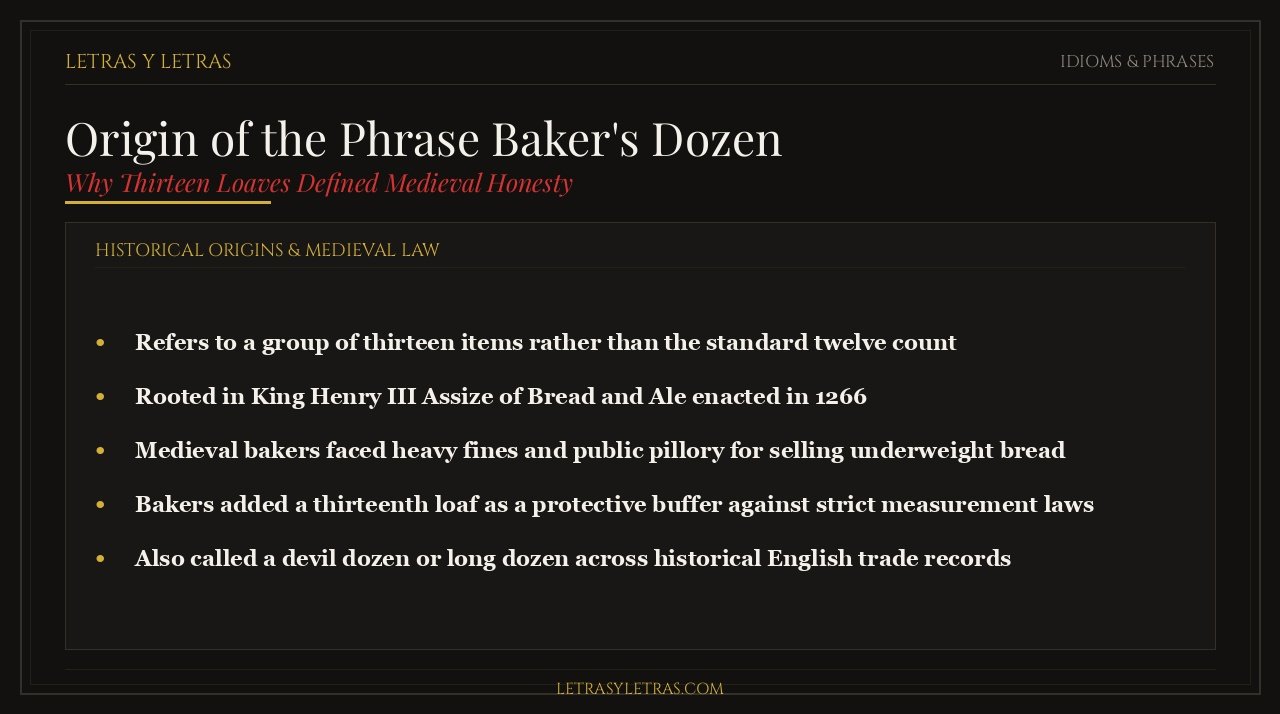
Quick Answer: Origin of the Phrase Baker’s Dozen
The phrase baker dozen refers to thirteen items instead of twelve. It originated in thirteenth-century medieval England following the Assize of Bread and Ale enacted by King Henry III in 1266. This strict statutory law tied loaf weight and bread price directly to fluctuating grain markets. Bakers who sold underweight bread faced ruinous fines, loss of trade guild privileges, or brutal public humiliation in town pillories. Because moisture loss during oven baking caused bread weights to fluctuate unpredictably, bakers could easily break royal law by accident. To avoid ruinous penalties, guild bakers added a thirteenth protective buffer loaf to every wholesale dozen. The practice protected merchants and gave consumers guaranteed weight.
Key Takeaways
- A baker dozen consists of thirteen items rather than standard twelve.
- Originates from King Henry III Assize of Bread and Ale passed in 1266.
- Bakers faced public pillorying or severed ear threats if bread fell short of statutory weights.
- The thirteenth loaf acted as insurance against moisture evaporation during wood-fired baking.
- First recorded in English literature in 1599 in Renaissance dramatic satire.
The Modern Baker Dozen: A Sweet Surprise with Harsh Roots
Modern bakeries celebrate the baker dozen as an endearing tradition of hospitality. Coffee shops hand out an extra bagel when customers buy a full dozen for workplace meetings. Doughnut shops frequently pack thirteen pastries into standard dozen boxes to surprise delighted patrons.
We interpret this custom through the lens of modern customer service. Retail brands routinely invent perks to cultivate consumer loyalty and positive online reviews. The thirteenth item appears to be an early precursor to loyalty rewards cards.
Historical records show a starkly different reality behind this commercial custom. Medieval bakers lived under intense legal scrutiny from royal inspectors and suspicious townspeople. Bread was not merely breakfast food, but the absolute foundation of daily human survival.
Lexicographical research in the Merriam-Webster dictionary traces the phrase to English trade customs. The historical dictionary defines the term as a group of thirteen units. This authoritative record confirms that medieval legal penalties birthed the extra item.
When medieval townspeople bought bread, they spent the majority of their household income. If a baker sold underweight loaves, the community suffered immediate caloric deprivation. Suspicion ran high across every market square in feudal Britain.
Medieval England and the Staple of Life
In thirteenth-century England, bread provided more than half the daily calories for ordinary citizens. Peasant laborers and urban artisans ate several pounds of coarse grain loaves each day. Meat, dairy, and fish were costly luxuries reserved for prosperous landowners.
Because bread sustained human life, any fluctuation in loaf weight threatened public peace. Bad weather frequently ruined wheat and rye crops, causing flour prices to spike. When grain grew scarce, dishonest millers and bakers tried to preserve profits by shrinking loaves.
Townspeople possessed little patience for short-weight merchants. Riots erupted when working families discovered that loaves were smaller than official decrees mandated. Crown officials viewed bread regulation as an urgent matter of national security.
Historical analysis by the Encyclopedia Britannica Assize overview outlines this intense medieval scrutiny. Royal ministers recognized that hungry crowds easily turned into armed mobs. Maintaining an honest food supply was essential for monarchical stability.
King Henry III governed an England recovering from baronial wars and agricultural shortages. He resolved to standardize commercial weights across the entire kingdom. His signature piece of consumer protection legislation would reshape European food production for five hundred years.
The Assize of Bread and Ale of 1266
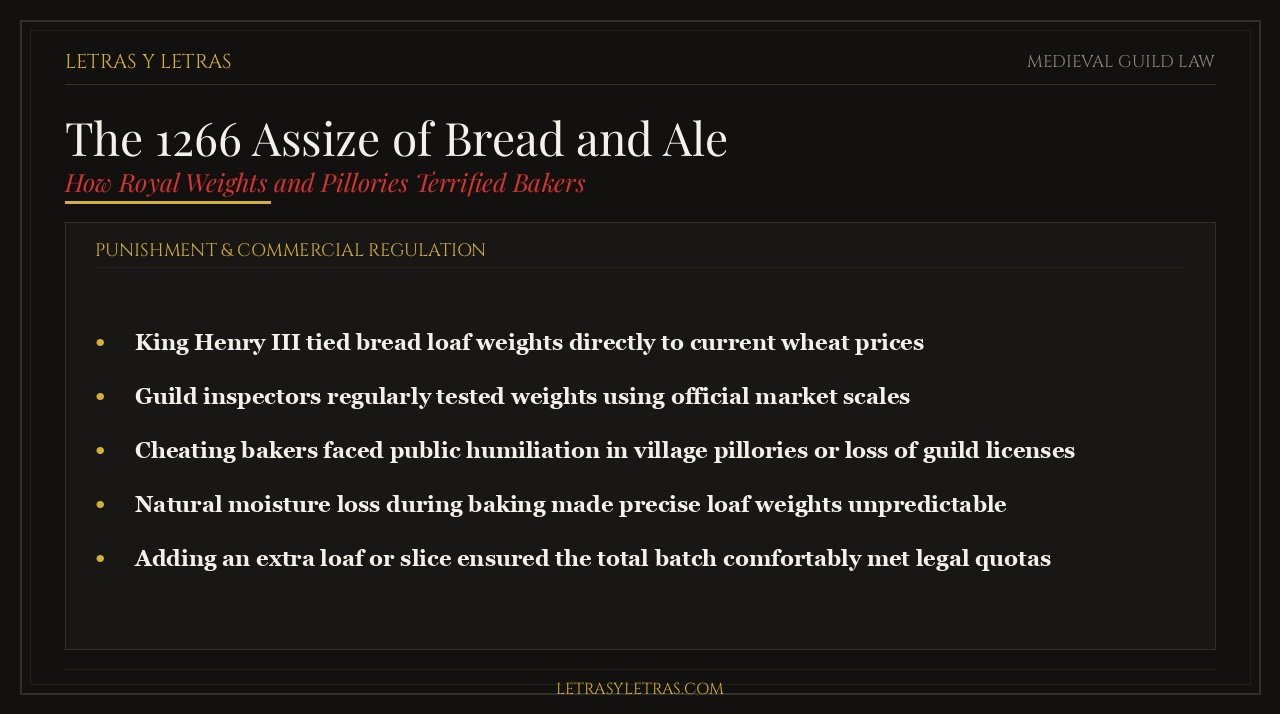
In the year 1266, King Henry III signed the Assize of Bread and Ale into English statutory law. This landmark statute created an intricate sliding scale connecting bread weights to grain market costs. It was the first British law to regulate food production systematically.
The statute did not fix the monetary price of a loaf of bread. Instead, a standard penny loaf or halfpenny loaf remained fixed in coin value throughout the year. As wheat prices rose or fell, the legal weight of the penny loaf adjusted accordingly.
If a quarter of wheat cost twelve pence, a penny loaf had to weigh several substantial pounds. Whenever wheat prices surged to six shillings, the statutory weight of the penny loaf shrank. Bakers had to adjust their dough scales each week based on local market reports.
The statute also established strict distinctions between bread qualities. Fine white bread made from sifted wheat flour had to meet different weight thresholds than coarse brown loaves. Inspectors known as aletasters and bread weighers toured markets with official brass scales.
These royal weighers tested bread directly off market stalls without warning. If an inspector found even a single loaf weighing less than statutory requirements, punishment fell swiftly. The Crown showed zero mercy to merchants who cheated common buyers.
Terrified Bakers and the Scourge of the Pillory
The punishments for violating the Assize of Bread were brutal and deeply humiliating. For a first minor offense, a baker paid a heavy monetary fine that erased months of profit. A second offense brought harsher financial ruin and confiscation of all inventory.
A third infraction triggered public corporal punishment in the village pillory. The disgraced baker was dragged through muddy streets on a wooden hurdle behind horses. Officials tied the underweight bread around the offender neck as a public badge of shame.
Crowds gathered in the town square to pelt the captive baker with rotten produce and mud. In London, municipal courts punished chronic offenders by demolishing their brick bakehouses completely. A baker lost both his livelihood and his standing in the community.
Guild records describe extreme cases where town magistrates threatened to nail offender ears to wooden posts. The Worshipful Company of Bakers maintained strict internal discipline to preserve the guild collective reputation. Individual bakers lived in constant terror of falling short on the scale.
This legal climate created immense anxiety among medieval breadmakers. A merchant could not afford to risk even a minor measurement discrepancy. The stakes were simply too high for mathematical precision errors.
The Math of Flour, Moisture, and Wood Ovens
Maintaining exact bread weights in medieval kitchens was technically impossible. Bakers worked without electric scales, digital thermometers, or climate-controlled proofing chambers. They relied on hand-kneaded dough batches and massive wood-fired brick ovens.
Every baker knew that raw dough loses substantial weight during the baking process. As water evaporates in high heat, a loaf loses between ten and fifteen percent of its mass. If an oven ran hotter than usual, moisture evaporated faster, shrinking the finished loaf.
Flour quality varied wildly between different millings and seasons. Damp grain absorbed less water, while dry summer wheat required heavy hydration. Even humidity on a rainy morning changed the weight balance of fresh dough.
A baker could weigh raw dough chunks with genuine honesty before sliding them into the oven. Yet two hours later, several loaves might emerge slightly under the statutory weight. Honest craftsmen faced the pillory purely due to ambient atmospheric shifts.
To protect themselves, bakers adopted an aggressive safety buffer. They deliberately baked extra weight into every batch to ensure compliance. Giving away extra dough was infinitely cheaper than standing in the pillory.
Hucksters, Middlemen, and the Thirteenth Loaf
The practical mechanism of the baker dozen developed through the medieval wholesale distribution system. Most bakers did not sell bread directly to consumers from retail shop windows. Instead, they sold large batches to street vendors known as hucksters.
Hucksters were independent traders, often poor women, who carried baskets of fresh loaves through city neighborhoods. They bought bread at wholesale rates from bakehouses and resold individual loaves to residential households. Hucksters assumed full legal liability once bread entered their wicker baskets.
If a royal inspector stopped a street huckster and found an underweight loaf, the huckster faced the pillory. Consequently, hucksters refused to buy bread unless bakers guaranteed total weight safety. Hucksters demanded compensation for the legal risk they carried.
The baker solved this dilemma by providing thirteen loaves for the price of twelve. This thirteenth loaf, called the inbread or vantage loaf, served as an insurance buffer. If individual loaves ran light, the extra loaf ensured the collective weight exceeded legal limits.
The huckster could also sell the thirteenth loaf at full retail price to secure her personal profit margin. Guild bylaws in London formalized this commercial trade rule by the late fourteenth century. The thirteenth loaf became mandatory standard practice across English wholesale commerce.
Alternative Names: Devil Dozen and Long Dozen
The baker dozen was not the only historical name for a set of thirteen units. English trade ledgers frequently referred to thirteen items as a long dozen. Merchants in other trades, including printers and potters, occasionally used long dozens for bulk wholesale deals.
In folk speech and rural dialects, people often called thirteen a devil dozen. European folklore had long viewed the number thirteen with deep superstitious suspicion. Christian mythology linked thirteen to the Last Supper, where Judas Iscariot sat as the thirteenth guest.
Witches covens were popularly believed to gather in groups of thirteen members. Superstitious villagers associated the baker thirteenth loaf with this unlucky spiritual number. Some folklorists suggested that bakers who gave thirteen items were warding off demonic misfortune.
Etymological documentation at the Online Etymology Dictionary explains the phrase transition into print. The noun phrase baker dozen first appeared in English literature during the late Elizabethan era. Playwright John Marston used the idiom in his 1599 satirical drama.
By the seventeenth century, English speakers used the phrase far beyond commercial bakeries. It became a colorful colloquialism for receiving an extra item without paying extra money. The terrifying medieval pillory had faded, leaving behind an amusing linguistic souvenir.
Chronological Milestones in the History of the Baker Dozen
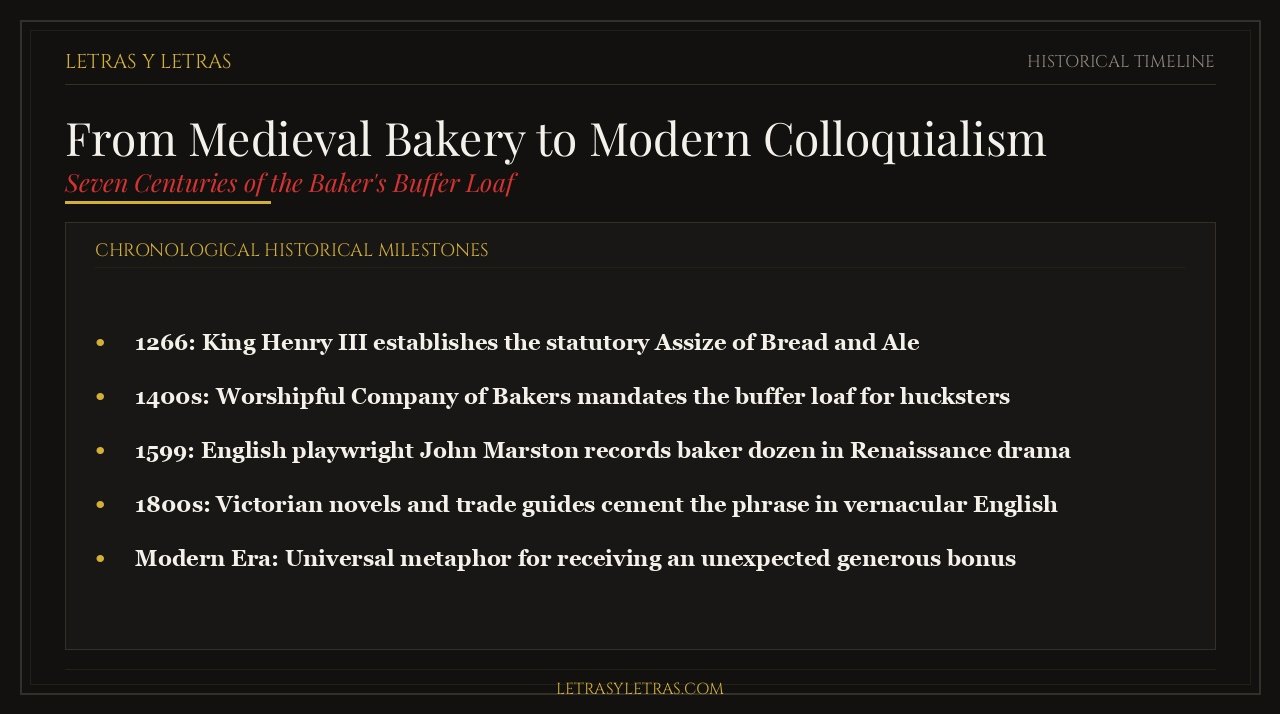
The historical table below traces key milestones in the development of the baker dozen across English trade history:
| Historical Era | Legal or Cultural Milestone | Commercial Practice | Impact on English Language |
|---|---|---|---|
| 1266 | Assize of Bread and Ale | King Henry III statutory bread laws | Establishes severe criminal penalties for selling underweight food loaves. |
| 1300s to 1400s | Worshipful Company of Bakers | Guild mandated buffer loaves | Bakers provide thirteen loaves to wholesale hucksters to protect profit margins. |
| 1599 | Elizabethan Drama | John Marston dramatic plays | First recorded literary appearance of baker dozen in printed English satire. |
| 1600s to 1700s | Colloquial Expansion | General trade and market slang | Phrase expands across British colonies to mean thirteen of any commodity. |
| 1800s | Victorian Lexicography | Standard dictionary documentation | Standardized in idioms collections as an emblem of commercial bonus. |
| 20th Century to Present | Modern Retail Culture | Bakery customer loyalty traditions | Universal English idiom celebrating generous hospitality and free bonus items. |
Debunking Common Myths About the Baker Dozen
Because thirteen is an unusual counting number, several charming myths have developed around the idiom. Examining medieval history allows us to dispel three common misconceptions:
The primary myth claims bakers were exceptionally generous craftsmen who loved rewarding faithful clients. In truth, medieval guild members were tight-fisted merchants struggling to survive steep grain taxes. They gave away the thirteenth loaf out of legal fear rather than altruistic kindness.
A second myth asserts that bakers made thirteen loaves because twelve loaves sat around one central loaf in round ovens. While brick ovens were round, baking pans and peel paddles held varying arrangements. Oven geometry had zero influence on guild statutory weights.
A third myth claims the custom began in colonial America among Dutch bakers in New York state. An old Hudson Valley folklore tale claims baker Volckert Douw added a thirteenth cookie to appease an angry witch. While colorful, Dutch American tales appeared centuries after English records documented the practice.
We observed similar folklore embellishments debunked in our origin of the phrase crocodile tears guide. Popular imagination frequently invents fanciful fables when harsh administrative laws create everyday phrases.
The Cultural Psychology of Trust, Commerce, and Generosity
Why does the baker dozen hold such lasting affection in the human imagination? The answer touches deep psychological instincts regarding fairness, commerce, and human trust. Human beings possess an innate fear of being cheated during financial transactions.
When a merchant provides unexpected surplus, that psychological anxiety instantly evaporates. The thirteenth item transforms a cold financial exchange into an act of mutual respect. What began as fear of royal punishment evolved into a universal symbol of good faith.
Human beings have always created social safeguards to protect community well-being. Examine ancient communal discipline and curfew bells in our origin of the word curfew investigation. Clear social boundaries preserve civilization across chaotic eras.
Maintaining personal and commercial integrity requires steadfast moral purpose. Explore historical reflections on daily perseverance in our curated quotes on discipline collection. Governing individual impulses builds lasting trust.
Commercial dishonesty often invited severe communal retribution across world history. Discover how Roman physicians viewed bodily power in our origin of the word muscle analysis. Physical strength must always serve honest social harmony.
Sudden financial and bodily vulnerabilities remind us of human fragility. Examine maritime navigation and seasickness in our origin of the phrase under the weather reflection. Weathering hardship requires patient endurance.
Social recreation and marketplace gatherings also shaped colorful cultural habits. Trace equestrian history and tavern culture in our origin of the word cocktail history. Community traditions reflect complex social rituals.
Great historical catastrophes have repeatedly tested human resilience and economic systems. Examine astrological omens and fallen stars in our origin of the word disaster study. Facing unpredictable hardship reveals inner strength.
Confronting dangerous habits directly often requires unyielding determination. Learn how withdrawal medicine forged a powerful idiom in our origin of the phrase cold turkey guide. Overcoming adversity demands disciplined resolve.
Superstition and historical biases also shaped everyday vocabulary across Europe. Examine Roman augury and directional omens in our origin of the word sinister review. Words carry surprising shadows from antiquity.
Reckless speculation and games of chance frequently brought ruin to medieval traders. Trace Arabic dice games and Crusader history in our origin of the word hazard investigation. Prudent calculation shields merchants from disaster.
Uncompromising honesty remains the true foundation of commercial success. Discover classical definitions of purity in our origin of the word sincere investigation. Lasting enterprise rests upon genuine truthfulness.
Ancient visions of tranquility inspire our search for peaceful living. Explore ancient Persian walled gardens in our origin of the word paradise reflection. Fair trade and honest measures create peace across human society.
Frequently Asked Questions
What is the literal meaning of a baker dozen?
A baker dozen is a group of thirteen items, one more than the standard measurement of twelve.
Why does a baker dozen have 13 items instead of 12?
Medieval English bakers added a thirteenth loaf as insurance against strict laws punishing underweight bread loaves.
What was the 1266 Assize of Bread and Ale?
The Assize was a royal statute by King Henry III that regulated bread weights based on wheat prices.
What punishment did medieval bakers face for underweight bread?
Cheating bakers faced severe financial fines, public pillory humiliation, or the destruction of their commercial ovens.
What was the thirteenth loaf called in medieval England?
Bakers and merchants called the extra loaf the inbread or vantage loaf in official guild records.
When was the phrase baker dozen first recorded in English?
The phrase first appeared in print in 1599 in a satirical drama written by playwright John Marston.
Alan Sledge is the lead writer at letrasyletras.com, uncovering historical wisdom and word origins.


Alan Sledge is the writer and founder behind Letters & Letters. A lifelong lover of words, Alan has always been drawn to the small mysteries hidden in everyday language, why we say what we say, where our favorite sayings came from and the quotes that manage to put feelings into words better than we ever could ourselves.

Alan Sledge
Alan Sledge is the founder and lead researcher behind Letters & Letters. A lifelong student of linguistic history, he cross-references every word origin, idiom, and quote against primary archival manuscripts, the Oxford English Corpus, and 18th-century print lexicons.