
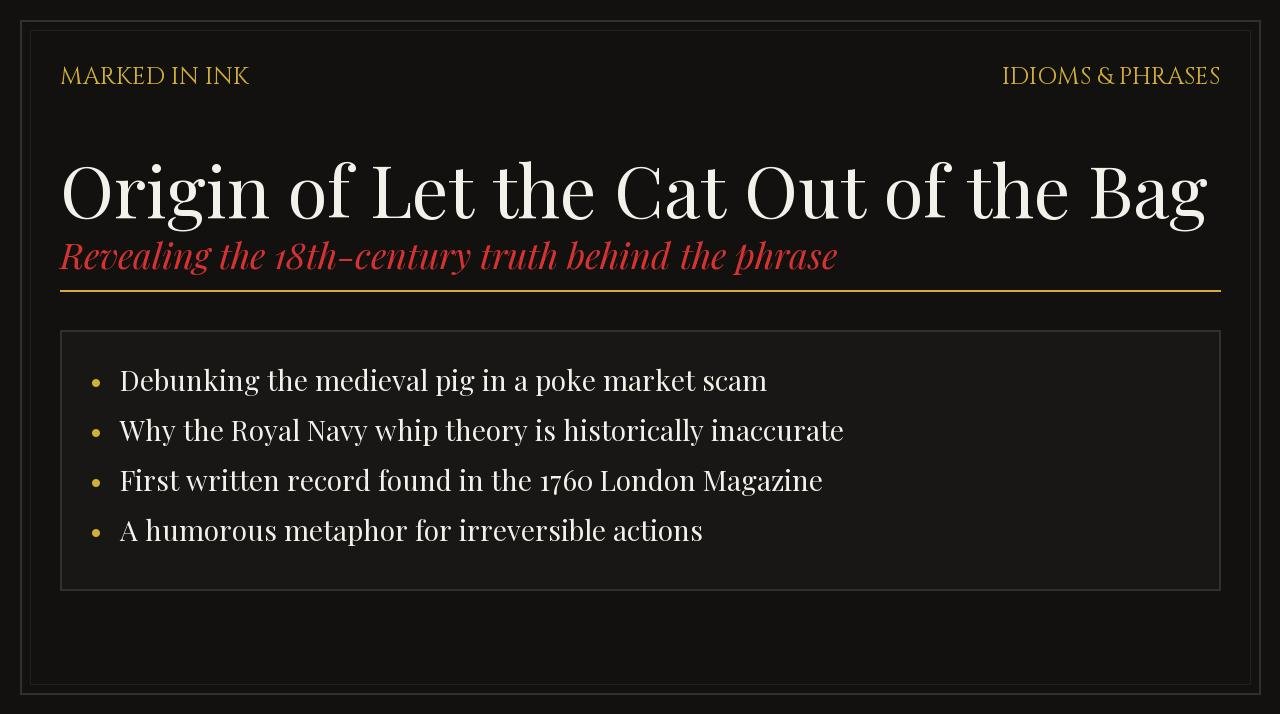
Discover the true origin of let the cat out of the bag. We explore the pig in a poke myth and 1760s records.
Have you ever wondered about the origin of the phrase let the cat out of the bag? Most people assume it involves a medieval scam. You might picture a trickster at a market shoving a stray feline into a sack.
When the buyer opens the sack, the animal escapes. The secret is out. Historical records tell a different story.
Etymologists point to 18th-century literary humor instead of marketplaces. In this guide, we explore two famous origin stories. We reveal what historians believe about this popular idiom.
Quick Answer: Origin of Let the Cat Out of the Bag
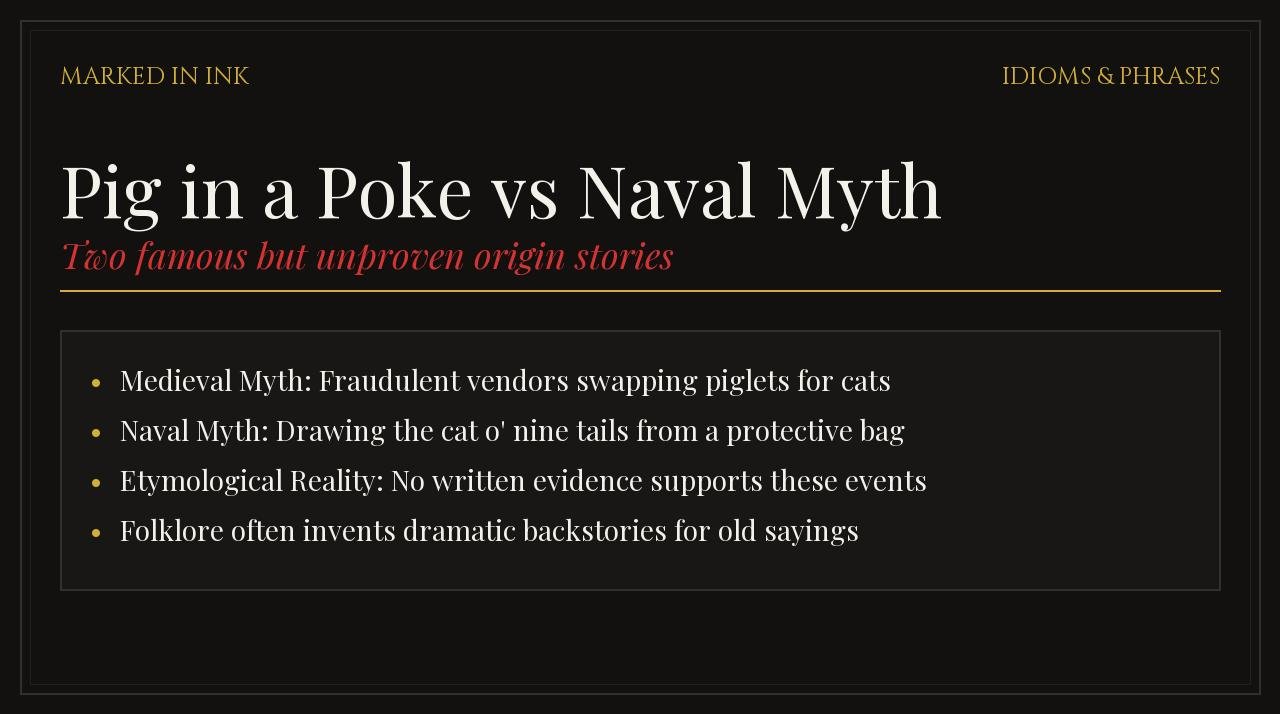
The phrase “let the cat out of the bag” originated in 18th-century British literature as a humorous metaphor for revealing a secret. While popular myths claim it comes from vendors swapping pigs for cats in medieval markets or naval officers storing whips in bags, there is no written evidence to support these folklore tales.
Key Takeaways
- The earliest written record of the idiom is from a 1760 issue of the London Magazine.
- The phrase was used casually as a metaphor for irreversibly revealing a secret.
- The medieval “pig in a poke” market scam theory lacks historical evidence.
- The Royal Navy “cat o’ nine tails” theory is also dismissed by etymologists.
- Old idioms often inspire colorful folklore to explain their origins.
The Medieval Marketplace Fraud Theory
A famous theory involves medieval markets. Vendors sold suckling pigs in tied sacks known as pokes. A dishonest merchant might substitute a worthless street feline for the expensive piglet.
If the buyer opened the sack early, the animal would jump out. The scam was revealed. This concept directly connects to the idea of a secret being exposed.
It is also linked to another idiom. A naive buyer bought a pig in a poke. Etymologists remain skeptical of this origin story.
There is no historical evidence linking this specific market scam to the idiom itself. The phrase did not appear in writing until centuries later.
The British Royal Navy Disciplinary Whip Myth
Another popular myth traces the phrase to the British Royal Navy. Sailors faced brutal punishments at sea. The primary tool for flogging was a multi-tailed whip.
This tool was called the cat o’ nine tails. Officers supposedly kept the whip in a red baize bag. This protective layer shielded the leather from sea salt.
When it was time for a flogging, the boatswain pulled the whip from its sack. He would literally let the feline out of the bag. This theory gained traction due to widespread fear.
The secret being revealed meant someone was about to suffer. Etymologists dismiss this theory as well. Navy slang for the whip was simply the cat without mentioning a bag.

First Written Record: The London Magazine of 1760
If both stories are myths, what is the true origin? Historians point to 18th-century British literature. The first confirmed written record appears in a 1760 issue.
A reviewer for the London Magazine wrote about a piece of literature. They wished the author had not revealed a secret. The text used the famous idiom casually.
This suggests it was already popular in spoken English at the time. Experts believe the phrase started as a humorous metaphor. Felines are notoriously difficult to control once they escape.
A secret acts in a very similar manner. Once it escapes, you cannot hide it again.
The Connection to Other Feline Idioms
The English language loves animal metaphors. This popular idiom shares similarities with other expressions. Feline idioms often involve chaos or uncontrollability.
For instance, herding felines describes an impossible task. Raining felines and dogs describes chaotic weather. These phrases rely on the unpredictable nature of animals.
You can learn more about these in our guide to english idioms and meanings. The idiom captures the irreversible nature of a spilled secret. Such imagery remains vivid today.
For more linguistic history, check out the origin of the phrase caught red handed. You can also explore the origin of the phrase bite the bullet. Old phrases still survive today.
Why Popular Folklore Ignores the Truth
People love a good story. The medieval market scam provides a clear visual narrative. This naval punishment theory offers dramatic tension.
These stories are much more thrilling than the reality of literary origins. Etymologists base their conclusions on written evidence. The Merriam-Webster dictionary tracks the earliest recorded uses of words.
Another resource, the Online Etymology Dictionary, does the same. They find no medieval or naval texts using this exact phrasing. Folklore fills the gaps when true origins are mundane.
Where did let the cat out of the bag originate?
The earliest known written use is from the London Magazine in 1760. It was used as a metaphor for revealing a secret.
Is the phrase related to a pig in a poke?
Thematically, yes. Both involve animals in sacks. Historians do not believe the two phrases share the exact same historical event.
Did the Royal Navy create this idiom?
No. The Royal Navy used a whip called the cat o’ nine tails. There is no evidence they invented this phrase.
What does the phrase mean today?
It means to reveal a secret, usually by accident. Once the secret is out, it cannot be hidden again.
Why are felines used in so many idioms?
Felines are independent and unpredictable. These traits make them great metaphors for chaotic or uncontrollable situations.