A bad dream is a common human experience. The origin of the word nightmare reveals a terrifying history. People once believed in a literal monster causing midnight terrors.
Quick Answer: Origin of the Word Nightmare
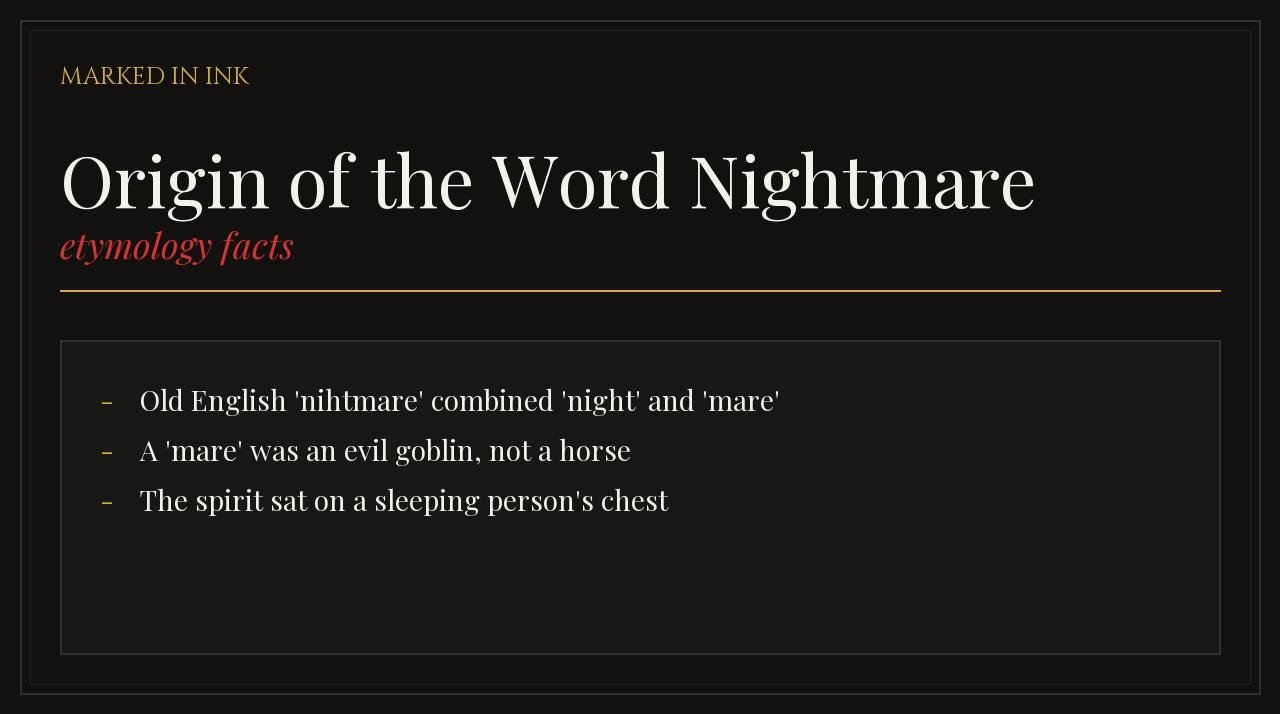
The origin of the word nightmare comes from the Old English word “nihtmare,” which combines “niht” (night) and “mare” (an evil spirit or goblin). Historically, a “mare” was a mythological demon believed to sit on the chests of sleeping people, causing suffocation and terror. The term traces back to the Proto-Germanic root “*maron”. For centuries, a nightmare was not just a bad dream, but a literal attack by a nocturnal creature. It was only in the 16th century that the word’s meaning shifted to describe the terrifying dream itself rather than the monster causing it.
Key Takeaways
- The word comes from Old English “nihtmare,” combining night and mare.
- A “mare” was originally an evil goblin, not a female horse.
- This demon was believed to sit on people’s chests, explaining sleep paralysis.
- The word only came to mean a “bad dream” in the 16th century.
- The concept spans many languages, including the French “cauchemar.”
This spirit would sit on a sleeping person’s chest. The monster caused heavy suffocation. Before modern science, this explained sleep paralysis.
They blamed a creature called the “mare” or “mara.” This supernatural being forms the etymology. The phrase has nothing to do with female horses.
What Does the Word Nightmare Mean?
The modern meaning is straightforward. We use the term to describe a frightening dream. These visions wake us up in a panic.
The historical meaning differs completely. The word once described a physical attack. A supernatural entity was the source of trauma.
The Old English Roots
The etymology starts in Old English. Early writers spelled the term as “nihtmare.” This compound contains two distinct parts.
The first part is “niht,” translating to “night.” The second part is “mare.” Here the story gets interesting.
In Old English, a “mare” or “mære” was an evil spirit. This goblin tormented sleeping individuals. The concept terrified early civilizations.
The Proto-Germanic Connection
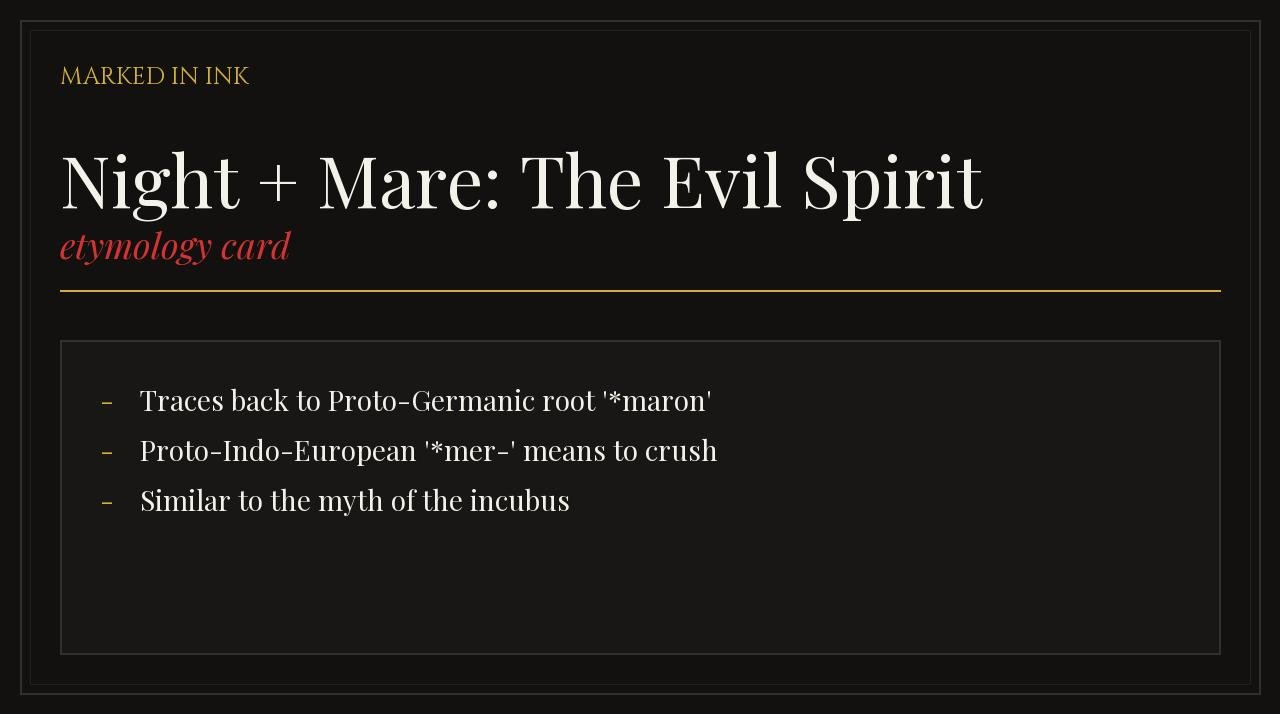
The roots go back even further. Linguists trace “mare” to the Proto-Germanic word “*marōn.” This was a common label for a nocturnal spirit.
Many Germanic languages share this root. Old Norse had the word “mara.” Old High German used the word “mahr.”
These terms relate to a Proto-Indo-European root. The root “*mer-” means to crush or press. This describes the sensation of sleep paralysis perfectly.
Not a Female Horse
A common misconception exists today. Many people think the word relates to horses. A female horse is called a mare.
The two words have entirely different origins. They are homophones sharing no historical connection.
The horse “mare” comes from the Old English “mearh.” The demonic “mare” comes from “mære.” Check the Online Etymology Dictionary for details.
The Myth of the Incubus
The concept links to the incubus. An incubus was a demon in male form. It was said to lie upon sleeping women.
The mare functioned similarly. The creature targeted vulnerable sleepers in the dark. Victims felt intense pressure on their chests.
People genuinely feared falling asleep. They believed the mare could kill them. The monster would literally press the breath out.
Sleep Paralysis Explained
Medical science now has an answer. We call this phenomenon sleep paralysis. It happens when your body remains asleep.
Your brain wakes up fully conscious. Your muscles are temporarily paralyzed. This prevents acting out your dreams.
During this state, people often hallucinate. They feel a heavy weight on their chests. This perfectly matches old descriptions of the mare.
A Universal Human Experience
This physiological quirk is universal. People globally experience the terrifying event. The biological reality remains unchanged.
Similar myths exist worldwide. Almost every culture has a version of the mare. They blame a creature for the chest pressure.
In Newfoundland, locals call it the “Old Hag.” In parts of Asia, a ghost presses down. The basic premise is always identical.
The Evolution of Meaning
Languages change over time. Words shift in their primary definitions. The origin of the word nightmare is an excellent example.
For hundreds of years, the word meant the monster. The noun referred to a physical goblin.
If you had a nightmare, you were under attack. The creature was literally sitting on you. Terror was considered a real event.
The Shift in the 16th Century
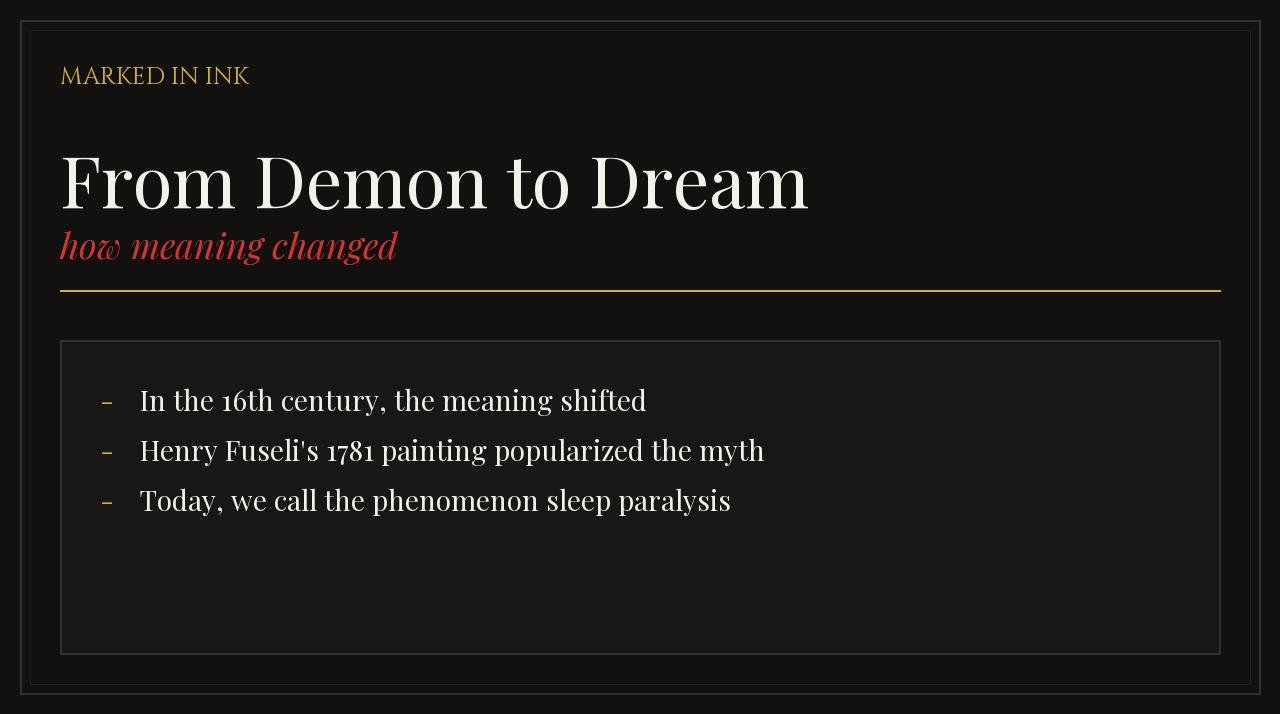
The shift began in the mid-16th century. Focus moved from the monster to the experience.
People started using the word to describe the dream. The bad dream resulted from the mare’s visit. Eventually, the dream itself took the name.
The idea of the physical goblin faded. The supernatural explanation became less popular. The word simply became a synonym for bad dreams.
The Earliest Citations
We can look at early texts for proof. The Oxford English Dictionary tracks these changes.
Texts from the 1300s refer to a spirit. Writers describe rituals to ward off the mare. They treat the creature as a factual threat.
By the late 1500s, the context changes. Writers use the word to describe a feeling. Having a nightmare meant experiencing a bad dream.
Henry Fuseli and The Nightmare
Visual art played a huge role in folklore. One painting is particularly famous. Henry Fuseli created “The Nightmare” in 1781.
The image is iconic and deeply unsettling. It brilliantly captures the ancient myth.
A woman lies asleep in a dramatic pose. A grotesque demon sits directly on her chest. This creature is the visual representation of the mare.
A Cultural Landmark
The painting was a massive sensation. The artwork shocked audiences when first exhibited. It gave a face to a common fear.
Even today, it remains a powerful image. The painting frequently illustrates sleep paralysis. It shows exactly what the old word described.
There is also a spectral horse in the background. The animal peers through velvet curtains. This visual pun reinforced the false connection to horses.
Cementing the Imagery
Fuseli did not invent the original myth. He simply illustrated the concept brilliantly. The artist captured the oppressive weight and terror.
The painting solidified the concept in popular culture. It kept the memory of the demon alive. The image is a lasting tribute to the etymology.
Read our guide on english idioms and meanings for more. Language is full of hidden stories.
The French Connection: Cauchemar
English is not the only language with this structure. French has a very similar word. The French word for nightmare is “cauchemar.”
This word breaks down into two parts. The second part, “mar,” is borrowed from the Germanic root. It refers to the exact same goblin.
The first part, “cauche,” comes from the Latin “calcare.” This Latin word means to trample or to press.
A Literal Translation
“Cauchemar” literally translates to “the pressing goblin.” It is a highly accurate description. The name describes the physical sensation of the attack.
This shows how widespread the myth was. The Germanic concept of the mare traveled far. The idea influenced languages outside the Germanic family.
Find more about this on the Merriam-Webster dictionary website. The entry highlights shared fears among early Europeans.
Other Supernatural Word Origins
The origin of the word nightmare is not unique. Many common words have supernatural roots. We use them without realizing their dark pasts.
Words often start as literal descriptions. They later become metaphors for abstract ideas. The magical connotations eventually vanish.
This happens as society becomes more scientific. We find rational explanations for things. We no longer need demons to explain our problems.
The Word “Lunatic”
Consider the word “lunatic” as another example. The term comes from the Latin word “luna,” meaning moon.
People once believed the moon caused madness. Moonlight could supposedly make you crazy. A lunatic was someone affected by the moon.
Today, we know this is false. The word remains in our vocabulary anyway. The noun is a ghost of an old belief system.
The Word “Disaster”
The word “disaster” has a similar story. The roots come from Italian and Latin. The literal translation is “bad star.”
Ancient people blamed the stars for bad events. They believed in astrology and cosmic signs. A disaster was a calamity caused by poor stellar alignment.
You will enjoy the origin of the word berserk. The tale explores ancient history shaping modern words.
The Endurance of the Word
The word nightmare has survived for centuries. The primary definition completely changed over time. Yet, it remains a powerful and evocative word.
The noun carries a sense of profound dread. A bad dream is just a dream. A nightmare represents something far worse.
The idea implies a feeling of being trapped. The concept suggests a total loss of control. The old meaning still echoes in modern usage.
The Power of Folklore
Folklore shapes language deeply and permanently. The stories we tell become the words we speak.
The mare was a myth, but the fear was real. Genuine human terror birthed the word.
This is why the term feels so potent. The root lies in a visceral, physical experience. The origin is not an abstract concept.
Modern Usage and Metaphor
Today, we use the word metaphorically everywhere. A bad situation is a complete nightmare. A difficult project feels like a nightmare.
We apply the term to anything causing severe stress. We use it for traffic jams and bad dates.
The word expanded far beyond sleep. The noun is a versatile tool in the English language. This pattern mirrors the origin of the phrase caught red handed.
Connecting History to Idioms
English is rich with hidden histories everywhere. Many phrases hold forgotten meanings. The origin of the word nightmare is just one piece.
Idioms work the same way as old words. The phrases start as literal actions. The meanings become figurative over time.
Learning these origins makes the language richer. The knowledge connects us to the people who spoke it previously.
Examples in Everyday Speech
Think about how often we use these phrases. We say someone needs to bite the bullet.
We hope an actor will break a leg.say “gesundheit” or bless you when someone sneezes.
All these sayings have deep historical roots. The idioms are miniature time capsules. The phrases preserve beliefs and habits of the past.
The Stories Behind the Words
Every single word has a unique story. Sometimes the story is mundane and plain. Food history explains the origin of the word sandwich.
Financial history explains the origin of the word salary. Grim history explains the origin of the phrase kick the bucket.
The history of language tracks human thought. The stories show us what our ancestors cared about deeply. The words reveal their greatest fears.
Frequently Asked Questions
What is the true origin of the word nightmare?
The word comes from the Old English “nihtmare.” The term combines “night” and “mare.” A “mare” was an evil spirit or goblin. People believed this spirit sat on chests, causing suffocation.
Does the word nightmare relate to female horses?
No, the word has no connection. The word for a female horse and the nocturnal demon share spelling. The historical roots are entirely different. The spelling converged over time.
When did a nightmare become just a bad dream?
The meaning shifted in the mid-16th century. People started using the word to describe the terrifying dream itself. Previously, the word referred strictly to the supernatural creature.
What is the connection to sleep paralysis?
The myth was an early attempt to explain sleep paralysis. Symptoms include an inability to move and chest pressure. The myth provided a supernatural reason for these physical symptoms.
Did Henry Fuseli invent the nightmare myth?
No, Henry Fuseli did not invent the myth. His famous 1781 painting illustrated an existing piece of folklore. The painting became iconic and cemented the demon in popular culture.
Final Thoughts on Night Terrors
The story of this word is truly captivating. The tale bridges ancient folklore and modern science. The history shows how ancestors tried explaining the world.
Remember the old myths next time you wake up. You are experiencing something humans felt for millennia.
The demon vanished, but the word remains. The noun reminds us of dark things lurking in the night. Explore our collection of famous quotes and quotations for more. You will find endless linguistic treasures.


Alan Sledge is the writer and founder behind Letters & Letters. A lifelong lover of words, Alan has always been drawn to the small mysteries hidden in everyday language, why we say what we say, where our favorite sayings came from and the quotes that manage to put feelings into words better than we ever could ourselves.

Alan Sledge
Alan Sledge is the founder and lead researcher behind Letters & Letters. A lifelong student of linguistic history, he cross-references every word origin, idiom, and quote against primary archival manuscripts, the Oxford English Corpus, and 18th-century print lexicons.